



Crime
Tinubu’s minister accused of working with bandits



The Minister of State for Defence, Bello Matawalle, is under fire after being linked with terrorism in the country.
Matawalle is alleged to have procured vehicles for bandit leaders, including a notorious kingpin, Bello Turji, and others while serving as Zamfara State Governor.
The current state governor, Dauda Lawal, who appeared on TVC, a national television station, on Wednesday, urged the minister to resign.
He said, “If I were him (Matawalle), I would resign and face all the allegations against me because, from all the information we are getting, my predecessor was fully involved in some of this banditry.”

According to Lawal, the former governor kept terrorists at the government house, and ransom was paid to terrorists through the government.
“In May 2023, there was this allegation of misappropriation of N70bn. We realised that the N70bn was a child’s play compared to what we have. This information is before the Economic and Financial Crimes Commission, and I wonder how this guy was cleared by the security operatives to become a minister.
“We are still waiting to hear from the EFCC; the case has been on for a year now. This is people’s money; we need the money in Zamfara to address the challenges we are facing.”
A presidential aide contacted to speak on the matter declined comment.
“You will get the answer to your question when the President announces the new cabinet list soon,” the source said.
Previous accusations
It is not the first time Matawalle will face accusation of sponsoring banditry.
In January 2022, while serving as state governor under the All Progressives Congress, the opposition Peoples Democratic Party had called for Matawalle’s resignation over alleged banditry sponsorship.
The APC had countered the allegation, insisting it was because he defected from the PDP to the party at the time.
An Islamic cleric, Bello Asada, also accused him of sponsoring bandits.
In a video seen by Saturday PUNCH, Asada, who spoke in Hausa, alleged that Matawalle procured vehicles for Turji and other bandits.
He said, “You didn’t love especially because of God. Murtala Bello said your godfather has bought vehicles for terrorists, among them is this Halilu Subububu. The defence (state) minister has bought a brand new car and given it to him (is he not the one who’s called ‘Wankin Dan Kanoma’). There is also Ada Aleru.
“I know that he has purchased about 34 vehicles and distributed them to leaders of terrorists. He (Halilu) who I was accused of purchasing a car; was the Zamfara State governor who gave him a brand new 2019 model Hilux, not a second-hand car. People like Ado Aleru were given. I was with the police; Bello Turji was given.
“Decent people like the police, military, and civil defence who are looking for Hilux were not given, only for them to use our money to buy brand new Hiluxes for terrorists.”
Asada further questioned why Turji, despite being a notorious criminal with a visible presence on social media, had not been captured.
Turji has terrorised Zamfara State by killing, kidnapping, and extorting residents for nearly nine years.
His activities gained public attention after a series of videos surfaced on social media, where he also accused Matawalle of sponsoring banditry in the state.
Matawalle’s amnesty
The minister had between 2019 and 2023 initiated amnesty for terrorists in Zamfara State while serving as governor.
But Turji, in a video in July 2024, claimed that the scheme only empowered some of his colleagues.
Premium Times reported that Turji said he killed one of the bandit leaders in his Shinkafi LGA for peace to reign, but the governor later allegedly sabotaged his efforts.
He said, “Any person living in Shinkafi, Zurmi, and Isa (Sokoto State) cannot deny this claim. There is a particular group of bandits whom the former governor pampered. I chased the group from Shinkafi, I killed their leader, Dudu, for peace to reign in Shinkafi. The group had 200 arms, but the governor later hosted them (Dudu’s boys) at the Government House.
“But the government failed to ask the group to surrender their weapons. Another group led by Bashari Maniya has over 300 guns. I seized 30 from them. Where are the remaining? And they never surrendered their weapons to the government.”
He alleged that some of the bandit leaders involved in the peace truce moved to the Sokoto metropolis after giving their arms to their boys kidnapping for ransom. He said the boys were making returns to their leaders living in Sokoto town.
He named some of them as Bashari Maniya, Kabiru, and Buhari.
Matawalle’s dealings with bandits – aide
But an aide to the minister, Dr Suleiman Shuaib, who spoke to Saturday PUNCH, described the allegations as baseless, stating that Governor Lawal was out to witch-hunt his boss and smear his image.
According to Shuaib, Matawalle had never sponsored banditry or terrorism either as governor or minister, adding that he was committed to securing the lives and property of the people of Zamfara State and Nigerians at large.
Shuaib explained that Matawalle only engaged in dialogue with bandits during his early days as governor, in a desperate move to restore peace and security to the state.
He added that Matawalle waged war against some of the bandits when they reneged on their promises, noting that it was wrong for anyone to use his efforts against him for political gain.
He said, “I want to call on Nigerians, including Governor Dauda Lawal, to desist from witch-hunting their predecessors. This is a mere allegation and an act of witch-hunting. This sends a very bad message to the younger generation. It is uncalled for; I am advising Governor Lawal to stop witch-hunting his predecessor.
“The main objective of Governor Lawal and Matawalle is to secure and protect the lives and property of the people of Zamfara. The Governor should focus on the promises he made during his campaign instead of chasing shadows. His duty is to provide security in the state, and the major challenge we have is banditry.
“Zamfara State is on the brink of being swallowed by insecurity, and I want the governor to focus on that. He should work hand-in-hand with Matawalle to bring an end to the insecurity in Zamfara.
“When Matawalle became the governor of the state, the most important issue to address was insecurity. People advised him to call the bandit leaders for dialogue, and he accepted. That was when he met the bandits in Government House; he didn’t know them before.
“The dialogue worked for nine months before some bad actors influenced certain bandits to make outrageous demands, which Matawalle, as the governor, couldn’t meet. Those bandits took up arms again, and the Governor confronted them. He was, and is, never involved in banditry.”



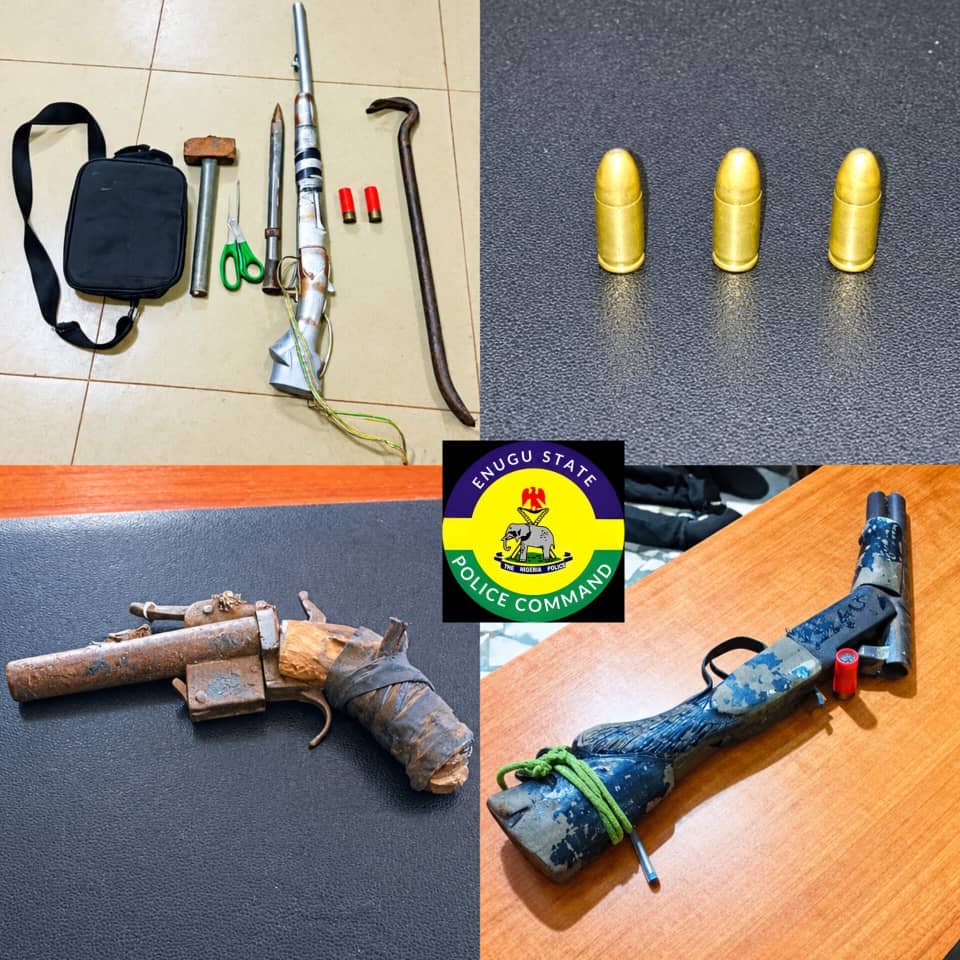
ENUGU — The Enugu State Police Command says it has arrested five male suspects in separate operations across the state and recovered three firearms, six rounds of live ammunition and other exhibits.
The Command disclosed this in a statement issued on Thursday, October 8, 2026, by its Police Public Relations Officer, SP Daniel Ndukwe.
According to the statement, police operatives attached to Inyi Division responded to a distress call about an armed robbery at Umuaor, Umukabia Isiama Awlaw Community, Oji-River Local Government Area, at about 5:10 a.m. on October 7.
One suspect, identified as 26-year-old Arinze Osita Onwuaso, was arrested while other suspects reportedly fled the scene. Police said they recovered a locally made cut-to-size single-barrel gun, two live cartridges, a pry-bar, hammer, scissors and chisel from him.
In a separate operation on October 5, operatives of the Anti-Cultism Section of the Violent Crime Response Unit arrested two suspected cultists, 24-year-old Jonas Adejo, also known as J-Money, and 25-year-old Okoro Innocent, also known as Virus, at Umudioka Community in Nsukka.
Three live rounds of 9mm ammunition were recovered from the suspects. Police said the two men confessed during interrogation to membership of the Supreme Vikings Confraternity.
Meanwhile, on September 25, operatives of Aninri Division, working with members of the Neighborhood Watch Group, raided a suspected criminal hideout at Amagu Mpu Community in Aninri LGA.
The operation led to the arrest of 25-year-old Anichebe Ogbonna, from whom police said one locally made pistol was recovered.
Similarly, on September 18 at about 11:00 p.m., operatives of 9th Mile Division, acting on information and in collaboration with Neighborhood Watch members, arrested 38-year-old Chukwujekwu Chukwuemeka at Ameke-Ngwo, Udi LGA.
He was arrested over alleged involvement in armed robberies in the area. Police said one cut-to-size pump-action gun and one live cartridge were recovered from him.
The Command said investigations into the cases are ongoing and that the suspects would be arraigned in court after the conclusion of investigations.
The Commissioner of Police, CP Mamman Bitrus Giwa, commended members of the public for providing information and praised the police operatives for their response to credible intelligence.
He reiterated the Command’s commitment to intelligence-led operations against armed robbery, cultism and other violent crimes, while urging residents to remain vigilant, law-abiding and supportive of security agencies.

By Okey Maduforo, Awka
The Awka High Court, on Tuesday, denied bail to the General Overseer of Day Spring Assembly, Mr Harrison Anazodo, who is standing trial over alleged offences relating to his activities as a pastor.
Anazodo had applied for bail on health grounds, but the presiding judge, Justice Jude Obiora, rejected the application, citing concerns over possible interference with witnesses.
The development came as seven persons, believed to be members of the congregation, are expected to testify in the case.
The court adjourned the matter until October 16 for further proceedings.
Speaking shortly after the hearing, State Counsel, Victoria Ekwerekwu, commended the Anambra State Government for its efforts to tackle alleged fraudulent activities by some religious figures.
She said, “We thank Governor Charles Soludo for trying to sanitise our society from pastors who make the younger generation believe that making money without hard work is possible.”
According to her, the prosecution has established a prima facie case against Anazodo, although the state would still be required to prove the allegations beyond reasonable doubt.
“Today, there is a prima facie case against the accused, Mr Harrison Anazodo, though it is left for us to prove it beyond reasonable doubt.
“The court ruled on the bail application and denied him bail because of the witnesses, to ensure that they are not interfered with. The matter was subsequently adjourned until October 16,” she said.
The Anambra State Commissioner for Information, Dr Law Mefor, expressed optimism that the case would be concluded expeditiously, stressing that the ultimate decision rests with the court.
“We have been here since 9am. The court considered the bail application filed by his counsel and, after weighing its merits, the judge ruled that bail should be denied.
“We are looking forward to the quick dispensation of the matter and we assure you that justice will be done and will be seen to have been done,” Mefor said.

By Our Correspondent
The Inspector-General of Police, Olatunji Disu, has deployed the Deputy Inspector-General of Police in charge of Operations, Shehu Nadada, to Imo State to coordinate the search-and-rescue operation for 20 prospective National Youth Service Corps members and other passengers abducted along the Owerri-Onitsha Road.
The victims were reportedly abducted on Thursday, October 1, 2026, around Umunoha in Imo State.
The Force Public Relations Officer, Force Headquarters, CSP Anietie Iniedu, disclosed this in a statement issued on Friday.
According to the statement, Nadada arrived in the state alongside two Commissioners of Police and immediately conducted an on-the-spot assessment of the incident and the ongoing rescue operation.
He also reviewed the operational strategies, deployment of personnel and available assets, while issuing additional directives aimed at strengthening the coordinated response.
The assessment was conducted alongside the Imo State Commissioner of Police, CP Audu Garba Bosso; the Commissioner of Police in charge of Federal Operations, CP Akpan Anifiok; the Commissioner of Police in charge of the Police Mobile Force; other service commanders and members of the management team of the Imo State Police Command.
Iniedu said the search-and-rescue operation had been intensified, with additional tactical teams and operational assets deployed to identified areas.
He added that the operation was being supported by intelligence-led tracking of the abductors and coordinated efforts with other security agencies.
Nadada assured members of the public that the police remained committed to securing the safe release of the abducted persons.
“The Nigeria Police Force is committed to securing the safe rescue of the 20 abducted persons and will sustain the operation until the mission is successfully concluded,” Iniedu quoted Nadada as saying.
The police boss urged members of the public and the media to remain calm and vigilant, while appealing to anyone with credible information that could assist the operation to contact the police or the nearest security formation.
He assured the public that all information received would be treated with strict confidentiality.
The police said further updates would be provided as the rescue operation progresses.

Five men have been arrested and arraigned before a Chief Magistrate’s Court in Maiduguri, Borno State, after police allegedly found them wearing T-shirts bearing the words “Tinubu Must Go.”
The defendants were identified as Baba Aji Gremami, 44; Mustapha Abba Yemen, 28; Abbacha Mohammed Ali, 32; Adam Umar Gubio, 21; and Abdulhamid Mohammed, 21.
According to a First Information Report issued by the State Criminal Investigation Department, the incident occurred on September 25, 2026, near West End Roundabout in Maiduguri.
Police charged the five men with criminal conspiracy, inciting disturbance, disturbance of public peace and thuggery under Sections 60, 78, 79 and 392 of the Borno State Penal Code.
The defendants pleaded not guilty to the charges when they appeared before Chief Magistrate Court I in Maiduguri.
Their lawyer subsequently applied for bail. The court adjourned the matter until October 6, 2026, to rule on the bail application, while the substantive trial has been scheduled for October 26.
The case has drawn attention because the alleged conduct involved wearing clothing displaying a political message.
Amnesty International criticised the prosecution, describing the arrests as arbitrary and arguing that peaceful political expression is protected by fundamental human rights. The organisation called for the immediate release of the five men and urged authorities to discontinue the case.
Amnesty International also expressed concern that the prosecution could have implications for political expression and opposition activities in Borno State.
The case has generated reactions on social media, with some commentators questioning whether the display of political messages on clothing should constitute a criminal offence.
There have also been allegations that a prominent politician in Borno State may have influenced the arrests. The allegation has not been independently verified.
Efforts to obtain a comment from the Borno State Police Public Relations Officer, ASP Kenneth Daso, were reportedly unsuccessful as of the time of filing.
The defendants remain subject to the court process, and the allegations against them have not been established in court.
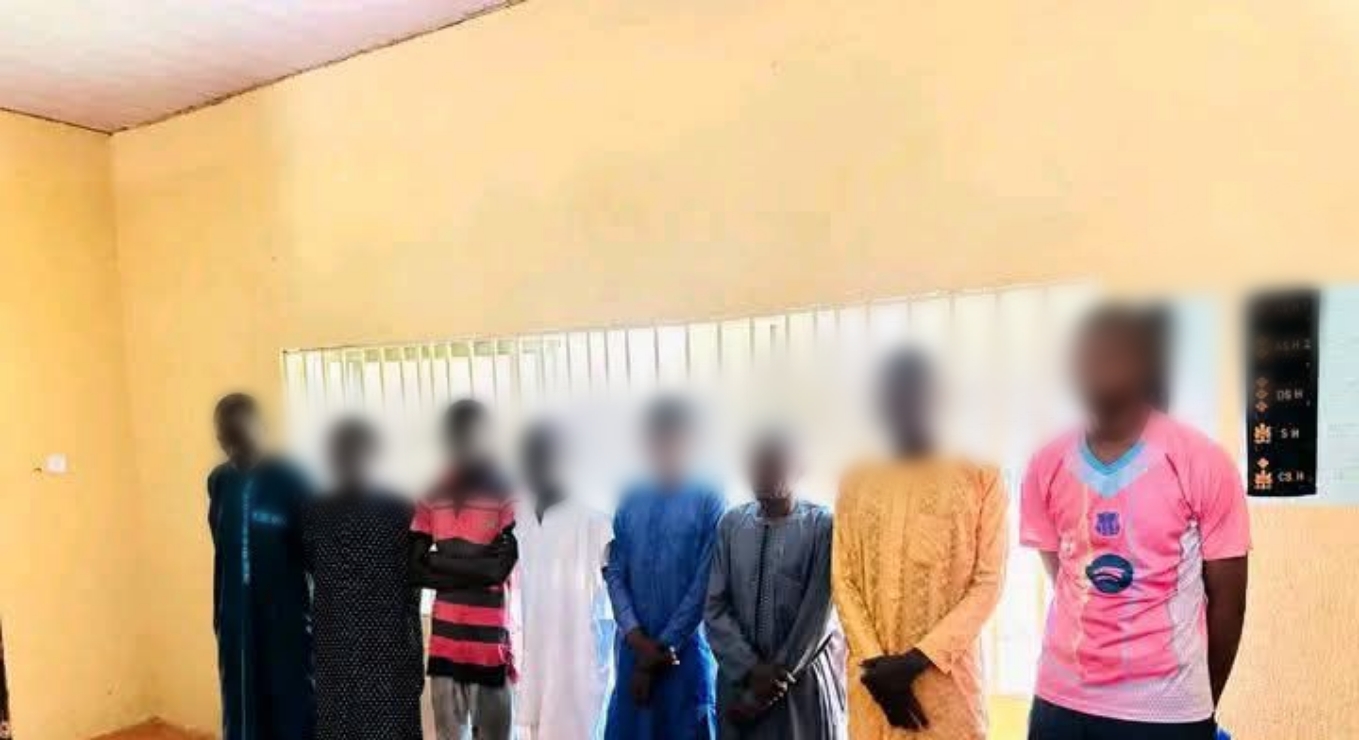
The Jigawa State Hisbah Board has arrested eight people in Kazaure Local Government Area over alleged homosexual acts, according to the board.
The board’s Public Relations Officer, Dauda Hadejia, disclosed this in a statement issued on Saturday, September 26, 2026.
Hadejia said the arrests followed a complaint filed by a 22-year-old man, who alleged that nine individuals had engaged in sexual acts with him on different occasions.
According to the statement, the complainant also claimed that he later contracted HIV, which he attributed to the alleged encounters. He reportedly appealed to the Hisbah authorities for justice, describing the alleged conduct as deceptive and harmful to his life.
Following the complaint, Hadejia said Hisbah operatives launched an investigation and began searching for the nine individuals named by the complainant.
“So far, eight suspects have been arrested, while efforts are ongoing to arrest the remaining suspect,” Hadejia said.
He added that the eight arrested individuals reportedly admitted during preliminary investigations to having engaged in sexual acts with the complainant.
Hadejia said the board had gathered information and evidence that would be presented before a court. He added that the investigation remained ongoing and that the suspects would be charged upon its completion.
The Deputy Commander-General of the Jigawa State Hisbah Board, Dr. Hussain Baban, reportedly urged parents to pay closer attention to their children’s upbringing and the people with whom they associate.
He also called on members of the public to be mindful of the consequences of their actions and to uphold religious and moral values.
The board further expressed appreciation to the Jigawa State Government for its support and cooperation in carrying out its responsibilities.

-

 Politics4 days ago
2027: Odii Will Not Step Down, Says Spokesperson
-

 News3 days ago
How NAF Plane Vanished From Radar Shortly After Take-Off, Crashes In Ondo Swamp
-

 EverydayNews Telescope3 days ago
Nkalagu Cement Factory: Project or 2027 Political Promise?
-

 News4 days ago
No Survivor Found Yet in Ondo Air Crash — Aiyedatiwa
-
Crime3 days ago
Court Denies Alleged Fake Pastor Bail as Seven Witnesses Await Trial
-
 News1 day ago
Curfew Continues as Soludo Sets Up Commission of Inquiry Over Aguleri–Umuoba Anam Clash
-

 News2 days ago
NAF Crash Claims Pilot 16 Days After Wedding
-

 Education1 day ago
Ihejirika Hails Mbah’s Infrastructure Drive as Coal City University Inaugurates Governing Council