



Crime
Scavengers, Enugu Taskforce Clash at Abakpa



The Enugu State taskforce enforcing the government’s ban on the activities of plastic and iron scavengers, Tuesday, clashed with scavengers, as team members were trying to prevent the loading of suspected stolen and vandalised items into trailers to their illicit buyers.
The incident occurred at the scavengers’ dumpsite located at Abakpa Nike, Enugu, where a vehicle belonging to the taskforce was also torched by the scavengers.
This was even as residents, who recounted their losses over the activities of the scavengers, commended the effort of the Peter Mbah Administration to enforce the provisions of the Enugu State Environmental Law, which prohibits the activities of scavengers and also prescribes a two-year prison term for violators.

The taskforce had taken the scavengers unawares as they were loading the items into a trailer. However, an attempt to stop them resulted in a violent attack on the taskforce members with dangerous items like iron and broken bottles.
Not even the reinforcement of the team with a detachment of police personnel could deter the scavengers, as they became more violent, hauling various missiles at the police and the taskforce.
It was gathered that the scavengers burnt a car belonging to the taskforce as the confrontation intensified, while one of the scavengers, who sustained serious injury, as he reportedly fell on a sharp iron, was rushed to the hospital.
A shopkeeper in the area, Ukamaka Udeh, said, “Look at what they did here today. Just imagine. You are doing something illegal. You are vandalising street lights, water galleries, and stealing things up and down. And you were caught red-handed, loading these items into a lorry. Instead of running away or pleading for mercy, you mobilise yourselves to fight the taskforce and fight the police. What more evidence do you need before you know that these are hardened criminals? They smoke weeds and take ‘Mkpuru Mmiri’ around this area as if there is no tomorrow.
“It is those of us who do business here that will tell you what we pass through. Everyday, shop vandalisation. I mean everyday.
“It is the same type of people that vandalise iron components of the newly constructed Second Niger Bridge as we saw in a trending video today. So, it is good that the government is now doing something about it. But the government must prepare for full war because these people are not easy nuts to crack,” she said.
A resident of Achara Layout, Enugu, who simply identified herself as Chidimma, described the scavengers as security and economic risks, saying, “They have finished us in this area.”
“They are vandalisers and security risks. They break into people’s shops at night in this neighbourhood and steal all they can. If you leave any valuable item outside, they will quickly steal them. They steal generators and generator parts. The same goes for electrical wirings in people’s homes. They remove the wires and burn them to extract the copers for sale. They even make the whole environment very, very dirty. We don’t want them here.
Another resident, who lives at Independence Layout, lamented that since the government banned them, they dropped the carts in the area and now carry sacks.
“We are not comfortable with them. Inside their bags are people’s valuables. These people have finished us here,” she stated.
It was further revealed that the Chief Security Officer of Ogbete Main Market caught the same scavengers with 15 bags of rice concealed in their carts.
From Monkey Roundabout at Independence Layout to Kenyatta, Gariki area, Coal Camp, and Emene, among others, the complaints are the same against the scavengers in virtually every part of the state capital and across the state: vandalism, theft, dirt, drug, and other forms of criminality.
Meanwhile, security sources said police stations across the state record 28 reports each on the average on the activities of scavengers.
He said, “Their activities have reached dangerous proportions. So, we are now targeting the big men behind them, the off-takers, who sponsor them or buy these things from them. Enough is enough.”
It is recalled that the Secretary to the State Government, Prof. Chidiebere Onyia, had at a meeting with leaders and representatives of Yoruba, Igbo, and Hausa/Fulani communities in January restated the government’s ban on the operations of scavengers, warning that defaulters would be prosecuted.
He said the ban followed numerous petitions by members of the public against the activities of the illegal waste merchants, revealing that enforcement of the ban, arrest and prosecution of violators would commence on Monday, 29 January, 2024, as some scavengers were associated with house breaking and stealing.
“The government will no longer condone the activities of scavengers in the state. We have to rid the state of every vestige of crimes by restoring sanity. We want to assure all residents in the state who are into genuine business that we will continue to work towards making the environment safer for them.
“You will recall that sometime in November 2023, after reports from residents complaining about harassment and theft from scavengers and illegal waste pickers, the government set up a committee to assess the extent of the threats scavengers posed to the wellbeing of our law-abiding citizens.
“It was established that criminals are now roaming the streets posing as scavengers. Following this establishment, the government activated Section 20 of the Enugu State Environmental Law, that provides against scavenging activities by outlawing these illegal operators,” Onyia stated.



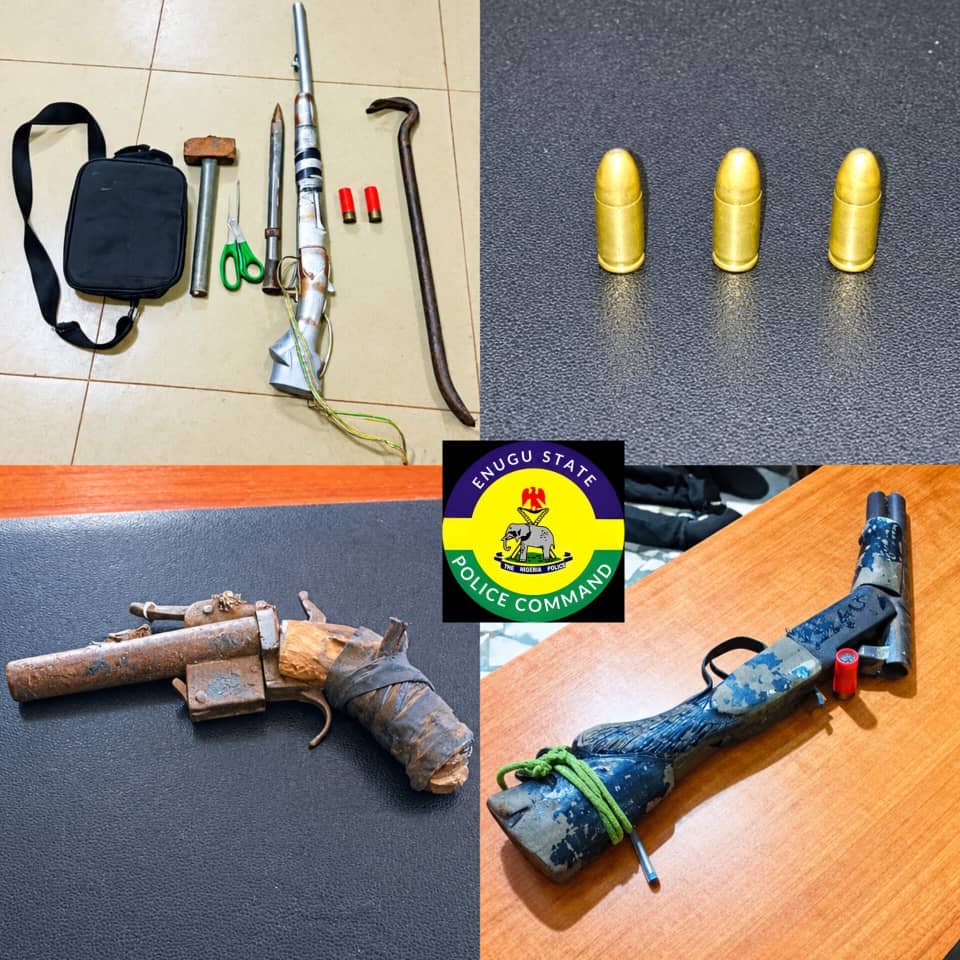
ENUGU — The Enugu State Police Command says it has arrested five male suspects in separate operations across the state and recovered three firearms, six rounds of live ammunition and other exhibits.
The Command disclosed this in a statement issued on Thursday, October 8, 2026, by its Police Public Relations Officer, SP Daniel Ndukwe.
According to the statement, police operatives attached to Inyi Division responded to a distress call about an armed robbery at Umuaor, Umukabia Isiama Awlaw Community, Oji-River Local Government Area, at about 5:10 a.m. on October 7.
One suspect, identified as 26-year-old Arinze Osita Onwuaso, was arrested while other suspects reportedly fled the scene. Police said they recovered a locally made cut-to-size single-barrel gun, two live cartridges, a pry-bar, hammer, scissors and chisel from him.
In a separate operation on October 5, operatives of the Anti-Cultism Section of the Violent Crime Response Unit arrested two suspected cultists, 24-year-old Jonas Adejo, also known as J-Money, and 25-year-old Okoro Innocent, also known as Virus, at Umudioka Community in Nsukka.
Three live rounds of 9mm ammunition were recovered from the suspects. Police said the two men confessed during interrogation to membership of the Supreme Vikings Confraternity.
Meanwhile, on September 25, operatives of Aninri Division, working with members of the Neighborhood Watch Group, raided a suspected criminal hideout at Amagu Mpu Community in Aninri LGA.
The operation led to the arrest of 25-year-old Anichebe Ogbonna, from whom police said one locally made pistol was recovered.
Similarly, on September 18 at about 11:00 p.m., operatives of 9th Mile Division, acting on information and in collaboration with Neighborhood Watch members, arrested 38-year-old Chukwujekwu Chukwuemeka at Ameke-Ngwo, Udi LGA.
He was arrested over alleged involvement in armed robberies in the area. Police said one cut-to-size pump-action gun and one live cartridge were recovered from him.
The Command said investigations into the cases are ongoing and that the suspects would be arraigned in court after the conclusion of investigations.
The Commissioner of Police, CP Mamman Bitrus Giwa, commended members of the public for providing information and praised the police operatives for their response to credible intelligence.
He reiterated the Command’s commitment to intelligence-led operations against armed robbery, cultism and other violent crimes, while urging residents to remain vigilant, law-abiding and supportive of security agencies.

By Okey Maduforo, Awka
The Awka High Court, on Tuesday, denied bail to the General Overseer of Day Spring Assembly, Mr Harrison Anazodo, who is standing trial over alleged offences relating to his activities as a pastor.
Anazodo had applied for bail on health grounds, but the presiding judge, Justice Jude Obiora, rejected the application, citing concerns over possible interference with witnesses.
The development came as seven persons, believed to be members of the congregation, are expected to testify in the case.
The court adjourned the matter until October 16 for further proceedings.
Speaking shortly after the hearing, State Counsel, Victoria Ekwerekwu, commended the Anambra State Government for its efforts to tackle alleged fraudulent activities by some religious figures.
She said, “We thank Governor Charles Soludo for trying to sanitise our society from pastors who make the younger generation believe that making money without hard work is possible.”
According to her, the prosecution has established a prima facie case against Anazodo, although the state would still be required to prove the allegations beyond reasonable doubt.
“Today, there is a prima facie case against the accused, Mr Harrison Anazodo, though it is left for us to prove it beyond reasonable doubt.
“The court ruled on the bail application and denied him bail because of the witnesses, to ensure that they are not interfered with. The matter was subsequently adjourned until October 16,” she said.
The Anambra State Commissioner for Information, Dr Law Mefor, expressed optimism that the case would be concluded expeditiously, stressing that the ultimate decision rests with the court.
“We have been here since 9am. The court considered the bail application filed by his counsel and, after weighing its merits, the judge ruled that bail should be denied.
“We are looking forward to the quick dispensation of the matter and we assure you that justice will be done and will be seen to have been done,” Mefor said.

By Our Correspondent
The Inspector-General of Police, Olatunji Disu, has deployed the Deputy Inspector-General of Police in charge of Operations, Shehu Nadada, to Imo State to coordinate the search-and-rescue operation for 20 prospective National Youth Service Corps members and other passengers abducted along the Owerri-Onitsha Road.
The victims were reportedly abducted on Thursday, October 1, 2026, around Umunoha in Imo State.
The Force Public Relations Officer, Force Headquarters, CSP Anietie Iniedu, disclosed this in a statement issued on Friday.
According to the statement, Nadada arrived in the state alongside two Commissioners of Police and immediately conducted an on-the-spot assessment of the incident and the ongoing rescue operation.
He also reviewed the operational strategies, deployment of personnel and available assets, while issuing additional directives aimed at strengthening the coordinated response.
The assessment was conducted alongside the Imo State Commissioner of Police, CP Audu Garba Bosso; the Commissioner of Police in charge of Federal Operations, CP Akpan Anifiok; the Commissioner of Police in charge of the Police Mobile Force; other service commanders and members of the management team of the Imo State Police Command.
Iniedu said the search-and-rescue operation had been intensified, with additional tactical teams and operational assets deployed to identified areas.
He added that the operation was being supported by intelligence-led tracking of the abductors and coordinated efforts with other security agencies.
Nadada assured members of the public that the police remained committed to securing the safe release of the abducted persons.
“The Nigeria Police Force is committed to securing the safe rescue of the 20 abducted persons and will sustain the operation until the mission is successfully concluded,” Iniedu quoted Nadada as saying.
The police boss urged members of the public and the media to remain calm and vigilant, while appealing to anyone with credible information that could assist the operation to contact the police or the nearest security formation.
He assured the public that all information received would be treated with strict confidentiality.
The police said further updates would be provided as the rescue operation progresses.

Five men have been arrested and arraigned before a Chief Magistrate’s Court in Maiduguri, Borno State, after police allegedly found them wearing T-shirts bearing the words “Tinubu Must Go.”
The defendants were identified as Baba Aji Gremami, 44; Mustapha Abba Yemen, 28; Abbacha Mohammed Ali, 32; Adam Umar Gubio, 21; and Abdulhamid Mohammed, 21.
According to a First Information Report issued by the State Criminal Investigation Department, the incident occurred on September 25, 2026, near West End Roundabout in Maiduguri.
Police charged the five men with criminal conspiracy, inciting disturbance, disturbance of public peace and thuggery under Sections 60, 78, 79 and 392 of the Borno State Penal Code.
The defendants pleaded not guilty to the charges when they appeared before Chief Magistrate Court I in Maiduguri.
Their lawyer subsequently applied for bail. The court adjourned the matter until October 6, 2026, to rule on the bail application, while the substantive trial has been scheduled for October 26.
The case has drawn attention because the alleged conduct involved wearing clothing displaying a political message.
Amnesty International criticised the prosecution, describing the arrests as arbitrary and arguing that peaceful political expression is protected by fundamental human rights. The organisation called for the immediate release of the five men and urged authorities to discontinue the case.
Amnesty International also expressed concern that the prosecution could have implications for political expression and opposition activities in Borno State.
The case has generated reactions on social media, with some commentators questioning whether the display of political messages on clothing should constitute a criminal offence.
There have also been allegations that a prominent politician in Borno State may have influenced the arrests. The allegation has not been independently verified.
Efforts to obtain a comment from the Borno State Police Public Relations Officer, ASP Kenneth Daso, were reportedly unsuccessful as of the time of filing.
The defendants remain subject to the court process, and the allegations against them have not been established in court.

The Jigawa State Hisbah Board has arrested eight people in Kazaure Local Government Area over alleged homosexual acts, according to the board.
The board’s Public Relations Officer, Dauda Hadejia, disclosed this in a statement issued on Saturday, September 26, 2026.
Hadejia said the arrests followed a complaint filed by a 22-year-old man, who alleged that nine individuals had engaged in sexual acts with him on different occasions.
According to the statement, the complainant also claimed that he later contracted HIV, which he attributed to the alleged encounters. He reportedly appealed to the Hisbah authorities for justice, describing the alleged conduct as deceptive and harmful to his life.
Following the complaint, Hadejia said Hisbah operatives launched an investigation and began searching for the nine individuals named by the complainant.
“So far, eight suspects have been arrested, while efforts are ongoing to arrest the remaining suspect,” Hadejia said.
He added that the eight arrested individuals reportedly admitted during preliminary investigations to having engaged in sexual acts with the complainant.
Hadejia said the board had gathered information and evidence that would be presented before a court. He added that the investigation remained ongoing and that the suspects would be charged upon its completion.
The Deputy Commander-General of the Jigawa State Hisbah Board, Dr. Hussain Baban, reportedly urged parents to pay closer attention to their children’s upbringing and the people with whom they associate.
He also called on members of the public to be mindful of the consequences of their actions and to uphold religious and moral values.
The board further expressed appreciation to the Jigawa State Government for its support and cooperation in carrying out its responsibilities.

-

 Politics3 days ago
2027: Odii Will Not Step Down, Says Spokesperson
-

 EverydayNews Telescope3 days ago
Nkalagu Cement Factory: Project or 2027 Political Promise?
-

 News3 days ago
How NAF Plane Vanished From Radar Shortly After Take-Off, Crashes In Ondo Swamp
-

 News4 days ago
Sacked Works Commissioner: Release or Charge Him to Court, Oganiru Izzi Challenges Nwifuru
-

 News3 days ago
No Survivor Found Yet in Ondo Air Crash — Aiyedatiwa
-
Crime4 days ago
Police Deploy DIG, Two Commissioners to Rescue 20 Abducted Prospective Corps Members
-
Crime2 days ago
Court Denies Alleged Fake Pastor Bail as Seven Witnesses Await Trial
-

 News11 hours ago
Curfew Continues as Soludo Sets Up Commission of Inquiry Over Aguleri–Umuoba Anam Clash
Isaac Newton is my name
June 6, 2024 at 3:13 am
Scrap business is a legitimate business and the way the task force people are dealing with the scrap dealers is not encouraging, breaking up their shops are carrying away their goods just like that, the government banned scavengers and it was stopped according to the government directives, why are they now going to people’s dump carrying their goods one after another, when they carry those goods they will still sell it out to people, this not how it is done in other states, even in fct Abuja scrap business is existing there and they are in union paying revenue to the state government, I don’t know what they problem is