



Crime
Traffickers connive with Local Govt officials to sell baby for N400,000

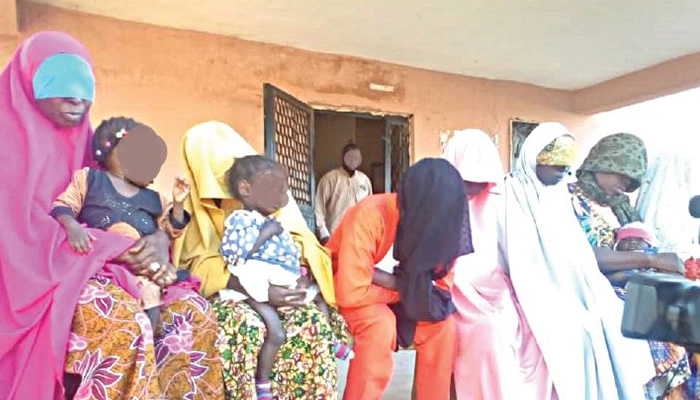

I have boys as children; I only wanted to have a girl-child,” was the excuse given by Mrs Tina Raphael, a 60-year-old woman from Anambra State who was arrested by the Gombe State Police Command over her involvement in a case of suspected child trafficking.
In an interview with Saturday PUNCH, Raphael said she adopted the baby from a suspected trafficker she identified as Khadijah for N400,000, adding that she was introduced to the ailing child who was dying from malnutrition.
“I had been wanting to adopt a baby girl since January 1, 2024, and was told that one was available by Khadijah. The baby is one year old and she was not walking and was sick, so I asked her (Khadijah) to bring the baby to me to see what I could do to help her.
“After looking at the baby, I noticed that she was suffering from malnutrition and needed medical assistance; that’s why I asked her to bring the child after which I asked her how I could get legal papers for the custody of the baby since she works with social welfare (in the Ministry of Women Affairs) because she told me she works there.”
Narrating further, the 60-year-old woman disclosed that she was charged an amount for the documentation of the baby’s ownership and denied buying the baby.

“She (Khadijah) told me to bring N400,000 which I did. This happened on January 1, 2024, and I was hoping that she would come on Friday and hand over the papers to me, only for me to see her with police in my house and (the police) arrested me without the papers; that was how I got involved.
“I didn’t buy the baby with the money I gave her because she said she would hand over papers to me and that was what I had been waiting for,” Raphael added.
When our correspondent asked her whether she knew who the little girl’s mother was, she said she was told that the baby’s mother had died.
“The baby’s mother is dead and nobody is there to take care of her. She is sick and cannot walk and my husband welcomed the idea too because I have only male children,” she added.
Like Raphael, another resident of Gombe also from Anambra State, Ukamaka Ugo, who was also arrested for baby racketeering, claimed she was innocent.
Ugo said Khadijah had promised to ‘give’ her baby for a fee when they met in a market.
“There was a day I went to the market and met Khadijah carrying a baby girl on her back. We exchanged greetings and I told her that the baby she had on her back was beautiful and that I wished she could let me have her since I did not have any.
“She said she would not give me this one (the baby) but that she was a worker in the hospital with the social welfare department. She said any time she got a baby she would let me know,” she said.
Ugo told Saturday PUNCH that in April 2023, Khadijah informed her about a woman who recently had a baby but did not have money for the child’s well-being.
“Khadijah called in April 2023 that there was a girl and the mother was in the hospital, that she gave birth but didn’t have the resources to take care of the baby. When I heard what she said, I told her that I was interested.
She told me to buy some baby items and take them to the mother of the girl at the hospital so she (the baby’s mother) would hand the baby over to me. I gave her N50,000 to process everything,” she said.
While arguing that the child wasn’t sold, Ugo noted that the N50,000 included the child’s medication and other needs. She, however, admitted that the baby was later handed over to her to keep as hers.
“She (Khadijah) told me that she would not hand the baby over to me until she had processed everything at the social welfare office. She called me after a week on the phone and told me that she was through with the social welfare processes.
“When they came to carry the baby, she said the paper was not yet out from the social welfare office and that anytime that the paper was ready, she would hand it over to me.”
“After a week, I started training the baby like mine, that’s all I know. I didn’t steal any child; I thought I was dealing with the right person and from the right source because she told me she worked with the social welfare office,” she told our correspondent.
Ugo disclosed that the parents of the child had signed an undertaking to hand over the child to her.
“The mother of the baby, the grandmother, the baby’s father, and his brother all went to the social welfare (office) and signed that they had handed the baby over to me; that was why I agreed to take care of the baby. The N50,000 was for the delivery (hospital bill).”
But the family of the baby denied selling their child to the suspect. The father of the baby, who spoke on the condition of anonymity, told Saturday PUNCH that they chose to involve the police when Khadijah’s movement and actions became suspicious.
“We didn’t sell our daughter’s child, though we received some money from Khadijah. We were prevented from seeing the child, so we alerted the police because that was not what they (Khadijah) told us,” he added.
Babies not taken without parents’ consent – Khadijah
However, the prime suspect debunked the allegations of child theft and trafficking. Khadijah said she didn’t commit any crime. She told our correspondent that while she collaborated with some social welfare workers, none of the children were forcefully taken away from their families.
“I’m not a trafficker. I only linked the person who saw the baby with me to the social welfare (office).
“I didn’t sell any child but the person I linked them up with was given N400,000 and I gave the office N200,000 and got the other (half). I have never sold any baby before nor have I bought from anyone.
“None of the children were stolen; they unfortunately had poor parents who couldn’t take care of them or their mothers died. So, in such a case, the baby needed to be given ample support and care to survive,” she claimed.
Child abduction in Nigeria
Child abduction is fast becoming a major problem in Nigeria, with several cases reported in Gombe and other parts of the North.
In September 2020, the police in Gombe disclosed that they uncovered a human trafficking ring and rescued 12 children
“The suspect we have in our custody today took to her heels since 2017; she has been on the run, changing locations, and in her custody, we found 12 children from various locations.
“We can’t comfortably say they are all from Gombe. This breakthrough was done painstakingly by the combined team of the police and parents in conjunction with the state government because they provided all the logistics.”
In December, 2023, the police in Anambra State said they arrested a couple trafficking a one-month-old baby from Lagos. According to a statement issued by the state Police Public Relations Officer, DSP Tochukwu Ikenga, the interception was made at the River Niger Bridgehead in Onitsha on December 17.
In June 2023, five children were rescued from two suspected child traffickers in Auchi, Edo State. The children, all girls, aged between seven and nine, who travelled unaccompanied, were said to have arrived at Auchi in the evening from Kaduna and were trying to establish contact with the two suspected female traffickers to take them to Onitsha before they were rescued.
In September 2021, the National Agency for the Prohibition of Trafficking in Persons, Makurdi Zonal Command, said it arrested two suspects in connection with the sale of babies in the state.
The Zonal Commander, Mrs Gloria Bai, who disclosed this in Makurdi, the state capital, said two young victims were taken from Gboko and sold out in Lagos.
Khadijah did not act alone – Police
The Gombe State Police command explained that Khadija colluded with 15 others, including staff of Gombe Local Government Area, involved in the sale of babies, stressing that they were arrested following an intelligence report received from the Barunde community.
The Police Public Relations Officer, ASP Mahid Abubakar, said, “The community claimed that sometime within last year, one Khadija Shehu-Manzo and 15 others were involved in selling young babies to people in need.
“Upon receipt of the report, detectives attached to Low-Cost Division swung into action where a full-blown investigation was carried out and the said Khadija was arrested.”
While Khadijah strongly denied her involvement in the crime, the police spokesman said, “The remaining suspects arrested confirmed that Shehu-Manzo allegedly sold two babies to Ukamaka Ugo on different occasions.
“Shehu-Manzo sold one child (for) N400,000 (and) out of the money (that came) from Tina Raphael, she gave N200,000 to one Haruna Abubakar, who is working with the social welfare (office in) Gombe in that he was going to make relevant documentation available for proper handing over of the child.
“Yahaya Sulaiman was the person who received the money on Abubakar’s behalf.
“Ukamaka Ugo bought two children; they are presently in Lagos and Anambra. We are working to see how to recover them as well,” he added.
Council official denies wrongdoing
But Abubakar, the Head of the Education and Social Development Department responsible for legitimising child adoption process in the Gombe Local Government Area, said the N200,000 he received from Khadijah was a gift and not a proceeds of crime.
The 50-year-old, “I work with the Gombe Local Government in the Education, Social Development Department. I was involved in a case through Hadisah (Khadijah) who came to our office to tell me that her sister was given a child for adoption and that they sent them to come to our office for us to document everything.”
“I told them since the mother of the child had passed away (died), she should invite the grandfather to come so that I can interview him. When he came, he said the same thing. So Hadisah (Khadijah) said she needed paper (documentation), but I objected saying there were procedures to getting a paper as there was a need to write applications for fostering, which included giving the paper to the ward head of their area to sign,
“It also included the passport of the woman who needed the child and the husband before one can proceed and it must be addressed to the Chairman of the Gombe Local Government Area then we can process the document to give you paper.”
On the alleged sum received, Abubakar added, “I told her to apply for the letter as we couldn’t give her the paper without proof. The money she gave I used N20,000 out of the money to give to the grandfather, and the rest (was) for us to share.
“She didn’t bring the application. I didn’t charge her N200,000; she decided to give me the money, I didn’t charge her anything as we don’t charge to process documents.”
When contacted by our correspondent, the state coordinator of the National Agency for the Prohibition of Trafficking in Persons, Aminu Shira, declined comment.
He said, “After completing the investigation, we will call the media for a briefing. Anything I tell you will tamper with it (the investigation).”
Child adoption without due process is human trafficking, says HRC
However, the Human Rights Commission taking custody of a child without following the process back by law was tantamount to human trafficking.
Speaking with our correspondent, the Public Relations Officer of the Gombe officer of the NHC, Alola Alfinti, said, “You can’t just pick someone from the street or just take a child and adopt them. There are laid down procedures, and legal processes up to a court.
“You can have legal custody of a child if you follow the process but there are gatekeepers in the state when it comes to this, including the Ministry of Women Affairs and Social Development which has a registry. If you go there, they would give you the child but you would have to complete the court processes.”
Alfinti, explained that a child adoption process could take many years to complete.
“I remember there was a time when one child was adopted in Gombe. It took about 10 years and they (foster parents) wanted to fly him abroad.
“They were caught at the airport (with the child) but they had to come back to Gombe to find out whether they followed laid down processes. Fortunately, when they came, documents were backing the child’s adoption. If you follow the processes, there wouldn’t be problems,” he added.
PUNCH

A police corporal attached to the Ajaokuta Division of the Kogi State Police Command has reportedly shot his girlfriend dead before taking his own life with his service rifle.
The incident allegedly occurred around 9 p.m. on Friday, October 23, 2026, leaving both the officer and the woman dead.
According to a report by Veracity News, the officer allegedly shot the woman at close range before turning the weapon on himself.
The circumstances surrounding the incident remain unclear, while the motive behind the alleged killings has yet to be established.
The bodies of the deceased were reportedly evacuated to a mortuary as investigations into the incident commenced.
Efforts to obtain an official reaction from the Kogi State Police Command were unsuccessful, as the command’s Public Relations Officer, ASP Saliu Afusat, could not be reached for comment, according to the publication.
The incident is expected to be investigated to establish the circumstances leading to the deaths and determine the events that preceded the shooting.
As of the time of filing this report, no further details about the identities of the deceased or the outcome of the investigation had been provided in the original report.
Editor’s note: The incident and details in this report have not been independently verified. An official statement from the Kogi State Police Command would be needed to confirm the circumstances of the deaths.

A young woman identified as Messioma Nwaora, who was earlier reported missing, has reportedly been found dead in Uga, Aguata Local Government Area of Anambra State.
Unverified reports circulating on social media allege that her former boyfriend, identified as Chima Emmanuel and said to be from Ebonyi State, killed her after she ended their relationship. The reports further claim that he strangled her with clothing, placed her body in a bag and transported it on a commercial motorcycle, popularly known as an okada.
The alleged confession and the circumstances surrounding the woman’s death have not been independently verified. Therefore, it cannot be conclusively established that the former boyfriend killed her.
As of the time of filing this report, the Anambra State Police Command had not issued an independently confirmed statement establishing the cause of death, confirming the identity of the deceased or stating whether a suspect had been arrested.
The reported death has prompted calls for a thorough investigation. Outstanding questions include where the body was recovered, how the woman died, whether Chima Emmanuel has been detained and whether investigators have obtained evidence linking him to the incident.
Further details are expected as reliable information becomes available.

A birthday party organised by popular Enugu socialite Nnaji Izuchukwu, popularly known as Stone, at Bull Hotel, Asata, Enugu, reportedly turned chaotic following a misunderstanding that allegedly prompted the hotel management to invite the police.
Stone, who was the celebrant, reportedly died from gunshot injuries sustained during the ensuing police operation.
Information available to Everydaynewsngr.net indicated that the misunderstanding at the birthday party degenerated into chaos, prompting the hotel management to call in operatives of the police Anti-Cultism Section.
In the confusion that followed, Stone was said to have attempted to escape through a window alongside another person before he sustained gunshot injuries.
However, the exact circumstances surrounding the shooting remained unclear as of the time of filing this report.
The Enugu State Police Command has since confirmed Stone’s death and ordered an investigation into the incident.
In a press release issued on Friday, October 23, 2026, the command said the Commissioner of Police, CP Mamman Bitrus Giwa, had directed a thorough investigation to establish the circumstances surrounding the death and determine whether the operation and use of firearms complied with established operational standards and applicable laws.
According to the police, operatives of the Anti-Cultism Section of the Violent Crime Response Unit (VCRU) stormed Bull Hotel during an intelligence-led operation targeting Nworie Chidera Kelvin, popularly known as Akidi, an alleged drug dealer and member of the Vikings Confraternity.
The police said Akidi was suspected of involvement in several cases relating to cultism and unlawful possession of firearms.
The operation reportedly led to the arrest of Akidi and nine other suspects, comprising males and females aged between 17 and 28.
The police also said quantities of dried weeds suspected to be cannabis, a weighing scale allegedly used for measuring illicit drugs, and ₦43,400 in cash were recovered during the operation.
Giving its account of how Stone died, the command said preliminary findings indicated that he and another suspect jumped through a window in an attempt to escape.
The statement added that an operative pursuing the two suspects was allegedly confronted by them as they attempted to disarm him.
According to the police, the officer’s firearm discharged during the ensuing struggle, leaving Stone with gunshot injuries, while the other suspect escaped.
Stone was rushed to a hospital, where he was later confirmed dead. His remains have been deposited in a mortuary for preservation and autopsy.
CP Giwa has directed the Assistant Commissioner of Police in charge of the State Intelligence Department to establish the facts of the incident and determine whether the officers involved complied with operational standards and applicable laws.
The commissioner assured that any officer found culpable would face appropriate disciplinary action.
He also urged Stone’s family, associates and members of the public to remain calm, stressing that professionalism, ethical conduct and strict adherence to operational standards, particularly those governing the use of firearms, must be upheld during police operations.
The police statement was signed by the Command’s Public Relations Officer, SP Daniel Ndukwe, on October 23, 2026.

The Nigerian Correctional Service (NCoS), Edo State Command, has launched a manhunt for a 28-year-old awaiting-trial inmate, Osita Thomas, who escaped while being taken to court for trial.
Thomas, an inmate of the Medium Security Custodial Centre, Auchi, reportedly escaped last week during a court appearance over charges bordering on conspiracy and stealing.
The Command’s Public Relations Officer, Aminu Suleman, disclosed the development in a statement dated October 21, 2026, and made available to journalists in Benin City on Thursday.
Suleman said the Controller of Corrections in Edo State had directed intensified efforts towards apprehending the fugitive, assuring residents that security measures across custodial facilities had been strengthened to prevent similar incidents.
The Command appealed to members of the public with useful information about Thomas’s whereabouts to report to the nearest police station or custodial centre.
It also released two telephone numbers, 08038075882 and 08039243704, through which information could be provided to security authorities.
Meanwhile, an official of the Correctional Service attributed the escape to inadequate manpower, explaining that the officer escorting Thomas to court could not abandon other inmates in his custody to pursue the fleeing suspect.
According to the official, pursuing Thomas would have exposed the remaining inmates to possible escape.
The official further raised concerns over worsening personnel shortages in the Service, alleging that more than 1,000 officers were expected to retire this year without corresponding plans for fresh recruitment.
He called on the Federal Government to urgently address the manpower deficit, warning that inadequate personnel could continue to undermine the effective management and security of custodial facilities across the country.
An alleged employment racket involving 21 job seekers and N8.29 million has landed an Enugu-based businesswoman, Stella Ezinne Egotanwa, in the net of the Economic and Financial Crimes Commission (EFCC).
The 45-year-old businesswoman is being investigated for allegedly collecting money from unsuspecting applicants under the guise of securing employment for them at a psychiatric hospital in Enugu State.
The EFCC, in a statement posted on its official X handle on Tuesday, October 20, 2026, disclosed that the suspect allegedly collected the money between December 28, 2025, and June 30, 2026, through bank accounts belonging to different Point of Sale (POS) operators.
According to the commission, trouble began for Egotanwa when 16 aggrieved job seekers petitioned the Nigeria Security and Civil Defence Corps (NSCDC), accusing her of collecting N6.193 million from them without delivering the promised jobs.
The petition subsequently led to her arrest by NSCDC operatives in Anambra State on July 30, 2026.
However, the case took another dimension when five additional victims approached the EFCC, alleging that the businesswoman had similarly defrauded them of N2,098,200 through promises of employment at the same hospital.
The fresh petitions brought the number of alleged victims to 21, with the total amount involved rising to N8,291,200.
One of the victims, who narrated his ordeal to investigators, claimed to have paid Egotanwa N1.05 million on December 28, 2025, believing that she had the connections to secure the promised employment.
“I made the payment in good faith because I believed that the employment opportunity she presented to me was genuine.
“However, after making the payment, the promised employment did not materialise. I subsequently experienced difficulty reaching her and there were periods she did not respond to my calls or messages,” the petitioner stated.
The anti-graft agency further disclosed that Egotanwa was already awaiting trial in a separate case involving a similar alleged employment scam.
It added that the suspect had admitted to the alleged offence during interrogation and would be arraigned in court upon the conclusion of investigations.
The EFCC maintained that investigations were ongoing to establish the full circumstances surrounding the alleged fraudulent recruitment scheme.
Clarify the EFCC’s role in her arrest
Use consistent language for alleged victims
Tighten the opening for stronger impact

-

 News4 days ago
C’RIVER 2027 BUDGET: GOV OTU PRESENTS ₦987.8bn ESTIMATES TO ASSEMBLY
-

 EverydayNews Telescope4 days ago
Enugu East Senate: The Dark Side of Ada Ogbu, NDC Candidate
-

 News3 days ago
Holy Ghost Transformation: How Enugu North Chairman Ibenaku Onoh Ended Years of Traffic Chaos, Roadside Trading
-

 EverydayNews Telescope4 days ago
Ebonyi 2027: The People’s Quest For ODII Vs Compromised Stakeholders
-
 Politics2 days ago
One Feared Dead, Several Injured as Thugs Attack Ebonyi NDC Assembly Candidate, Burn Campaign Vehicle
-

 News5 days ago
Cross River Assembly Passes State Police Bill with 22 Votes
-
 Politics4 days ago
2027: Tinubu Has No Hand in Alleged Assassination Plot Against Atiku – APC
-
 News5 days ago
My Brother’s Murder Not Political — Ebonyi Commissioner