



Business
Nigeria records N8.9tn trade deficit in nine months, expert blames insecurity



Nigeria recorded a negative trade balance of N8.9tn, between January and September, 2021, data from the National Bureau of Statistics have shown.
Within this period, total foreign trade stood at N35.09tn, comprising N22tn imports and N13.1tn exports, leading to N8.9tn trade deficit.
A breakdown of the trade data by quarters shows that Nigeria’s total merchandise trade stood at N9.76tn in the first quarter of the year representing 6.99 per cent increase over the value recorded in Q4 2020.
The export component of this trade stood at N2.91tn, representing 29.79 per cent of the total trade in Q1 while import was valued at N6.85tn representing 70.21 per cent.
The higher level of imports over exports resulted in a trade deficit (in goods) of N3.94tn in Q1 2021.

The value of crude oil export stood at N1.93tn representing 66.38 per cent of the total export recorded in Q1, 2021, while non-crude oil export accounted for 33.62 per cent of the total export.
Data from the Bureau showed that majority of the goods imported during this period originated from China, valued at N2tn, followed by the Netherlands (N726.09bn), the United States (N608.12bn), India (N589.1bn) and Belgium (N238.5bn).
Similarly, Nigeria’s top export trade partners in Q1 were India (N488.1bn), Spain (N287.2bn), China (N190.1bn), the Netherlands (N160.bn) and France (N133bn).
However, in the second quarter of the year, Nigeria’s trade deficit fell to N1.87tn as exports jumped to N5.08tn against imports of N6.95tn.
The value of imports and exports in Q2 brought total merchandise trade to N12.03tn, representing a 23.28 per cent increase from the N9.7tn recorded in Q1.
The NBS said crude oil, the major component of export trade, stood at N4.08tn (80.29 per cent) of total export.
It further said crude oil value had a sharp increase of 111.32 per cent in Q2 compared to the N1.93tn recorded in Q1 2021, while the non-crude oil goods recorded N1tn (19.71 per cent) of total export trade during Q2 2021.
Further analysis of data from the bureau shows that the majority of imported goods in Q2 2021 originated from China with a value of N2.08tn, followed by India with N570.01bn, Netherlands (N557.15bn), United States (N526.92bn), and Russia (N284.36bn).
Meanwhile, most goods were exported to India (949.05bn), Spain (N524.49bn), Canada (N355.60bn), Netherlands (N298.29bn), and the United States (N256.63bn).
The NBS on Monday revealed that Nigeria’s trade deficit rose to N3.03tn in the third quarter of the year.
According to the Statistician General of the Federation, Simon Harry, who disclosed this in a press briefing held in Abuja, total trade in the review period rose to N13.3tn, comprising N8.2tn imports and N5.1tn exports.
The NBS noted that the rise in imports was driven majorly by increase in the importation of commodities such as motor spirits (N1.1tn), Gas Oil (N225.6bn), imported motorcycles and cycles and CKD valued at N116.3bn from N94.7bn respectively.
“Comparing 3rd quarter to 2nd quarter, 2021, total trade grew by 10.43 per cent from N12,029.64bn, export trade grew by 1.00 per cent from N5,079.44bn, import trade also grew by 17.32 per cent from N6,950.21bn,” Harry said.
He stated that crude oil dominated export trade in Q3, as total export of the commodity amounted to N4tn or 78.47 per cent of total export.
He added, “This was followed by natural gas, liquefied with N487.49bn (9.50 per cent), floating or submersible drilling platforms with N163.70bn (3.19 per cent) and urea, whether or not in aqueous solution with N107.17bn (2.08 per cent).
“On the other hand, imports were mainly motor spirit valued at N 1,052.5bn (12.91 per cent), Durum wheat valued at N 315.17bn (3.87 per cent), gas oil with N225.63bn (2.77 per cent), Used Vehicles N185.41bn (2.27 per cent).”
The NBS also listed China (2.4tn), India (N710.3bn), the United States (N599.1bn), Netherlands (N554.2bn) and Belgium (N434.1bn) as Nigeria’s top five import trade partners during the review period.
Similarly, “The top five major trading partners in export trade during the 3rd Quarter, 2021 were India with N758.1bn, Spain with N627.01bn, Italy with N446.04bn, France with N363.23bn and Netherlands with N242.49bn.
A renowned economist and a former presidential candidate, Pat Utomi, who spoke on the N8.9tn trade deficit, attributed the country’s huge appetite for imports to insufficient domestic production driven by worsening insecurity and stringent government regulations.
He said while there were many interventions being introduced by the government and the Central Bank of Nigeria to reduce imports and shore up exports, most of the initiatives were fraught with inconsistencies and corrupt practices which prevent real impact.
He said, “You will notice that Nigeria’s top imports which are food products and motor spirits are thing that we should be exporting because we are a food producing nation and we have oil in abundance. This is scandalous.
“But the reason this is so is simple; firstly, access to farms is problematic. I am in the agriculture value chain business and farmers say to us ‘we can’t supply to you, because we are afraid to go to our farms’. So the insecurity contributes significantly to poor farm output.
“Beyond insecurity, government regulations and policies also hinder production in various sectors.”
He added that the Nigerian environment made production difficult and the small money that came from oil was used to import goods for consumption.
PUNCH.


By Chinedu Sabastine
ENUGU – Value Circle Africa (VCA), a marketing outfit dealing in organic food products, has launched operations in Enugu, promising to promote health and wealth creation among millions of Africans.
The company, which markets products including soya bean oil, swallow, fufu and Ganadima mushroom, said it was targeting 20 million Africans through its business model.
Speaking at the unveiling in Enugu, Chairman of VCA, Elder Dennis Ogbonnaya Nwankwo, claimed that participants who purchase products worth N65,000 could earn up to N550,000 over six months under the company’s reward scheme.
Nwankwo said VCA was an offshoot of Nature’s Renaissance International Limited (NRI), founded by High Chief Clinton Brown Odiagbe.
He explained that the initiative was designed to share the company’s profits with customers rather than concentrate its earnings on business expansion.
According to him, a participant who purchases products worth N65,000 would receive N50,000 initially, with subsequent monthly payments of N100,000, subject to the company’s stated terms.
He further claimed that an investment of N6.5 million could yield about N55 million within six months.
Nwankwo said the company manufactured its organic products and intended to use the proceeds to improve the financial circumstances and health of its customers.
“Every other company is marketing its products and making its profit. We manufacture our organic products, including soya bean oil, swallow, fufu and Ganadima mushroom.
“But we decided that we should not use the money to establish an airline or acquire more estates. Instead, we decided to share it with people around us,” he said.
He added that the company encouraged participants to reinvest their earnings to build sustainable financial capacity.
“We believe that if we continue to do this, we will also train people not to consume all the money they earn but to reinvest it. That is how we intend to wipe away poverty,” he said.
The VCA chairman urged interested persons to participate in the scheme, claiming that those who borrowed N65,000 to purchase the products could repay their loans from subsequent payments.
He, however, did not provide independently verified financial records to substantiate the returns being promised.
One of the company’s beneficiaries, Pastor David Ime Jesus, said he joined the scheme in June 2026 and had received payments under the arrangement.
“I began to invest in June and have been earning N100,000 every month since the initial N50,000 I earned in July,” he said.
Business
No Bad Blood Over New Cement Factories, But Our Mining Rights Run Till 2045 — Ibeto Tells Ebonyi Govt

ABAKALIKI, EBONYI STATE — Billionaire industrialist and Chairman of Ibeto Group, Dr. Cletus Ibeto, has clarified his position on plans by the Ebonyi State Government to establish a new cement manufacturing plant, saying he has no objection to fresh investment in the state provided his company’s existing mining rights are respected.
Ibeto, who is also a core investor in the Nigerian Cement Company (Nigercem), said the proposed development should not interfere with areas covered by valid mining leases held by his company.
“We are not against the establishment of new cement factories in Ebonyi State. However, such developments must not interfere with or overlap the specific areas where Ibeto Group holds valid Mining Lease Licences issued by the Federal Ministry,” Ibeto stated.
He said the company’s statutory mining leases covering limestone deposits in the Nkalagu axis remain valid until 2045.
Ibeto stressed the need for proper delineation and mapping of mining areas to prevent conflicts between existing title holders and new investors seeking to establish businesses in the state.
Under Nigeria’s legal framework, mineral resources are vested in the Federal Government, with mineral titles administered through the Federal Ministry of Solid Minerals Development and the Mining Cadastre Office.
Nigercem Ready to Resume Operations
Addressing concerns over the future of the historic Nigercem plant, Ibeto said Ibeto Group remains committed to reviving the facility and is ready to commence work once outstanding administrative issues with the state government are resolved.
He said the company’s position should not be interpreted as opposition to new investment in Ebonyi, stressing that his concern was the protection of legally acquired mining rights.
The development could pave the way for both the revival of Nigercem and the entry of new investors into Ebonyi’s cement industry, provided the respective mining areas are clearly mapped out and existing legal titles are respected.
Business
Patience Jonathan Hails Azikel Boss Eruani as ‘Small Boy’ She Mentored Into Billionaire League
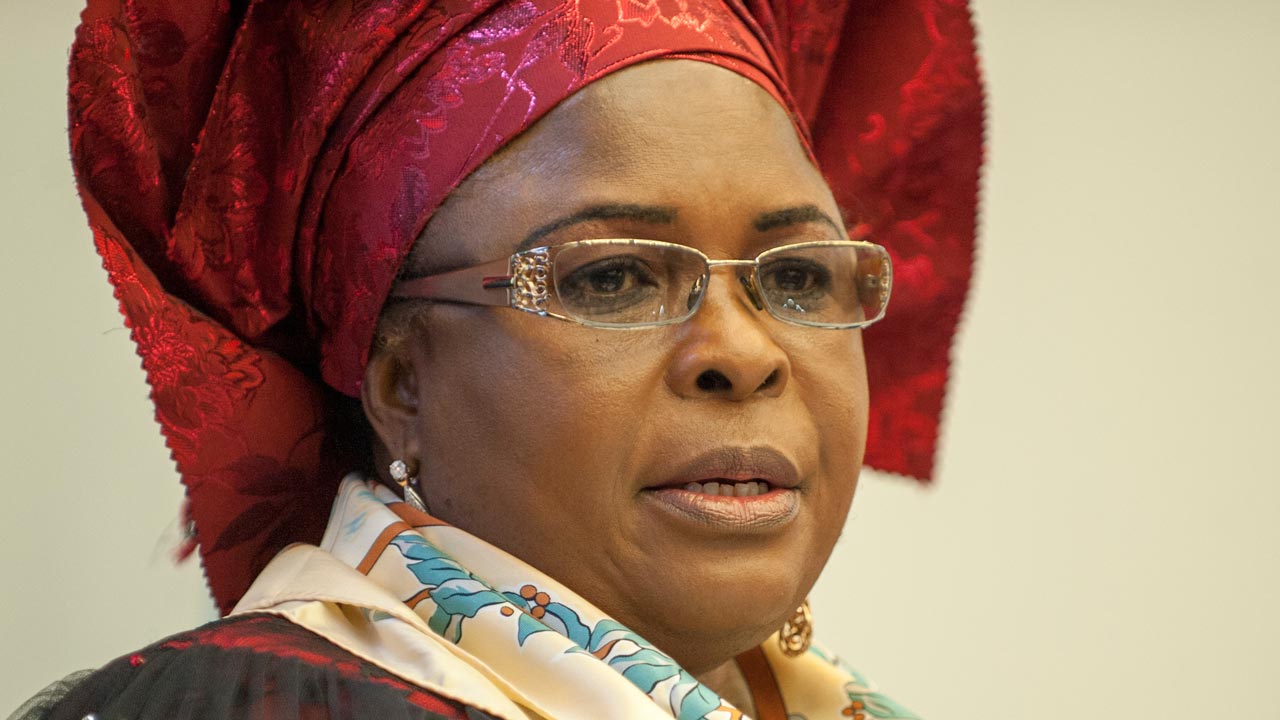
She said her guidance was behind his bold entry into big business at a relatively young age.
The former First Lady spoke on Tuesday in a video which went viral on Thursday during an inspection tour of the Azikel Refinery in Obunagha, Bayelsa State, alongside other dignitaries.
She said she personally introduced Eruani to billionaire businessmen, Aliko Dangote and Aminu Dantata, and pushed him to aspire to their level despite being the youngest among them.
“He’s a boy that I brought up. We are always together. Although he’s the little one among us when we are friends — Dangote, Seyi, Dantata, Eruani — among us, he’s the smallest. But I made sure he followed the Dangotes, he followed Dantata.
“Because I’m a woman in their midst, I made sure I told this small boy, ‘Go and follow them, and stop the grammar.’ But when he told me that one day he would be like Dangote, I said, ‘You’re thinking too high.’ I prayed to God to grant him his heart’s desire,” she said.
The former First Lady also recalled how the immediate past APC administration under Muhammadu Buhari initially failed to grant Eruani a refinery licence before eventually approving three.
“During the Buhari administration, he and others came to me and told me they were going to apply for a refinery. I told him, ‘Eruani, your brother, the President, did not give you a refinery.
“Is it the APC government that will give you one?’ I prayed it would happen. But later, they came back and told me they had been given three refineries,” she said.
The 25,000 barrels-per-day plant is a private hydro-skimming refinery designed to process condensate into petrol, diesel, aviation fuel, kerosene and other products.
It is set to become Nigeria’s second-largest full-slate refinery and the first major privately owned refinery in the Niger Delta.
The Managing Director/Chief Executive Officer of the Niger Delta Development Commission, Samuel Ogbuku, who joined the inspection tour, commended Eruani for his perseverance, noting that he had attended the project’s groundbreaking ceremony eight years ago.
Ogbuku described the refinery as an inspiration and a potential catalyst for investment, job creation and economic growth in Bayelsa State, and urged residents, particularly youths, to key into the opportunities it would create.
He also praised the Bayelsa State Government for improving road infrastructure leading to the refinery site and called for continued support for the project.
Governor Douye Diri, who was represented at the inspection by his deputy, Peter Akpe, has consistently backed the project, which is expected to employ hundreds of workers and drive industrialisation in the state.
Other dignitaries at the event included the Chairman of the Bayelsa State Council of Traditional Rulers, King Bubaraye Dakolo; Vice President of Azikel Group, Presley Asemota; and Isaac Yalah, among others.

A market check on Tuesday showed that NNPCL outlets in Abuja and nearby areas adjusted their petrol price from N1,155 per litre to N1,270 per litre.
The latest adjustment represents an increase of N115 per litre by the state-owned oil company.
The new price change follows recent increases by depot owners and petroleum marketers, who have adjusted their rates twice within a week.
The latest development also comes days after Dangote Refinery resumed the sale of refined petroleum products in dollars, a move that has raised concerns among industry players over the direction of fuel pricing in the country.

The Federal Government has disclosed that 13 of the 50 oil and gas blocks offered in the 2025 Licensing Round will be returned to the licensing basket after failing to attract bids from prospective investors.
The Chief Executive of the Nigerian Upstream Petroleum Regulatory Commission (NUPRC), Oritsemeyiwa Eyesan, disclosed this on Tuesday at the 2025 Commercial Bid Conference in Abuja.
Eyesan said that although 50 blocks were initially put up for bidding, prospective investors showed interest in only 37.
“At the end of the exercise, we had 50 blocks on offer, but we only had representation for 37 of those 50 blocks. Thirteen of those blocks will be returning back to the basket,” she said.
She further disclosed that 143 companies participated in the commercial bid process, submitting about 200 bids for the available oil and gas assets.
“We have a total of 143 companies showing interest for 200 bids. That, for us, was remarkable, and I must say thank you,” Eyesan stated.
According to her, nearly 300 companies initially expressed interest in the licensing round, which she described as a sign of renewed investor confidence in Nigeria’s upstream petroleum sector.
“When we started the journey, we got interest from almost 300 companies. I repeat, almost 300 companies. That, in my view, was an indication that the tide has turned for Nigeria,” she said.
She explained that the number of interested companies was reduced to 196 following the prequalification stage, before the process moved to the technical and commercial evaluation phases.
“From the almost 300 interests that we got, we moved to the pre-qualification stage, and that number was pruned down to 196,” she added.
The 2025 Licensing Round was launched on November 11, 2025, in accordance with the Petroleum Industry Act 2021, with 50 oil and gas blocks put up for bidding across seven sedimentary basins.
The assets comprise 16 Niger Delta onshore blocks, 18 shallow-water blocks, one deep offshore block, three blocks in the Benin Basin, four in the Anambra Basin, four in the Chad Basin and four in the Benue Trough.
The bid portal opened on December 1, 2025, while a pre-bid conference was held in Lagos on January 14, 2026, to provide prospective investors with guidance on the bidding requirements.
Registration and prequalification submissions closed on February 27, 2026, with the prequalification process completed on March 16.
The NUPRC said winning bids are being determined through a weighted evaluation that considers signature bonus commitments, proposed work programmes and performance security. The process combines technical and commercial scores rather than relying solely on financial offers.
The framework is aimed at ensuring that Nigeria’s petroleum assets are awarded to investors with the financial capacity, technical expertise and operational strength required to accelerate exploration and production in the country’s upstream sector.


-

 Education2 days ago
Caleb British International School Wins Zenith Bank Young Innovators Challenge, Bags ₦5m Prize
-

 Politics5 days ago
Ebonyi NDC Reps Candidate Calls for Probe of Attack on Assembly Candidate
-

 News4 days ago
Online Media Professionals Association Emerges in South-East
-
 News4 days ago
Mbah Moves to End Excessive Agency, Legal Fees, Arbitrary Rent Increases in Enugu
-

 Politics5 days ago
2027: Odii’s Camp Tells Nwifuru to Quit Governorship Race
-

 News4 days ago
Modern Onitsha Main Market With Over 6,000 Shops Ready for Christmas
-

 Crime4 days ago
Gunman Robs Female POS Operator of N200,000 in Enugu, Threatens Pursuers
-

 Health4 days ago
Ebola Scare: FG Moves to Establish Treatment Centres in States as Contacts Rise to 53