



Crime
Nigeria among top 10 human trafficking, drug markets – Report



The 2021 Global Organised Crime Index has ranked Nigeria among the top 10 criminal markets for trafficking in people, firearms, illicit cannabis and heroin trade, fauna crimes, synthetic drugs and non-renewable resource crimes.
The index shows that the countries with the highest criminality levels are those experiencing conflict or fragility, adding that such affected nations were most affected by organised crime.
According to the report, the Democratic Republic of Congo topped the list of the criminal markets with a score of 7.75, followed by Columbia 7.66; Myanmar 7.59; Mexico 7.56; Nigeria 7.15; Iran 7.10; Afghanistan 7.08; Iraq 7.05; Central African Republic 7.04 and Honduras 6.08.
Other high-scoring countries include Afghanistan, Iraq and Syria, where conflicts have decimated the formal economies, led to mass displacement and an influx of weapons.
The report was authored by the Institute for Security Studies and INTERPOL in affiliation with the Global Initiative against Transnational Organised Crime.
In conflict settings, the GOCI notes that states’ attention and capacities may be diverted to war efforts, leaving social, economic and security institutions weakened, while resilience to organised crime declines.

The lowest-scoring countries with better resilience and social safety include Tuvalu 1.54; Nauru 1.76; Sao Tome & Principe 1.78; Liechtenstein 1.88; Samoa 2.04; Vanuatu 2.20; Marshal Island 2.31; Kiribati 2.35; Luxembourg 2.36 and Monaco 2.43.
The report states, “In breaking down criminality and looking at the 10 criminal markets covered, the global average was slightly lower at 4.65, with human trafficking determined to be the most pervasive worldwide (with a global average of 5.58). Indeed, human trafficking features in the top five criminal markets of every continent in the world. After the trafficking of people, the illicit cannabis trade and arms trafficking were assessed to be the second and third most pervasive markets worldwide, with global averages of 5.10 and 4.92, respectively.”
The index observed that failure on the part of states to provide safe environments and stable economic livelihoods for millions of vulnerable populations created conditions conducive to exploitation, as human traffickers exploit victims for profit both within national borders and abroad through sexual exploitation, forced labour/modern slavery, forced begging, organ trafficking and child soldier recruitment, noting that the vast majority of victims are women and girls.
It affirmed that opportunities for human trafficking have increased with Internet technology, which provides both a ready online market and, simultaneously, the means to exploit people with greater anonymity, adding that human trafficking market is present in a wide range of contexts, from both stable countries to those in conflict, often overlapping with other criminal markets, such as human smuggling.
On the regional level, Asia leads in criminality, criminal markets, criminal actors and resilience followed by Africa, Americas, Europe and Oceania
On the sub-regional level, East Africa leads in criminality followed by West Africa, Central Africa, Northern Africa and Southern Africa.
The Index data further shows that, as with criminal markets, East Africa is home to the most influential criminal actors on the continent, driven predominantly by state-embedded actors.
Overall, state-embedded actors scored 7.22 in the region with Central Africa (7.55) leading the way, followed by North Africa (7.17), West Africa (6.90) and Southern Africa (6.90).
The report reads, “Criminal networks are also prevalent across all regions in Africa, but none more so than in East Africa (6.83) and West Africa (6.43). On the other hand, while Central Africa is home to countries with some of the highest levels of state capture in the world, criminal networks in numerous countries in the region are fairly weak.
“While mafia-style groups are the lowest-scoring criminal actor type across the continent, there are several countries in Africa where highly organised gangs, armed groups and militias yield significant influence in the criminal landscape, many of whom have even been strengthened by the COVID-19 pandemic, capitalising on openings in illicit markets and in doing so consolidating control over the communities in which they operate.”
PUNCH
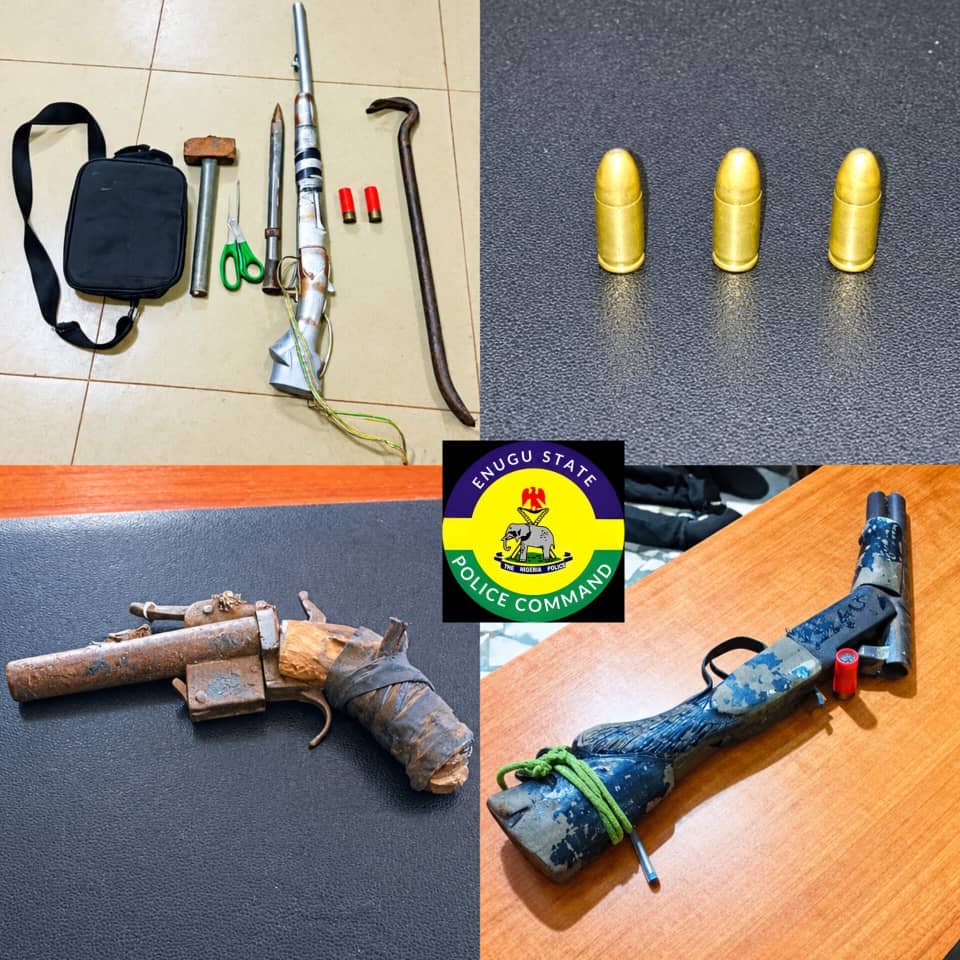
ENUGU — The Enugu State Police Command says it has arrested five male suspects in separate operations across the state and recovered three firearms, six rounds of live ammunition and other exhibits.
The Command disclosed this in a statement issued on Thursday, October 8, 2026, by its Police Public Relations Officer, SP Daniel Ndukwe.
According to the statement, police operatives attached to Inyi Division responded to a distress call about an armed robbery at Umuaor, Umukabia Isiama Awlaw Community, Oji-River Local Government Area, at about 5:10 a.m. on October 7.
One suspect, identified as 26-year-old Arinze Osita Onwuaso, was arrested while other suspects reportedly fled the scene. Police said they recovered a locally made cut-to-size single-barrel gun, two live cartridges, a pry-bar, hammer, scissors and chisel from him.
In a separate operation on October 5, operatives of the Anti-Cultism Section of the Violent Crime Response Unit arrested two suspected cultists, 24-year-old Jonas Adejo, also known as J-Money, and 25-year-old Okoro Innocent, also known as Virus, at Umudioka Community in Nsukka.
Three live rounds of 9mm ammunition were recovered from the suspects. Police said the two men confessed during interrogation to membership of the Supreme Vikings Confraternity.
Meanwhile, on September 25, operatives of Aninri Division, working with members of the Neighborhood Watch Group, raided a suspected criminal hideout at Amagu Mpu Community in Aninri LGA.
The operation led to the arrest of 25-year-old Anichebe Ogbonna, from whom police said one locally made pistol was recovered.
Similarly, on September 18 at about 11:00 p.m., operatives of 9th Mile Division, acting on information and in collaboration with Neighborhood Watch members, arrested 38-year-old Chukwujekwu Chukwuemeka at Ameke-Ngwo, Udi LGA.
He was arrested over alleged involvement in armed robberies in the area. Police said one cut-to-size pump-action gun and one live cartridge were recovered from him.
The Command said investigations into the cases are ongoing and that the suspects would be arraigned in court after the conclusion of investigations.
The Commissioner of Police, CP Mamman Bitrus Giwa, commended members of the public for providing information and praised the police operatives for their response to credible intelligence.
He reiterated the Command’s commitment to intelligence-led operations against armed robbery, cultism and other violent crimes, while urging residents to remain vigilant, law-abiding and supportive of security agencies.

By Okey Maduforo, Awka
The Awka High Court, on Tuesday, denied bail to the General Overseer of Day Spring Assembly, Mr Harrison Anazodo, who is standing trial over alleged offences relating to his activities as a pastor.
Anazodo had applied for bail on health grounds, but the presiding judge, Justice Jude Obiora, rejected the application, citing concerns over possible interference with witnesses.
The development came as seven persons, believed to be members of the congregation, are expected to testify in the case.
The court adjourned the matter until October 16 for further proceedings.
Speaking shortly after the hearing, State Counsel, Victoria Ekwerekwu, commended the Anambra State Government for its efforts to tackle alleged fraudulent activities by some religious figures.
She said, “We thank Governor Charles Soludo for trying to sanitise our society from pastors who make the younger generation believe that making money without hard work is possible.”
According to her, the prosecution has established a prima facie case against Anazodo, although the state would still be required to prove the allegations beyond reasonable doubt.
“Today, there is a prima facie case against the accused, Mr Harrison Anazodo, though it is left for us to prove it beyond reasonable doubt.
“The court ruled on the bail application and denied him bail because of the witnesses, to ensure that they are not interfered with. The matter was subsequently adjourned until October 16,” she said.
The Anambra State Commissioner for Information, Dr Law Mefor, expressed optimism that the case would be concluded expeditiously, stressing that the ultimate decision rests with the court.
“We have been here since 9am. The court considered the bail application filed by his counsel and, after weighing its merits, the judge ruled that bail should be denied.
“We are looking forward to the quick dispensation of the matter and we assure you that justice will be done and will be seen to have been done,” Mefor said.
By Our Correspondent
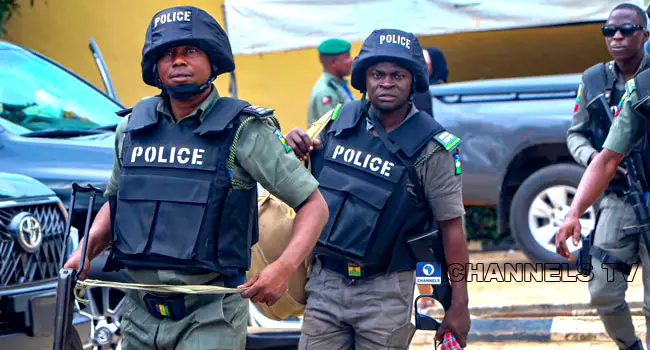
The Inspector-General of Police, Olatunji Disu, has deployed the Deputy Inspector-General of Police in charge of Operations, Shehu Nadada, to Imo State to coordinate the search-and-rescue operation for 20 prospective National Youth Service Corps members and other passengers abducted along the Owerri-Onitsha Road.
The victims were reportedly abducted on Thursday, October 1, 2026, around Umunoha in Imo State.
The Force Public Relations Officer, Force Headquarters, CSP Anietie Iniedu, disclosed this in a statement issued on Friday.
According to the statement, Nadada arrived in the state alongside two Commissioners of Police and immediately conducted an on-the-spot assessment of the incident and the ongoing rescue operation.
He also reviewed the operational strategies, deployment of personnel and available assets, while issuing additional directives aimed at strengthening the coordinated response.
The assessment was conducted alongside the Imo State Commissioner of Police, CP Audu Garba Bosso; the Commissioner of Police in charge of Federal Operations, CP Akpan Anifiok; the Commissioner of Police in charge of the Police Mobile Force; other service commanders and members of the management team of the Imo State Police Command.
Iniedu said the search-and-rescue operation had been intensified, with additional tactical teams and operational assets deployed to identified areas.
He added that the operation was being supported by intelligence-led tracking of the abductors and coordinated efforts with other security agencies.
Nadada assured members of the public that the police remained committed to securing the safe release of the abducted persons.
“The Nigeria Police Force is committed to securing the safe rescue of the 20 abducted persons and will sustain the operation until the mission is successfully concluded,” Iniedu quoted Nadada as saying.
The police boss urged members of the public and the media to remain calm and vigilant, while appealing to anyone with credible information that could assist the operation to contact the police or the nearest security formation.
He assured the public that all information received would be treated with strict confidentiality.
The police said further updates would be provided as the rescue operation progresses.

Five men have been arrested and arraigned before a Chief Magistrate’s Court in Maiduguri, Borno State, after police allegedly found them wearing T-shirts bearing the words “Tinubu Must Go.”
The defendants were identified as Baba Aji Gremami, 44; Mustapha Abba Yemen, 28; Abbacha Mohammed Ali, 32; Adam Umar Gubio, 21; and Abdulhamid Mohammed, 21.
According to a First Information Report issued by the State Criminal Investigation Department, the incident occurred on September 25, 2026, near West End Roundabout in Maiduguri.
Police charged the five men with criminal conspiracy, inciting disturbance, disturbance of public peace and thuggery under Sections 60, 78, 79 and 392 of the Borno State Penal Code.
The defendants pleaded not guilty to the charges when they appeared before Chief Magistrate Court I in Maiduguri.
Their lawyer subsequently applied for bail. The court adjourned the matter until October 6, 2026, to rule on the bail application, while the substantive trial has been scheduled for October 26.
The case has drawn attention because the alleged conduct involved wearing clothing displaying a political message.
Amnesty International criticised the prosecution, describing the arrests as arbitrary and arguing that peaceful political expression is protected by fundamental human rights. The organisation called for the immediate release of the five men and urged authorities to discontinue the case.
Amnesty International also expressed concern that the prosecution could have implications for political expression and opposition activities in Borno State.
The case has generated reactions on social media, with some commentators questioning whether the display of political messages on clothing should constitute a criminal offence.
There have also been allegations that a prominent politician in Borno State may have influenced the arrests. The allegation has not been independently verified.
Efforts to obtain a comment from the Borno State Police Public Relations Officer, ASP Kenneth Daso, were reportedly unsuccessful as of the time of filing.
The defendants remain subject to the court process, and the allegations against them have not been established in court.
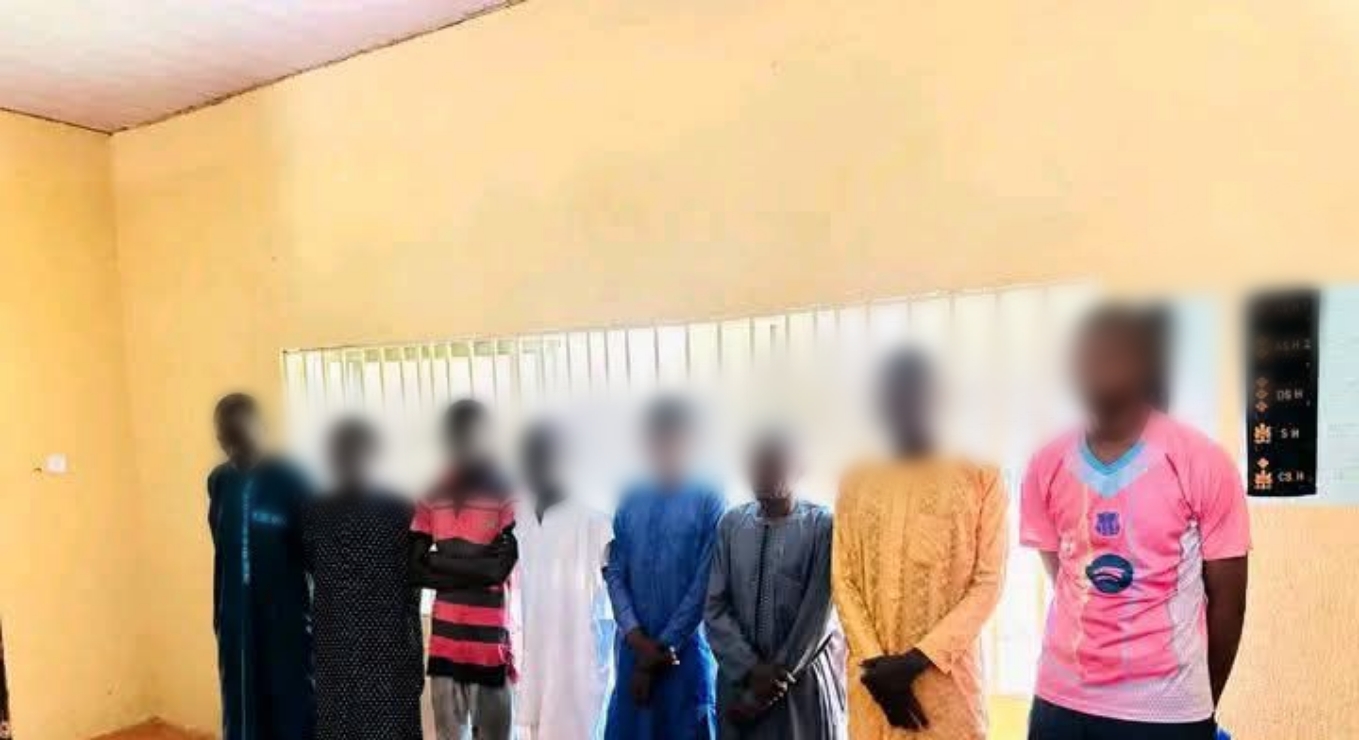
The Jigawa State Hisbah Board has arrested eight people in Kazaure Local Government Area over alleged homosexual acts, according to the board.
The board’s Public Relations Officer, Dauda Hadejia, disclosed this in a statement issued on Saturday, September 26, 2026.
Hadejia said the arrests followed a complaint filed by a 22-year-old man, who alleged that nine individuals had engaged in sexual acts with him on different occasions.
According to the statement, the complainant also claimed that he later contracted HIV, which he attributed to the alleged encounters. He reportedly appealed to the Hisbah authorities for justice, describing the alleged conduct as deceptive and harmful to his life.
Following the complaint, Hadejia said Hisbah operatives launched an investigation and began searching for the nine individuals named by the complainant.
“So far, eight suspects have been arrested, while efforts are ongoing to arrest the remaining suspect,” Hadejia said.
He added that the eight arrested individuals reportedly admitted during preliminary investigations to having engaged in sexual acts with the complainant.
Hadejia said the board had gathered information and evidence that would be presented before a court. He added that the investigation remained ongoing and that the suspects would be charged upon its completion.
The Deputy Commander-General of the Jigawa State Hisbah Board, Dr. Hussain Baban, reportedly urged parents to pay closer attention to their children’s upbringing and the people with whom they associate.
He also called on members of the public to be mindful of the consequences of their actions and to uphold religious and moral values.
The board further expressed appreciation to the Jigawa State Government for its support and cooperation in carrying out its responsibilities.

-

 Politics4 days ago
2027: Odii Will Not Step Down, Says Spokesperson
-

 EverydayNews Telescope4 days ago
Nkalagu Cement Factory: Project or 2027 Political Promise?
-
 News4 days ago
How NAF Plane Vanished From Radar Shortly After Take-Off, Crashes In Ondo Swamp
-

 News4 days ago
No Survivor Found Yet in Ondo Air Crash — Aiyedatiwa
-

 News2 days ago
Curfew Continues as Soludo Sets Up Commission of Inquiry Over Aguleri–Umuoba Anam Clash
-
Crime3 days ago
Court Denies Alleged Fake Pastor Bail as Seven Witnesses Await Trial
-

 Education2 days ago
Ihejirika Hails Mbah’s Infrastructure Drive as Coal City University Inaugurates Governing Council
-

 News3 days ago
NAF Crash Claims Pilot 16 Days After Wedding