



News
Insecurity: Govs disagree on need for regional outfits




Governor Gboyega Oyetola of Osun State, and his colleagues in the South-South, yesterday, disagreed over the need to set up regional security structures to checkmate the rising wave of insecurity in the country.
While Oyetola urged other geo-political zones to emulate the South-West by setting up structures such as Amotekun to rid their regions of crime, insisting that the centralised policing system is not working, chairman of South-South Governors Forum and governor of Delta State, Ifeanyi Okowa, said it is better to have a centralised police system that should be strengthened for effectiveness.
Similarly, Chairman of South-East Governors Forum and governor of Ebonyi State, Dave Umahi, who spoke through the Secretary to the State Government, SSG, Dr. Ugala Kenneth, said the issue will have to be discussed at a meeting of governors of the region.
The governors spoke on a day Vice-President Yemi Osinbajo tasked acting Inspector-General of Police, Alkali Baba Usman, to restore dignity to the force and rebuild broken bridges of trust with the public.
Why Amotekun became inevitable — Oyetola

Governor Oyetola, who threw the challenge at the 2nd Annual Colloquium of the Sultan Maccido Institute for Peace, Leadership and Development Studies, University of Abuja, also blamed worsening insecurity in the country on poverty and illiteracy.
He identified the sources of insecurity as “poverty which creates a gulf between the rich and the poor; inequitable allocation of resources which pits one region against the other; and injustice which makes offended parties resort to self-help and consequently take up arms against the state.”
The governor also identified “illiteracy which makes innocent citizens willing tools at the hands of unscrupulous elites and elements; youth unemployment which makes able-bodied and educated youths susceptible to crime, among others.”
He said the inability of the central police to tackle insecurity effectively led to the creation of Amotekun, the regional security network in the South-west.
“The nation’s conventional security agencies are overstretched and sorely under-funded. The Police once confirmed the sorry state of its manpower when it said the Force needs 155,000 additional hands to effectively police the nation.
“The nation’s security agencies as currently constituted are too centralised and too far from the grassroots to adequately provide the required security for the nation.
“Worse still, they are unfamiliar with the terrains where crimes take place. It is our belief that our people understand the topography of their communities more and can govern them better.
“The nation’s expansive forests have unfortunately become the hideouts of bandits, kidnappers, and other criminals. With the establishment of Amotekun, the forests of the South-West are now better policed.
‘Let other regions emulate S-West’
“The issues that make Amotekun inevitable in the South West are the same in other regions of the nation. Other regions may wish to emulate the South West to put structures in place to rid their regions of crime.
“Our recent experience where the attempts to confront armed banditry headlong in the North resulted in their incursion into the South-West and other regions that were erroneously perceived to be immune from the insecurity challenge is proof that each region has to be adequately policed for the region to know peace,” the governor said. He also called for collective and concerted efforts to deliver the security that “we desire as a nation as a people.”
His words: “Our recent experience in which insecurity has challenged education, peace, economy and other spheres of life has lent credence to Abraham Maslow’s emplacement of security as one of the foremost in the hierarchy of needs.
“This realisation underscores the need for our leaders and professionals, including traditional rulers, political leaders, academics, religious leaders and corporate leaders, to constantly collaborate to brainstorm on ensuring peace in the nation.
“Security breeds peace, economic and other developments, political stability and good governance. The converse of this is that insecurity is a destroyer of these desirable indices.
“As a people, we must realise that it is only in a safe and secure environment that optimal local commercial activities can take place; foreign investors can be attracted; goods and services can be provided; infrastructure can be built and maintained; public service can be delivered, and social and political activities can take place peacefully. “Therefore, the quest for a sustainable peaceful society must be prioritised as the collective responsibility of all citizens.
“Delivering security is not a task for the government alone. Corporate bodies and Non-Governmental Organisations need to partner with the government to achieve success. Business thrives in an atmosphere of peace. Business concerns must join the government to restore peace to the regions of the country.
“For proper security of lives and property of our people and the prompt containment of growing challenges, we must inevitably now engage our traditional institutions. Governors, particularly, cannot afford not to look in the direction of the traditional institution.
“This is because every conflict is local and as such, traditional institutions cannot be left out of the scheme. Traditional rulers know their people and also have better strategies for engaging them. Therefore, we must ride on this to be able to protect our nation from implosion.”
Governor Okowa reacts
Reacting to Governor Oyetola’s call yesterday, chairman of the South-South Governors Forum and governor of Delta, Senator Ifeanyi Okowa, who spoke through the State Commissioner for Information, Mr Charles Aniagwu, said: “Our leaders in the South-South are very much concerned about the spate of insecurity in the country and are determined to put heads together to forge a common front and possibly reduce the challenges of insecurity in the region.
“Of course, you know insecurity in the country is no longer news to anybody, and then the South-South is not spared in that insecurity which has become the bane of development across the 36 states and the Federal Capital Territory, FCT.
“But, we are also concerned that it would have been better for us to have a national security outfit and at the moment we do have them. We just pray that they are possibly equipped and empowered to be able to deal with the issues of insecurity so that we move away from tokenism of everybody having to be on their own.
“We will not shy away from addressing the challenges as it affects our people but we believe that the Federal Government needs to step up action to deal with these dare-devil criminals; that way everybody is safe.
‘BRACED Commission tasked on security outfit’
On whether the South South Governors are prepared to set up their own security outfit like Amotekun, he said: “The South-South governors have handed that over to the Bayelsa, Rivers, Akwa-Ibom, Cross Rivers, Edo and Delta, BRACED Commission which is a body that deals with issues of common interest in the region to work out the modalities so that we don’t just jump into setting up an outfit that is just in the name and not be able to do what it ought to do.
“But beyond that, you do know that when an outfit is set up, there are some constitutional inhibitions that will still make it impossible for some of these issues to be addressed the way we like it to. And it’s important that Nigerians begin to look at these issues rather than mounting pressure in the wrong quarters.
“For instance, you can’t have some of the heavy weapons other than small arms and light weapons. Some of those heavy weapons that are in the hands of those criminals, you cannot have them without the Federal Government giving you the license to so do. So, even if you set up your outfit, what are you going to be using to equip those outfits?
“When the ability to equip them to be able to confront these dare-devil criminals is largely still being determined by the approval to be given by the Federal Government, that tells you that where everybody should channel their energy, including the other geo-political zones, is how to make the Federal Government secure all of us and for individuals to move away from whatever will divide us.
“Let us look at what will unite us the more. Recall, I did say we will not shy away from the need to protect our people in the region. Much as we desire to do so, we are much more interested in the common good of our country where our common patrimony lies, the nation, Nigeria.”
Rebuild broken bridges of trust with the public, Osinbajo tasks Ag. IGP
Meanwhile, Vice-President Yemi Osinbajo yesterday asked acting Inspector General of Police, IGP, Usman Baba Alkali, to restore dignity to the force and rebuild the broken bridges of trust with the public.
Speaking during the decoration of the acting IGP with his new rank at State House, Abuja, Osinbajo told the new Police boss he is assuming office at a turbulent time in the history of the country.
Urging him to implement community policing in order to curb growing insecurity in the land, Osinbajo said: “Let me once again, offer my congratulations to you as new Inspector-General of Police on your appointment. Your selection by Mr. President follows a rigorous process where all eligible Deputy Inspectors-General of Police and Assistant Inspectors-General of police were considered. The president then appointed you as the most senior qualified and eligible officer.
“IG, you are assuming office at a very turbulent time in the life of our people. There are multiple threats to law, order and public safety. The role of law enforcement and particularly that of the police force as primary agency charged with maintaining law and order has never been more important. The police is our institution of first resort, the first line of defence against crime and anarchy and the first sign of the strength of the state.
“The challenges before you are indeed onerous and will test your mettle, the organisation you are leading is one that is itself facing several challenges. Your officers work still in extremely difficult conditions. And some face the threat of physical harm by terrorists, hostile non-state actors while in the line of duty but they have lived up to expectations.
“There is no question at all that there is a lot that needs to be done. There is a lot of work that needs to be done. Under your leadership, the police must now rebuild in some ways also the broken bridges of trust to the public and regain the confidence of the citizenry.
“This is an ongoing challenge, an ongoing task the police force and all of the senior members of the police force must take on as a responsibility, that of the continual process of building trust to the Nigerian people. One of the ways you can do this is by implementing the community policing policy which had already taken off and re-conceptualising policing as a task carried out in partnership with local communities and by officers who are members of these localities.
“Under your leadership, the force must live up to all of the highest standards of professional conduct and compliance with the rule of law. It must significantly improve the welfare and working conditions of its officers.”
Osinbajo also tasked the new IGP to stamp out the excesses, abuses and culture of impunity from the police force.
What to expect from me, by Alkali
Speaking with journalists after his decoration, the new IGP promised to put into practice community policing to tackle the worsening security situation in the country.
Asked what Nigerians should hope for, he said: “Hope to see improvement on where my predecessor has left. I came in at a very challenging time, I know it, I recognize it and I will work on how to improve from where my predecessor has left.
“I have been a member of the management team and we have been trying to do our best but it is not enough, there is room for improvement.
“With all the inadequacies we have, we still require everybody to be part of policing in this country. And that is why the emphasis on community policing will continue and the emphasis of collaborating with all other sister agencies will continue and we hope to have a better situation very soon.”
On whether he was coming with any change in strategy, the Acting IGP said: “Definitely, we are going to rejig our operational strategies.”
On issues of equipment and manpower, the IGP said he had the blessings of President Buhari, adding that he was optimistic that he would get more of what the police had requested through the Police Trust Fund very quickly.
On community policing, he said: “We will continue to practicalize it. My predecessor left at the theoretical stage, we have started practicalising it but we have not gone far and, therefore, all the methods of practicalising it have been put in place and we are going to continue with it, in collaboration with other stakeholders.”
Vanguard

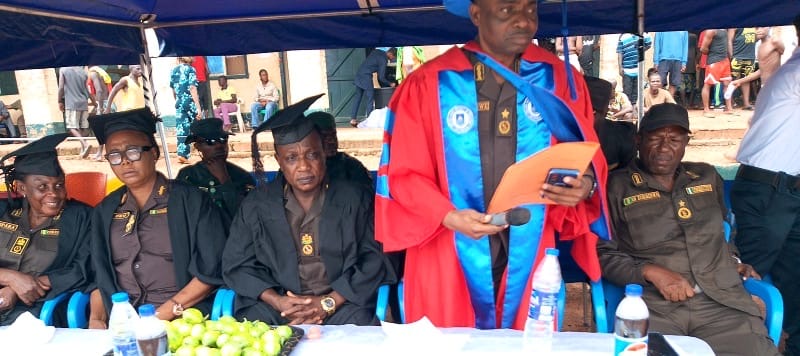
The National Open University of Nigeria (NOUN) has matriculated 70 inmates enrolled in various undergraduate programmes at its Special Study Centre within the Maximum-Security Custodial Centre, Enugu.
The matriculation took place on Wednesday during the 31st matriculation ceremony of the centre.
In an address at the ceremony, the Controller-General of the Nigerian Correctional Service (NCoS), Sylvester Nwakuche, described the event as a milestone in the Service’s commitment to using education as an instrument for the reformation, rehabilitation and reintegration of inmates.
Nwakuche, who was represented by the Assistant Controller-General of Corrections in charge of Zone M, Prisca Oku, said the NCoS would continue to strengthen correctional education and expand opportunities for academic, vocational and skills development across custodial centres.
He encouraged the matriculating inmates to remain focused, abide by the rules and regulations of both the university and the Service, and strive to become worthy ambassadors of the correctional education programme.
“I therefore encourage our matriculating inmates to remain focused, uphold the rules and regulations of the University and the Service, and strive to become worthy ambassadors of the correctional education programme,” he said.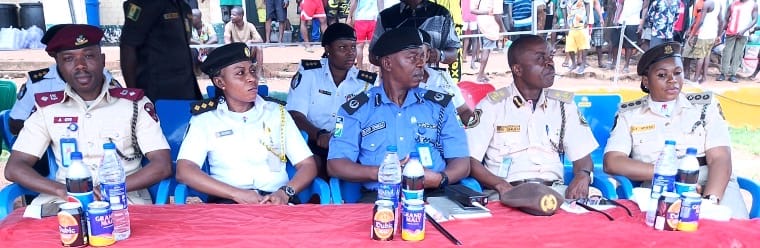
He added: “To the matriculating students, I also urge you to embrace this opportunity with seriousness, discipline and determination.
“Your present circumstances should not define your future; rather, let this opportunity equip you with the knowledge, skills and character needed to build a productive and responsible life beyond custody.
“Your academic journey is not merely about obtaining a qualification; it is also about transforming your mindset, broadening your horizons and preparing yourselves for meaningful reintegration into society.”
Speaking at the ceremony, the Vice-Chancellor of NOUN, Prof. Udoma Oji Udoma, said the university had continued to provide quality and accessible higher education to inmates by offering 100 per cent tuition-free education at all levels.
Udoma, who was represented by the Director of NOUN Enugu Study Centre, Prof. Loveth Ekwueme, said the university had consistently championed inclusivity by providing educational opportunities for inmates.
“NOUN affirms its belief that education is a fundamental right, not a privilege,” he said.
According to him, the initiative reflects NOUN’s commitment to national development, social justice and the rehabilitation of citizens who deserve a second chance.
“To our new students: today you pledge to uphold the values of scholarship, discipline, and integrity. Your enrollment signifies courage, determination, and the desire to transform your lives through knowledge.
“Remember that education is the most powerful tool for personal renewal and societal reintegration,” he said.
The Controller of Corrections in Enugu State, Mr Valins Obizue, encouraged inmates to take advantage of the free educational opportunities available to them and pursue academic qualifications that could improve their lives.
Obizue commended the Controller-General of the NCoS and NOUN for providing a veritable and accessible platform for the reformation and academic advancement of inmates across the country.
In his welcome address, the Officer-in-Charge of the NCoS Maximum-Security Custodial Centre, Enugu, Dr Sunday Igwe, said the study centre commenced in July 2011 with 12 students but had grown to 262 students.
Igwe described the growth as more than a numerical increase, saying it represented “262 dreams, 262 aspirations, 262 opportunities and 262 journeys towards personal and professional development.”
He said the NCoS firmly believed that education was one of the most powerful instruments for human development, reformation, rehabilitation, reintegration, empowerment and positive transformation.
“Our custodial environment is not only about security and safe custody. It is also about preparing individuals for meaningful contributions to society.
“The presence and growth of NOUN academic activities within this environment demonstrates that education can flourish wherever there is commitment, discipline and determination.
“NOUN remains and offers the foremost Open and Distance Learning opportunity in Nigeria,” he said.
One of the matriculating inmates, whose name was withheld, appreciated the Controller-General of the NCoS and the Vice-Chancellor of NOUN for providing the educational and reformative programme and making it accessible to inmates.
The newly admitted undergraduates enrolled in various programmes, including Public Administration, Peace and Conflict Resolution, and Criminology and Security Studies, among others.
Highlights of the ceremony included the administration of the matriculation oath to the new students and the cutting of the matriculation cake.
By Okey Maduforo, Awka
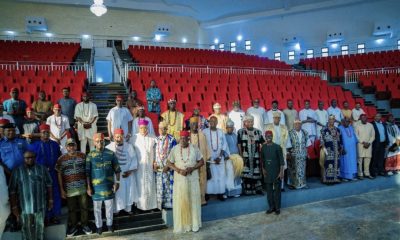
The indefinite curfew imposed on Aguleri and Umuoba Anam communities in Anambra State following their recent communal clash remains in force as Governor Chukwuma Soludo has set up a Judicial Commission of Inquiry to investigate the crisis.
The governor also ordered an immediate ceasefire, warning that the state government would not tolerate further lawlessness or any breach of peace and order in the two communities.
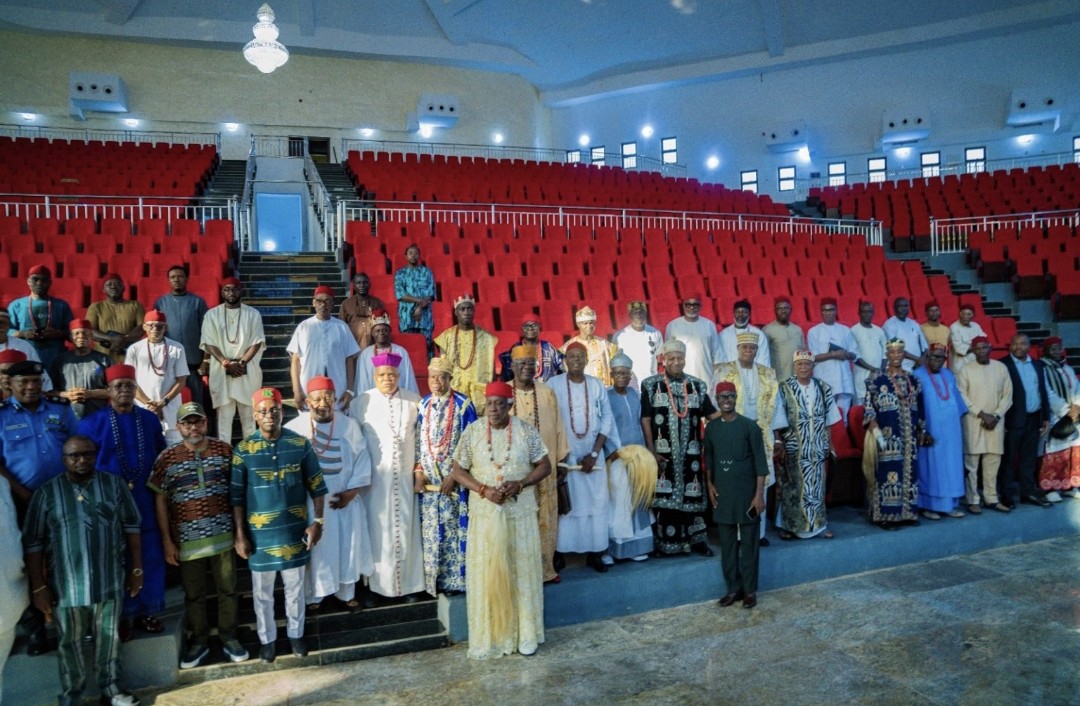
The directives followed a conflict-resolution meeting convened by the governor at the Light House, Awka, which was attended by traditional rulers and other leaders from the affected communities.
At the meeting, the stakeholders agreed that both communities must lay down their arms and embrace peace.
In a statement by the Chief Press Secretary to the governor, Christian Aburime, Soludo lamented the loss of lives and destruction of property, saying the violence was inconsistent with his administration’s vision of a peaceful and prosperous Anambra State.
“Opening the deliberations, the Governor decried the tragic loss of lives and the widespread destruction of properties, emphasizing that such lawlessness is entirely unacceptable to the administration,” the statement said.
Soludo also directed security agencies to maintain a round-the-clock presence in the affected areas to ensure compliance with the ceasefire.
The governor assured the parties that the government would remain “firm, fair, and uncompromising” in its pursuit of lasting peace and justice.
Community leaders, including Igwe Michael Idigo and Hon. Fidel Okafor, condemned the violence, particularly the killing of a minor and an unarmed person from Umuoba Anam, as well as the retaliatory destruction of the historic Idigo Palace.
They called for an immediate end to the hostilities and the prosecution of those responsible for the violence.
Speaking as an observer on behalf of the Umueri community, retired Justice Charles C. Okaa appealed for restraint and urged the state government to enforce the 1982 Supreme Court judgment on boundary matters involving Umueri and Aguleri as part of efforts to achieve a lasting resolution.
The stakeholders also agreed on the immediate cessation of hostilities, prosecution of perpetrators, accountability for community leadership and the rebuilding of the destroyed Idigo Palace.
Condemning the destruction of the traditional palace as an attack on the heritage of the state, Soludo announced that the state government would assist in rebuilding it and restoring its traditional dignity.
The governor also established a Judicial Commission of Inquiry to examine petitions, complaints and historical grievances connected to the crisis. The commission is expected to submit its comprehensive report within four months.
However, the state government has yet to make public the names and number of members of the commission.
Meanwhile, the indefinite curfew remains in force as security agencies continue to maintain heightened surveillance in the affected communities.

For Squadron Leader Ahamefule Aham Man-Ugwueje, Monday was supposed to be another routine day of duty. Instead, the Nigerian Air Force pilot lost his life in the crash of an ATR-42 aircraft in Igbokoda, Ondo State, barely 16 days after his wedding.
Man-Ugwueje had married Flight Lieutenant Damilola Adekunle on September 19, 2026, in an elaborate ceremony in Abuja.
The couple exchanged vows at the Redeemed Christian Church of God, The Masters Place, Utako, Abuja, before proceeding to the Nigerian Army Conference Centre, Asokoro, for the reception.
Details of the wedding were contained in the couple’s invitation and posts shared by vendors who participated in the ceremony. A videographer, Beejay Creates, also shared footage from the event, identifying the couple as bride Damilola and groom Ahamefule.
Man-Ugwueje, who was identified by the Nigerian Air Force as the co-pilot of the ill-fated aircraft, was among the five crew members and 20 passengers who died in the crash.
The aircraft, NAF 931, was on a routine mission from Benin to Lagos when it crashed in a swampy area around Igbokoda in Ilaje Local Government Area of Ondo State.
The Nigerian Air Force on Tuesday confirmed that all 25 people on board died in the accident and released the names of the victims.
The Chief of the Air Staff, Air Marshal Sunday Kelvin Aneke, described the incident as a deeply painful moment for the Nigerian Air Force and the nation, while commiserating with the families, friends and colleagues of the victims.
The Air Force also ordered a comprehensive investigation into the circumstances surrounding the crash.
Man-Ugwueje, whose Facebook profile listed Umuahia, Abia State, as his hometown and Abuja as his current city, was the son of retired Group Captain Man-Ugwueje.
Meanwhile, Ondo State Governor, Lucky Aiyedatiwa, said no survivor was found after security agencies, emergency responders and local residents joined the search for victims at the crash site.
Aiyedatiwa said he was informed of the crash at about 10:30am on Monday after receiving a call from the chairman of Ilaje Local Government Area.
According to the governor, residents across the river from the Nigerian Navy base in Igbokoda heard a loud sound and subsequently saw the aircraft plunge into the swamp.
He said Navy personnel initially exercised caution while trying to determine whether there was a fire or explosion before moving towards the crash site.
“When they noticed that it’s just an accident, they didn’t see any sign of fire. So they moved in, trying to see if they could rescue the people,” the governor said.
Personnel of the local emergency management agency, residents and members of the Amotekun Corps later joined the rescue operation.
However, the search ended in tragedy after authorities confirmed that there were no survivors.
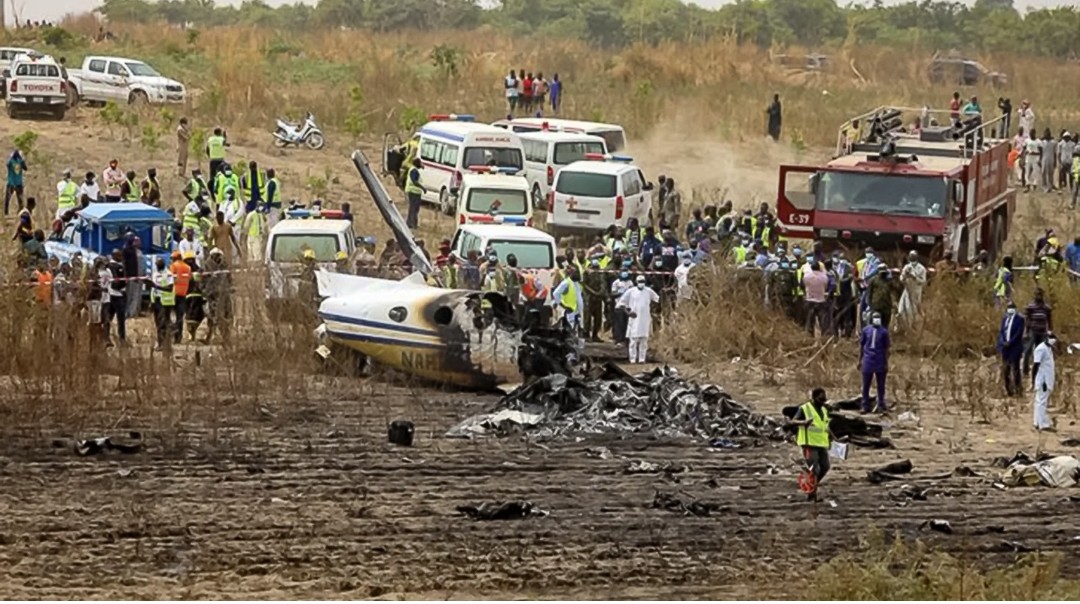
A Nigerian Air Force ATR-42 aircraft on a routine flight from Benin City to Lagos crashed into a swamp in Igbokoda, Ilaje Local Government Area of Ondo State, on Monday after reportedly disappearing from radar shortly after take-off.
The aircraft, with tail number NGR 931, lost communication with air traffic controllers at about 9:13am. A senior air traffic controller, who spoke anonymously, said repeated attempts to re-establish contact with the aircraft failed.
According to the source, personnel around Okitipupa later reported hearing a loud bang suspected to have come from the crash site.
The Minister of Aviation and Aerospace Development, Festus Keyamo, confirmed that the aircraft had disappeared from radar and that all efforts to raise it on radio were unsuccessful.
He later announced that the wreckage had been located near the Naval Base in Igbokoda.
Keyamo said 32 people—25 passengers and seven crew members—were on board.
The Nigerian Air Force confirmed the crash, saying the aircraft was on a routine mission from Benin to Lagos and that search-and-rescue operations had commenced in coordination with relevant authorities.
The crash site, located in a swampy creek, proved difficult to access, with military personnel, emergency responders and local fishermen joining the rescue operation.
Governor Lucky Aiyedatiwa said no survivor had been found as of Monday evening, although the authorities had yet to officially announce a death toll.
The governor said rescuers recovered parts of the aircraft, identification cards and military uniforms from the site.
President Bola Tinubu expressed sadness over the incident and directed the Nigerian Air Force to immediately commence a thorough investigation into the cause of the crash.
Investigators are expected to examine the wreckage, flight path, weather conditions, maintenance records and air traffic control communications. Efforts were also being made to recover the aircraft’s flight recorder, which could provide crucial information about its final moments.
The cause of the crash remains unknown.
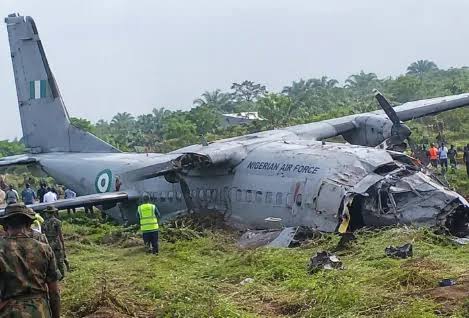
Ondo State Governor, Lucky Aiyedatiwa, has disclosed that no survivor has so far been found following the crash of a Nigerian Air Force aircraft in Igbokoda, Ilaje Local Government Area of the state.
Aiyedatiwa made this known during an interview with Channels Television on Monday, saying local residents, security personnel and emergency responders had searched the crash site without finding anyone alive.
The governor said he received information about the incident at about 10:30am after the chairman of the local government contacted him.
According to him, residents living across the river from the Nigerian Navy base in Igbokoda heard a loud sound and subsequently saw the aircraft plunge into a swampy area.
He explained that personnel of the Nigerian Navy initially stayed back to determine whether the crash had triggered a fire or explosion before proceeding to the site.
“When they noticed that it’s just an accident, they didn’t see any sign of fire. So they moved in, trying to see if they could rescue the people,” Aiyedatiwa said.
He added that officials of the state emergency management agency, local residents and personnel of the Amotekun Corps later joined the search and rescue operation.
“But from the information we got, no single life was saved up to this moment. They could not see any living soul that was in that aircraft,” the governor said.
Aiyedatiwa said searchers recovered parts of the aircraft, including pieces of the wings, identification cards and military uniforms, which helped establish that the aircraft was a military plane.
“But they saw the ruins, some of the wreckage from the wings of the aircraft, you know, some ID cards, I was told, and then uniform. That was when they knew it was a military aircraft,” he said.
The governor described the incident as a painful development, noting that the crash occurred not only in Ondo State but also in his home local government area.
“So it’s a sad situation today. And we’re all really, really agreed as a Nigerian. And also it happens in my own state, not just my state, even in my own local government where I’m from,” he said.
Aiyedatiwa expressed sympathy for the military personnel involved, describing them as officers assigned to protect the territorial integrity of Nigeria.
The Nigerian Air Force had earlier confirmed that an ATR-42 aircraft with tail number NGR 931 crashed in Igbokoda while on a routine mission from Benin, Edo State, to Lagos.
Minister of Aviation and Aerospace Development, Festus Keyamo, said preliminary information indicated that 25 passengers and seven crew members were on board the aircraft.
The Nigerian Air Force said search and rescue operations were ongoing following the crash.

-

 Politics3 days ago
2027: Odii Will Not Step Down, Says Spokesperson
-

 EverydayNews Telescope2 days ago
Nkalagu Cement Factory: Project or 2027 Political Promise?
-

 News4 days ago
Sacked Works Commissioner: Release or Charge Him to Court, Oganiru Izzi Challenges Nwifuru
-
 News2 days ago
How NAF Plane Vanished From Radar Shortly After Take-Off, Crashes In Ondo Swamp
-
 News3 days ago
No Survivor Found Yet in Ondo Air Crash — Aiyedatiwa
-
 Crime4 days ago
Police Deploy DIG, Two Commissioners to Rescue 20 Abducted Prospective Corps Members
-
 Crime2 days ago
Court Denies Alleged Fake Pastor Bail as Seven Witnesses Await Trial
-
 News9 hours ago
Curfew Continues as Soludo Sets Up Commission of Inquiry Over Aguleri–Umuoba Anam Clash