



World
Father’s search for truth after daughter killed in Britain’s deadliest terror attack

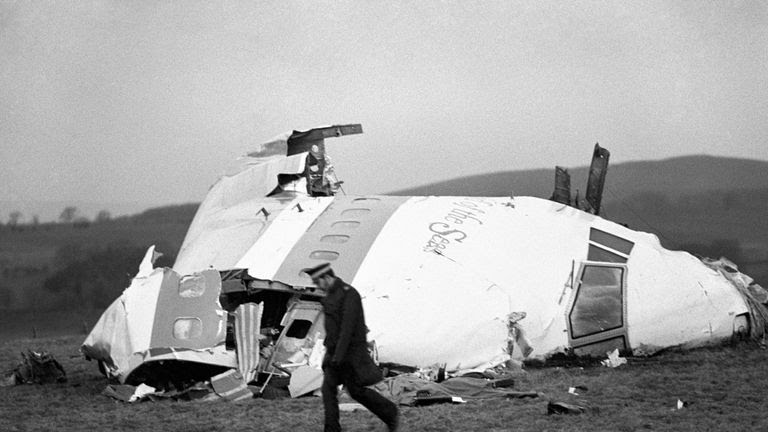

A new Sky documentary tells the story of Britain’s deadliest terrorist atrocity and the most fatal terrorist attack on America before 9/11: the bombing of Pan Am flight 103, when 270 people lost their lives.
“All I was after was the truth,” says Dr Jim Swire.
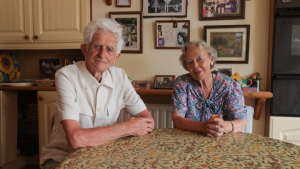
Jim and Jane Swire
The retired GP’s 35-year search for answers has seen him board a US-bound flight from Heathrow carrying a replica bomb, hold a secret meeting with Libyan dictator Muammar Gaddafi, and collapse in shock after a criminal trial at a former military base in the Netherlands.
His 23-year-old daughter was among the 270 people killed in the Lockerbie bombing on 21 December 1988 – the deadliest ever UK terrorist attack.
“I think I know who was responsible for killing her and I think I can prove it,” the old Etonian, now 87, says in a new four-part Sky documentary.
He keeps the evidence he has collected in cardboard folders in a metal filing cabinet in an office in the Cotswolds home he shares with his wife Jane.

‘No one had really heard of Lockerbie’
Flora “was everything a parent could wish for”, says Mrs Swire.
She was about to turn 24 and studying medicine when she set off to the US to meet her boyfriend for Christmas.
“Everything was booked up, except there were plenty of seats available on a certain flight known as Pan Am 103,” says Dr Swire, sitting in a leather armchair in his cottage, overlooking the rugged coastline on the Isle of Skye.
Less than 40 minutes after taking off from Heathrow on the transatlantic leg to New York’s JFK, the Boeing 747 was 31,000ft over the Scottish town of Lockerbie when the aircraft was almost instantly destroyed by a massive blast.
Residents remember “a huge explosion” before the sky lit up with “bright red flames” and a “great big mushroom ball of fire”.
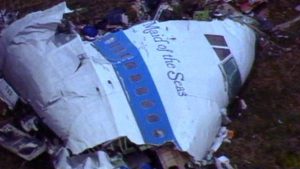
270 people died on 21 December 1988
“Life here was just undramatic.”
That all changed at 7.03pm that evening. All 259 passengers and crew members on board the plane were killed along with 11 people in the town as windows were blown in and wreckage destroyed their homes.
Locals are still haunted by images of the bodies that fell from the sky, some still strapped in their seats as they landed in gardens and fields.
The smell of aviation fuel hung thick in the air as they surveyed the carnage strewn with luggage and the Christmas presents victims were carrying for loved ones.
Peter Giesecke can’t shake the image of the woman still wearing one high-heeled shoe, while Margaret and Hugh Connell became “attached” to the man they found in a field near their home, watching over him for 24 hours until his body was recovered.
“We developed quite a love for ‘our boy’, not knowing who he was,” says Mr Connell.
As news of the disaster broke, relatives were desperate to know whether their loved ones were on board.
Unable to get through to Heathrow, Dr Swire rang the Pan Am desk in New York and could hear “chaos in the background and women screaming” as families of the victims, many of whom were American, received the terrible news.
Dr Swire, tall and slim with a full head of white hair, is measured as he recalls the kindness of the pathologist who allowed him to see his daughter’s body in the local ice rink, where the post-mortems were being carried out.
“She was barely recognisable,” he says, the grief which still bubbles just under the surface after all these years coming to the fore as he tells how he was allowed to take a lock of Flora’s hair.
“Human kindness can be very important when these things happen,” he adds, with tears in his eyes.

It took investigators a week to discover the disaster was caused by a bomb in a terrorist attack against the US – the biggest in the country’s history until 9/11.
“My first reaction was of fury, which led me to want to find the truth,” says Dr Swire. And that did a lot to help with the grief because I was busy doing things. It was rather how, I think, Flora would’ve reacted.”
The prime suspect was Iran, but they have always denied any involvement in the attack.
Iran had vowed to take revenge for the accidental downing of an Iran Air passenger flight by the US Navy in the Gulf in July 1988, which killed 290 people.
But the sprawling international investigation was just beginning.
“Nothing is what it seems in the Lockerbie story, nothing quite adds up,” says local reporter David Johnston, one of the first journalists on the scene.
It soon emerged a call was made to the US embassy in the Finnish capital that a Pan Am plane from Frankfurt to the US would be bombed in what was known as the “Helsinki warning”, with American diplomats in Europe told of a threat.
Passengers and luggage were transferred at Heathrow to Pan Am 103 from a feeder flight originating in Frankfurt and Dr Swire believes the plane was only two-thirds full because people were “warned off”. “We weren’t warned. Nobody told us,” he says.
“I felt I had a right to know the truth about how my daughter had come to be killed and why she wasn’t protected against being killed. And those were the bases on which we very soon found we were being richly and profusely deceived by the authorities.”
Biggest crime scene
Wreckage from the plane was spread over 845 square miles in what Richard Marquise, who headed up the FBI Lockerbie taskforce, describes as “the biggest crime scene in history”.
Investigators concluded the bomb was in a cassette player that was wrapped in clothes and put inside a brown hard-sided Samsonite suitcase.
A fragment of Toshiba circuit board pointed to possible links to tape recorder bombs made by Iran-backed PLFP-GC, a Palestinian terror group active in the 1970s and 1980s, who were suspected of carrying out the attack for the Iranians.
Dr Swire took his own replica bomb – the explosive material substituted for marzipan – on a plane from Heathrow to the US to highlight the security flaws.
“It was an obsession,” he admits. “All I was after was the truth of why our beautiful daughter had been murdered and I was bloody determined to find out who did it.”
This is a limited version of the story so unfortunately this content is not available.
The kindness of the women in Lockerbie
Meanwhile, in Lockerbie volunteers were cleaning the mud, blood and aviation fuel from the victims’ belongings left scattered amid the wreckage and bodies.
Clothes were washed, pressed and folded, jewellery was polished, and the pages of a tattered bible were individually ironed.
Miami-based Victoria Cummock, whose husband John died on board, was surprised to receive his clean laundry.
“I got back his personal effects due to the kindness of the women in Lockerbie,” she says.
Charred clothes which were packed with the bomb were traced to a shop in Malta, and two Libyan suspects came into the FBI’s sights.
Colonel Gaddafi’s Libya had a motive for the attack after an American bombing in capital Tripoli and a tiny fragment of circuit board, called PT35, found embedded in a shirt collar 20 miles from Lockerbie, was traced to Swiss electronics expert Edwin Bollier, who said he sold a batch of timers to the rogue state.
After CIA asset Majid Giaka, a Libyan double agent codenamed “Puzzle Piece”, said he saw the suspects with a brown suitcase at Malta airport the day before the bombing, two men were charged.
But there was little hope of Colonel Gaddafi handing over Abdelbaset al Megrahi, a Libyan intelligence officer, and Lamin Khalifah Fhimah, a security official for Libyan Arab Airlines, to face trial.
Telling only his wife for fear he would be intercepted by the security services, Dr Swire travelled to Libya to meet the dictator face to face in an attempt to persuade him.
“I was pretty crazy at that time,” he says. “I was so determined that I wasn’t scared, nervous yes, but not scared.”
Dr Swire says he heard the “click, click, click” of Gaddafi’s female soldiers readying their AK47s as he opened his briefcase to reveal pictures of his daughter, then again at the end of the meeting when he pinned a badge reading “Lockerbie the truth must be known” to the Libyan leader’s lapel.
The meeting had no obvious impact, and it was not until 11 years after the bombing that Gaddafi finally agreed to extradite the suspects in the face of tough economic sanctions imposed in response to the atrocity.
‘The shock was so great I collapsed’
The trial was held at former US Airforce base Camp Zeist, in the Netherlands, under Scottish law, and Dr Swire rented an apartment with Rev John Mosey, whose 19-year-old daughter Helga died on board Pan Am 103, to follow the evidence closely over 84 days.
Supergrass Giaka crumbled in the witness box as he was shown to be a liar and a fantasist, while Bollier couldn’t confirm he supplied the bomb timer to Libya.
“I couldn’t continue to believe that there was a cogent body of evidence that justifies the finding of either of those two men guilty,” says Dr Swire.
The Scottish judges cleared Fhimah but found al Megrahi guilty of 270 counts of murder for which he was later handed a life sentence.
“The shock of the verdict initially was so great I collapsed,” says Dr Swire.
Families of the American victims were pleased with the guilty verdict and FBI agents felt vindicated by the finding Libya was behind the bombing.
But Dr Swire “couldn’t believe three senior Scottish judges could convict someone on that evidence”, which he believes to be “false” in order to frame Libya to protect the West’s fragile relationship with Iran.
“I wasn’t prepared to have anything associated with Flora’s death as untrue and debasing as the story that was raised by the authorities against those two men,” he says.
“I was very shaken up psychologically by the fact I knew al Megrahi was innocent, and the authorities protected her killers.”
Sky News has contacted the Crown Office and Procurator Fiscal Service in Scotland for a response.
‘The truth is very simple’
In 2009, al Megrahi was released from a Scottish jail on compassionate grounds after he was diagnosed with terminal prostate cancer, having spent just nine years behind bars.
But some believe he was freed in exchange for an oil deal with Libya.
He received a hero’s welcome when he landed back home with Scottish flags waved as he got off the plane.
Families of the American victims were disgusted but Dr Swire was happy and even visited him before he died in 2012.
From his Zurich office, Mr Bollier now claims the PT35 fragment is a fake and says he believes police tampered with the evidence.
He also says he was shown a brochure with two briefcases full of cash and offered $4m (£3.2m) by Mr Marquise, but the ex-FBI agent insists he didn’t offer him “one cent”.
For Dr Swire “the truth is very simple but the consequences of trying to conceal the truth are very complicated”.
“I think she (Flora) was killed by a bomb which was ordained by the Iranian authorities,” he says.
“They had had an Airbus destroyed by an American missile and 290 people killed. Therefore, they were lusting for revenge.”
Former CIA operations officer John Holt, the one-time handler of Giaka, agrees. “I have no doubt it was Iran,” he says, adding that the PLFP-GC carried out the attack on their behalf.
However, most people still believe the official narrative and Libya has officially accepted responsibility, agreeing to a $2.7bn (£1.95bn) compensation deal with the victims’ families, albeit with expectations sanctions would be lifted.
Dr Swire’s search for answers continues as the alleged bombmaker Abu Agila Mohammad Mas’ud Kheir al Marimi is in US custody awaiting trial accused of being the third man involved in the terrorist attack.
Back in Lockerbie, the Connells did find out who their “boy” was – New Yorker Frank Ciulla.
The couple have formed a lasting friendship with his widow Mary Lou Ciulla and daughter Michelle Ciulla Lipkin, who are greeted with warm smiles and hugs as they step into their home from the Scottish drizzle.
“I felt that he was alone somewhere and yet when I came here, he wasn’t alone,” says Mrs Ciulla, her friend Mrs Connell’s arm around her shoulder. “Mine was actually… a nice story.”
Source: Sky News

The New York judge presiding over President-elect Donald Trump’s hush money case, on Friday, set sentencing for 10 days before his January 20 inauguration and said he was not inclined to impose jail time.
Judge Juan Merchan said Trump, the first former president ever convicted of a crime, can appear either in person or virtually at his January 10 sentencing.
In an 18-page decision, Merchan upheld Trump’s conviction by a New York jury, rejecting various motions from Trump’s lawyers seeking to have it thrown out.
The judge said that instead of incarceration he was leaning towards an unconditional discharge –- meaning the real estate tycoon would not be subject to any conditions.
The sentence would nevertheless see Trump entering the White House as a convicted felon.
The 78-year-old Trump potentially faced up to four years in prison but legal experts — even before he won the November presidential election — did not expect Merchan to send the former president to jail.
“It seems proper at this juncture to make known the Court’s inclination to not impose any sentence of incarceration,” the judge said, noting that prosecutors also did not believe a jail term was a “practicable recommendation.”
Trump is expected to lodge an appeal that could potentially delay his sentencing.
Trump was convicted in New York in May of 34 counts of falsifying business records to cover up a hush money payment to porn star Stormy Daniels on the eve of the 2016 election to stop her from revealing an alleged 2006 sexual encounter.
Trump’s attorneys had sought to have the case dismissed on multiple grounds, including the Supreme Court’s landmark ruling last year that former US presidents have sweeping immunity from prosecution for a range of official acts committed while in office.
Merchan rejected that argument but he noted that Trump will be immune from prosecution once he is sworn in as president.
“Finding no legal impediment to sentencing and recognizing that Presidential immunity will likely attach once Defendant takes his Oath of Office, it is incumbent upon this Court to set this matter down for imposition of sentence prior to January 20, 2025,” the judge said.
“This lawless case should have never been brought and the Constitution demands that it be immediately dismissed,” Cheung said in a statement.
“President Trump must be allowed to continue the Presidential Transition process and to execute the vital duties of the presidency, unobstructed by the remains of this or any remnants of the Witch Hunts,” he said.
“There should be no sentencing, and President Trump will continue fighting against these hoaxes until they are all dead,” Cheung added.
Trump also faced two federal cases brought by special counsel Jack Smith but both were dropped under a long-standing Justice Department policy of not prosecuting a sitting president.
In those cases, Trump was accused of conspiring to overturn the results of the 2020 election he lost to Joe Biden and removing large quantities of top secret documents after leaving the White House.
Trump also faces racketeering charges in Georgia over his alleged efforts to subvert the 2020 election results in the southern state, but that case will likely be frozen while he is in the White House.

China is facing a growing health crisis with a surge in respiratory illnesses, including human metapneumovirus (HMPV), five years after the COVID-19 pandemic.
Reports obtained by Core News indicate that hospitals are overwhelmed, particularly children’s facilities, as multiple viruses spread rapidly across the country.
A Surge in Viral Infections
Social media posts and videos show overcrowded hospitals, with one widely shared claim stating, “China is battling a surge in Influenza A, HMPV, Mycoplasma pneumoniae, and COVID-19. Hospitals and crematoriums are under strain, and cases of pneumonia and ‘white lung’ syndrome are on the rise.”
Speculation of a state of emergency has surfaced online, but Chinese authorities have not confirmed this.
New Monitoring System in Place
In response to the outbreak, China’s National Disease Control and Prevention Administration is testing a system to track pneumonia of unknown origin. The aim is to strengthen early detection and establish protocols for handling new pathogens—a gap identified during the early days of COVID-19.
State broadcaster CCTV reported that this system involves laboratories reporting cases, which disease control agencies then verify and manage. Officials say respiratory illnesses, particularly among children under 14, have been on the rise, with northern provinces seeing the highest numbers.
Winter Adds to the Pressure
As the country heads into winter, experts warn of an expected increase in respiratory infections. Alongside HMPV, other viruses like rhinovirus and Mycoplasma pneumoniae are contributing to the surge. However, authorities predict fewer total cases this year compared to 2024.
No Vaccine for HMPV
Medical experts are urging caution in the use of antiviral drugs, as there is currently no vaccine for HMPV. The virus causes symptoms similar to the common cold but can lead to severe illness in vulnerable populations, including children and the elderly.
A Critical Test for China’s Health System
This outbreak underscores the ongoing challenges of managing infectious diseases. While China’s new monitoring system aims to provide better preparedness, the country’s healthcare system faces a critical test in the months ahead as infections continue to rise.
Health officials and the global community are closely watching how China addresses this growing crisis.

A ceasefire between Israel and Hezbollah has come into effect hours after United States President Joe Biden said a proposal to end the “devastating” conflict had been reached, promising to halt nearly 14 months of cross-border fighting that has killed thousands of people.
The ceasefire began at 4am local time (02:00 GMT) on Wednesday amid concerns as to whether the truce would hold and lead to the permanent end of fighting between Israel’s military and Hezbollah forces.
“The fighting across the Lebanese-Israeli border will end — will end. This is designed to be a permanent cessation of hostilities,” Biden said when announcing on Tuesday night that an agreement had been reached.
“Civilians on both sides will soon be able to safely return to their communities and begin to rebuild their homes, their schools, their farms, their businesses and their very lives,” Biden said.
Hezbollah, which did not participate in any direct talks on the ceasefire – with Lebanese parliamentary speaker Nabih Berri mediating on the group’s behalf – has yet to formally comment.
Lebanon’s caretaker Prime Minister Najib Mikati said he told Biden that he welcomed the deal to end hostilities between the Lebanese armed group Hezbollah and Israel.
Israeli Prime Minister Benjamin Netanyahu also told the US president that his government had approved the truce and that he appreciated his “understanding that Israel will maintain its freedom of action in enforcing it”, his office said.
As part of the ceasefire agreement, Israel will “gradually withdraw” its forces from southern Lebanon over the next 60 days, and the Lebanese Army and state security forces would deploy to the territory.
Biden released a joint statement with French President Emmanuel Macron that emphasised both countries “will work with Israel and Lebanon to ensure this arrangement is fully implemented and enforced”.
The US and France also committed “to lead and support international efforts for capacity-building of the Lebanese Armed Forces as well as economic development throughout Lebanon to advance stability and prosperity in the region”.
Lebanon began striking Israel on October 8, 2023, in solidarity with Palestinians in Gaza. Cross-border attacks persisted for months. Then, at the start of last month, Israel invaded southern Lebanon.
At least 3,768 Lebanese have been killed and 15,699 wounded since the fighting began.
Ongoing fighting
Despite the anticipated ceasefire, Israel’s bombardment of Lebanon continued to rage on Tuesday, with Israeli warplanes pounding Beirut’s southern suburbs.
Reporting from the Lebanese capital, Al Jazeera’s Zein Basravi said Israeli strikes continued in the minutes immediately after Biden spoke.
“Right now, all of the politics we’ve heard in the last half hour to one hour, none of that matters,” Basravi said. “This evening, tonight in Beirut, in the capital of Lebanon, across multiple areas in this country, the war is still very much going.”
“Within five minutes or so of Biden completing his speech, we heard loud explosions in Beirut. Once again, sirens started sounding in northern Israel,” he said.
“In upper Galilee, Hezbollah fired a large amount of rockets across the border into Israeli territory, fulfilling a pledge that if the Israelis strike inside central Beirut, that Hezbollah will strike Israel,” he said.
Earlier in the day, the Israeli military said that one barrage of strikes had hit 20 targets in the city in just 120 seconds.
Seven people were killed and 37 others wounded in Israeli attacks on a Beirut building housing displaced people, the National News Agency reported, citing Lebanon’s Ministry of Public Health.
“The Israeli strike on the Nweiri area in Beirut destroyed a four-storey building housing displaced people,” Lebanon’s official news agency said.
Lebanon’s Health Ministry said earlier that Israeli strikes had killed at least 31 people on Monday, mostly in the south of the country.
A new push for a Gaza ceasefire
Reporting from the White House, Al Jazeera’s Kimberly Halkett noted that the ceasefire announcement comes in the waning days of Biden’s term.
Republican President-elect Donald Trump is set to take office on January 20.
The Biden administration has repeatedly sought to broker a ceasefire agreement in Gaza but has come up short. It has repeatedly refused to leverage US military aid to Israel in its push for peace.
“The fact is [Tuesday’s ceasefire] falls short of the Biden administration’s goal, in that it does not in any way speak to the conflict in Gaza,” Halkett said.
Still, during the address, Biden pledged to “make another push with Turkey, Egypt, Qatar, Israel and others to achieve a ceasefire in Gaza” in his final days in office.
He also said he would work towards forging new normalisation agreements between Israel and several Arab countries, including Saudi Arabia, a goal which had been set back amid the war in Gaza.

Russia’s defence ministry said its military shot down five ATACMS missiles and damaged one more. Fragments fell on the territory of an unspecified military facility, the ministry said. The falling debris sparked a fire but didn’t cause any damage or casualties, it said.
Speaking at the G20 summit in Brazil, Russia’s foreign minister Sergei Lavrov said: “That ATACMS was used repeatedly overnight … is of course a signal that they [the US] want escalation,” he said. “And without the Americans, use of these high-tech missiles, as Putin has said many times, is impossible.”
“We will be taking this as a renewed face of the Western war against Russia and we will react accordingly,” he told a press conference.
The missile launch took place as Ukraine marked 1,000 days of war, with battle-fatigued troops at the front, its cities besieged by airstrikes, a fifth of Ukrainian territory in Moscow’s hands and doubts about the future of Western support as Donald Trump heads back to the White House. US officials have expressed dismay at Russia’s deployment of North Korean troops to help it fight, particularly around Kursk, where around 50,000 Russian troops have massed.
Asked about his response to Russia ramping up the nuclear threat, prime minister Sir Keir Starmer said “the quickest way for this conflict to end is for Russia to cease”.
Britain has its own long-range Storm Shadow missiles, which Ukraine could use to strike inside Russia, but they typically rely on US technology for targeting. They have only been used to date on Russian-occupied territory in Ukraine. The authorisation to use them inside Russia is yet to come but Sir Keir said Britain would “ensure Ukraine has whatever is needed for as long as it’s needed to be put in the strongest possible position”.
“Russia is the aggressor in Ukraine and today is the day that marks 1,000 days of the conflict,” he added. “That is 1,000 days of Russian aggression, 1,000 days of Ukraine suffering from that aggression, and we’ve said throughout that we stand firmly with Ukraine.”
President Volodymyr Zelensky said Ukraine was working with all partners to win their support for longer-range strikes and he called out Germany in particular.
“I think after statements about nuclear weapons, it is also time for Germany to support corresponding decisions,” Mr Zelensky said during a briefing in Kyiv with Danish prime minister Mette Frederiksen.
Mr Zelensky earlier warned that North Korea could grow its deployment of troops in Russia from 11,000 to as many as 100,000.
He said a string of recent airstrikes were evidence that Mr Putin has no interest in ending the war. US president-elect Donald Trump has said he will look to end the war in 24 hours when he enters the White House. Despite the hyperbole, Kyiv is concerned it could be railroaded into an agreement that would force it to give up territory occupied by Russia, something Mr Zelensky has said he would not do.
A third Russian strike in three days hit a civilian residential area in Ukraine, killing at least 12 people, including a child, officials said on Tuesday. The strike by a Shahed drone in the northern Sumy region late on Monday hit the dormitory of an educational facility in the town of Hlukhiv and wounded 11 others, including two children, authorities said, adding that more people could be trapped under the rubble.
On Sunday, a Russian ballistic missile with cluster munitions struck a residential area of Sumy in northern Ukraine, killing 11 people and wounding 84 others. On Monday, a Russian missile barrage sparked apartment fires in the southern port of Odesa, killing at least 10 people and wounding 43.
“Each new attack by Russia only confirms Putin’s true intentions. He wants the war to continue. Talks about peace are not interesting to him. We must force Russia to a just peace by force,” Mr Zelensky said.
Separately, Germany and Finland said the damage to two undersea internet cables in the Baltic sea must be seen as an act of sabotage.

United States President-elect Donald Trump has picked 27-year-old Karoline Leavitt as the White House press secretary.
She has had a meteoric rise since getting her break as a student assistant for Fox News during his 2016 campaign for the White House.
After serving as an assistant press secretary during Trump’s first stint as president, she is set to return as the youngest person ever in the high-pressure top press job.
“Leavitt is smart and tough and has proven to be a highly effective communicator. I have the utmost confidence she will excel at the podium and help deliver our message to the American People,” Trump said in a statement announcing her appointment
The conservative from New Hampshire has been a regular presence at Trump’s side in 2024, serving as his campaign spokeswoman at his rallies, as well as his multiple court appearances.
The mother-of-one, who took nine days off to give birth to her son during the campaign in July, is a fervent believer in Trump’s “America First” anti-immigrant agenda and shares his disdain for traditional media companies.
She told a Fox News podcast posted online on Friday that she had spent the campaign “battling a lot of ‘fake news’ reporters. I hate to call them that, but it’s true.”
“There are a lot of journalists who aren’t interested in journalism anymore, and we deal with them every day,” she added.
As press secretary, she will face enormous pressure from Trump, who is known to closely scrutinize cable news coverage.
Leavitt began her rise through the Republican party ranks after Trump and other contenders for the 2016 presidential nomination visited her university campus in Manchester, New Hampshire, for a primary debate that was broadcast by Fox News.
“As one of the lone conservatives on campus, they appointed me to be an assistant running around that week for Fox News. I was just running around backstage, and that’s when I decided what I wanted to do with my career,” she said on the network’s “The Untold Story” podcast.
She went on to pen a column for the student newspaper at Saint Anselm College entitled “Why Donald Trump just keeps on winning, and the media doesn’t get it,” where she opposed the “identity politics” professed by many of her fellow students.
“I didn’t believe … that the colour of your skin or your gender can hold you back in this country. I don’t believe that’s true. That’s the foundation of my conservative beliefs,” she told the podcast.
After leaving the White House following Trump’s election defeat in 2020, she ran unsuccessfully for a seat in the House of Representatives representing New Hampshire during the 2022 midterm elections.


-
 Politics5 days ago
One Feared Dead, Several Injured as Thugs Attack Ebonyi NDC Assembly Candidate, Burn Campaign Vehicle
-

 News5 days ago
Onitsha North LG Boss Reads Riot Act to Traders, Residents Over Poor Sanitation
-
 Health5 days ago
Nigeria’s Ebola Patient Identified as Wife of Swiss Diplomat, Infection Traced to Uganda
-
 Entertainment5 days ago
Nollywood Thrown Into Mourning as Veteran Actor Francis Duru Dies at 57
-
 Politics5 days ago
2027: It’s Not South-East’s Turn, Obi Not Our Best Presidential Candidate – Umahi
-
 Politics5 days ago
2027: APGA, APC Set for Joint Meeting in Anambra to Mobilise Support for Tinubu’s Re-election
-

 Politics5 days ago
2027: Minister Udeh to Unveil ‘ATM’ Political Group for Tinubu, Mbah’s Re-election
-
 News4 days ago
National Assembly Receives Proposals for New LGAs as Lagos Seeks 37, Akwa Ibom Missing from Lis