



News
We may have been scammed by asylum seekers – Church of England



The Rt Revd Dr Guli Francis-Dehqani, the Bishop of Chelmsford, conceded it was “very difficult” to look into the hearts of converts and be 100 per cent certain that they were genuine.
She acknowledged there had been a “small number” of alleged abuses but said the clergy “do the best they can” and it was “ultimately” the job of immigration tribunals and the Home Office to assess and vet the validity of asylum claims.
Her comments come after robust denials by the Church of England of claims by senior MPs and whistleblowers that clergy have been routinely supporting “bogus” asylum claims and enabled a “conveyor belt” of thousands of asylum seekers to convert.
Abdul Ezedi, the Clapham chemical attack suspect, was granted asylum after claiming to have converted to Christianity, despite having two convictions in the UK for sex assault and exposure.

Friends of Ezedi, an illegal migrant, told The Telegraph that he was a “good Muslim” who bought half a halal sheep every fortnight, despite his apparent conversion. James Cleverly, the Home Secretary, is reviewing the facts of the case to establish if the law needs to be overhauled to prevent such abuses.
Abdul Ezedi, the Clapham chemical attack suspect, was granted asylum after claiming to have converted to Christianity.
Asked on the BBC Sunday programme if she thought there were asylum seekers scamming the system, she said: “It’s very difficult to look into the hearts of people ever and be 100 per cent. And that goes for whether that person is from Britain or an immigrant from elsewhere.
“But we absolutely advise clergy to do the best they can. And I think what’s happening here is that inevitably there will be a small number of cases.
“But it seems to me that it’s wrong that a very small number of alleged abuses should be highlighted because it’s diverting attention away from the systemic problems, which is that we have an immigration system that’s overwhelmed and inefficient.”
She said she was “very open” to “looking again” at the Church of England guidance for clergy on how to help and support asylum seekers wanting to convert.
‘Conveyor belt of baptisms’
Asked if the bar should be set higher for baptisms, she said: “Preparation is in most cases very rigorous and that’s right and proper. I think, God forbid, you do take that seriously regardless of where people are coming from. It’s just that in the end, it’s impossible to prove 100 per cent.
“But we do have this guidance and we do make it very clear that clergy must be as confident as they possibly can be that those seeking baptism fully understand what it signifies.
“As we’ve heard already, some people fall away from the system if they are trying to scam it because they realise it’s taking longer than they would ideally like.”
Her comments follow claims last week by a whistleblowing former Church of England priest that the Church was complicit in a ”conveyor belt” of asylum seeker baptisms used by migrants to remain in the UK.
The Rev Matthew Firth, who was priest in charge at a parish in the north of England, told The Telegraph how he tried to stop the “veritable industry” of baptisms after discovering the scale of abuse in the system.
On Sunday, The Telegraph also revealed judges have raised concerns that some “unquestioning” church leaders were being “duped” by insincere asylum seekers converting to Christianity to avoid deportation.
Judicial decisions highlighted examples of clergymen and lay leaders failing to query the motives of purported converts whose asylum applications they had agreed to support.

Hon. Obi Aguocha, member representing Ikwuano/Umuahia North/Umuahia South Federal Constituency in the House of Representatives, is facing mounting criticism and backlash over his video in which he is seen singing and vibing to a sexually vulgar and demeaning song against women.
In the video, which is currently making the rounds online and in Ikwuano/Umuahia WhatsApp groups, Aguocha is clearly seen singing and enjoying the Ogele cultural song, whose lyrics reduce women to objects of sexual gratification.
The footage was reportedly recorded at a public gathering that had families in attendance, including children, a detail that has intensified the backlash.
The song, performed in the Ogele cultural music tradition associated with communities in Abia State, has sparked outrage among women and women’s groups who say the lyrics are not just vulgar but deeply degrading.
“This is not culture. This is humiliation dressed in tradition,” said Mrs. Ngozi Ibe, a women’s leader in Umuahia North. “We have watched the video. The words used against women in that song are not the kind of thing any serious leader should be associated with. A lawmaker representing our constituency should be defending our dignity, not promoting content that strips women of it.”
Another woman, a trader in Umuahia South who identified herself simply as Madam Grace, said the video had caused deep anger among market women.
“We heard about it and we watched it. Many of us were shocked. You cannot claim to represent women and then be seen singing and vibing to a song where women are being insulted in the most vulgar way. We are not laughing. We are insulted,” she said.
A coalition of women’s groups in the constituency, under the aegis of the Ikwuano/Umuahia Concerned Women’s Forum, also issued a statement condemning the video.
“The lyrics go beyond ordinary expressions of affection. They employ vulgar sexual references that reduce women to objects and make our sexuality the subject of degrading entertainment. For a serving federal lawmaker to be seen actively singing and enjoying such content is a serious indictment on his judgment and his respect for the women he claims to represent,” the group said.
The women’s forum also expressed concern over the presence of children at the event.
“What message does it send to our children when a leader they look up to is seen celebrating a song that reduces women to sexual objects? This is not the kind of example we should be setting for the next generation,” the statement added.
“Ogele is our heritage. But heritage is not a licence for vulgarity. Culture should uplift, not humiliate. We call on Hon. Aguocha to explain his involvement in this video and to apologise to the women and families of Ikwuano/Umuahia,” the group said.
The controversy raises questions about the judgment expected of a public officeholder and the appropriateness of associating with content that many women and families could reasonably find offensive and humiliating.
Aguocha has not responded to requests for comment as of press time.
News
National Assembly Receives Proposals for New LGAs as Lagos Seeks 37, Akwa Ibom Missing from Lis

The National Assembly has reportedly received proposals for the creation of additional local government areas (LGAs) across Nigeria, with Lagos State seeking 37 new councils, while Akwa Ibom State is conspicuously missing from a published list of submissions.
The proposals, according to a report by The Insight Lens Project, cover various communities across the country’s six geopolitical zones and reflect demands for administrative restructuring, improved grassroots representation and better access to government services.
However, the complete list of submissions has not been independently verified, and the proposals do not constitute approval for the creation of new local government areas.
In the North-East, the reported requests include Bidoma and Michika South in Adamawa State, Boi-Tapshin in Bauchi, Banki in Borno, Cham in Gombe, Gudi in Yobe and Wukari in Taraba State.
In the North-West, the proposed areas reportedly include locations in Jigawa, Piriga in Kaduna, Dankama in Katsina, as well as Moriki and other communities in Zamfara State.
The North-Central zone also features in the reported submissions, with proposals covering Agasha and other communities in Benue State, alongside several areas in Kogi, Kwara, Nasarawa, Niger and Plateau states.
In the South-East, the list includes Abiriba in Abia State, proposed councils around Obosi in Anambra State, several communities in Ebonyi State and numerous proposed local government areas in Imo State.
The South-West proposals reportedly include Eso-Obe and Gbonyin in Ekiti State, Ogijo and other areas in Ogun State, as well as additional proposed councils in Osun and Oyo states.
Lagos State stands out with a reported request for 37 new local government areas, although the published report did not provide the names and proposed boundaries of all the councils.
In the South-South, the reported proposals include Akassa and other communities in Bayelsa State, Ughievwen in Delta State, several areas in Edo State, and Ataba, Evo and Alesa in Rivers State.
Cross River State is also listed, with proposed councils around Mbube and Calabar. Akwa Ibom State, however, has no clearly identified entry in the published list, raising questions about whether the state submitted proposals or was omitted from the report.
Constitutional Requirements
The creation of new local government areas is governed by Section 8 of the 1999 Constitution of Nigeria, which prescribes a series of procedures involving consultations, a referendum, legislative approval and the submission of relevant records to the National Assembly.
The constitutional process must be completed before newly created councils can be recognised and reflected in the relevant constitutional schedules.
Consequently, proposals submitted by states or communities do not automatically translate into legally recognised local government areas.
The reported development comes amid broader constitutional review efforts by the National Assembly. In October 2025, the legislature reported receiving 278 requests for additional local government areas and 55 proposals for the creation of new states.
Nevertheless, the specific state-by-state submissions contained in the latest published list, including Lagos State’s reported demand for 37 additional councils and the absence of Akwa Ibom, remain subject to confirmation through official National Assembly records.
The proposals, if confirmed, could reopen discussions on administrative boundaries, grassroots governance and the constitutional procedures required for the creation of additional local government areas in Nigeria.

By Okey Maduforo, Awka
The Mayor of Onitsha North Local Government Area of Anambra State, Ezennia Emelie Ibekwe, has issued a stern warning to traders and residents against indiscriminate dumping of refuse and blockage of drainage channels, threatening sanctions against those who fail to comply with sanitation directives.
Ibekwe, who handed down the warning during an inspection of Ajasa Market, expressed displeasure over the deteriorating environmental conditions in parts of the commercial city, describing the situation as unacceptable and detrimental to healthy living and business activities.
During the inspection, the Mayor observed that refuse and other waste materials generated from market activities were being dumped into drainage channels, obstructing the free flow of water and exposing traders, residents and their properties to flooding.
“This practice contributes to flooding whenever it rains, putting traders, residents and their properties at risk.
“An environment of this nature is not conducive to business and healthy living. It does not speak well of a commercial city that houses one of the largest markets in sub-Saharan Africa,” he stated.
Consequently, Ibekwe directed traders and other persons responsible for the blocked drainage channels to ensure their immediate clearance, giving them until the following day to comply.
He further announced that he would return to the market for another inspection to ascertain the level of compliance with the directive.
“People should be alive to their responsibilities by ensuring a clean and healthy environment. Government alone cannot handle this effectively without the active participation of residents and traders.
“I am going to come back here to see what you have done,” he warned.
The Mayor stressed that the sanitation directive was not restricted to Ajasa Market but extended to all markets within Onitsha North Local Government Area.
He consequently charged market leaders to take responsibility for enforcing environmental sanitation regulations within their respective markets, warning that the council would no longer tolerate practices capable of worsening flooding and environmental degradation.
“It is not only Ajasa Market but all the markets in Onitsha North Local Government Area. Market leaders should ensure that this directive is not compromised,” Ibekwe declared.

The Speaker of the Cross River State House of Assembly, Rt. Hon. Elvert Ayambem, has commissioned a community market in Afi, Ikom II State Constituency, as part of his commitment to sustainable development and improved living conditions in rural communities.
The project, facilitated and completed by the Speaker, was identified as one of the priority needs of the community following consultations by the Constituency Needs Assessment Team established by Ayambem to evaluate infrastructure and identify projects that would directly benefit the people.
The team was mandated to identify critical infrastructure capable of improving the livelihoods of residents and promoting sustainable economic growth across the constituency.
According to community members, the absence of a suitable trading environment had been a major challenge for years, forcing traders to conduct business under harsh weather conditions, including rain and intense sunshine.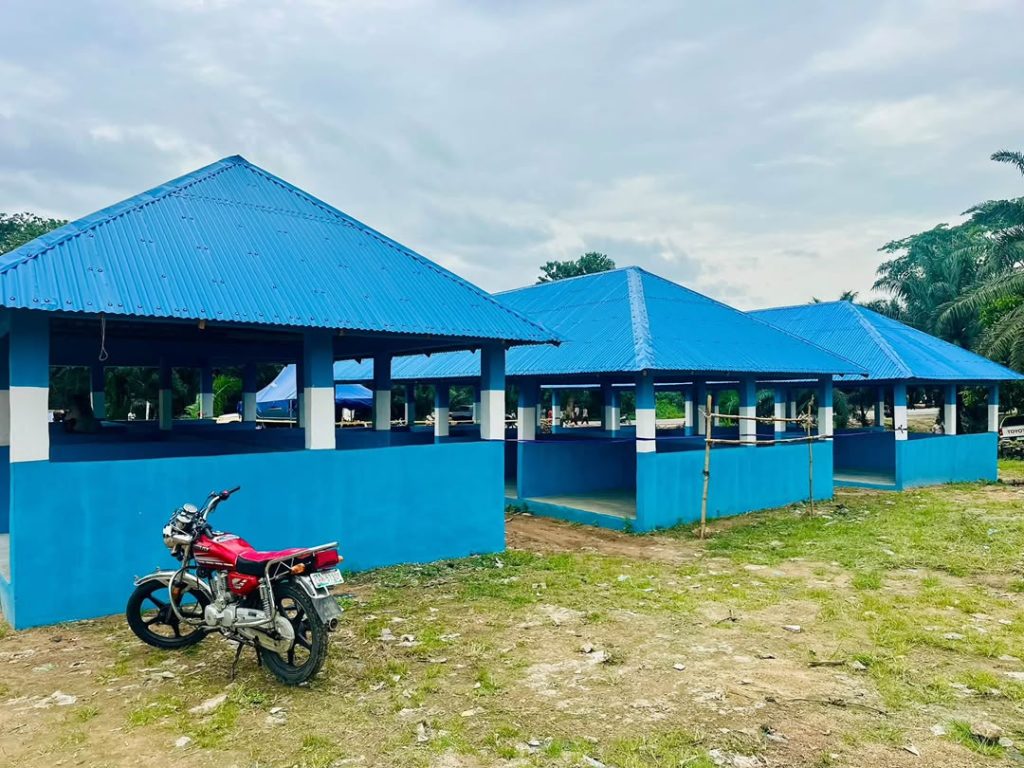
Speaking on behalf of the community, the village head, Chief Etta Ekawor, commended Ayambem for the intervention, describing the market as a miracle and a blessing that would transform the fortunes of the people.
In his remarks, Ayambem expressed appreciation to the Cross River State Governor, Senator Bassey Edet Otu, for his continued support for people-oriented projects and development initiatives across rural communities in the state.
He also thanked the people for their patience, support for his leadership and commitment to the All Progressives Congress (APC).
The Speaker was accompanied by the member representing Yala I State Constituency, Hon. Brian Odey; the Vice Chairman of Ikom Local Government Area, Hon. Maurice Ndome; and the Assistant Financial Secretary of the APC in Cross River State, Hon. Akanya Agbor.
Other stakeholders from Nde Ward who attended the commissioning included the former Vice Chairman of Ikom Local Government Area, Hon. Asinya Ntan, and the Community Relations Officer, Hon. Abang Neji.
Matthew Okache
Chief Press Secretary to the Speaker
October 22, 2026
News
Holy Ghost Transformation: How Enugu North Chairman Ibenaku Onoh Ended Years of Traffic Chaos, Roadside Trading

Driving through Holy Ghost and Chris Chemist Roundabout in Enugu metropolis was, until recently, a nightmare many motorists dreaded. Those who dared to navigate the busy commercial corridor often had unpleasant tales to tell.
Beyond the chaotic traffic situation, the area was notorious for rowdy and unorganised roadside trading, indiscriminate parking, commercial buses competing for passengers and the activities of illegal levy collectors who allegedly extorted motorists under various guises, including car radio licences and local government levies.
It was a situation that appeared to have defied successive interventions, leaving residents and motorists wondering whether sanity could ever return to one of Enugu’s busiest commercial districts.

Onoh, Executive Chairman Enugu North
Today, however, the Chairman of Enugu North Local Government Area, Hon. Ibenaku Onoh, appears to have achieved what many considered almost impossible.
Through a combination of political will, infrastructural adjustments and sustained enforcement, the once-chaotic Holy Ghost corridor has witnessed a remarkable transformation, with improved traffic flow and a significant reduction in the disorder that previously characterised the area.
Onoh explained that his decision to tackle the perennial congestion was inspired by the massive road rehabilitation, urban renewal and aesthetic improvements being undertaken across Enugu metropolis by Governor Peter Mbah.
According to him, having witnessed the governor’s determination to give Enugu a modern outlook through infrastructural development and beautification, he considered it necessary for the local government to key into the vision by sanitising Holy Ghost and its adjoining commercial areas.
He noted that it would amount to a contradiction for the state government to invest heavily in road rehabilitation and urban renewal while one of the city’s busiest commercial corridors remained overwhelmed by traffic congestion, illegal trading and environmental disorder.
Consequently, Onoh identified the Holy Ghost traffic situation as one of his administration’s immediate priorities upon assuming office.
He disclosed that he visited the area four times within his first week in office to personally assess the challenges before approaching Governor Mbah with a proposal to remove the Chris Chemist Roundabout.
“When I came on board, I paid attention to that area. In my first week of working here, I went there like four times. And I knew that was the problem. So I told the governor that the Chris Chemist Roundabout was a problem and that it had to go. The governor told me, go ahead and do whatever you want,” he recalled.
Armed with the governor’s approval, the council commenced the removal of the roundabout, expanded and asphalted portions of the road, and redesigned the median separating traffic moving into and out of Holy Ghost.
The chairman explained that the median had virtually become a market, with traders occupying every available space and contributing to the perennial congestion.
Rather than merely displacing the traders, his administration reconstructed the median in a manner that made it uncomfortable and unsuitable for roadside trading, thereby discouraging their return.
He also acknowledged the contribution of the new Holy Ghost transport terminal constructed by the Mbah administration, noting that commercial buses which previously clustered along the roads had been moved into the facility.
“The terminal has also helped. We thank the governor for that terminal. Some of these buses that used to cluster the road, we have now pushed them into the terminal,” he stated.
But beyond the physical transformation, Onoh identified sustained enforcement as the greatest challenge in restoring sanity to the area.
He explained that roadside traders and other operators frequently attempted to return to prohibited locations despite repeated efforts to remove them.
According to him, the situation required not only determination but also the establishment of a legal framework to deal with persistent offenders.
Consequently, the council approached the Chief Judge and subsequently enacted a by-law establishing a mobile court for the local government.
Onoh said the court provided a legal mechanism for prosecuting offenders, ensuring that resistance to enforcement would no longer end in mere confrontations with council officials.
He further alleged that some individuals had attempted to compromise enforcement efforts by offering monthly financial inducements, insisting that his administration would not sacrifice its objectives for personal gains.
“For me, I know exactly what I want, and once I see what I don’t want, I know I don’t want it. I think it is also that discipline, strength and consistency that have made us sustain it for as long as we have,” he said.
The chairman disclosed that enforcement remained a daily exercise, recalling how he recently directed his Chief Security Officer to remove wheelbarrows that had resurfaced around the council premises.
He maintained that without consistency, the gains recorded in Holy Ghost could easily be reversed by individuals determined to reclaim public spaces for unauthorised commercial activities.
Meanwhile, the council has shifted attention to another major environmental challenge in the area: indiscriminate waste disposal.
Onoh disclosed that his administration recently took delivery of about 35 large waste bins procured from Lagos, which would be deployed across the commercial district.
He explained that additional metal fabrication was being carried out to make the bins compatible with evacuation trucks operated by the Enugu State Waste Management Authority (ESWAMA).
According to him, the initiative would provide traders, residents and commuters with designated refuse disposal points before the council intensifies prosecution of environmental offenders.
“People just come and dump their waste on the road. What I have said is to give them an option. I will give you an option of where you are supposed to put waste. But when you don’t do it, by the time we take you to mobile court and have you arraigned there, you will know that you had an option,” he explained.
For motorists familiar with the old Holy Ghost, the difference is striking. What was once regarded as an unavoidable traffic nightmare is gradually becoming an example of how local government leadership can complement the urban renewal agenda of the state government.
For Onoh, however, the achievement is not merely about removing a roundabout or displacing roadside traders. It is about ensuring that the massive investments being made by Governor Mbah in transforming the Enugu capital are complemented by discipline, environmental responsibility and orderliness at the grassroots.
The challenge now is to sustain the transformation and ensure that the disorder which once defined the Holy Ghost and Chris Chemist corridor does not return.

-
 News3 days ago
C’RIVER 2027 BUDGET: GOV OTU PRESENTS ₦987.8bn ESTIMATES TO ASSEMBLY
-

 EverydayNews Telescope4 days ago
Enugu East Senate: The Dark Side of Ada Ogbu, NDC Candidate
-
 News5 days ago
Tension Mounts in Awka Anglican Diocese as Supervising Bishop Ezeofor Moves to Take Over Wednesday
-

 News2 days ago
Holy Ghost Transformation: How Enugu North Chairman Ibenaku Onoh Ended Years of Traffic Chaos, Roadside Trading
-

 EverydayNews Telescope4 days ago
Ebonyi 2027: The People’s Quest For ODII Vs Compromised Stakeholders
-
 Politics2 days ago
One Feared Dead, Several Injured as Thugs Attack Ebonyi NDC Assembly Candidate, Burn Campaign Vehicle
-
 Politics4 days ago
2027: Tinubu Has No Hand in Alleged Assassination Plot Against Atiku – APC
-
 Economy5 days ago
Fuel Subsidy Removal Irreversible, Nigeria Won’t Return to Egypt — Tinub