


Politics
Presidency must come to South in 2023 – Akeredolu

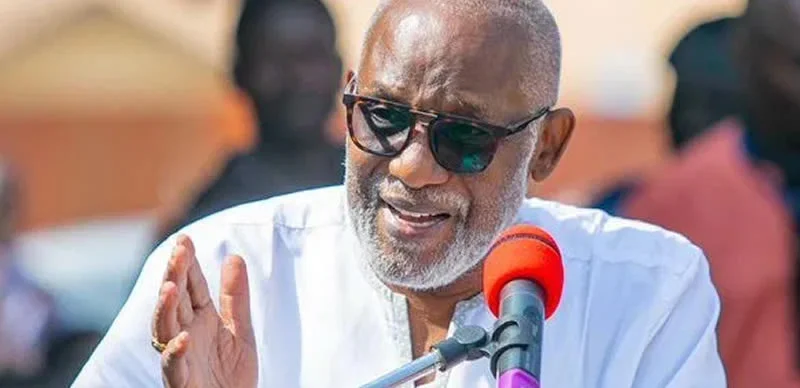

Akeredolu said power rotation had been an unwritten agreement in the country since the return to civil rule in 1999, saying that arrangement must be changed now.
He said this on Wednesday at the one-year remembrance of Prof. Bankole Oke of the Faculty of Veterinary Medicine, University of Ibadan, while delivering a lecture entitled, ‘Nigeria: The politics of religion in a transitional society.’
He advised Nigerians to make sure that power did not return to the North under what he described as the guise of a party picking a southerner as its vice presidential candidate.
He said, “A party that picked somebody from the North as its presidential candidate is not doing so in the country’s interest. (Peter) Obi has the right to contest because he is from the South.

“We are ready to give it whatever it takes to make sure power returns to the South in 2023.”
“There appears to be an understanding that power must rotate between the North and the South. This understanding witnessed the contest of two candidates from the South-West for the Presidency. It was part of the unwritten agreement that the power equation must be balanced to allay the fear of domination harboured by the people of the South.
“There is a conscious attempt not to disrupt the extant agreement. There has been a seamless transition from one civilian regime to another since 1999, the longest in the political history of the country.
“The current political permutations raise strong suspicions on an undeclared motive to thwart the arrangement that has been working for the country. The rotation of the office of the President is between the North and the South since the inception of the Fourth Republic.”
Akeredolu said politicians in the First Republic achieved so much because they were people with huge capacity, and religion was not an issue in determining those elected and appointed into offices but the capacity to deliver
He said Nigerian leaders before the independence laboured hard to wrest power from the colonial masters while urging Nigerians to be optimistic that the country would be great again. However, he admitted that it was taking too long.
He stressed that Nigeria must be restructured, and state police must be created to address the raging insecurity in the country.
“Religion is currently being deployed most shamelessly by the elites to gain unmerited advantage. The earlier we stop this dangerous and divisive campaign, the better it will be for everyone. Any war fought to establish the supremacy of a faith over others can only end in tears. The manipulative skills of politicians currently put to use will aggravate an already bad situation.
“The solution to the challenges faced in the country will not be found in the faiths of individuals. A person’s religious persuasion is based on personal conviction. It is essentially private. The public space must remain secular.
“Consequently, the current agitations for a faith-based political representation are anchored on a certain misapprehension of the requirements for leadership in a multi-ethnic state such as Nigeria.
“It borders on plain mischief to set the people on themselves to attain political power. Any so-called religious leader, who ignores knowledge and competence as necessary criteria to measure leadership capacity, is an apostate,” he added.
A Professor of Veterinary Public Health and Preventive Medicine, Simeon Cadmus, and others described Oke as a great teacher, mentor, and outstanding academic.
Politics
2027: Your votes do not count, the Courts Will Endorse It Unless We Do Something-Dele Farotimi warns
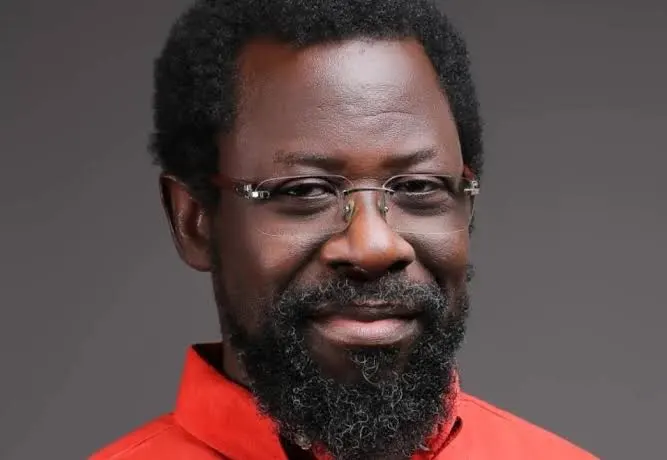
Human rights lawyer and political activist Dele Farotimi has called for a revolution to save Nigeria, urging citizens to unite behind a common national vision and push for fundamental changes to the country’s political and governance systems.
Farotimi made the remarks while expressing concerns about Nigeria’s democracy, the credibility of its electoral process and the role of the judiciary in resolving electoral disputes.
According to the activist, Nigerians risk losing confidence in democracy if their votes are not adequately protected and electoral outcomes are not respected. He warned that public passivity could create conditions for authoritarian rule.
“Your votes do not count and the judiciary will endorse it unless we decide to do something about it, because we are sleeping whilst a dictatorship is being installed in our country, demon-cratically,” he said.
Farotimi argued that Nigeria needs to be restructured and reimagined to address its persistent political challenges. He maintained that meaningful change would require citizens to come together around a clearly defined vision for the country’s future rather than placing their hopes solely in individual politicians.
He said a critical mass of Nigerians who are dissatisfied with the existing system must be mobilised to support an alternative approach to governance.
“The one thing I have never been shy about is to tell you what it will take to save Nigeria. It will take a revolution to save Nigeria,” Farotimi declared.
The activist suggested that such a revolution could be achieved through the ballot box, although he expressed doubts about whether the current political process, on its own, could deliver the transformation Nigeria needs.
He stressed that a credible national vision, backed by purposeful leadership, could encourage greater citizen participation and strengthen public resolve to defend electoral choices.
Farotimi’s remarks highlight broader concerns about electoral integrity, judicial accountability and the need for structural reforms in Nigeria. His call for a democratic revolution centres on collective action, political restructuring and the emergence of a shared vision capable of mobilising citizens towards meaningful change.
As the country approaches another general election cycle, debates over electoral credibility, institutional trust and the future of Nigeria’s democracy are likely to remain central to the national conversation.

By PETRUS OBI.
Veteran journalist and ARISE News presenter, Dr Reuben Abati, appeared uncertain about the name of Ebonyi State Governor, Francis Nwifuru, during a live television interview with the Peoples Democratic Party (PDP) governorship candidate in the state, Chief Ifeanyi Odii, popularly known as Anyichuks.
While questioning Odii on the political situation in Ebonyi ahead of the 2027 general elections, Abati, in a video which has gone viral on social media remarked:
“…Are you aware that Governor Nwifuru, I think that’s the name of Ebonyi Governor…”
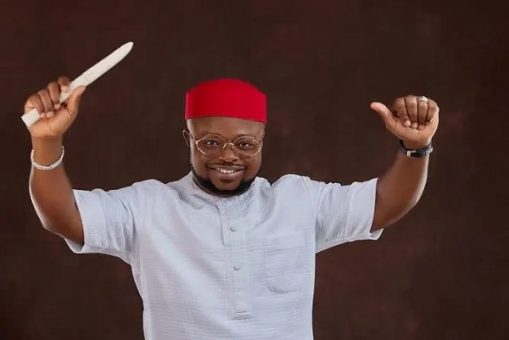
Popular Ebonyi Guber Candidate ANYICHUKS
The remark, which appeared to be an attempt to confirm the governor’s name, has raised questions about Nwifuru’s visibility beyond Ebonyi State, particularly amid growing criticism of his administration over allegations of poor performance.
During the interview, Odii accused Governor Nwifuru of allegedly intimidating opposition parties in the state, claiming that incidents involving attacks on opposition supporters had been reported to security agencies.
He also criticised an alleged threat by the governor to sack local government chairmen who allow opposition parties to campaign in their council areas, describing such a move as unconstitutional and an affront to democratic principles.
Odii urged his supporters to remain peaceful and law-abiding, stressing that the governor has a constitutional responsibility to protect all residents, irrespective of their political affiliations.
Speaking on the PDP’s support for President Bola Tinubu’s re-election bid, the governorship candidate explained that the arrangement formed part of a broader political understanding involving factions of the PDP and the ruling All Progressives Congress (APC).
He dismissed suggestions that supporting Tinubu could undermine his governorship ambition, insisting that the presidential and governorship elections were separate political contests.
On his economic agenda, Odii pledged to attract ₦2 trillion in investments to Ebonyi within his first six months in office if elected governor.
He identified solid minerals, manufacturing, real estate, healthcare and hospitality as key sectors through which his administration would stimulate economic growth, attract investment and generate employment opportunities.
The PDP candidate maintained that his business experience, grassroots connections and record of community interventions had adequately prepared him to attract investors, create jobs and improve the living standards of Ebonyi residents.

President Bola Tinubu has said he will not attend every campaign rally ahead of the 2027 general election, explaining that he must balance his re-election campaign with the demands of governing Nigeria.
Tinubu made this known on Wednesday in Abuja during the inauguration of the All Progressives Congress (APC) Presidential Campaign Council, where he urged members to take the party’s message to Nigerians across the states, local government areas and wards.
The President said he agreed with concerns that the demands of campaigning should not distract him from his responsibilities as head of state, stressing that the country needed his attention at a critical time.
“You’ve warned me not to allow the rigour of the campaign to distract me from governance, I hear you. I am in full agreement with your decision. Nigeria needs more attention now,” he said.
Tinubu explained that his decision to limit his attendance at campaign events was also influenced by the need to meet the country’s financial obligations.
“So, you will excuse me from going everywhere with you, we have bills to pay. The American creditors cannot wait,” the President stated.
He also highlighted the importance of attracting investors who would make long-term commitments to Nigeria, noting that sustained investment was essential to building a better future for the country’s children.
“We want those investors to come in, be here to stay, to invest for the future of our children,” he said.
Despite his plan to reduce his presence at campaign rallies, Tinubu assured Nigerians that he would still engage directly with voters during the campaign period.
“However, I will still make time to speak directly with Nigerians, even as you lead the campaign in the states and local government areas,” he added.
The President described the inauguration of the campaign council as more than a routine political event, saying it represented a renewed commitment to Nigerians and the responsibility entrusted to the APC as the ruling party.
“We have not gathered merely to inaugurate a council. We have gathered to renew a covenant. A covenant with Nigerian people and the historic responsibility they have entrusted to us as Nigeria’s governing party,” Tinubu said.
He charged members of the council to communicate the administration’s vision, achievements and policy agenda to Nigerians nationwide, expressing confidence in their ability to mobilise support for the party at every level.
“This council will carry our vision, our records and our agenda to every Nigerian, and it will carry them to victory every ward of this country,” he said.
Tinubu also praised APC members for successfully completing the party’s congresses, recalling predictions that the exercise could trigger an internal crisis.
According to the President, the party overcame the anticipated challenges and completed the process with members participating from the ward level to the national leadership.
“They said there will be implosion. We passed through it. We did not fail. You didn’t let us down. We got here together,” he stated.
Tinubu’s remarks signal an approach to the 2027 election campaign in which he intends to maintain focus on governance and economic management while relying on the APC Presidential Campaign Council to coordinate nationwide mobilisation and promote the party’s message ahead of the polls.
Politics
Tinubu Inaugurates APC Presidential Campaign Council, Vows to Renew Covenant With Nigerians in 2027
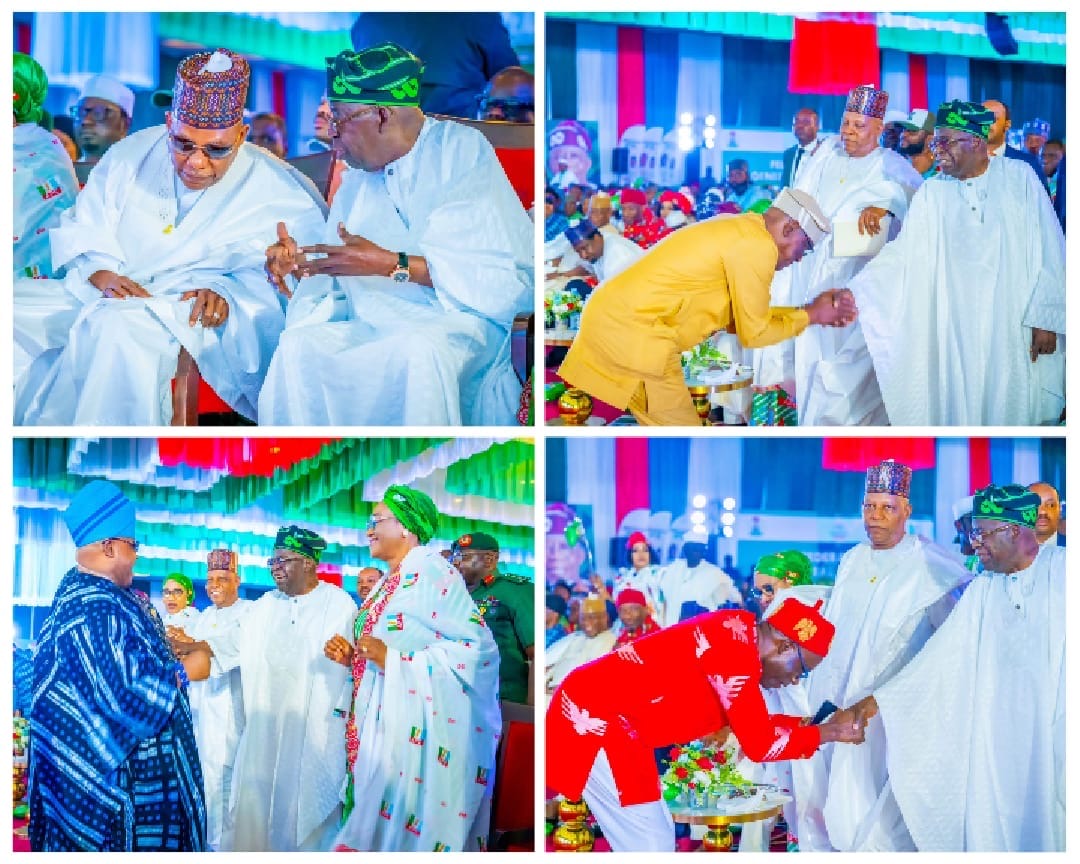
ABUJA— President Bola Ahmed Tinubu has inaugurated the All Progressives Congress (APC) Presidential Campaign Council (PCC) ahead of the 2027 general election, declaring that the party is united and prepared to seek a renewed mandate from Nigerians.
Tinubu inaugurated the council on Wednesday at the State House Conference Centre in Abuja, charging members and party leaders to demonstrate unity, discipline and commitment while sustaining his administration’s governance priorities.
Addressing the gathering, the President expressed gratitude to party members for their support during the previous election but stressed that their political assignment would only be complete when they secured victory in the next polls.
“I thank all of you for the last election, but no one gets credit for an incomplete assignment until you deliver the next election, until you deliver your electoral wards, until you deliver the votes,” he said.
Tinubu acknowledged advice from Imo State Governor and Chairman of the Progressive Governors Forum, Hope Uzodimma, who urged him to remain focused on governance despite the demands of the election campaign.
The President said he would continue to engage directly with Nigerians while the campaign council coordinated mobilisation across states and local government areas.
He also highlighted the need to meet the country’s financial obligations and attract foreign investment, saying international creditors and investors remained important to Nigeria’s economic future.
“We have bills to pay. The American creditors cannot wait. We want those investors to come in and invest for the future of our children,” Tinubu said.
Shettima Defends Tinubu, Criticises Opposition Figures
Vice President Kashim Shettima praised Tinubu’s commitment to democracy, citing his support for former Vice President Atiku Abubakar’s presidential ambition in 2007 under the platform of the defunct Action Congress of Nigeria.
Shettima also defended the dignity of the presidency in response to criticism of Tinubu, insisting that the office must be respected regardless of political differences.
“You can call him Bola, if you like, call him Adekunle, but he is the President of the Federal Republic of Nigeria,” he said.
The Vice President also criticised Peter Obi, the presidential candidate of the National Democratic Movement, accusing him of using misleading statistics and making comparisons between Nigeria and other countries without sufficient context.
APC Promises Nationwide Mobilisation
APC National Chairman, Professor Nentawe Yilwatda, said the inauguration reflected the party’s determination to build a better Nigeria and secure Tinubu’s re-election.
Yilwatda urged campaign council members to communicate the administration’s policies and achievements clearly, while demonstrating how its reforms could translate into tangible improvements in the lives of Nigerians.
He pledged that the party would intensify grassroots mobilisation across electoral wards, local government areas and states to ensure a strong voter turnout in 2027.
The APC chairman also called for a peaceful election focused on ideas, records and policies, rather than hostility.
Uzodimma Defends Tinubu’s Economic Reforms
Uzodimma, who serves as secretary of the campaign council, expressed confidence that the administration’s policies would strengthen the campaign’s message.
He praised Tinubu for removing the petrol subsidy and reforming the foreign exchange system, arguing that previous administrations had avoided tackling the challenges because of their potential political consequences.
According to Uzodimma, the reforms had imposed hardships on Nigerians but were necessary to address longstanding economic weaknesses.
He also cited Nigeria’s economic growth, which he put at 4.43 per cent, compared with 4.23 per cent a year earlier, and praised the administration’s tax reforms.
Uzodimma maintained that the campaign would focus on issues and the government’s record rather than political rhetoric.
Adeleke, Soludo and Wike Back Tinubu’s Re-election
Osun State Governor Ademola Adeleke, Anambra State Governor Charles Soludo and Minister of the Federal Capital Territory Nyesom Wike were among those who delivered goodwill messages in support of Tinubu’s second-term bid.
Adeleke, who belongs to the Accord Party, drew cheers from attendees with his trademark dance moves during the event.
Wike, a prominent figure in the Peoples Democratic Party (PDP), said he supported Tinubu because of what he described as the President’s bold leadership and willingness to address problems previous administrations had left unresolved.
He challenged governors to work towards delivering their states for Tinubu in the 2027 election.
The event also featured messages from Senate President Godswill Akpabio, Speaker of the House of Representatives Tajudeen Abbas, Special Adviser to the President on Political Affairs Ibrahim Kabiru Masari and elder statesman Tanko Yakassai, who called for support for Tinubu’s second term.
Tinubu, meanwhile, urged the campaign council to conduct its activities responsibly, engage Nigerians constructively and promote the administration’s Renewed Hope Agenda while ensuring that governance remains a priority.
The inauguration formally sets the APC’s campaign machinery in motion as the party prepares to seek another presidential mandate in 2027.
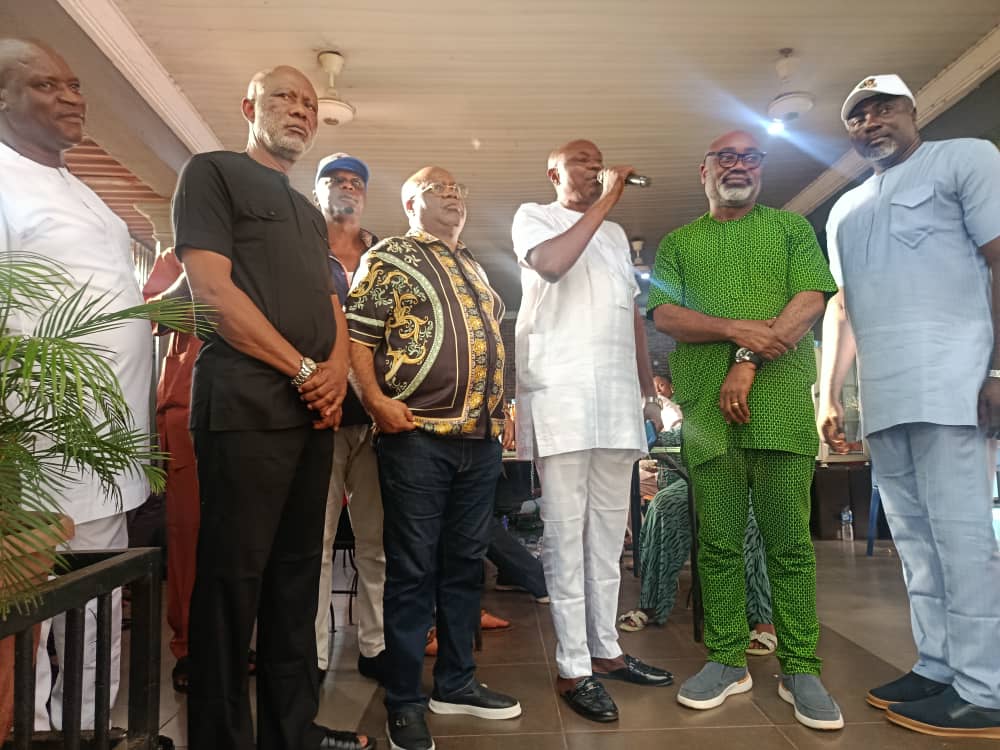
…Says Party’s Achievements at All Levels Make Opposition Unnecessary
A political support group, Kwashy and Friends for Peter Mbah, has pledged to mobilise massive grassroots support for President Bola Ahmed Tinubu, Governor Peter Mbah and other candidates of the All Progressives Congress (APC) ahead of the 2027 general elections.
The group said the achievements of the APC-led administrations at the federal, state and local government levels provided compelling reasons for Nigerians to support the party, insisting that good governance should be encouraged rather than opposed.
Speaking during the group’s bi-monthly meeting held on Sunday at Rockbase Hotels, Enugu, its Coordinator, Hon. Cletus Chigozie Akalusi, popularly known as Kwashy, said the platform, established in 2023, had consistently mobilised support for candidates seeking various political offices.
Akalusi explained that the meeting was convened to strengthen the group’s grassroots structures and develop strategies for communicating the achievements of the APC to voters across the state.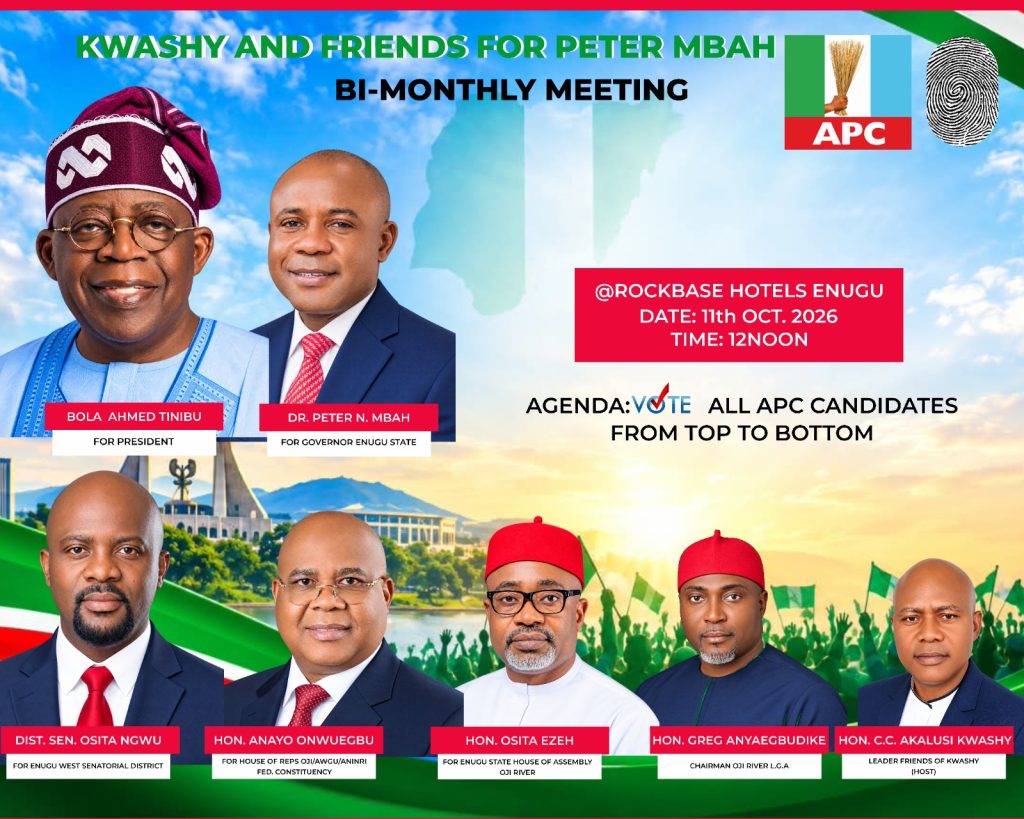
He urged members to sustain the top-to-bottom voting approach adopted during previous elections to guarantee victory for all APC candidates in 2027.
“Our bi-monthly meetings are avenues for us to strategise and re-strategise on how to ensure that President Bola Ahmed Tinubu, Governor Peter Ndubuisi Mbah and all candidates of our party are massively voted for.
“Our support group is not filled with urban guerrillas. We are all grassroots soldiers, and we undoubtedly have the capacity to ensure a landslide victory for our party.
“Considering the achievements our party is recording at the federal, state and local government levels, I have never lost sleep over our victory in the 2027 general elections,” he declared.
Also speaking, the member representing Oji River/Awgu/Aninri Federal Constituency, Hon. Anayo Onwuegbu, who was accompanied by the member representing Oji River Constituency in the Enugu State House of Assembly, Hon. Osita Ezeh, expressed satisfaction with what he described as the growing acceptance of the APC across the state.
Onwuegbu charged members to intensify mobilisation at polling-unit and ward levels, stressing that the party’s developmental strides should translate into overwhelming electoral support.
“What enthrals me most is that you have agreed to vote for APC candidates from top to bottom. Just like our governor always says, we should take the message from polling unit to polling unit and ensure that no vote is lost.
“There is no ward you will go to in Enugu today without seeing a project worth about N2 billion ongoing. It has never happened in the history of this state. Our core mandate is to work towards victory because it is not over until it is over,” he said.
In his remarks, the Chairman of Oji River Local Government Area, Hon. Greg Anyaegbudike, commended the group for its contributions to the party’s success in the last chairmanship and councillorship elections.
He maintained that the performance of President Tinubu, Governor Mbah and other APC leaders had provided sufficient justification for continued public support.
“The manner in which you supported us in the last elections is mind-blowing. If you look around, you will see reasons to support our party.
“There is no ward in Enugu State today without a Smart School, Type-2 Primary Healthcare Centre and other ongoing infrastructure.
“It is on this note that we should not only preach the gospel but also ensure that we protect the interest of our party wherever we find ourselves,” he stated.
The meeting reaffirmed the group’s commitment to expanding its grassroots mobilisation network and working towards securing victory for APC candidates at all levels in the 2027 general elections.
Make the headline more news-focused
Attribute all political performance claims
Tighten the report for publication

-

 Politics16 hours ago
UNPOPULAR? Abati Seeks Confirmation of Ebonyi Gov’s Name During Interview With Anyichuks
-
 Politics5 days ago
2027: Over 30,000 Enugu Teachers Endorse Mbah, Tinubu, Cite Welfare Improvements, Increased Education Funding
-
 Features4 days ago
New Cement Factory: Is Ebonyi Governor Misleading the People Over Proposed Nkalagu Project?
-
 Politics4 days ago
2027: Enugu Alleges Opposition Plot to Import Armed Thugs, Bandits
-
 Opinion4 days ago
EBONYI GUBER 2027: Are Clergy, Youths, Political Stakeholders Becoming Accomplices in Bad Governance?
-
 Politics2 days ago
Ebonyi Students Endorse ANYICHUKS, Declare ‘We Won’t Support a Failure’
-
 News3 days ago
Mbah Calls for Impartial Probe into Violence at Political Gathering in Enugu
-
 News22 hours ago
2027: APC, APGA Rift Deepens Over Support for Tinubu’s Re-election