





News
Osun Poll Proved INEC Credibility as Tinubu’s Reforms Take Hold – Ex-Abia Speaker Orji



Former Speaker of the Abia State House of Assembly and APC House of Representatives candidate for Ikwuano/Umuahia Federal Constituency, Rt. Hon. Chinedum Enyinnaya Orji, has said the recent Osun State governorship election proved that the Independent National Electoral Commission (INEC) can conduct free and fair polls, while President Bola Ahmed Tinubu’s transparency reforms are taking hold and redefining Nigerian democracy.
In an article titled “Transparency, Trust, and Transformation: Why INEC’s Credibility and Tinubu’s Reforms Are Redefining Nigerian Democracy,” Orji argued that transparency is the oxygen of true democracy, enabling free elections, economic growth, and citizens’ ability to hold leaders to account.
“Transparency is the oxygen of true democracy. Without it, elections become rituals, policies become decrees, and public trust erodes. With it, citizens can see the process, judge the outcomes, and believe that their votes and their taxes actually matter,” Orji wrote.

The former Speaker said President Tinubu’s commitment to openness is a governing philosophy anchored on the belief that legitimacy comes from process, not pronouncement.
He cited the Osun election as a defining moment for INEC’s credibility. According to Orji, despite widespread skepticism that the ruling APC had predetermined the winner, INEC conducted a free and fair election.
“To their dumbfounding surprise, INEC conducted a free and fair election. Voters were accredited, results were transmitted, and party agents were allowed to witness the process at every level. The atmosphere reflected competition, not coercion,” he wrote.
Orji noted that Accord Party candidate Ademola Adeleke emerged as winner, adding that the outcome “cut across expectations and party lines” and forced even skeptical observers to reassess.
He said President Tinubu’s posture before, during, and after the election reinforced INEC’s credibility, adding that there was no directive from the Villa to skew the process.
“That is adherence to the Rule of Law in practice. When the head of government allows institutions to function independently, he is telling Nigerians that no one, including his own party, is above the process,” Orji stated.
The APC chieftain also linked INEC’s credibility to the administration’s economic transparency agenda, describing both as “two sides of the same coin.”
“One protects political rights, the other protects economic rights. Both depend on institutions being allowed to work,” he wrote.
On the removal of petroleum subsidy, Orji described the policy as a “difficult but necessary path” that has delivered immediate and measurable results.
“Federation allocations to states have quadrupled in many cases. Money that previously disappeared into subsidy payments is now flowing into state coffers,” he wrote.
He said governors across party lines now have more fiscal space to pay salaries, rehabilitate schools, invest in healthcare, and fix roads, adding that it is “only fair and only right” that they acknowledge President Tinubu’s role in the reform.
Orji said transparency in the reform matters because Nigerians can now see monthly FAAC figures published, track what comes into the federation account, and demand accountability from their state governments.
“When citizens know how much their state received, they can also ask how it is being spent. That is democracy extending beyond election day into governance itself,” he wrote.
He said the judiciary has also benefited from the executive’s respect for court judgments and due process, adding that public trust is being slowly rebuilt because people can point to concrete examples.
“Osun is one. Improved allocations is another. There is a pattern forming,” Orji stated.
He concluded that President Tinubu has demonstrated a consistent willingness to uphold the principles of democratisation—free elections, open policies, and governance that answers to the people.
“In the final analysis, transparency is not a slogan. It is an enabler. It enables free elections, it enables economic growth, and it enables citizens to hold leaders to account,” he wrote.
“That is the standard Nigerians should now demand, and it is the standard this administration has set.”


Ebonyi State is still awaiting the arrival of three aircraft Governor Nwifuru reportedly paid for about two years ago.
The governor had promised the arrival of the aircraft years back but as at the time of this report not even one aircraft has landed to start the proposed Ebonyi Air.
This is even as Enugu Air which is taking over the Nigeria Airspace has secured regulatory approval to commence direct flights between Lagos and London Gatwick in December 2026, with bookings for the international route now open.
The state-owned airline announced the development in a statement on Wednesday, describing the approval as a major milestone in its international expansion and efforts to strengthen air connectivity between Nigeria and the United Kingdom.
The Lagos-London Gatwick service will be operated in partnership with Omni-Blu Aviation (OBA), which has been appointed as the designated operating partner for the route.
“Enugu Air has received approval for its Lagos-London Gatwick route, with Omni-Blu Aviation (OBA) appointed as the designated operator under a strategic partnership.
“Bookings are now open, and flights will commence in December 2026,” the statement said.
For an airport that has refused to function the governor may have decided to change the narrative but for some reasons the project may have gone the way of the Vanco flyover which has become a burden to the government.
While the former governor Dave Umahi completed flyover projects in less than one year, Governor Nwifuru has failed to deliver just one in more than three years.
As Enugu Air goes to the United Kingdom, Ebonyi people are whispering the question in hushed tones for fear of the unknown; “when will the planes arrive?
Meanwhile, Enugu Air described the latest development as a significant step towards expanding its international operations, improving passenger connectivity and creating new opportunities for trade and investment between Nigeria and the United Kingdom.
It also credited Governor Peter Mbah’s strategic aviation agenda, saying his administration’s vision was positioning Enugu as an emerging gateway for international connectivity, investment, tourism and economic growth.
The announcement comes barely six weeks after Enugu Air operated its maiden international flight to Douala, Cameroon, on September 23, 2026.
Launched in July 2025 with an initial fleet of three Embraer aircraft comprising the E170 and E190 series, the airline was established as part of the Mbah administration’s integrated plan to develop a modern, multimodal transport system.
The initiative is also aimed at positioning Enugu as a major aviation hub in West and Central Africa.
Since its launch, Enugu Air has expanded its fleet and route network, with the latest regulatory approval representing another step in its international expansion drive.
No wonder the Ebonyi governor took the whole time given to him at the recent APC rally in Enugu to praise the developmental magic Governor Peter Mbah is doing. The governor could not name one project he was able to deliver for his people.
News
Ogarabe Returns To Enugu As Commissioner Of Police As PSC Deploys New Commissioners To Four States
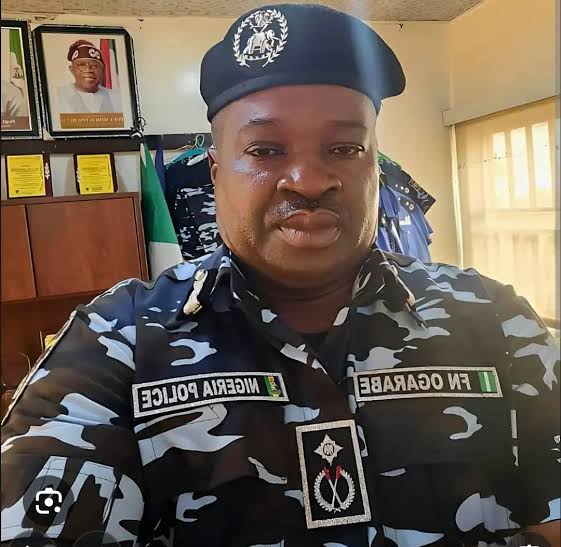
The Police Service Commission (PSC) has approved the deployment of four new Commissioners of Police to Enugu, Plateau, Nasarawa and Ondo states.
Among the newly deployed officers is CP Fidelis Ogarabe, who has been appointed Commissioner of Police for Enugu State.
Ogarabe was formerly the Commissioner of Police in charge of the INTERPOL Annex, Lagos.
Other officers affected by the deployment include CP Sunday J. A. Okoebor, formerly Commissioner of Police, Police Accounts and Budget, Force Headquarters, who has been posted to Plateau State.
CP Sheikh Mohammed Danko, formerly Commissioner of Police, Force Intelligence Annex, Lagos, has been deployed to Nasarawa State, while CP Johnson Ayodeji Babalola, formerly of the Special Inquiry Unit, Force Headquarters, Abuja, has been posted to Ondo State.
The appointments followed a series of interviews conducted by the commission to assess the officers’ fitness, competence and suitability for their new responsibilities.
The deployment was approved on Thursday at the Solomon Arase Conference Hall, Police Service Commission Headquarters, Abuja.
In a statement signed by the commission’s Head of Protocol and Public Relations, Torty Kalu, the PSC said the appointments were made in accordance with its constitutional mandate.
The Chairman of the commission, DIG Hashimu Salihu Argungu, said the appointments were consistent with Section 215(1)(b) of the 1999 Constitution, which provides for the commission’s authority in the appointment of Commissioners of Police for the states and the Federal Capital Territory.
Argungu, who was represented by a board member, Justice Paul Adamu Galumje (JSC, rtd.), said the officers had been found worthy in learning and character following the assessment.
He charged the newly deployed commissioners to discharge their responsibilities with impartiality, professionalism and a strong commitment to the expectations of their respective offices.
News
Failed Government: Nwifuru Praises Mbah’s Achievements in Enugu, Fails to Highlight Own Projects at APC Rally

The Anyichuks Campaign Office has criticised Ebonyi State Governor, Francis Nwifuru, for failing to showcase any significant achievements of his administration during the Southeast presidential campaign flag-off of the All Progressives Congress (APC) Women’s Mobilisation held at Okpara Square, Enugu, describing his remarks as another indication of the absence of tangible accomplishments to justify his four years in office.
The campaign office expressed disappointment that while the governors of Imo and Enugu states used the opportunity to reel out projects and development initiatives executed with their respective states’ resources and federal allocations, Governor Nwifuru chose to devote his speech to praising his Enugu counterpart, Governor Peter Mbah.
According to the campaign office, the contrast was particularly striking because the event provided an opportunity for the three governors to demonstrate what their respective administrations had achieved and how they had deployed public resources to improve the lives of their people.
“But when the microphone got to Governor Nwifuru, what did Ebonyi people hear? Instead of telling the audience what he has done with the enormous resources accruing to Ebonyi State, he chose to commend Governor Peter Mbah for his achievements in Enugu State.
“Why couldn’t he tell the gathering what he has done with Ebonyi people’s money? Why was he more interested in celebrating another governor’s achievements than presenting his own scorecard to the people he was elected to serve?” the campaign office queried.
It recalled that Nwifuru, in his remarks, praised Governor Mbah for initiatives aimed at promoting unity, developing skills and introducing innovations to women, but offered no comparable account of what his administration had done to advance the welfare and economic fortunes of Ebonyi residents.
The campaign office said the governor’s decision to focus on another state’s achievements, rather than present his own administration’s record, was a missed opportunity that had further reinforced public concerns about his performance.
“It is particularly unfortunate that a governor who has spent almost four years in office could stand before an audience of political leaders and party faithful without identifying concrete achievements of his administration that ordinary Ebonyi people can relate to.
“Ebonyi people deserve more than political slogans, praise-singing and repeated appeals for votes. They deserve leadership that can point to measurable improvements in their living conditions, infrastructure, education, healthcare, employment and economic opportunities.”
The campaign office further argued that Nwifuru’s remarks were symptomatic of what it described as an administration that had failed to add sufficient value to the lives of ordinary men and women in Ebonyi State.
It said the governor’s appeal to women to support the APC and his declaration that the party had an open manifesto would mean little to citizens who, according to the campaign office, were more interested in the practical benefits of governance than political promises.
The office said the growing clamour for Anyichuks to emerge as Ebonyi State’s next governor was rooted in the people’s desire for a departure from what it described as years of disappointing leadership and unfulfilled expectations.
It maintained that Ebonyi could not afford another administration that would merely occupy the Government House without delivering meaningful improvements in the lives of its citizens.
“The growing support for Anyichuks is a reflection of the people’s hunger for a government that understands their struggles and is prepared to translate public resources into tangible benefits.
“Ebonyi people cannot continue to endure an administration that adds little or no value to the everyday lives of ordinary citizens. They want a government that will create opportunities, empower families, support businesses and ensure that the state’s resources work for the people.
“Leadership is not about praising another governor for what he has accomplished. It is about being able to stand before your own people and account for what you have done with the mandate and resources entrusted to you.”
The campaign office therefore urged Ebonyi residents to look beyond party slogans and political endorsements and begin demanding accountability, measurable performance and leadership that places the welfare of the people above political interests.
It said Anyichuks represented the aspiration for a new direction in Ebonyi State, insisting that the state deserved leadership capable of converting its resources and enormous human potential into prosperity for its people.

By Ugoo Aniagoh
From the restoration of electricity at the local government secretariat after 13 years to renewed road, water, sanitation and security initiatives, the Okakpu-led administration is setting its governance agenda in motion.
The administration of Hon. (Dr.) Ikechukwu Okakpu, popularly known as OKD Jnr, and his Deputy, Hon. Ifunanya Nwanadile, has recorded a number of developmental milestones as the duo mark their first 30 days in office as Mayor and Deputy Mayor of Njikoka Local Government Area of Anambra State.
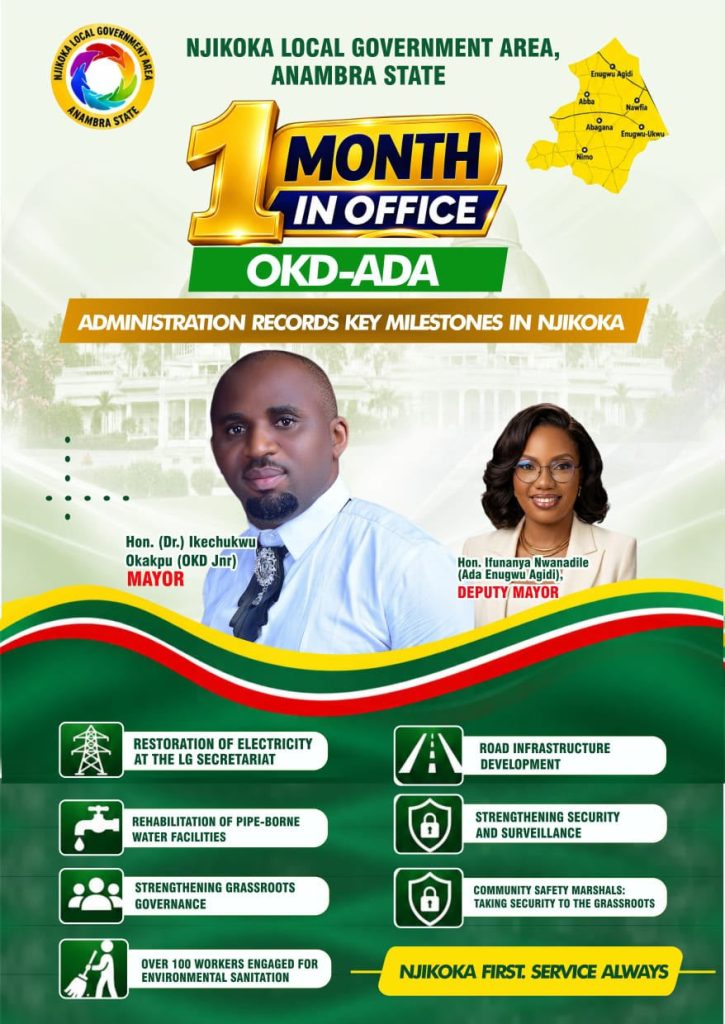
Since assuming office on October 3, 2026, the administration has initiated interventions across critical sectors, including infrastructure, environmental sanitation, water supply, grassroots governance and community security.
One of the notable achievements recorded within the period is the restoration of electricity at the Njikoka Local Government Secretariat after 13 years without public power supply. The development marks a significant improvement in the working environment at the council headquarters and is expected to enhance administrative efficiency.
In the area of water infrastructure, rehabilitation of pipe-borne water facilities across the local government has commenced, reflecting the administration’s commitment to improving access to basic amenities.
The administration has also strengthened its governance structure through the appointment and inauguration of elected councillors, Supervisory Councillors and Special Advisers to support grassroots representation, policy implementation and effective service delivery.

Environmental sanitation has received considerable attention, with over 100 ad-hoc workers engaged to support waste management, routine cleaning and general environmental sanitation across the local government.
On infrastructure development, the administration has commenced a Public-Community-Private Partnership (PCPP) road project along the Awovu–Osili axis in Enugwu Ukwu. An assessment of Ezi Norbert Road has also been conducted as part of efforts to identify infrastructure needs and explore possible interventions.
Security has equally featured prominently in the administration’s first-month activities. Adopting a zero-tolerance stance towards insecurity, the council has mounted CCTV cameras at strategic locations to strengthen surveillance and improve security monitoring.
In a grassroots-driven security initiative, local traders and street operators have also been engaged as Community Safety Marshals. Equipped with walkie-talkies, the marshals are expected to serve as additional sources of community security intelligence, promptly reporting suspicious movements and activities to the appropriate authorities.
These initiatives represent some of the administration’s early efforts to address longstanding challenges while laying the groundwork for sustained development across Njikoka’s six communities.
Speaking through its first-month performance record, the administration maintains that its focus remains on practical governance, improved public services, environmental responsibility, infrastructure development and a safer community.
Although the administration is still in its early days, its first 30 days have provided an indication of its immediate priorities and development direction.
For residents of Njikoka, the expectation will now be to see these initial interventions translated into sustainable projects, measurable improvements and lasting impact across the local government.
Thirty days down, more work ahead. Njikoka First.

The Federal Government has released guidelines explaining how Nigerians selected for its N50,000 relief grant can confirm their eligibility, accept the offer, access the funds and withdraw the money.
The government also warned beneficiaries against fraudsters seeking to exploit the intervention by demanding money or sensitive personal information.
The National Emergency Relief and Stabilisation Intervention (NERSI) is designed to support vulnerable households struggling with rising living costs.
The programme, managed by the Federal Ministry of Humanitarian Affairs and Poverty Reduction, provides a one-off grant of N50,000 to selected beneficiaries through mobile wallets operated by five approved payment providers.
According to the frequently asked questions published on the programme’s website and sighted by PUNCH Online on Thursday, the grant is not a loan, requires no repayment and can be accessed without a smartphone or internet connection.
Here are the key things Nigerians need to know about the programme.
1. Who qualifies for the N50,000 grant?
The government said beneficiaries were selected from the National Social Register and verified national identity records.
It explained that individuals cannot apply directly or pay anyone to secure a place on the beneficiary list.
Selection is based on need, with beneficiaries drawn from the six geopolitical zones, irrespective of religion, ethnicity or political affiliation.
The government also clarified that payments would be made in phases, meaning not everyone would receive a notification at the same time.
2. How can you check if you are eligible?
Selected beneficiaries will receive SMS notifications from one of the five approved payment providers: ALAT, MoMo PSB, NairaGram, OPay and Moniepoint.
The messages will confirm their selection and provide a USSD code to dial to accept the grant.
Beneficiaries can also dial their assigned provider’s USSD code and select the eligibility-check option to confirm their status.
Those who are not selected will receive a notification informing them that they are currently not eligible for the relief support.
3. How do beneficiaries claim the N50,000?
Recipients are required to dial the USSD code contained in the notification from their payment provider and follow the instructions.
The process activates a mobile wallet, after which the N50,000 is credited and a confirmation SMS is sent.
The government stressed that receiving a selection message does not automatically mean the money has been paid. Beneficiaries must first accept the offer.
Those who mistakenly reject the offer can dial the code again and select the acceptance option.
4. Can people without smartphones receive the grant?
Yes. The government said beneficiaries do not need smartphones or internet access to receive the money.
A basic mobile phone is sufficient because the USSD codes work without an internet connection.
However, customers of OPay, Moniepoint and MoMo PSB can also use their providers’ official mobile applications to access their wallets and carry out transactions.
5. How can beneficiaries withdraw the money?
Beneficiaries can withdraw their funds through Point of Sale agents by transferring money from their mobile wallets and collecting cash.
Each approved payment provider also offers alternative withdrawal and transfer options.
The available USSD codes include:
- ALAT: Dial 94523Account NumberAmount# to transfer funds.
- MoMo PSB: Dial 6710# or use the MoMo NG application.
- NairaGram: Dial 72600#.
- OPay: Dial 95520# or use the OPay application.
- Moniepoint: Dial 557327# or use the Moniepoint application.
Beneficiaries can withdraw the entire N50,000 or take only part of it, leaving the balance in their wallets.
They can also transfer the money to personal bank accounts or other beneficiaries through the available channels.
6. Are there charges for receiving the grant?
The government said accepting the grant, receiving the money and responding to programme SMS notifications are free.
However, POS operators may charge their usual withdrawal fees when beneficiaries collect cash.
Recipients are therefore advised to confirm the applicable charges before completing transactions.
7. What if you have not received an SMS?
The government explained that payments were being made in phases, with payment providers contacting beneficiaries in batches.
Therefore, not receiving an SMS does not necessarily mean an individual has been permanently excluded.
Interested persons can check their eligibility through their assigned provider’s USSD code.
The government, however, warned that nobody could add an individual to the beneficiary list or accelerate payment in exchange for money.
8. How can beneficiaries avoid fraud?
The government warned Nigerians against individuals claiming they could help them secure or release the N50,000 grant for a fee.
It stressed that programme officials and payment providers would never request beneficiaries’ PINs, one-time passwords or Bank Verification Numbers.
Genuine messages will come only from the official sender names of the five approved payment providers and will not contain links.
Beneficiaries were also advised against clicking unfamiliar links, downloading unknown applications or forwarding WhatsApp messages claiming that sharing them would guarantee access to the grant.
The government further warned recipients not to refund money to anyone claiming that the payment was made in error. Such claims should first be verified through the provider’s official customer service channels.
9. What happens if you lose your phone or SIM card?
Beneficiaries who lose their phones or SIM cards should immediately contact their payment providers to secure their wallets.
They should also obtain replacement SIM cards bearing the same phone numbers from their network operators.
The government assured beneficiaries that their money would remain in their mobile wallets even if they lost their phones or SIM cards.
10. What should beneficiaries do if their USSD codes stop working?
The programme advised beneficiaries to check their network signals and retry if their USSD codes fail.
If the problem persists, they should contact their payment providers through their official customer service channels.
The following helplines were provided:
- ALAT by Wema: 0803 900 3700
- MoMo PSB: 671 or 0803 106 7100
- NairaGram: 0201 330 0880 or 0201 330 0881
- OPay: 0700 888 8328 or 0201 888 8328
- NERSI programme: 0700-022-2222
Enquiries concerning mobile wallets and payments should be directed to the respective providers, while questions about the intervention can be addressed to the programme’s helpline.
11. Which organisations are authorised to disburse the grant?
The Federal Government identified five approved payment providers for the N50,000 intervention.
They are ALAT, the digital banking platform of Wema Bank; MoMo PSB, a licensed Payment Service Bank; NairaGram, a digital money transfer service; OPay, a licensed mobile money operator; and Moniepoint, a licensed microfinance bank.
Beneficiaries were advised to deal only with their assigned providers and use official channels for enquiries and transactions.
The government reiterated that beneficiaries do not need to pay anyone, click external links or download unfamiliar applications to access the grant.


-

 Crime4 days ago
End Of The Road: Kidnapper Arrested While Collecting ₦200,000 Ransom
-
 News2 days ago
OPay Explains How Nigerians Can Check Eligibility for FG’s ₦50,000 Monthly Cash Suppor
-

 Sports5 days ago
Super Falcons Receive $100,000 Each as Tinubu Fulfils Reward Pledge
-
 Politics3 days ago
Court Nullifies Enugu NDC Primary, Orders INEC to Delist Candidate
-

 Politics3 days ago
2027: Tomorrow Is Here Group Rallies Thousands of Nsukka’s Voters for APC, Mbah, Tinubu’s Re-elections
-
 Politics4 days ago
Soludo: Obi and I Remain Friends Despite Political Differences
-

 News3 days ago
Mbah Has Wiped Our Tears, Says Enugu Pensioner After Receiving 20-Year Gratuity Arrears
-

 News3 days ago
Enugu Air To Commence Direct Flights To London In December