



News
Obaseki vs Shaibu: Tinubu, Okorocha, Sullivan, other govs who ‘fought’ their deputies

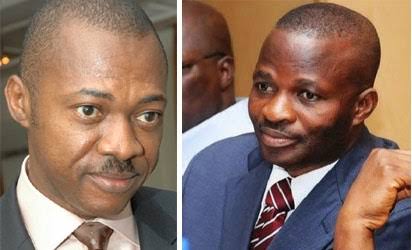

Both Obaseki and Shaibu have been at loggerheads over the latter’s ambition to contest the 2024 governorship polls in the state.
In an apparent move to wade off any show of public affection, security aides attached to Obaseki reportedly barred Shaibu from approaching the governor during the event. Again, the following day, on Monday, August 28, at the 60th anniversary of the Midwest Referendum celebration, Shaibu’s media aides were reportedly denied entry to the venue of the event, despite pleas from the deputy governor who later stormed out.
All these developments only mean one thing, that both men are far from sheathing their swords even though the deputy governor had a few times downplayed their disagreement.
In the larger context, feuds between a governor and his deputy are not new to the Nigerian political space. Infact, since the return of democracy in 1999, several states have had their fair share of such battle royales.

In this piece, we highlight a few of those notable tussles between state governors and their second-in-command.
Bola Tinubu vs Femi Pedro
President Bola Tinubu as governor of Lagos State had a go with his then deputy, Otunba Olufemi Pedro.
Pedro was said to have got on the wrong side of his principal over Tinubu’s choice to back his Chief of Staff, Tunde Fashola, as his successor.
The animosity between both men forced the deputy governor to defect to the Labour Party and contest against his boss anointed heir, Fashola.
After the election, which he lost, Pedro got an impeachment notice from the House of Assembly. He promptly sent in his resignation letter, but the lawmakers were said to have rejected the letter leading to his eventual impeachment.
The relationship between former Enugu Governor Sullivan Chime and his deputy Sunday Onyebuchi hit the rocks following the ambition of the deputy to run for Senate.
The face-off led to the infamous “Chicken impeachment” by then House of Assembly.
He was impeached for running a poultry in his official quarters.
Mr. Onyebuchi, a deputy to former Gov. Sullivan Chime, was impeached on Aug. 26, 2014, and replaced by Rev. Ifeanyi Nwoye.
In a judgment of the court, Justice R. Odugu declared the impeachment of Mr. Onyebuchi “null and void’’.
The judge ordered the reinstatement of the former governor’s rights and benefits from the time of his removal from office to the period his tenure elapsed.
He declared as unconstitutional, null and void the nomination of Mr. Nwoye as replacement of the plaintiff.
Rochas Okorocha vs Jude Agbaso & Eze Madumere
Former Imo State Governor, Rochas Okorocha, had two deputy governors for his two terms in office and fell out with both of them at different points.
Jude Agbaso was deputy governor of Imo State till March 2013 when he was impeached. It was said that Agbaso’s battle with his principal began when he challenged the then-governor for a second tenure, citing a supposed gentleman’s agreement that stipulated that Okorocha would rule Imo State for only four years. He was sent packing and summarily replaced by Prince Eze Madumere.
If Agbaso and Okorocha’s relationship was a political necessity, Madumere’s relationship with Okorocha was seen to be more cordial. However, he too fell out with his principal in similar circumstances.
Madumere was said to be against the choice of Okorocha’s son-in-law, Uche Nwosu, as his successor. Miffed, Madumere threw his cap into the ring, creating a breakaway faction full of his loyalists in the All Progressives Congress.
Abdullahi Ganduje vs Hafiz Abubakar
When Prof Hafiz Abubakar resigned as the deputy of then-Kano State governor Abdullahi Ganduje on August 4, 2018, he said the decision was taken due to ‘irreconcilable differences’ on matters relating to governance and government operations.
He further stated he suffered “immeasurable and unjustifiable humiliation” for over two and a half years on issues of governance and the desire to keep government on track.
Though Ganduje denied those allegations, observers said the Ganduje’s feud with Abubakar began when the latter failed to disassociate himself from the governor’s predecessor, Senator Rabi’u Musa Kwankwaso.
Obong Victor Attah vs Chris Ekpenyong
Former Akwa Ibom State Governor, Obong Victor Attah’s not-so-cordial relationship with his then deputy, Dr. Chris Ekpenyong, degenerated to the point that the latter was impeached.
Despite efforts by the then President Olusegun Obasanjo and the PDP to halt the impeachment, the state House of Assembly voted to remove Ekpeyong in June 2005.
Ayodele Fayose vs Abiodun Aluko
Governor Ayo Fayose was alleged to have instigated the removal of his deputy, Abiodun Aluko in 2005.
The state House of Assembly impeached Aluko after finding him guilty of 16 offences. The lawmakers claimed all the offences were grounds for impeachment.
Isa Yuguda vs Garba Gadi
Alhaji Garba Gadi was said to have crossed the red line with his principal, Isa Yuguda, owing to the latter’s refusal to defect to the PDP from the ANPP that brought them to power.
Gadi was impeached but later re-instated by a High Court in Bauchi due to irregularities in the proceedings leading to his impeachment.
Olusegun Mimiko vs Ali Olanusi
Former Ondo State Deputy Governor, Alhaji Ali Olanusi, was said to have enraged his principal, Olusegun Mimiko when he defected to the All Progressives Congress instead of joining him in the Peoples Democratic Party.
He was impeached by the state House of Assembly in 2015 but two years later, a court declared the impeachment illegal and restored Olanusi to his office. But it was too little too late for him as his tenure with Mimiko had already elapsed.
By Okey Maduforo, Awka
The indefinite curfew imposed on Aguleri and Umuoba Anam communities in Anambra State following their recent communal clash remains in force as Governor Chukwuma Soludo has set up a Judicial Commission of Inquiry to investigate the crisis.
The governor also ordered an immediate ceasefire, warning that the state government would not tolerate further lawlessness or any breach of peace and order in the two communities.
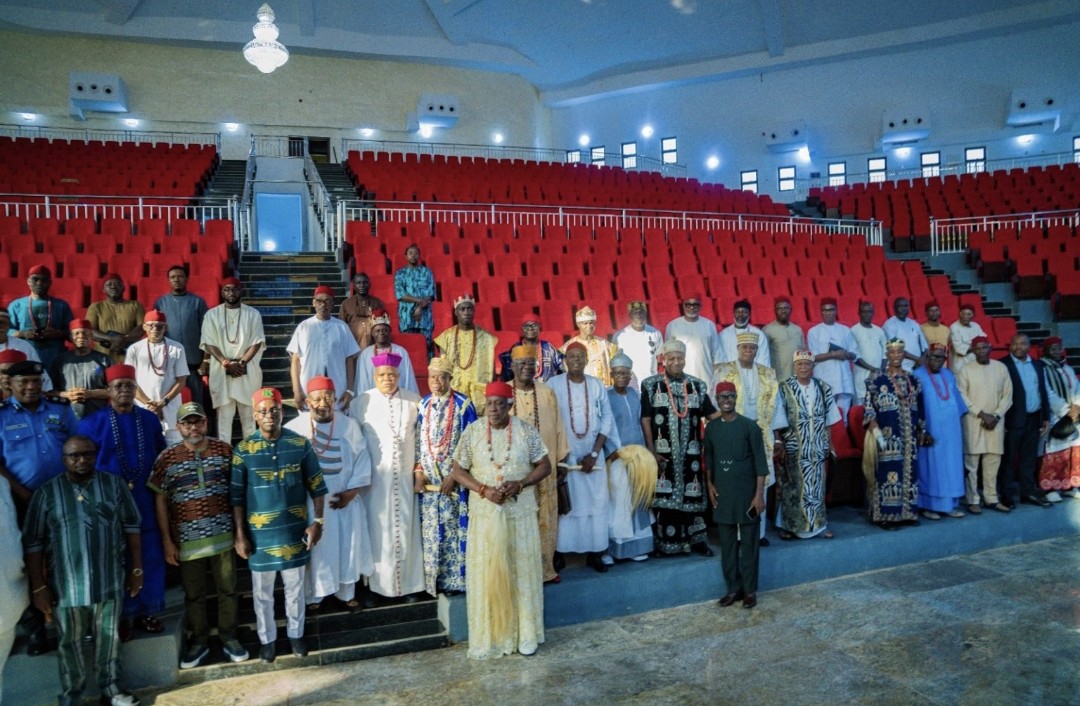
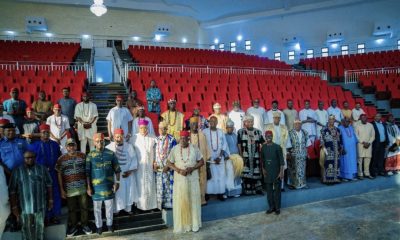
The directives followed a conflict-resolution meeting convened by the governor at the Light House, Awka, which was attended by traditional rulers and other leaders from the affected communities.
At the meeting, the stakeholders agreed that both communities must lay down their arms and embrace peace.
In a statement by the Chief Press Secretary to the governor, Christian Aburime, Soludo lamented the loss of lives and destruction of property, saying the violence was inconsistent with his administration’s vision of a peaceful and prosperous Anambra State.
“Opening the deliberations, the Governor decried the tragic loss of lives and the widespread destruction of properties, emphasizing that such lawlessness is entirely unacceptable to the administration,” the statement said.
Soludo also directed security agencies to maintain a round-the-clock presence in the affected areas to ensure compliance with the ceasefire.
The governor assured the parties that the government would remain “firm, fair, and uncompromising” in its pursuit of lasting peace and justice.
Community leaders, including Igwe Michael Idigo and Hon. Fidel Okafor, condemned the violence, particularly the killing of a minor and an unarmed person from Umuoba Anam, as well as the retaliatory destruction of the historic Idigo Palace.
They called for an immediate end to the hostilities and the prosecution of those responsible for the violence.
Speaking as an observer on behalf of the Umueri community, retired Justice Charles C. Okaa appealed for restraint and urged the state government to enforce the 1982 Supreme Court judgment on boundary matters involving Umueri and Aguleri as part of efforts to achieve a lasting resolution.
The stakeholders also agreed on the immediate cessation of hostilities, prosecution of perpetrators, accountability for community leadership and the rebuilding of the destroyed Idigo Palace.
Condemning the destruction of the traditional palace as an attack on the heritage of the state, Soludo announced that the state government would assist in rebuilding it and restoring its traditional dignity.
The governor also established a Judicial Commission of Inquiry to examine petitions, complaints and historical grievances connected to the crisis. The commission is expected to submit its comprehensive report within four months.
However, the state government has yet to make public the names and number of members of the commission.
Meanwhile, the indefinite curfew remains in force as security agencies continue to maintain heightened surveillance in the affected communities.

For Squadron Leader Ahamefule Aham Man-Ugwueje, Monday was supposed to be another routine day of duty. Instead, the Nigerian Air Force pilot lost his life in the crash of an ATR-42 aircraft in Igbokoda, Ondo State, barely 16 days after his wedding.
Man-Ugwueje had married Flight Lieutenant Damilola Adekunle on September 19, 2026, in an elaborate ceremony in Abuja.
The couple exchanged vows at the Redeemed Christian Church of God, The Masters Place, Utako, Abuja, before proceeding to the Nigerian Army Conference Centre, Asokoro, for the reception.
Details of the wedding were contained in the couple’s invitation and posts shared by vendors who participated in the ceremony. A videographer, Beejay Creates, also shared footage from the event, identifying the couple as bride Damilola and groom Ahamefule.
Man-Ugwueje, who was identified by the Nigerian Air Force as the co-pilot of the ill-fated aircraft, was among the five crew members and 20 passengers who died in the crash.
The aircraft, NAF 931, was on a routine mission from Benin to Lagos when it crashed in a swampy area around Igbokoda in Ilaje Local Government Area of Ondo State.
The Nigerian Air Force on Tuesday confirmed that all 25 people on board died in the accident and released the names of the victims.
The Chief of the Air Staff, Air Marshal Sunday Kelvin Aneke, described the incident as a deeply painful moment for the Nigerian Air Force and the nation, while commiserating with the families, friends and colleagues of the victims.
The Air Force also ordered a comprehensive investigation into the circumstances surrounding the crash.
Man-Ugwueje, whose Facebook profile listed Umuahia, Abia State, as his hometown and Abuja as his current city, was the son of retired Group Captain Man-Ugwueje.
Meanwhile, Ondo State Governor, Lucky Aiyedatiwa, said no survivor was found after security agencies, emergency responders and local residents joined the search for victims at the crash site.
Aiyedatiwa said he was informed of the crash at about 10:30am on Monday after receiving a call from the chairman of Ilaje Local Government Area.
According to the governor, residents across the river from the Nigerian Navy base in Igbokoda heard a loud sound and subsequently saw the aircraft plunge into the swamp.
He said Navy personnel initially exercised caution while trying to determine whether there was a fire or explosion before moving towards the crash site.
“When they noticed that it’s just an accident, they didn’t see any sign of fire. So they moved in, trying to see if they could rescue the people,” the governor said.
Personnel of the local emergency management agency, residents and members of the Amotekun Corps later joined the rescue operation.
However, the search ended in tragedy after authorities confirmed that there were no survivors.
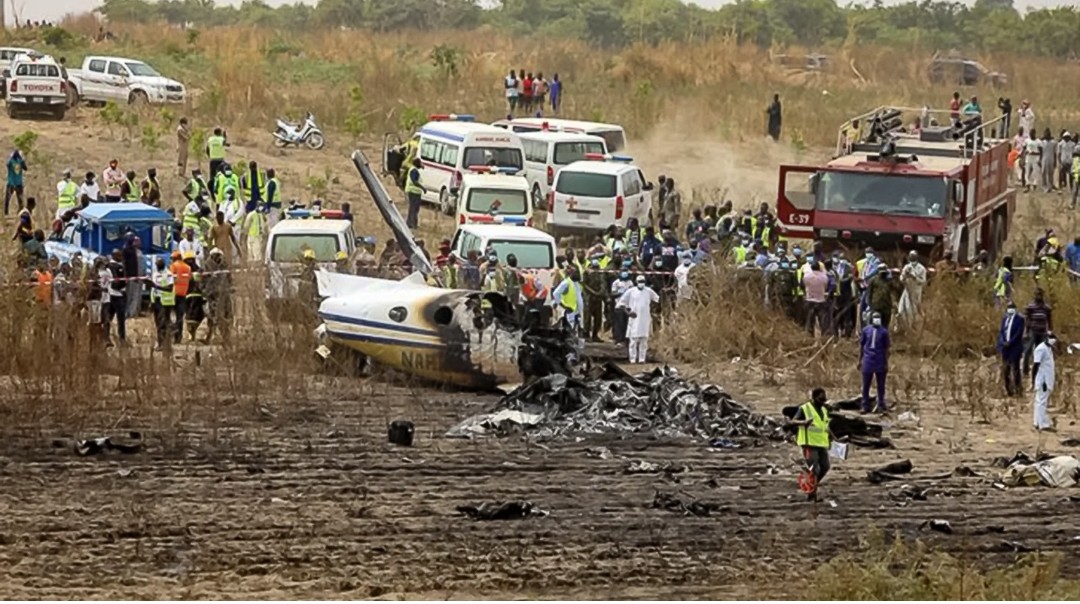
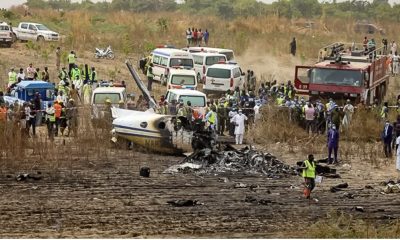
A Nigerian Air Force ATR-42 aircraft on a routine flight from Benin City to Lagos crashed into a swamp in Igbokoda, Ilaje Local Government Area of Ondo State, on Monday after reportedly disappearing from radar shortly after take-off.
The aircraft, with tail number NGR 931, lost communication with air traffic controllers at about 9:13am. A senior air traffic controller, who spoke anonymously, said repeated attempts to re-establish contact with the aircraft failed.
According to the source, personnel around Okitipupa later reported hearing a loud bang suspected to have come from the crash site.
The Minister of Aviation and Aerospace Development, Festus Keyamo, confirmed that the aircraft had disappeared from radar and that all efforts to raise it on radio were unsuccessful.
He later announced that the wreckage had been located near the Naval Base in Igbokoda.
Keyamo said 32 people—25 passengers and seven crew members—were on board.
The Nigerian Air Force confirmed the crash, saying the aircraft was on a routine mission from Benin to Lagos and that search-and-rescue operations had commenced in coordination with relevant authorities.
The crash site, located in a swampy creek, proved difficult to access, with military personnel, emergency responders and local fishermen joining the rescue operation.
Governor Lucky Aiyedatiwa said no survivor had been found as of Monday evening, although the authorities had yet to officially announce a death toll.
The governor said rescuers recovered parts of the aircraft, identification cards and military uniforms from the site.
President Bola Tinubu expressed sadness over the incident and directed the Nigerian Air Force to immediately commence a thorough investigation into the cause of the crash.
Investigators are expected to examine the wreckage, flight path, weather conditions, maintenance records and air traffic control communications. Efforts were also being made to recover the aircraft’s flight recorder, which could provide crucial information about its final moments.
The cause of the crash remains unknown.
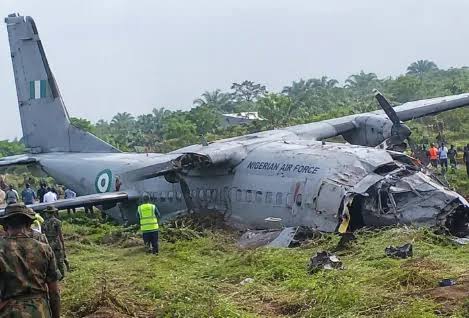
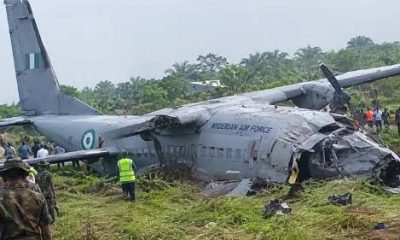
Ondo State Governor, Lucky Aiyedatiwa, has disclosed that no survivor has so far been found following the crash of a Nigerian Air Force aircraft in Igbokoda, Ilaje Local Government Area of the state.
Aiyedatiwa made this known during an interview with Channels Television on Monday, saying local residents, security personnel and emergency responders had searched the crash site without finding anyone alive.
The governor said he received information about the incident at about 10:30am after the chairman of the local government contacted him.
According to him, residents living across the river from the Nigerian Navy base in Igbokoda heard a loud sound and subsequently saw the aircraft plunge into a swampy area.
He explained that personnel of the Nigerian Navy initially stayed back to determine whether the crash had triggered a fire or explosion before proceeding to the site.
“When they noticed that it’s just an accident, they didn’t see any sign of fire. So they moved in, trying to see if they could rescue the people,” Aiyedatiwa said.
He added that officials of the state emergency management agency, local residents and personnel of the Amotekun Corps later joined the search and rescue operation.
“But from the information we got, no single life was saved up to this moment. They could not see any living soul that was in that aircraft,” the governor said.
Aiyedatiwa said searchers recovered parts of the aircraft, including pieces of the wings, identification cards and military uniforms, which helped establish that the aircraft was a military plane.
“But they saw the ruins, some of the wreckage from the wings of the aircraft, you know, some ID cards, I was told, and then uniform. That was when they knew it was a military aircraft,” he said.
The governor described the incident as a painful development, noting that the crash occurred not only in Ondo State but also in his home local government area.
“So it’s a sad situation today. And we’re all really, really agreed as a Nigerian. And also it happens in my own state, not just my state, even in my own local government where I’m from,” he said.
Aiyedatiwa expressed sympathy for the military personnel involved, describing them as officers assigned to protect the territorial integrity of Nigeria.
The Nigerian Air Force had earlier confirmed that an ATR-42 aircraft with tail number NGR 931 crashed in Igbokoda while on a routine mission from Benin, Edo State, to Lagos.
Minister of Aviation and Aerospace Development, Festus Keyamo, said preliminary information indicated that 25 passengers and seven crew members were on board the aircraft.
The Nigerian Air Force said search and rescue operations were ongoing following the crash.

“If You Have Evidence Against Stanley Mbam, Charge Him; Otherwise, Release Him” — Oganiru Izzi
A socio-cultural organisation of Izzi extraction, Oganiru Izzi, has challenged Ebonyi State Governor, Chief Francis Ogbonna Nwifuru, to either release the state’s sacked Commissioner for Works, Mr Stanley Mbam, or charge him before a competent court if the government has credible evidence of wrongdoing against him.
The group said the continued detention of the former commissioner without a formal charge raises concerns about due process, constitutional rights and the rule of law.
The leader of Oganiru Izzi, Mr Godwin Mbam, made the demand while speaking with correspondents of National Issue Newspapers at the Crack Department of the Ebonyi State Police Command in Abakaliki.
Mbam condemned what he described as the prolonged detention of Stanley Mbam without allowing a court to determine whether he had committed any offence.
He challenged the state government to produce evidence if it believes the former commissioner committed a criminal offence.
“If there is credible evidence against him, charge him to court and let the court decide. If there is no case against him, he should be released,” Mbam said.
He also appealed to the Ebonyi State Police Command to uphold the Constitution and resist any pressure that could result in unlawful detention.
Vanco Flyover: “We Will Reveal the Full Details”
Mbam also issued a three-day challenge to Governor Nwifuru, declaring that if the former commissioner was not released or charged to court, his organisation would make public what it described as the “full details” of the Vanco Flyover project.
According to him, the proposed disclosure would address issues surrounding the project, including its funding, payments, contractual arrangements and other financial details.
“We will let the world know the full details of the Vanco Flyover and how the funds were utilised,” he warned.
He further challenged the state government to demonstrate transparency by making relevant documents concerning the project available to the public.
“What About the Alleged ₦1.5 Billion Forfeiture?”
The Izzi group also questioned what it described as the selective application of the state government’s anti-corruption campaign.
Mbam referred to allegations involving an account reportedly frozen by the Economic and Financial Crimes Commission (EFCC) and an alleged ₦1.5 billion forfeiture to the Federal Government.
He questioned why, according to him, the governor had allegedly not taken similar action if the facts surrounding the matter warranted it.
Mbam stressed that he was not opposed to the fight against corruption but insisted that any anti-corruption campaign must be comprehensive, transparent and applied equally.
“If Governor Nwifuru wants to fight corruption, let him fight it holistically. Nobody should be targeted while other serious allegations are ignored,” he said.
“If Nwifuru Says He Knows Nothing, We Will Produce the Facts”
Mbam further challenged Governor Nwifuru to publicly state whether he was aware of alleged corruption issues within the Ministry of Works.
“If Nwifuru publicly claims that he is unaware of corruption in the Works Ministry, I will make public the facts available to me. The facts will shock the state,” he declared.
He insisted that the matter should not degenerate into a political vendetta, arguing that the appropriate place to determine criminal liability is a court of law.
According to him, the people of Ebonyi State deserve clear answers concerning the Vanco Flyover and other issues involving public funds.
“Everybody Should Be Subject to the Law”
The Oganiru Izzi leader maintained that the controversy should be resolved through transparency, documentary evidence and due process.
“If there is a case, charge him. If there is no case, release him. The government cannot claim to be fighting corruption while abandoning the principles of justice and the rule of law,” he said.
Mbam warned that failure to address the issues could compel the organisation to make further disclosures concerning the Vanco Flyover and other matters it considers to be in the public interest.

-

 Politics3 days ago
2027: Odii Will Not Step Down, Says Spokesperson
-

 EverydayNews Telescope2 days ago
Nkalagu Cement Factory: Project or 2027 Political Promise?
-
 News2 days ago
How NAF Plane Vanished From Radar Shortly After Take-Off, Crashes In Ondo Swamp
-

 News4 days ago
Sacked Works Commissioner: Release or Charge Him to Court, Oganiru Izzi Challenges Nwifuru
-
 News3 days ago
No Survivor Found Yet in Ondo Air Crash — Aiyedatiwa
-
 Crime4 days ago
Police Deploy DIG, Two Commissioners to Rescue 20 Abducted Prospective Corps Members
-
 Crime2 days ago
Court Denies Alleged Fake Pastor Bail as Seven Witnesses Await Trial
-
 News4 hours ago
Curfew Continues as Soludo Sets Up Commission of Inquiry Over Aguleri–Umuoba Anam Clash