



News
Insecurity worsening, Nigerians dying, Buhari should go – PFN president, Kukah, Ighodalo



Prominent Nigerians have berated the President, Major General Muhammadu Buhari (retd.) over the growing insecurity in the country.
They spoke at different events across the country.
The President of the Pentecostal Fellowship of Nigeria, Bishop Wale Oke, said the President had failed to secure Nigerians and should be removed if it would bring the desired peace and security to the country.
Oke, who is the Presiding Bishop of The Sword of the Spirit Ministries, Ibadan, the capital of Oyo State, said these in a message he delivered in the early hours of Saturday at a vigil organised by his church.
A statement by the PFN president’s media aide, Mr Kayode Oladeji, quoted the cleric as saying this during a vigil held at the Precious Cornerstone University Garden of Victory, Ibadan.

The university is owned by the church.
With killings going across the country on daily basis while security agencies remain helpless, Oke said Nigeria had become a war-ravaged country.
He said, “The President should be removed if that would pave the way for the desired peace in the country. In the 1960s when Nigeria fought a civil war, the eastern part of the nation was the theatre of war. Sadly today, everywhere in Nigeria is a theatre of war with killings and bloodshed going on in the country every day.
“Some wicked people kidnapped some students and demanded N800m for their release; they killed them. The government did not lift a finger and you are telling me that the President has not failed. Buhari has failed. For the first time, I have found myself praying that God should remove Buhari.
“They kidnapped students without the government doing anything and you are telling me that the government has not failed. Are you saying we cannot move against an incompetent government whose security apparatus has collapsed?”
The cleric accused the Buhari regime of treating killer herdsmen, with kid gloves.
He said the Fulani people who were less than 10 per cent of the population of the country were being fingered in most of the killings across the country and the President did not do anything about it.
The bishop further said, “It is a shame that government could not protect those in Internally Displaced Persons camps which led to the massacre of a number of them in Benue State. The Presidency is now attacking Governor (Samuel) Ortom who was weeping over his people that were slaughtered.
“Give us peace by all means even if it means removing an incompetent and a failed President. Oh God, do it quickly and give us peace by all means. Give us a quick change at the top level of government of Nigeria.”
He invoked the wrath of God on the troublers of Nigeria and their sponsors in a congregational prayer he led
Nigerians dying, our leaders’ statements saying nothing to us – Kukah
The Catholic Bishop of Sokoto Diocese, Matthew Kukah, on Saturday said Nigerians were dying in the face of hardship and insecurity, and the silence of the leaders, whom he said had not shown empathy for the plight of the citizens.
Kukah, who made this known while speaking on the topic, ‘We need to exhale,’ at the May 1 edition of The Platform organised the Covenant Christian Centre, lamented that Nigerians no longer get the sense that their leaders understand their pain.
“A government must develop a sense of empathy and I have said it several times and I do not mean anything negative. Everywhere you turn, this is what Nigerians are saying, that people are dying and we don’t get a sense that those who govern us understand and feel our pain because we have not seen them at our funerals; we have not seen them at condolence visits; we’ve not seen them whether by telephone call or whatever.
“Empathy is not sympathy; empathy is at the heart of who we are as human beings. That is, it is what makes you go to greet somebody who is dying and you put your hand over their shoulder and you tell them it will be okay. Empathy is the feeling of the sorrow, the pain of the other person – indeed, entering the skin of another person,” the cleric said.
Kukah said that the agony faced by suffering Nigerians had been increased by “just simple statements” from their leaders “that really say nothing to us”.
“It (empathy) does not bring healing immediately, but there is a certain kind of psychological comfort that it brings. A woman who has just lost her husband, for example, you go to her to tell her it is okay, she will nod (her head) but she knows that it is not okay. But, at least, if you tell her as a priest it is okay, she knows that somebody feels her pain.
“And the point I am making on the issue of Nigerians dying, the government has come up very short and this is what is increasing the pain, the agony, the sorrow of people, that we are dying alone, burying our people alone and all we get are just simple statements that really say nothing to us. I want to end by saying the lack of empathy and the deployment of empathy has consequences.”
President not showing concern as ex-general, says Ighodalo
Meanwhile, the Pastor-in-Charge, Trinity House Church, Ituah Ighodalo, has criticised Buhari for his alleged lack of interest or concern despite the mounting insecurity in the country.
Ighodalo, who spoke at Press Conference on the State of the Nation organised by the Africa Leadership Group, in conjunction with the Nigeria Leadership Series in Lagos State on Saturday, expressed bewilderment over the rampant herdsmen killings and kidnappings, saying the buck stopped with the President.
The cleric said, “Let me say it boldly, loud and clear: The problem of insecurity in Nigeria lies on the table of Muhammadu Buhari. If Muhammadu Buhari is ready today to stop all this insecurity, he has the power and ability, and he knows what to do.
“The reason he is not doing it, I really don’t understand. The reason he is not showing enough energy, effort, direction, interest, and concern in this, I really don’t understand. For a person who was a general in the Nigerian Army, he looks a little bit too complacent and lackadaisical concerning this issue of insecurity.”
He described it as worrisome that despite the human and technological resources available at present, the abduction of schoolgirls was possible without punishment for the perpetrators.
“How can you capture 257 girls and we don’t know where they are? It is not possible in this day and age with technology and everything (we have today). Do you know the amount of effort it takes to move 250 people across a certain place and nobody saw them? And you can’t find them? And they disappeared?
“For the last four years, you had a bunch of security leaders who were disunited, quarrelling among themselves. They couldn’t agree on anything. They couldn’t fight behind one common purpose and a lot of them were just doing whatever they wanted, and the gentleman, Buhari, was looking at them,” he said.
Ighodalo lamented that despite numerous allegations that the recently replaced security chiefs lacked a team spirit and had different agendas, Buhari did nothing about the complaints.
The cleric added, “Now, we have a new set of security leaders. Let us hope that these ones can come together and face this problem. They say this girl, Leah Sharibu, is captured, she’s having babies every year and you can’t find her? What does that mean? What nonsense is that? And you’re telling us that she had babies? Who made that announcement? Where is the person?
“Why don’t we bring him and say, ‘Where is the baby that you saw and where is the girl? We can’t find her, yet we cross our arms and we are looking, because we are not really serious about these things. People go into a village and rape 20 of them, carry the women and children, and we cannot find them. Who does that in this day and age?
“They pick up a man, take him into a forest and cut his head off. Eight of them are filming it. We are seeing them and not one person says, ‘Where are we going to look for these people?’ There was no call for these people. They filmed it, they sent it to us, we saw it, and nobody did anything. How can that happen?”
He also condemned the proliferation of attacks and killings by herdsmen and kidnappers in forests.
The cleric said, “The police know them and know where to find them, but nobody is engaging or crying out. It’s a business; people are making money from this thing. People are selling arms to these people.
“People are making money from security votes. People are making money from the pain and the death of these innocent people. That is why this problem is not being solved and, somehow, we are looking away.
“Nobody who has authority is really concerned. We can solve this problem if, together, we say we want to solve this problem. It shouldn’t have descended to this level.”
According to Ighodalo, Nigerians must no longer grumble. The cleric stated that if they did not change the leadership, the leadership would not change. He urged them to talk to one another to ensure the country becomes better.
Meanwhile, the Ekiti State Governor, Kayode Fayemi, has decried the spate of insecurity in the country saying that Nigerians are living in fear.
Fayemi said the various challenges facing the country speak to the fundamental issue of restructuring and devolution.
‘I don’t know anyone in APC who is committed to public good who is not worried about the situation we have found ourselves in. Nigeria is too big to fail, but Nigeria cannot be managed unitarily.
“Nigeria has to be restructured in such a manner that more responsibility, more revenue and more accountability must issue from the national to lower levels,” he said.
The governor said the nation must do all within its power to ensure that its people are safe through manpower and technology to deal with criminals.
He added, “All these must be done as a short-term goal, as the nation must deal with the long-term goal which is the root cause of our challenges as a nation. It’s good to be tough on crime. But we must also be tough on the root causes of these things we are dealing with.’’
Also speaking, a former Minister of Aviation, Osita Chidoka, called the President, to address Nigerians on the rising cases of killings across the country.
A former President of the Nigerian Bar Association, Dr Olisa Agbakogba SAN, said Nigeria’s foundational structure was not strong enough and needs to be addressed.
Agbakogba also said though the National Assembly could the process, Nigerians should be involved in constitution making.

By Okey Maduforo, Awka
The indefinite curfew imposed on Aguleri and Umuoba Anam communities in Anambra State following their recent communal clash remains in force as Governor Chukwuma Soludo has set up a Judicial Commission of Inquiry to investigate the crisis.
The governor also ordered an immediate ceasefire, warning that the state government would not tolerate further lawlessness or any breach of peace and order in the two communities.
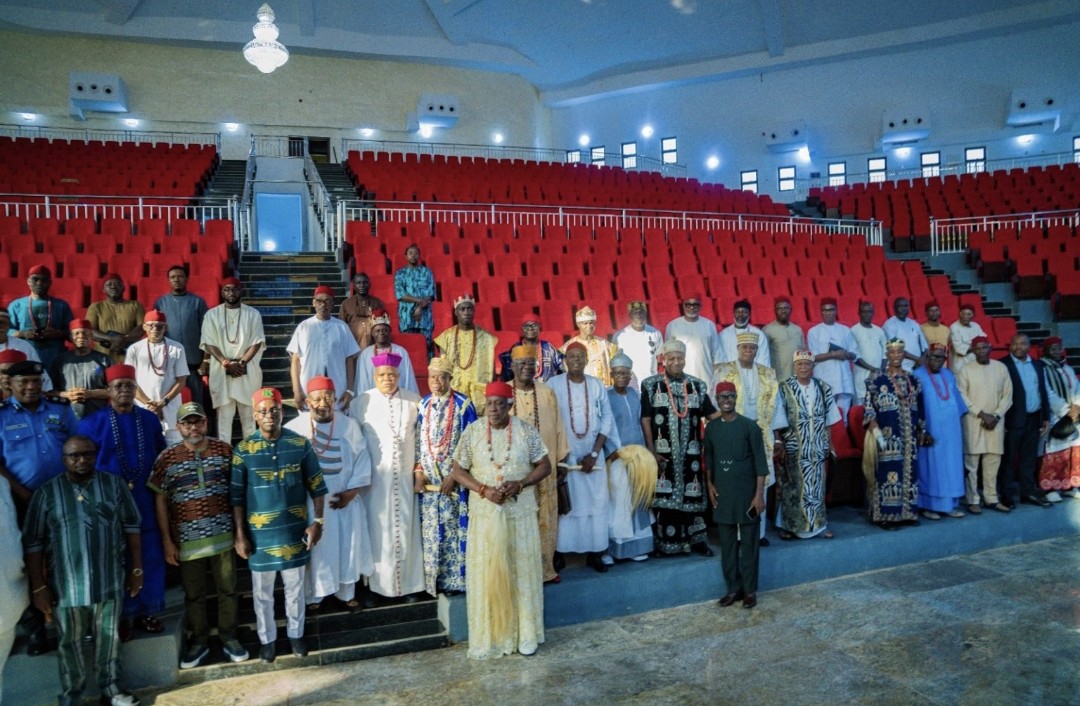
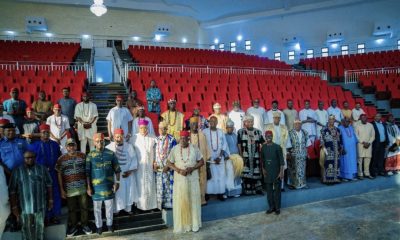
The directives followed a conflict-resolution meeting convened by the governor at the Light House, Awka, which was attended by traditional rulers and other leaders from the affected communities.
At the meeting, the stakeholders agreed that both communities must lay down their arms and embrace peace.
In a statement by the Chief Press Secretary to the governor, Christian Aburime, Soludo lamented the loss of lives and destruction of property, saying the violence was inconsistent with his administration’s vision of a peaceful and prosperous Anambra State.
“Opening the deliberations, the Governor decried the tragic loss of lives and the widespread destruction of properties, emphasizing that such lawlessness is entirely unacceptable to the administration,” the statement said.
Soludo also directed security agencies to maintain a round-the-clock presence in the affected areas to ensure compliance with the ceasefire.
The governor assured the parties that the government would remain “firm, fair, and uncompromising” in its pursuit of lasting peace and justice.
Community leaders, including Igwe Michael Idigo and Hon. Fidel Okafor, condemned the violence, particularly the killing of a minor and an unarmed person from Umuoba Anam, as well as the retaliatory destruction of the historic Idigo Palace.
They called for an immediate end to the hostilities and the prosecution of those responsible for the violence.
Speaking as an observer on behalf of the Umueri community, retired Justice Charles C. Okaa appealed for restraint and urged the state government to enforce the 1982 Supreme Court judgment on boundary matters involving Umueri and Aguleri as part of efforts to achieve a lasting resolution.
The stakeholders also agreed on the immediate cessation of hostilities, prosecution of perpetrators, accountability for community leadership and the rebuilding of the destroyed Idigo Palace.
Condemning the destruction of the traditional palace as an attack on the heritage of the state, Soludo announced that the state government would assist in rebuilding it and restoring its traditional dignity.
The governor also established a Judicial Commission of Inquiry to examine petitions, complaints and historical grievances connected to the crisis. The commission is expected to submit its comprehensive report within four months.
However, the state government has yet to make public the names and number of members of the commission.
Meanwhile, the indefinite curfew remains in force as security agencies continue to maintain heightened surveillance in the affected communities.

For Squadron Leader Ahamefule Aham Man-Ugwueje, Monday was supposed to be another routine day of duty. Instead, the Nigerian Air Force pilot lost his life in the crash of an ATR-42 aircraft in Igbokoda, Ondo State, barely 16 days after his wedding.
Man-Ugwueje had married Flight Lieutenant Damilola Adekunle on September 19, 2026, in an elaborate ceremony in Abuja.
The couple exchanged vows at the Redeemed Christian Church of God, The Masters Place, Utako, Abuja, before proceeding to the Nigerian Army Conference Centre, Asokoro, for the reception.
Details of the wedding were contained in the couple’s invitation and posts shared by vendors who participated in the ceremony. A videographer, Beejay Creates, also shared footage from the event, identifying the couple as bride Damilola and groom Ahamefule.
Man-Ugwueje, who was identified by the Nigerian Air Force as the co-pilot of the ill-fated aircraft, was among the five crew members and 20 passengers who died in the crash.
The aircraft, NAF 931, was on a routine mission from Benin to Lagos when it crashed in a swampy area around Igbokoda in Ilaje Local Government Area of Ondo State.
The Nigerian Air Force on Tuesday confirmed that all 25 people on board died in the accident and released the names of the victims.
The Chief of the Air Staff, Air Marshal Sunday Kelvin Aneke, described the incident as a deeply painful moment for the Nigerian Air Force and the nation, while commiserating with the families, friends and colleagues of the victims.
The Air Force also ordered a comprehensive investigation into the circumstances surrounding the crash.
Man-Ugwueje, whose Facebook profile listed Umuahia, Abia State, as his hometown and Abuja as his current city, was the son of retired Group Captain Man-Ugwueje.
Meanwhile, Ondo State Governor, Lucky Aiyedatiwa, said no survivor was found after security agencies, emergency responders and local residents joined the search for victims at the crash site.
Aiyedatiwa said he was informed of the crash at about 10:30am on Monday after receiving a call from the chairman of Ilaje Local Government Area.
According to the governor, residents across the river from the Nigerian Navy base in Igbokoda heard a loud sound and subsequently saw the aircraft plunge into the swamp.
He said Navy personnel initially exercised caution while trying to determine whether there was a fire or explosion before moving towards the crash site.
“When they noticed that it’s just an accident, they didn’t see any sign of fire. So they moved in, trying to see if they could rescue the people,” the governor said.
Personnel of the local emergency management agency, residents and members of the Amotekun Corps later joined the rescue operation.
However, the search ended in tragedy after authorities confirmed that there were no survivors.
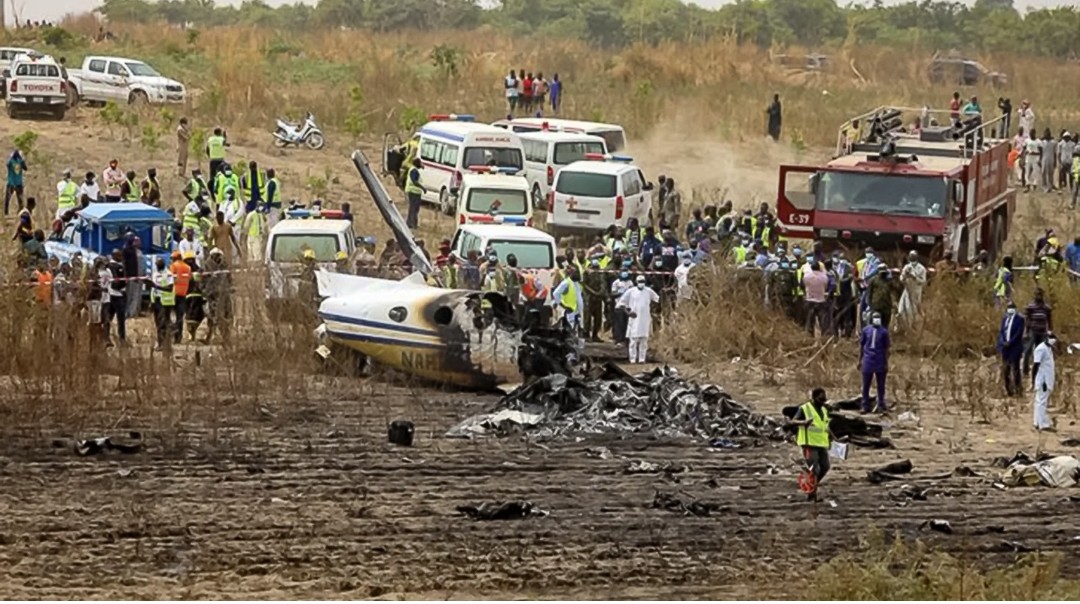
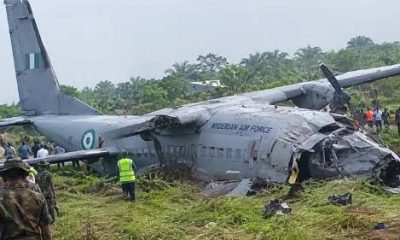
A Nigerian Air Force ATR-42 aircraft on a routine flight from Benin City to Lagos crashed into a swamp in Igbokoda, Ilaje Local Government Area of Ondo State, on Monday after reportedly disappearing from radar shortly after take-off.
The aircraft, with tail number NGR 931, lost communication with air traffic controllers at about 9:13am. A senior air traffic controller, who spoke anonymously, said repeated attempts to re-establish contact with the aircraft failed.
According to the source, personnel around Okitipupa later reported hearing a loud bang suspected to have come from the crash site.
The Minister of Aviation and Aerospace Development, Festus Keyamo, confirmed that the aircraft had disappeared from radar and that all efforts to raise it on radio were unsuccessful.
He later announced that the wreckage had been located near the Naval Base in Igbokoda.
Keyamo said 32 people—25 passengers and seven crew members—were on board.
The Nigerian Air Force confirmed the crash, saying the aircraft was on a routine mission from Benin to Lagos and that search-and-rescue operations had commenced in coordination with relevant authorities.
The crash site, located in a swampy creek, proved difficult to access, with military personnel, emergency responders and local fishermen joining the rescue operation.
Governor Lucky Aiyedatiwa said no survivor had been found as of Monday evening, although the authorities had yet to officially announce a death toll.
The governor said rescuers recovered parts of the aircraft, identification cards and military uniforms from the site.
President Bola Tinubu expressed sadness over the incident and directed the Nigerian Air Force to immediately commence a thorough investigation into the cause of the crash.
Investigators are expected to examine the wreckage, flight path, weather conditions, maintenance records and air traffic control communications. Efforts were also being made to recover the aircraft’s flight recorder, which could provide crucial information about its final moments.
The cause of the crash remains unknown.
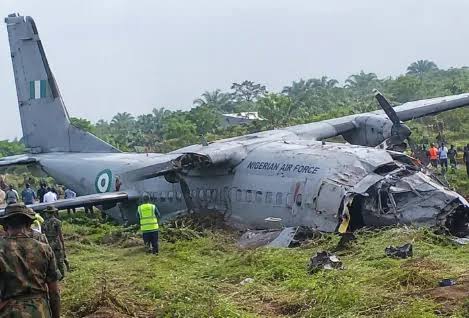
Ondo State Governor, Lucky Aiyedatiwa, has disclosed that no survivor has so far been found following the crash of a Nigerian Air Force aircraft in Igbokoda, Ilaje Local Government Area of the state.
Aiyedatiwa made this known during an interview with Channels Television on Monday, saying local residents, security personnel and emergency responders had searched the crash site without finding anyone alive.
The governor said he received information about the incident at about 10:30am after the chairman of the local government contacted him.
According to him, residents living across the river from the Nigerian Navy base in Igbokoda heard a loud sound and subsequently saw the aircraft plunge into a swampy area.
He explained that personnel of the Nigerian Navy initially stayed back to determine whether the crash had triggered a fire or explosion before proceeding to the site.
“When they noticed that it’s just an accident, they didn’t see any sign of fire. So they moved in, trying to see if they could rescue the people,” Aiyedatiwa said.
He added that officials of the state emergency management agency, local residents and personnel of the Amotekun Corps later joined the search and rescue operation.
“But from the information we got, no single life was saved up to this moment. They could not see any living soul that was in that aircraft,” the governor said.
Aiyedatiwa said searchers recovered parts of the aircraft, including pieces of the wings, identification cards and military uniforms, which helped establish that the aircraft was a military plane.
“But they saw the ruins, some of the wreckage from the wings of the aircraft, you know, some ID cards, I was told, and then uniform. That was when they knew it was a military aircraft,” he said.
The governor described the incident as a painful development, noting that the crash occurred not only in Ondo State but also in his home local government area.
“So it’s a sad situation today. And we’re all really, really agreed as a Nigerian. And also it happens in my own state, not just my state, even in my own local government where I’m from,” he said.
Aiyedatiwa expressed sympathy for the military personnel involved, describing them as officers assigned to protect the territorial integrity of Nigeria.
The Nigerian Air Force had earlier confirmed that an ATR-42 aircraft with tail number NGR 931 crashed in Igbokoda while on a routine mission from Benin, Edo State, to Lagos.
Minister of Aviation and Aerospace Development, Festus Keyamo, said preliminary information indicated that 25 passengers and seven crew members were on board the aircraft.
The Nigerian Air Force said search and rescue operations were ongoing following the crash.

“If You Have Evidence Against Stanley Mbam, Charge Him; Otherwise, Release Him” — Oganiru Izzi
A socio-cultural organisation of Izzi extraction, Oganiru Izzi, has challenged Ebonyi State Governor, Chief Francis Ogbonna Nwifuru, to either release the state’s sacked Commissioner for Works, Mr Stanley Mbam, or charge him before a competent court if the government has credible evidence of wrongdoing against him.
The group said the continued detention of the former commissioner without a formal charge raises concerns about due process, constitutional rights and the rule of law.
The leader of Oganiru Izzi, Mr Godwin Mbam, made the demand while speaking with correspondents of National Issue Newspapers at the Crack Department of the Ebonyi State Police Command in Abakaliki.
Mbam condemned what he described as the prolonged detention of Stanley Mbam without allowing a court to determine whether he had committed any offence.
He challenged the state government to produce evidence if it believes the former commissioner committed a criminal offence.
“If there is credible evidence against him, charge him to court and let the court decide. If there is no case against him, he should be released,” Mbam said.
He also appealed to the Ebonyi State Police Command to uphold the Constitution and resist any pressure that could result in unlawful detention.
Vanco Flyover: “We Will Reveal the Full Details”
Mbam also issued a three-day challenge to Governor Nwifuru, declaring that if the former commissioner was not released or charged to court, his organisation would make public what it described as the “full details” of the Vanco Flyover project.
According to him, the proposed disclosure would address issues surrounding the project, including its funding, payments, contractual arrangements and other financial details.
“We will let the world know the full details of the Vanco Flyover and how the funds were utilised,” he warned.
He further challenged the state government to demonstrate transparency by making relevant documents concerning the project available to the public.
“What About the Alleged ₦1.5 Billion Forfeiture?”
The Izzi group also questioned what it described as the selective application of the state government’s anti-corruption campaign.
Mbam referred to allegations involving an account reportedly frozen by the Economic and Financial Crimes Commission (EFCC) and an alleged ₦1.5 billion forfeiture to the Federal Government.
He questioned why, according to him, the governor had allegedly not taken similar action if the facts surrounding the matter warranted it.
Mbam stressed that he was not opposed to the fight against corruption but insisted that any anti-corruption campaign must be comprehensive, transparent and applied equally.
“If Governor Nwifuru wants to fight corruption, let him fight it holistically. Nobody should be targeted while other serious allegations are ignored,” he said.
“If Nwifuru Says He Knows Nothing, We Will Produce the Facts”
Mbam further challenged Governor Nwifuru to publicly state whether he was aware of alleged corruption issues within the Ministry of Works.
“If Nwifuru publicly claims that he is unaware of corruption in the Works Ministry, I will make public the facts available to me. The facts will shock the state,” he declared.
He insisted that the matter should not degenerate into a political vendetta, arguing that the appropriate place to determine criminal liability is a court of law.
According to him, the people of Ebonyi State deserve clear answers concerning the Vanco Flyover and other issues involving public funds.
“Everybody Should Be Subject to the Law”
The Oganiru Izzi leader maintained that the controversy should be resolved through transparency, documentary evidence and due process.
“If there is a case, charge him. If there is no case, release him. The government cannot claim to be fighting corruption while abandoning the principles of justice and the rule of law,” he said.
Mbam warned that failure to address the issues could compel the organisation to make further disclosures concerning the Vanco Flyover and other matters it considers to be in the public interest.

-

 Politics3 days ago
2027: Odii Will Not Step Down, Says Spokesperson
-

 EverydayNews Telescope2 days ago
Nkalagu Cement Factory: Project or 2027 Political Promise?
-
 News2 days ago
How NAF Plane Vanished From Radar Shortly After Take-Off, Crashes In Ondo Swamp
-

 News4 days ago
Sacked Works Commissioner: Release or Charge Him to Court, Oganiru Izzi Challenges Nwifuru
-
 News2 days ago
No Survivor Found Yet in Ondo Air Crash — Aiyedatiwa
-
 Crime4 days ago
Police Deploy DIG, Two Commissioners to Rescue 20 Abducted Prospective Corps Members
-
 News3 hours ago
Curfew Continues as Soludo Sets Up Commission of Inquiry Over Aguleri–Umuoba Anam Clash
-
 Crime1 day ago
Court Denies Alleged Fake Pastor Bail as Seven Witnesses Await Trial
Pingback: Fight for me, Buhari begs - Everydaynewsngr