



News
India’s deadly COVID-19 variant: FG expert panel meets today, plans additional measures

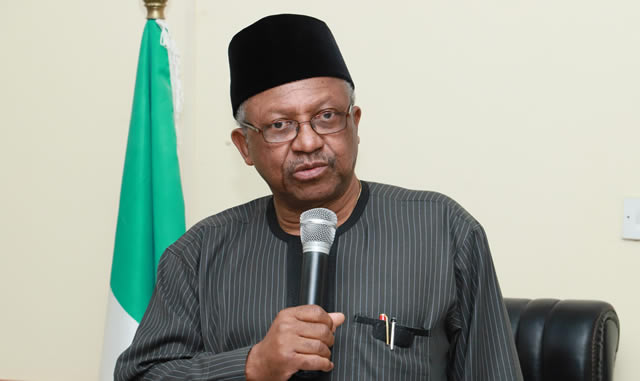

The Federal Government has resolved to introduce additional control measures to prevent the spread of the COVID-19 strain in India to Nigeria.
The Minister of Health, Osagie Ehanire, who disclosed this in an interview with one of our correspondents on Sunday, said the issue would be discussed at the ministerial experts’ committee meeting on Monday (today).
India is currently witnessing what has been described as a devastating second wave of COVID-19 with confirmed cases and deaths increasing in the past weeks.
The country is said to recording more than a quarter million cases per day.
One of the new variants circulating in India is referred to as the “double mutant” though it is officially called B.1.617.
With many Indians in Nigeria and the fact that the index case of the virus in the country was an Italian, there are concerns that the Indian strain may find its way into Nigeria if proper control measures are not put in place.

The PUNCH therefore asked the minister on Sunday the efforts being made by the Federal Government to prevent the strain from entering Nigeria.
Although he said it had been resolved that additional control measures be put in place, Ehanire did not disclose the details.
He however said the issue would form discussions at a meeting holding on Monday (today).
“We resolved to add additional control measures; but we shall discuss all ideas tomorrow (Monday) at the ministerial expert committee meeting,” the minister simply said.
India is said to have overtaken Brazil to become the second-most affected country in the world.
With second wave of wreaking havoc in India, a third mutation in this B.1.617 strain has now been identified in at least four states.
Two of these triple-mutant varieties have been found in samples collected from Maharashtra, Delhi, West Bengal and Chhattisgarh.
According to an Indian Express report, sources said the Health Ministry was last week briefed about the possibility of a double mutant variant developing another significant mutation and becoming a ‘triple-mutant.’
The report further said West Bengal seems to be becoming the hotspot for such mutations and the new triple mutant could make the virus even more capable of evading human immune response.
According to www.worldometers.info, India currently has 17,306,300 cases out of the world figure 147million; while the country has also recorded 195,116 deaths out of the 3.1million world figure.
It has also recorded 14,296,640 recoveries.
The United States currently has 32,814,104 cases, 586,084 deaths and 25,371,747 recoveries; Brazil has 14,308,215 cases, 389,609 deaths and 12,766,772 recoveries; while United Kingdom has 4,404,882 cases,127,428 deaths and 4,193,828 recoveries.
The total number of confirmed COVID-19 cases in Nigeria as of April 24 was 164,684, according to the Nigeria Centre for Disease Control. A total of 2,061 deaths have also been recorded while 154,687 people have recovered from the virus.
According to the National Primary Health Care Development Agency, 1,171,515 people have received the first dose of the AstraZeneca vaccine in the country as of April 25. The percentage of eligible Nigerians who have been vaccinated is 58.2 per cent.
In the data released by the NPHCDA, Lagos State is leading the vaccination drive and has vaccinated 227,718 people, followed by the Federal Capital Territory, 57,368 and Kaduna, 60,918.
The President of the Nigeria Association of Resident Doctors, Dr. Uyilawa Okhuaihesuyi, in an interview with The PUNCH, expressed concern about low level of testing in the country, particularly rural areas.
“For whatever reasons, African countries, especially Nigeria seem to have a semblance of herd immunity acquisition at this time, evidenced by the decreasing numbers of reported cases and low hospital visits on account of COVID – 19.
“Rarely does one see people on the streets wearing protective face masks, except those who are compelled to wear them on attempts to enter public government buildings or other enclosed spaces.
“It is noteworthy to add that there is insufficient testing still, especially involving those in the villages and hinterlands who don’t have good roads and other resources to access health care. Most of these places are devoid of primary health care facilities.”
Monitor airlines that convey passengers from India – Prof Tomori
Eminent virologist and Chairman, Expert Review Committee on COVID-19, Prof. Oyewale Tomori, told The PUNCH that since Nigeria did not have direct flights coming in from India, the country could not place a ban on flights from India like the United Kingdom has done.
He recalled that this was the challenge during the onset of the COVID-19 pandemic in Nigeria in 2020, when Nigeria could not ban flights from China which was the epicentre of the pandemic.
The former Vice Chancellor of Redeemer’s University, however, said airlines that convey passengers indirectly from India to Nigeria must be closely monitored.
Tomori said any attempt by the government to ban persons coming from India would not be productive, adding that Nigeria must focus more on testing and monitoring.
The virologist stated, “We don’t have direct flights from India but there are people that come in through other cities. I know that Ethiopia Airlines goes to India and they bring passengers from India through Addis Ababa to Nigeria. So, with the problem in India, I think it will be good to monitor people coming from there.
“You must be proactive to study the routes through which people come from India. We should have an idea of the main route through which people come from India and other information. You cannot just place a ban. So, we need home-grown information on the airlines they use and the number that usually come in.
“The Presidential Steering Committee must look into this. We need proper targeting.”
Tomori also noted that there was a need for states to do more in monitoring, adding that statistics from the Nigerian Centre for Disease Control in recent time showed that some states now test just one sample in a day.
This, he said, was not adequate and was giving the country inaccurate statistics on the rate of infection.
“Some states are testing only one sample in a week. Sometimes only five to eight states send their information to the NCDC. This is why some believe the infection is dropping when in actual fact we are not doing enough testing,” Tomori stated.

By Okey Maduforo, Awka
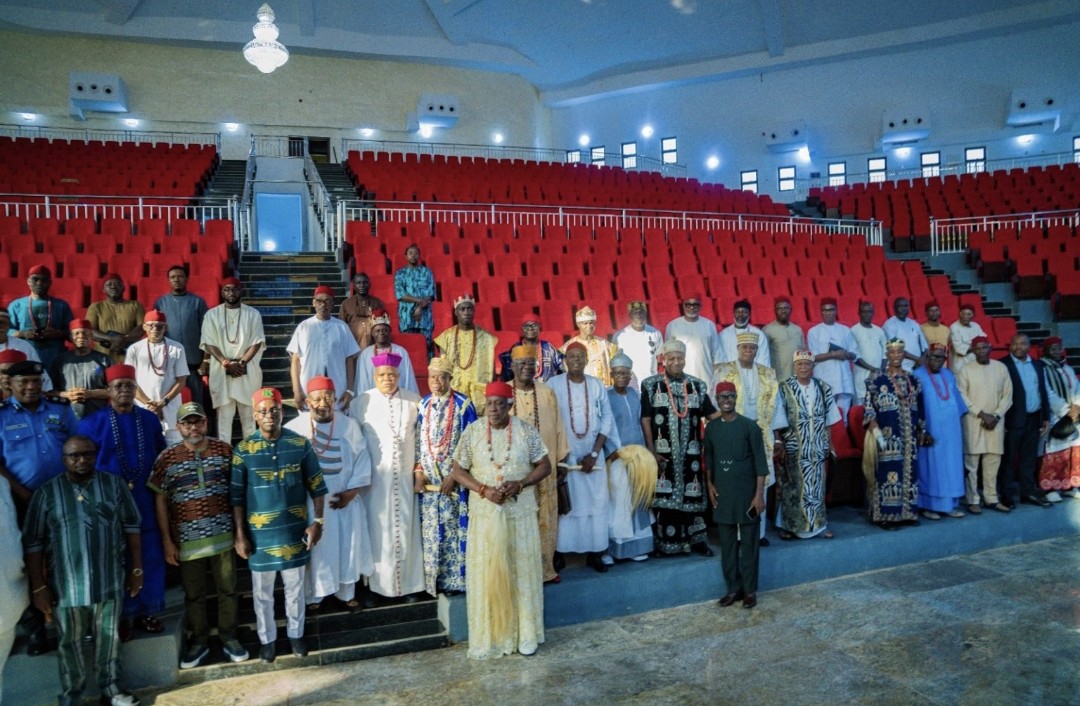
The indefinite curfew imposed on Aguleri and Umuoba Anam communities in Anambra State following their recent communal clash remains in force as Governor Chukwuma Soludo has set up a Judicial Commission of Inquiry to investigate the crisis.
The governor also ordered an immediate ceasefire, warning that the state government would not tolerate further lawlessness or any breach of peace and order in the two communities.
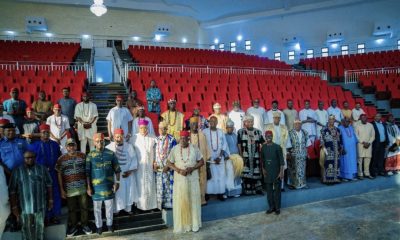
The directives followed a conflict-resolution meeting convened by the governor at the Light House, Awka, which was attended by traditional rulers and other leaders from the affected communities.
At the meeting, the stakeholders agreed that both communities must lay down their arms and embrace peace.
In a statement by the Chief Press Secretary to the governor, Christian Aburime, Soludo lamented the loss of lives and destruction of property, saying the violence was inconsistent with his administration’s vision of a peaceful and prosperous Anambra State.
“Opening the deliberations, the Governor decried the tragic loss of lives and the widespread destruction of properties, emphasizing that such lawlessness is entirely unacceptable to the administration,” the statement said.
Soludo also directed security agencies to maintain a round-the-clock presence in the affected areas to ensure compliance with the ceasefire.
The governor assured the parties that the government would remain “firm, fair, and uncompromising” in its pursuit of lasting peace and justice.
Community leaders, including Igwe Michael Idigo and Hon. Fidel Okafor, condemned the violence, particularly the killing of a minor and an unarmed person from Umuoba Anam, as well as the retaliatory destruction of the historic Idigo Palace.
They called for an immediate end to the hostilities and the prosecution of those responsible for the violence.
Speaking as an observer on behalf of the Umueri community, retired Justice Charles C. Okaa appealed for restraint and urged the state government to enforce the 1982 Supreme Court judgment on boundary matters involving Umueri and Aguleri as part of efforts to achieve a lasting resolution.
The stakeholders also agreed on the immediate cessation of hostilities, prosecution of perpetrators, accountability for community leadership and the rebuilding of the destroyed Idigo Palace.
Condemning the destruction of the traditional palace as an attack on the heritage of the state, Soludo announced that the state government would assist in rebuilding it and restoring its traditional dignity.
The governor also established a Judicial Commission of Inquiry to examine petitions, complaints and historical grievances connected to the crisis. The commission is expected to submit its comprehensive report within four months.
However, the state government has yet to make public the names and number of members of the commission.
Meanwhile, the indefinite curfew remains in force as security agencies continue to maintain heightened surveillance in the affected communities.

For Squadron Leader Ahamefule Aham Man-Ugwueje, Monday was supposed to be another routine day of duty. Instead, the Nigerian Air Force pilot lost his life in the crash of an ATR-42 aircraft in Igbokoda, Ondo State, barely 16 days after his wedding.
Man-Ugwueje had married Flight Lieutenant Damilola Adekunle on September 19, 2026, in an elaborate ceremony in Abuja.
The couple exchanged vows at the Redeemed Christian Church of God, The Masters Place, Utako, Abuja, before proceeding to the Nigerian Army Conference Centre, Asokoro, for the reception.
Details of the wedding were contained in the couple’s invitation and posts shared by vendors who participated in the ceremony. A videographer, Beejay Creates, also shared footage from the event, identifying the couple as bride Damilola and groom Ahamefule.
Man-Ugwueje, who was identified by the Nigerian Air Force as the co-pilot of the ill-fated aircraft, was among the five crew members and 20 passengers who died in the crash.
The aircraft, NAF 931, was on a routine mission from Benin to Lagos when it crashed in a swampy area around Igbokoda in Ilaje Local Government Area of Ondo State.
The Nigerian Air Force on Tuesday confirmed that all 25 people on board died in the accident and released the names of the victims.
The Chief of the Air Staff, Air Marshal Sunday Kelvin Aneke, described the incident as a deeply painful moment for the Nigerian Air Force and the nation, while commiserating with the families, friends and colleagues of the victims.
The Air Force also ordered a comprehensive investigation into the circumstances surrounding the crash.
Man-Ugwueje, whose Facebook profile listed Umuahia, Abia State, as his hometown and Abuja as his current city, was the son of retired Group Captain Man-Ugwueje.
Meanwhile, Ondo State Governor, Lucky Aiyedatiwa, said no survivor was found after security agencies, emergency responders and local residents joined the search for victims at the crash site.
Aiyedatiwa said he was informed of the crash at about 10:30am on Monday after receiving a call from the chairman of Ilaje Local Government Area.
According to the governor, residents across the river from the Nigerian Navy base in Igbokoda heard a loud sound and subsequently saw the aircraft plunge into the swamp.
He said Navy personnel initially exercised caution while trying to determine whether there was a fire or explosion before moving towards the crash site.
“When they noticed that it’s just an accident, they didn’t see any sign of fire. So they moved in, trying to see if they could rescue the people,” the governor said.
Personnel of the local emergency management agency, residents and members of the Amotekun Corps later joined the rescue operation.
However, the search ended in tragedy after authorities confirmed that there were no survivors.
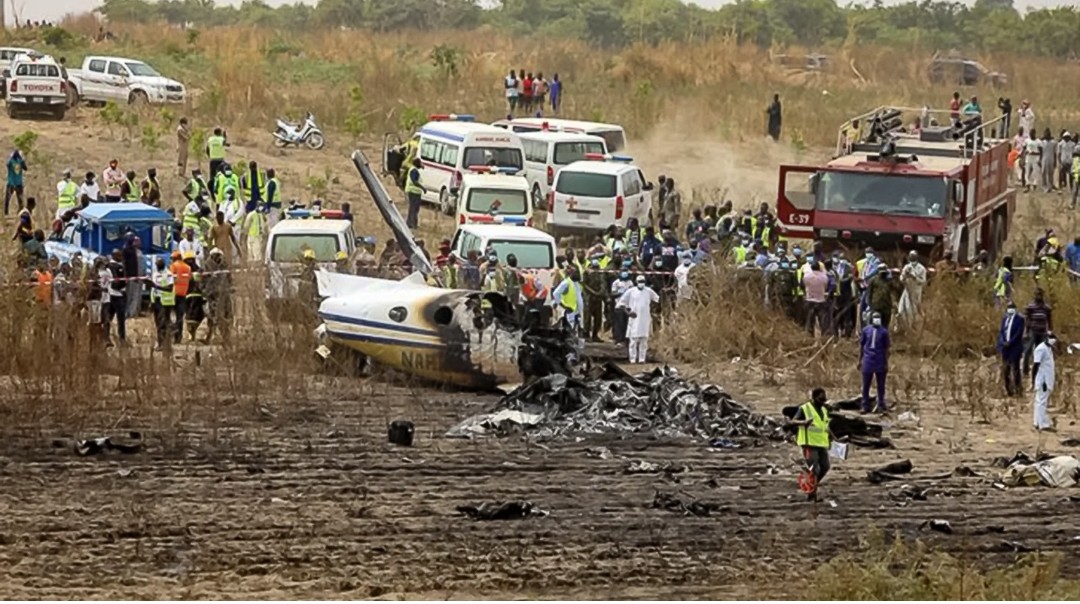
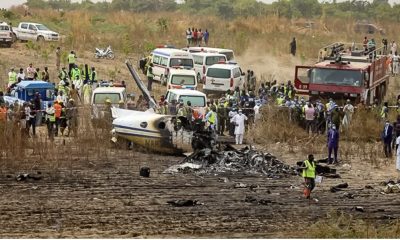
A Nigerian Air Force ATR-42 aircraft on a routine flight from Benin City to Lagos crashed into a swamp in Igbokoda, Ilaje Local Government Area of Ondo State, on Monday after reportedly disappearing from radar shortly after take-off.
The aircraft, with tail number NGR 931, lost communication with air traffic controllers at about 9:13am. A senior air traffic controller, who spoke anonymously, said repeated attempts to re-establish contact with the aircraft failed.
According to the source, personnel around Okitipupa later reported hearing a loud bang suspected to have come from the crash site.
The Minister of Aviation and Aerospace Development, Festus Keyamo, confirmed that the aircraft had disappeared from radar and that all efforts to raise it on radio were unsuccessful.
He later announced that the wreckage had been located near the Naval Base in Igbokoda.
Keyamo said 32 people—25 passengers and seven crew members—were on board.
The Nigerian Air Force confirmed the crash, saying the aircraft was on a routine mission from Benin to Lagos and that search-and-rescue operations had commenced in coordination with relevant authorities.
The crash site, located in a swampy creek, proved difficult to access, with military personnel, emergency responders and local fishermen joining the rescue operation.
Governor Lucky Aiyedatiwa said no survivor had been found as of Monday evening, although the authorities had yet to officially announce a death toll.
The governor said rescuers recovered parts of the aircraft, identification cards and military uniforms from the site.
President Bola Tinubu expressed sadness over the incident and directed the Nigerian Air Force to immediately commence a thorough investigation into the cause of the crash.
Investigators are expected to examine the wreckage, flight path, weather conditions, maintenance records and air traffic control communications. Efforts were also being made to recover the aircraft’s flight recorder, which could provide crucial information about its final moments.
The cause of the crash remains unknown.
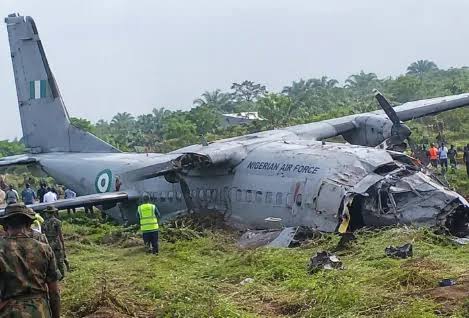
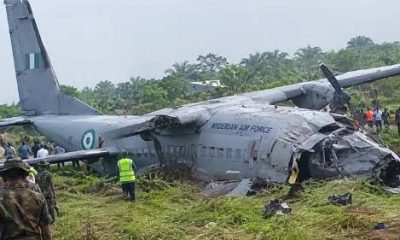
Ondo State Governor, Lucky Aiyedatiwa, has disclosed that no survivor has so far been found following the crash of a Nigerian Air Force aircraft in Igbokoda, Ilaje Local Government Area of the state.
Aiyedatiwa made this known during an interview with Channels Television on Monday, saying local residents, security personnel and emergency responders had searched the crash site without finding anyone alive.
The governor said he received information about the incident at about 10:30am after the chairman of the local government contacted him.
According to him, residents living across the river from the Nigerian Navy base in Igbokoda heard a loud sound and subsequently saw the aircraft plunge into a swampy area.
He explained that personnel of the Nigerian Navy initially stayed back to determine whether the crash had triggered a fire or explosion before proceeding to the site.
“When they noticed that it’s just an accident, they didn’t see any sign of fire. So they moved in, trying to see if they could rescue the people,” Aiyedatiwa said.
He added that officials of the state emergency management agency, local residents and personnel of the Amotekun Corps later joined the search and rescue operation.
“But from the information we got, no single life was saved up to this moment. They could not see any living soul that was in that aircraft,” the governor said.
Aiyedatiwa said searchers recovered parts of the aircraft, including pieces of the wings, identification cards and military uniforms, which helped establish that the aircraft was a military plane.
“But they saw the ruins, some of the wreckage from the wings of the aircraft, you know, some ID cards, I was told, and then uniform. That was when they knew it was a military aircraft,” he said.
The governor described the incident as a painful development, noting that the crash occurred not only in Ondo State but also in his home local government area.
“So it’s a sad situation today. And we’re all really, really agreed as a Nigerian. And also it happens in my own state, not just my state, even in my own local government where I’m from,” he said.
Aiyedatiwa expressed sympathy for the military personnel involved, describing them as officers assigned to protect the territorial integrity of Nigeria.
The Nigerian Air Force had earlier confirmed that an ATR-42 aircraft with tail number NGR 931 crashed in Igbokoda while on a routine mission from Benin, Edo State, to Lagos.
Minister of Aviation and Aerospace Development, Festus Keyamo, said preliminary information indicated that 25 passengers and seven crew members were on board the aircraft.
The Nigerian Air Force said search and rescue operations were ongoing following the crash.

“If You Have Evidence Against Stanley Mbam, Charge Him; Otherwise, Release Him” — Oganiru Izzi
A socio-cultural organisation of Izzi extraction, Oganiru Izzi, has challenged Ebonyi State Governor, Chief Francis Ogbonna Nwifuru, to either release the state’s sacked Commissioner for Works, Mr Stanley Mbam, or charge him before a competent court if the government has credible evidence of wrongdoing against him.
The group said the continued detention of the former commissioner without a formal charge raises concerns about due process, constitutional rights and the rule of law.
The leader of Oganiru Izzi, Mr Godwin Mbam, made the demand while speaking with correspondents of National Issue Newspapers at the Crack Department of the Ebonyi State Police Command in Abakaliki.
Mbam condemned what he described as the prolonged detention of Stanley Mbam without allowing a court to determine whether he had committed any offence.
He challenged the state government to produce evidence if it believes the former commissioner committed a criminal offence.
“If there is credible evidence against him, charge him to court and let the court decide. If there is no case against him, he should be released,” Mbam said.
He also appealed to the Ebonyi State Police Command to uphold the Constitution and resist any pressure that could result in unlawful detention.
Vanco Flyover: “We Will Reveal the Full Details”
Mbam also issued a three-day challenge to Governor Nwifuru, declaring that if the former commissioner was not released or charged to court, his organisation would make public what it described as the “full details” of the Vanco Flyover project.
According to him, the proposed disclosure would address issues surrounding the project, including its funding, payments, contractual arrangements and other financial details.
“We will let the world know the full details of the Vanco Flyover and how the funds were utilised,” he warned.
He further challenged the state government to demonstrate transparency by making relevant documents concerning the project available to the public.
“What About the Alleged ₦1.5 Billion Forfeiture?”
The Izzi group also questioned what it described as the selective application of the state government’s anti-corruption campaign.
Mbam referred to allegations involving an account reportedly frozen by the Economic and Financial Crimes Commission (EFCC) and an alleged ₦1.5 billion forfeiture to the Federal Government.
He questioned why, according to him, the governor had allegedly not taken similar action if the facts surrounding the matter warranted it.
Mbam stressed that he was not opposed to the fight against corruption but insisted that any anti-corruption campaign must be comprehensive, transparent and applied equally.
“If Governor Nwifuru wants to fight corruption, let him fight it holistically. Nobody should be targeted while other serious allegations are ignored,” he said.
“If Nwifuru Says He Knows Nothing, We Will Produce the Facts”
Mbam further challenged Governor Nwifuru to publicly state whether he was aware of alleged corruption issues within the Ministry of Works.
“If Nwifuru publicly claims that he is unaware of corruption in the Works Ministry, I will make public the facts available to me. The facts will shock the state,” he declared.
He insisted that the matter should not degenerate into a political vendetta, arguing that the appropriate place to determine criminal liability is a court of law.
According to him, the people of Ebonyi State deserve clear answers concerning the Vanco Flyover and other issues involving public funds.
“Everybody Should Be Subject to the Law”
The Oganiru Izzi leader maintained that the controversy should be resolved through transparency, documentary evidence and due process.
“If there is a case, charge him. If there is no case, release him. The government cannot claim to be fighting corruption while abandoning the principles of justice and the rule of law,” he said.
Mbam warned that failure to address the issues could compel the organisation to make further disclosures concerning the Vanco Flyover and other matters it considers to be in the public interest.

-

 Politics2 days ago
2027: Odii Will Not Step Down, Says Spokesperson
-
 News2 days ago
How NAF Plane Vanished From Radar Shortly After Take-Off, Crashes In Ondo Swamp
-

 News4 days ago
Sacked Works Commissioner: Release or Charge Him to Court, Oganiru Izzi Challenges Nwifuru
-
 News2 days ago
No Survivor Found Yet in Ondo Air Crash — Aiyedatiwa
-

 EverydayNews Telescope2 days ago
Nkalagu Cement Factory: Project or 2027 Political Promise?
-
 Crime4 days ago
Police Deploy DIG, Two Commissioners to Rescue 20 Abducted Prospective Corps Members
-
 News2 hours ago
Curfew Continues as Soludo Sets Up Commission of Inquiry Over Aguleri–Umuoba Anam Clash
-
 Crime1 day ago
Court Denies Alleged Fake Pastor Bail as Seven Witnesses Await Trial