


Politics
Emergency: Ibas meets Reps panel today as protests continue



The River State Sole Administrator, Vice Admiral Ibok-Ete Ibas (retd,), was expected to appear before the House of Representatives Committee overseeing the state’s administration under the emergency rule on Thursday but did not attend the meeting.
The Committee Chairman, Prof Julius Ihonvbere, conducted a closed-door session with committee members, lasting about 50 minutes, but declined to speak to the press afterward.
Journalists were left disappointed as the committee members refused to comment.
The meeting included prominent lawmakers such as Deputy Chief Whip, Ali Isah, and the chairpersons of various House committees, including those for Federal Character, Finance, Water Resources, and Health Services.
While no official reason was provided for Admiral Ibas’s absence, a source disclosed that Ibas will now meet with the committee on Friday, April 25, 2025, at 10 am in the National Assembly Complex.

The Sole Administrator’s participation at the National Economic Council meeting, chaired by Vice President Kashim Shettima, could explain his absence.
Meanwhile, protests continued in Rivers State as hundreds of women from the Opobo Kingdom marched to demand the immediate reinstatement of Governor Siminalayi Fubara, whose suspension followed the declaration of a state of emergency in the state.
The women rejected the appointment of a Sole Administrator to manage the state’s affairs, calling the emergency rule unconstitutional.
The protest, led by the President of the Opobo Women Association, Felicia Pepple, began with a solemn prayer session at King Jaja Monument Square, with the women wearing black to seek divine intervention.
A cleric, Venerable Michael Dappa, delivered a sermon that inspired the protesters. The women then marched to the Water Side, chanting, “Bring back our Governor,” and sat on the ground in protest.
Pepple emphasised the governor’s positive contributions to the state’s development and appealed to President Bola Tinubu to reinstate Fubara: “We voted for our peaceful and amiable Governor, Sir Siminalayi Fubara; we say no to emergency rule.” She urged Nigerians to support their cause and decried the hardship faced by the people of Rivers State under the emergency rule.
A resident, Blessing Accra-Jaja, lamented that the town’s once-bustling landmarks, like King Jaja Monument Square and local hotels, had become deserted.
She called on the National Assembly Reconciliation Committee and President Tinubu to reinstate Governor Fubara, hoping it would restore peace and the town’s festive spirit.
The Rivers Women Unite Prayer Group also expressed concern over the ongoing emergency rule, calling on President Tinubu to end the crisis.
They warned that the economy of Rivers State was deteriorating, causing hardship for women, youths, and children. In a prayer rally held in Port Harcourt, the group urged the president to lift the emergency rule, restore the state’s democratic institutions, and return Governor Fubara to office.
The group’s statement, signed by Dr. Vivian Ige-Elenwo and Chikodi Okpara, appealed for reconciliation and an end to the political standoff, emphasising the need for urgent action to save the state’s economy and improve the living conditions of its people.The women expressed unwavering support for President Tinubu but remained firm in their demand for justice, equity, and the return of their elected governor.
The statement also called for greater security measures in the wake of recent attacks in Plateau, Benue, and Gombe states, highlighting the need for sustainable peace and development in the country.
Lawyers demand NBA President’s resignation
Meanwhile, a coalition of prominent legal professionals under the aegis of the Public Interest Lawyers League has called for the immediate resignation of the President of the Nigerian Bar Association, Afam Osigwe (SAN), and the Chairman of the NBA Annual General Conference Organising Committee, Emeka Obegolu, following controversy surrounding a N300m payment allegedly received from the Rivers State Government.
The group’s demand comes amid growing calls for the NBA to refund the sum, said to have been paid into its coffers by the suspended Governor of Rivers State, Siminalayi Fubara, for the hosting of the association’s 2025 Annual General Conference.
Though the NBA has since relocated the conference to Enugu, it maintains that the N300m was a “gift” from the Rivers State Government.
At a press briefing on Thursday in Abuja, PILL President, Abdul Mahmud, accused the NBA leadership of compromising the integrity of the association.
He urged them to return the funds and resign immediately to salvage what remains of the association’s credibility.
“The NBA cannot claim to be the watchdog of public morality while engaging in conduct so thoroughly devoid of the very standards it seeks to impose on others,” Mahmud said. “The insistence of the NBA leadership to hold on to the N300m is not only disgraceful but reflects a deeper rot that has enabled an unaccountable elite within the association to treat the NBA as a personal fiefdom.”
Mahmud stressed that their call for resignation was not punitive, but a necessary first step towards organisational reform.
“This moment demands accountability, courage, and leadership,” he declared. “These resignations are necessary acts of organisational cleansing, aimed at restoring trust and credibility in the NBA.”
PILL further condemned the lack of transparency surrounding the transaction, noting that the revelation came not from NBA leadership, but from the Sole Administrator of Rivers State.
“It was not disclosed in any official NBA communication, nor acknowledged by the Conference Organising Committee. It took an external whistleblower to bring this dark secret to light,” Mahmud said. “This scandal is not just about money—it is about principle, integrity, and the very soul of the Nigerian Bar

…Denies Government Involvement in NDC Airport, Secretariat Incidents
…Says Mbah’s Performance Sufficient to Secure Re-election in Free, Fair Polls
The Enugu State Government has alleged that some opposition elements are plotting to bring armed thugs and bandits into the state to create panic and portray Enugu as insecure ahead of the 2027 general elections.
The Secretary to the State Government (SSG), Prof. Chidiebere Onyia, made the allegation on Sunday during a press conference at the Government House, Enugu, where he addressed two incidents involving the Nigeria Democratic Congress (NDC) at the Akanu Ibiam International Airport and the party’s state secretariat in Enugu on Saturday.
Onyia denied any involvement of the state government or Governor Peter Mbah’s Chief Security Officer, Ifeanyi Osondu, in either incident. He described the airport confrontation as a matter between the NDC and federal authorities, while noting that the shooting incident at the party’s secretariat was under police investigation.
According to the SSG, the government’s preliminary findings indicated that the airport incident followed the NDC’s attempt to hold what it described as a “Grand Statewide Campaign Flag-off 2026” at the facility without obtaining the necessary approval from the Federal Airports Authority of Nigeria (FAAN).
He said the party had publicised the event and invited members and supporters to attend, including through the Facebook page of its governorship candidate in the state.
Onyia explained that the police had advised the party to obtain FAAN’s approval before security personnel could be deployed to the airport for the event.
“Further findings, however, revealed that the NDC did not secure the approval of FAAN to host a grand statewide rally at its facility. Security agencies, therefore, advised the organisers of the rally to rethink it,” he said.
The SSG alleged that the party proceeded to mobilise its members to the airport and attempted to gain entry into the facility, resulting in a confrontation with airport authorities.
He said security agencies intervened to disperse what he described as “riotous” party members and restore order around the airport, which he characterised as a strategic national asset.
Onyia added that the state government’s account was consistent with a statement issued by the Enugu State Police Command on Sunday.
NDC Secretariat Shooting
Addressing the shooting incident at the NDC state secretariat in the GRA area of Enugu, Onyia said security reports had confirmed that a violent clash occurred at the party’s office and that the police were investigating the matter.
He disputed reports of fatalities, claiming that the government’s preliminary findings indicated that no one had died in the incident.
According to him, a 43-year-old man, identified as Ifeanyi Nworie, sustained a gunshot wound and was taken to the Enugu State University Teaching Hospital, Park Lane, where he was stabilised before being transferred to the National Orthopaedic Hospital, Enugu, for further examination.
“We can, therefore, authoritatively report that there were no deaths as falsely claimed by some reports and NDC leaders,” he said.
Onyia also rejected allegations that the governor’s Chief Security Officer was present at the party secretariat and supervised the shooting. He maintained that Osondu was with Governor Mbah at the Teachers Grassroots Movement mega rally at Okpara Square, Enugu, when the incident occurred.
The SSG further criticised the reported observance of a minute’s silence for an individual he claimed was still alive, describing it as an attempt to mislead the public for political gain.
Reaffirming the government’s position, Onyia said Mbah had sworn to protect the lives and property of all residents, irrespective of their religious beliefs or political affiliations.
He said the administration’s ambition to grow Enugu into a $30 billion economy and make it a preferred destination for investment, business, tourism and living depended significantly on sustained peace and security.
According to him, this commitment informed the government’s substantial investments in security infrastructure and operations over the past three years.
“Consequently, the Enugu State Government strongly condemns in its entirety any form of violence, including politically induced violence in the state. We welcome healthy debate and freedom of association and peaceful assembly,” he said.
He urged political parties and their candidates to exercise restraint and embrace issue-based campaigns ahead of the 2027 elections.
The SSG maintained that democratic rights should be exercised responsibly, arguing that political parties ought to serve as models of decorum and integrity.
He questioned the decision to announce a statewide campaign flag-off at the airport without obtaining approval from the relevant authorities.
“Without holding brief for FAAN, is it not sheer rascality to attempt to hold a ‘Grand Statewide Campaign Flag-off 2026’ of the NDC at the airport as publicised by the party and its gubernatorial candidate, especially without the approval by the appropriate authorities?
“Is it not equally gross mischief and a sign of political desperation to hold a minute’s silence for a living person, just to mislead the public for political traction?” he queried.
Government Alleges Opposition Plot
Onyia accused opposition elements in Enugu of attempting to create the impression that the state was unsafe and that the government was intolerant of opposing political parties.
He alleged that some opposition groups had been attributing internal disagreements and violent clashes to the All Progressives Congress (APC) in the state.
Citing an incident at Obuofia in Nkanu West Local Government Area on September 12, 2026, the SSG claimed that investigations had identified the alleged perpetrators and that the police were prosecuting them.
He described the opposition as factionalised and alleged that some of its members were attempting to draw the state government into controversies to gain political relevance.
Onyia reiterated the government’s allegation that some opposition elements were plotting to bring armed thugs and bandits into Enugu to create panic and undermine public confidence in the state’s security ahead of the 2027 general elections.
“We, however, make bold to say that the peace and security we have achieved in Enugu State in the last three years, and at huge material costs and sacrifices by our security agents, are non-negotiable and irreversible,” he said.
The SSG said the Mbah administration remained committed to protecting citizens’ democratic rights, including the freedom to campaign for and vote for candidates of their choice in the forthcoming elections.
He described the right of residents to elect their leaders through free, fair and credible polls as fundamental to the state’s democratic development.
Mbah’s Performance and 2027 Re-election Bid
Onyia expressed confidence that Mbah would secure a second term, citing what he described as the governor’s performance and delivery on campaign promises.
He said the administration had no reason to resort to desperate measures, insisting that its record in office would form the basis of its appeal to voters for a renewed mandate.
“Indeed, these inalienable rights of Ndi Enugu to elect their leaders in free, fair and credible polls are our surest hope for re-election come 2027,” he said.
Politics
2027: Over 30,000 Enugu Teachers Endorse Mbah, Tinubu, Cite Welfare Improvements, Increased Education Funding
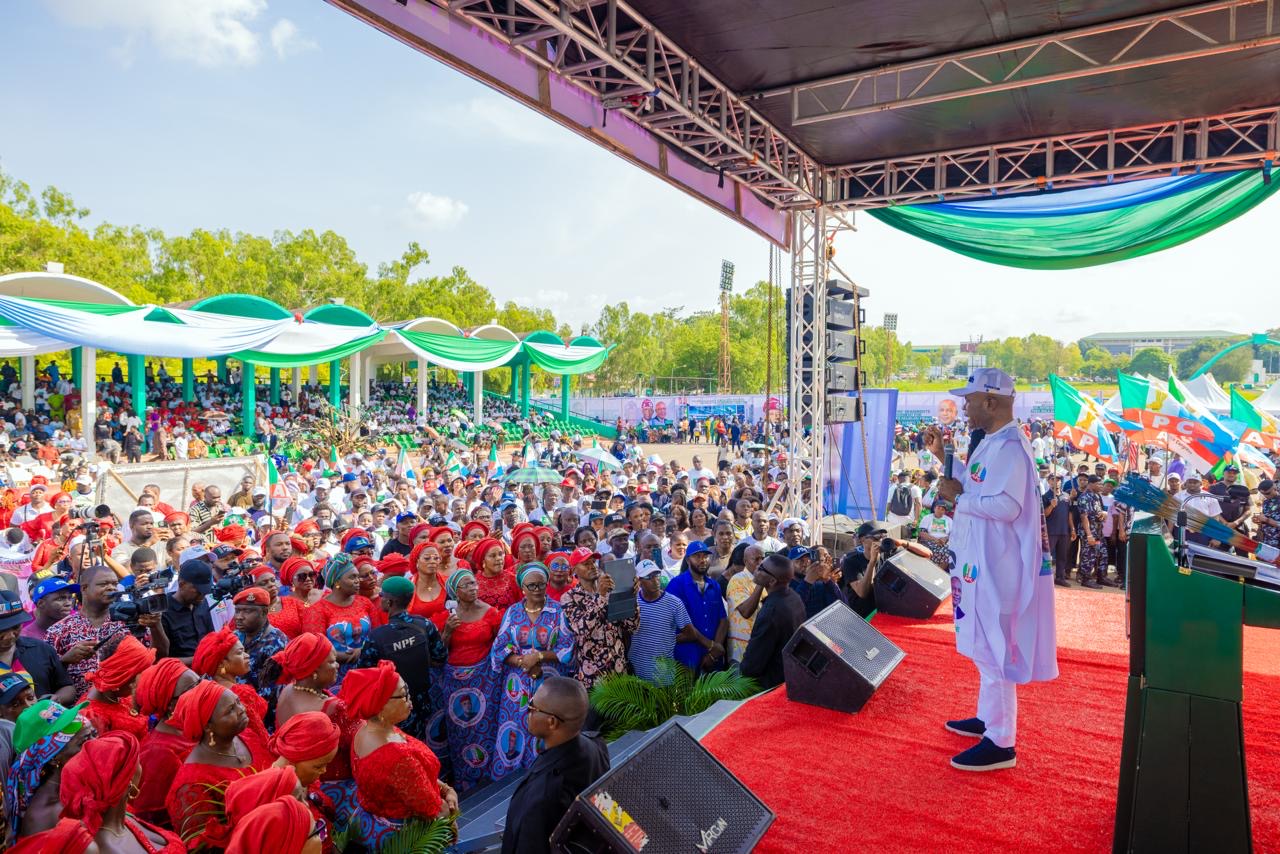
Teachers across public and private schools in Enugu State have endorsed Governor Peter Mbah for a second term in office, citing improved welfare, timely promotions, increased education funding and other interventions by his administration.
The teachers also endorsed President Bola Ahmed Tinubu, whose economic reforms, according to Mbah, had made more resources available to states to undertake major projects, including the construction of over 267 Smart Green Schools across the 260 political wards of Enugu State.
The teachers declared their support through a rally organised by the Teachers for Grassroots Movement (TGM), with over 12,000 members marching through parts of Enugu metropolis before converging on Okpara Square, Enugu, on Saturday for the endorsement event.
Speaking at the rally, the Chairman of the Enugu State chapter of the Nigeria Union of Teachers (NUT), Comrade Theophilus Odo, described Mbah as a Godsend, highlighting measures taken by the governor to address longstanding challenges in the state’s education sector.
“On behalf of the NUT, I want to say that we are happy today because God has given us a caring governor, Peter Mbah,” Odo said.
He noted that Mbah had supported the domestication of harmonised retirement benefits for teachers even before becoming governor.
“The building of over 260 Smart Green Schools is a very positive change. Our teachers and children can now compete favourably with their peers in other places,” he said.
Odo added that the administration had commenced the recruitment of thousands of teachers while investing in professional development through symposiums and other training programmes.
“There are no outstanding promotions, and our salaries are coming at the appropriate time.
“So, we, the teachers, are endorsing our governor for a second term in office. The votes of our teachers are only for Governor Mbah,” he declared.
In his remarks, the Enugu State Chairman of the National Association of Proprietors of Private Schools (NAPPS), Nelson Agu, said private school teachers were participating in such a rally in the state for the first time to show support for what he described as Mbah’s revolution in the education sector.
He said the introduction of Smart Green Schools had challenged private school proprietors to upgrade their facilities and improve educational standards.
“When you came and started the idea of over 260 Smart Green Schools, we thought we were out of service. But we went and upgraded our schools to meet the required standards,” Agu said.
He also commended the administration’s allocation of 33 per cent of the state budget to education for three consecutive years.
“Importantly, the idea of allocating 33 per cent of the budget to the education sector for three consecutive years is something to laud your administration for,” he added.
The Chairman of the Trade Union Congress (TUC) in Enugu State, Simeon Akaeme, said the Mbah administration had restored the dignity of teachers and improved their living conditions through investments in infrastructure and social services.
Similarly, the Director-General of TGM, Dr. Nwakaego Aja, described education as a pathway to liberation, self-reliance and economic development, particularly amid the systemic challenges confronting the country.
Aja assured the governor of the support of the movement’s over 30,000 members, saying the administration’s education reforms had demonstrated the role of education in driving economic growth.
“Through experiential learning and innovation, you brought answers to the quest by our nationalists, elevating education to a catalyst for economic development,” she said.
“We, the teachers, are not ingrates. We see what you are doing. You promised disruptive innovation, and you have delivered disruptive innovation. That is why we are here.
“We promise you this: we will take your good news to the communities, to the staff rooms, to every market, to every polling unit, and we will deliver. Our vote is for the All Progressives Congress (APC) from bottom to top,” she added.
The Enugu State Commissioner for Education and patron of TGM, Prof. Ndubueze Mbah, described the endorsement by thousands of teachers as an indication of the broader support expected for Governor Mbah and President Tinubu ahead of the 2027 general elections.
Speaking on behalf of the teachers, he thanked the governor for prioritising education and investing resources in creating better opportunities for children across the state.
“On behalf of every teacher gathered here today, I have one message, and that is to thank you for believing and investing in the vision that it is through education that Enugu State will attain greater heights. You have committed so many resources to giving every Enugu child a future,” he said.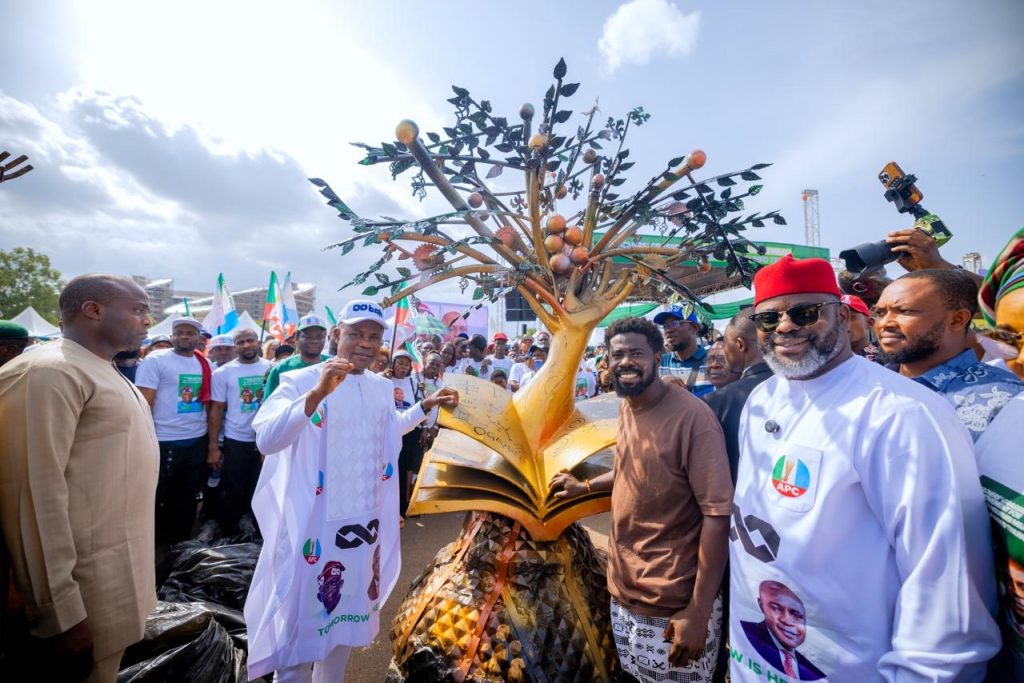
In his address, Governor Mbah said the endorsement was significant beyond the 2027 elections, stressing that the success of his administration’s development agenda depended largely on teachers and the education system.
“Today’s endorsement carries a particular significance, and that is because everything we do, all the promises we have made, all the projections we have made — growing Enugu’s economy, becoming one of the top three states in terms of GDP, making Enugu State the number one state in terms of investment, business, living and tourism — are in the hands of our teachers,” he said.
The governor said his administration’s investments in education included the construction of over 7,000 classrooms, the provision of 25,000 desktop computers and more than 5,000 tablets, as well as free feeding and uniforms for pupils.
He added that the government was focused on transforming the state’s education system rather than merely providing infrastructure and learning materials.
“For us, it is about transformation — transforming an education system. And that whole transformation, whether we fail or succeed, would lie largely in your hands,” Mbah said.
He expressed appreciation for teachers’ contributions to the state’s development, acknowledging the challenges they face in educating children and preparing them for the future.
“That is why, when I say that I see you and I value you, it comes from the depths of my heart because I understand what you go through to inculcate this knowledge into our children so that we can become that great state. So, we love you and appreciate you dearly,” he added.
The governor’s wife, Mrs. Nkechinyere Mbah, represented by the Commissioner for Children, Gender Affairs and Social Development, Mrs. Ngozi Enih, described the endorsement as a strong affirmation of an administration that had placed education at the centre of its development agenda.
The rally was attended by senior government officials, political and community leaders, and other stakeholders.
…Says 2027 Election Will End Politics of Godfatherism, Privilege in Ebonyi
BY PETRUS OBI
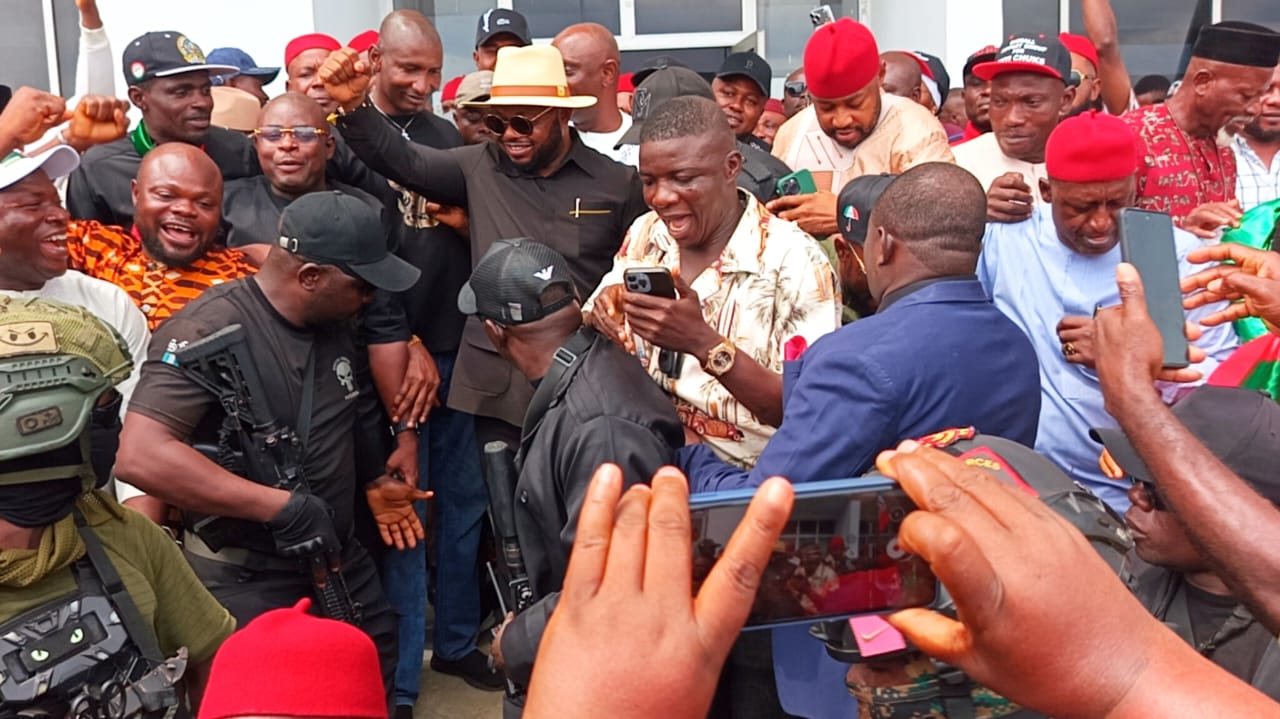
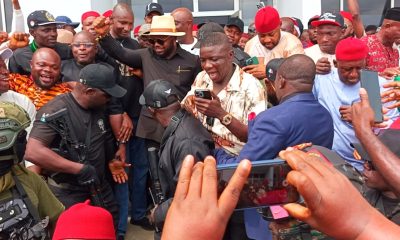
Abakaliki, the Ebonyi State capital, witnessed an extraordinary political reception as thousands of enthusiastic supporters trooped out to welcome the Peoples Democratic Party (PDP) governorship candidate, Chief Dr Ifeanyi Chukwuma Odii, on his return to the state.
From the Akanu Ibiam International Airport, Enugu, where a large crowd gathered to receive him, to Abakaliki, where another mammoth crowd assembled, Odii’s arrival generated considerable excitement among supporters, temporarily bringing activities in parts of the state capital to a standstill.
The reception took another dimension at a filling station in Abakaliki, where the PDP candidate reportedly treated supporters who gathered to welcome him to free fuel, with beneficiaries driving away with filled tanks.
Addressing the enthusiastic crowd, Odii urged Ebonyi residents, irrespective of their places of origin, to prepare for what he described as a tough but decisive political battle ahead of the 2027 governorship election.
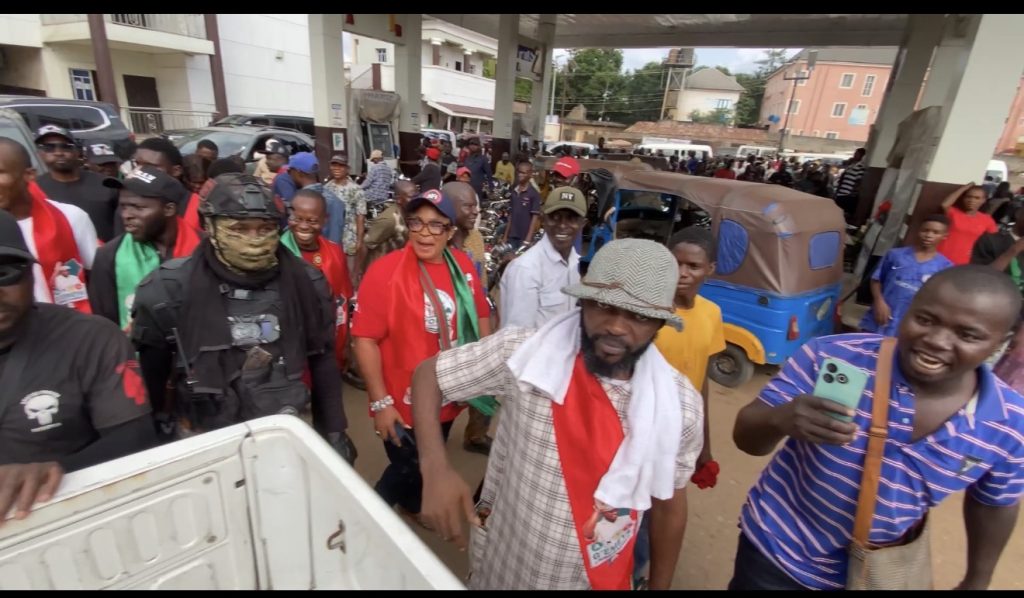
He expressed confidence that the collective determination of the people would ultimately prevail, insisting that the forthcoming election represents a defining moment in the political history of the state.
According to him, his governorship ambition is not driven by personal interests but by a determination to rescue Ebonyi from years of missed opportunities and alleged mismanagement of public resources.
Odii described his Anyi G’ Emeya movement as a people-driven mission aimed at restoring accountable leadership, creating economic opportunities and building an inclusive government that works for every Ebonyi resident.
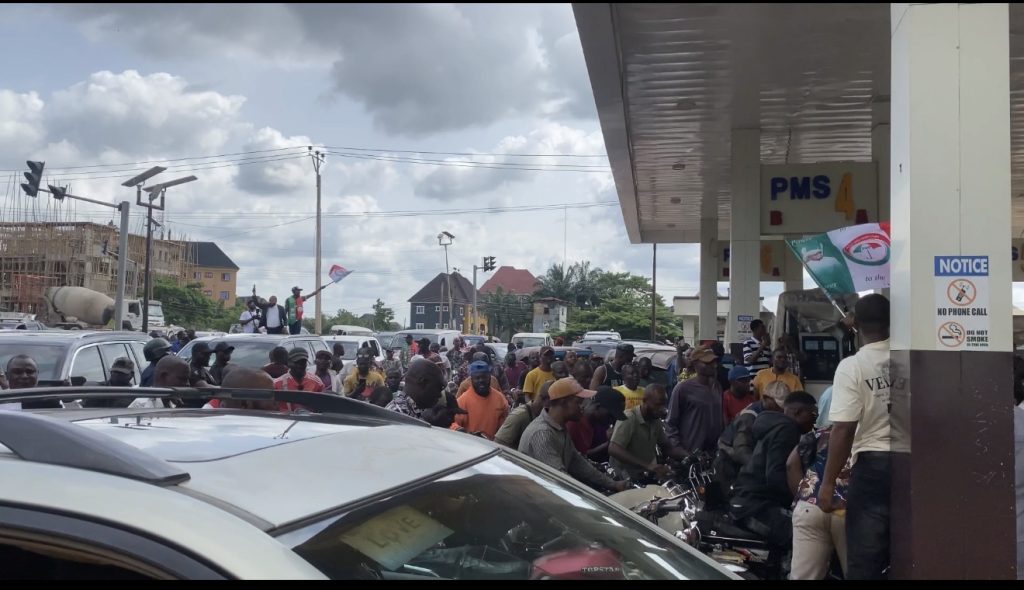
Cheering supporters
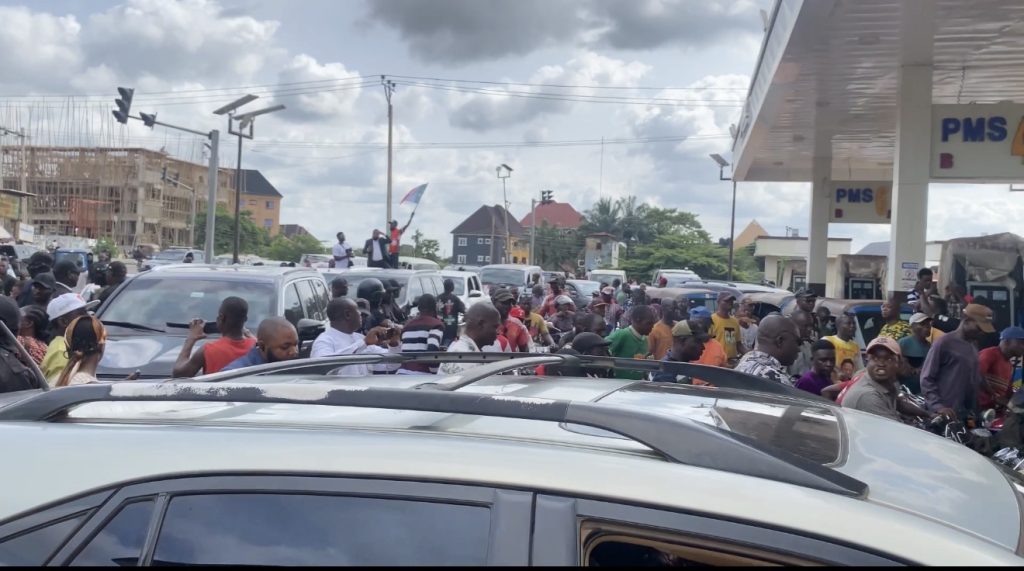
Free fuel for all
He assured supporters that the deployment of modern technology and competent technology experts to monitor electoral activities across polling units would make electoral manipulation increasingly difficult.
The PDP candidate consequently urged eligible voters to obtain their Permanent Voter Cards (PVCs) and remain vigilant throughout the electoral process.
Speaking further, Odii declared that his achievements in business had already placed him in a position to enjoy extraordinary comfort and luxury anywhere in the world without seeking political office.
He explained that he could have chosen a life of leisure, travelling in luxury yachts and private aircraft, rather than subjecting himself to the demands and challenges of political leadership.
However, he maintained that his decision to contest the governorship election was informed by a greater desire to create an Ebonyi State where opportunities would no longer be the exclusive preserve of the politically connected.
Odii said his vision was to build a society where children from poor families could aspire to become governors, ministers, lawmakers and other prominent public officeholders on the strength of their intelligence, competence, leadership qualities and personal accomplishments.
He condemned a political culture in which access to opportunities and public offices is perceived to depend on family connections, influential relatives, in-laws or powerful political godfathers.
The PDP standard-bearer insisted that Ebonyi must embrace a new political order where merit, fairness and equal opportunity, rather than privilege and political patronage, determine the future of its citizens.
He called on supporters to remain united and committed to the Anyi G’ Emeya movement, expressing optimism that the 2027 election would usher in a new era of leadership in Ebonyi State.
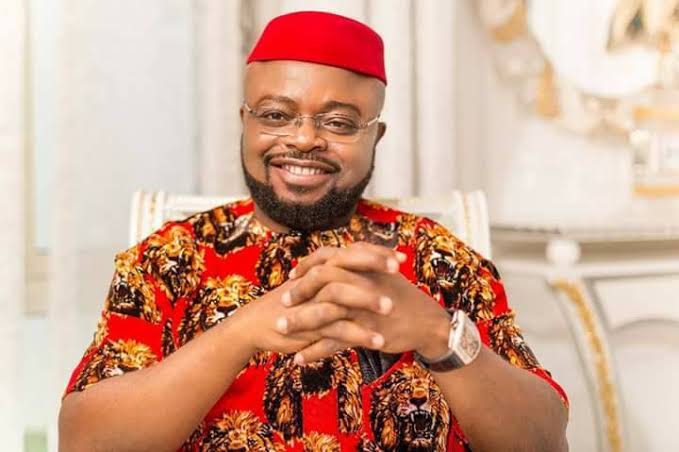
ABAKALIKI — The camp of the Peoples Democratic Party (PDP) governorship candidate, Chief Dr Ifeanyi Chukwuma Odii, has dismissed reports suggesting that he may withdraw from the 2027 Ebonyi State governorship race and support Governor Francis Nwifuru.
In a statement signed by Odii’s spokesperson, Chief Emmanuel Chidi Igwe, the campaign described the reported withdrawal as false, insisting that Odii remains committed to contesting the election.
According to Igwe, “Chief Dr Ifeanyi Chukwuma Odii will never, under any condition, step down from the 2027 governorship contest.”
The statement said Odii’s political camp remains focused on what it described as its campaign position: “Odii must run and win.”
It added that any political discussions, persuasion or negotiations involving other individuals should not be interpreted as a decision by Odii to abandon his governorship ambition.
Camp Rejects Withdrawal Narrative
The Odii camp further described reports of a possible withdrawal as a political narrative allegedly being promoted by individuals opposed to his candidacy.
Igwe challenged those behind the reports to produce evidence showing that Odii had personally announced his withdrawal from the race.
“There is a fundamental difference between reporting that a politician intends to persuade Chief Odii to withdraw and reporting that Chief Odii has agreed to withdraw,” the statement said, stressing that the latter would require evidence from the candidate himself.
The spokesperson also urged journalists, bloggers and online publishers to maintain professional standards when reporting political developments, warning against presenting speculation or the intentions of third parties as established decisions by political candidates.
24-Hour Retraction Demand
The camp has consequently demanded that publishers of the alleged withdrawal story retract or prominently correct their reports within 24 hours, unless they can produce an authentic statement from Odii confirming that he has decided to withdraw from the 2027 contest.
The statement also reminded online publishers of their responsibilities under Nigerian law, citing the Cybercrimes (Prohibition, Prevention, etc.) Act 2015, as amended, as well as other laws relating to unlawful online publications and defamatory material.
The spokesperson clarified that the reference to the law was not intended as a threat against legitimate journalism or political criticism, but as a reminder that political disagreements should remain within the bounds of the law.
The statement concluded by reaffirming that Odii remains in the 2027 governorship race and urged members of the public to regard reports of his withdrawal as unverified unless supported by a direct statement from him.
By Petrus Obi, London
London — The Peoples Democratic Party (PDP) governorship aspirant in Ebonyi State, Ifeanyi Odii, has intensified his criticism of the administration of Governor Francis Nwifuru, insisting that the people of the state deserve a different approach to governance.
Odii, who spoke with EverydayNewsngr.net in London, said what he described as the “fire brigade approach” of the Nwifuru administration was not the kind of governance Ebonyi needs.
According to him, the state requires a government with a clear vision, long-term planning and the capacity to deliver meaningful development to its people.
“The fire brigade approach of the Nwifuru government is not what the state needs,” Odii said.
He added: “I am coming to bring a new lease of life to my people.”
Odii’s comments come amid renewed political debate in Ebonyi State following the recent removal of the state Commissioner for Works. The development has attracted attention from opposition circles, with critics using it to question aspects of the administration’s handling of governance and infrastructure.
The PDP chieftain said the people of Ebonyi should expect more than what he described as reactive governance, arguing that development should be driven by a coherent programme capable of producing lasting results.
He maintained that his political ambition was motivated by a desire to provide what he described as purposeful leadership and improve the welfare of residents across the state.
“We deserve better government in Ebonyi State,” Odii said, stressing that his vision was centred on giving the people renewed confidence in government and creating opportunities for them to prosper.
As political activities ahead of the next governorship election continue to gather momentum, governance, infrastructure, accountability and the delivery of public services are expected to feature prominently in the emerging contest.
Odii’s intervention in London is likely to add further momentum to the political conversation, particularly as opposition figures seek to distinguish their vision for Ebonyi from that of the incumbent administration.

-
 News4 days ago
Ebonyi Cement Project: Where Is the Limestone Evidence?
-
 Politics2 days ago
Odii Shuts Down Abakaliki, Buys Fuel for Thousands of Supporters at Grand Reception
-
News4 days ago
Governor Mbah Hails Chibuikem Emmanuel as Youth Entrepreneurship Reference Point, Commends Powell Homes’ Housing Investment
-
 News4 days ago
REC urges Enugu residents not to wait for rush hours in Claims/Objections, PVC collection windows
-
Entertainment4 days ago
The Green Panther: Meet the Singer Behind ‘Heal Nigeria’ and ‘Higher Higher’
-

 Crime3 days ago
Freed NYSC Graduates Offered South-West Postings After Kidnap
-
 Business2 days ago
Value Circle Africa berths in Enugu, promises wealth creation
-
 Crime3 days ago
Court Remands US-Based Car Dealer Over Alleged $680,000 Fraud