



Crime
Ataga: Police forced me to write false statement, says Chidinma



Chidinma is standing trial for the alleged murder of the Chief Executive Officer of Super TV, Michael Usifo Ataga.
In her defence before Justice Yetunde Adesanya at the Lagos High Court sitting at Tafawa Balewa Square, Chidinma said fear prevented her from speaking the truth during her interactions with the police.
“Because of the fear that the Investigating Police Officer, Mr. Bamidele, and his team put in me, I couldn’t say anything contrary to the narration he asked me to tell the Commissioner of Police,” she testified.
Chidinma, Adedapo Quadri and her sister, Chioma Egbuchu, are facing charges of stealing and forgery.

They were arraigned on October 12, 2021, on a nine-count charge.
The defendant, who opened her defence on April 17, 2025, narrated how she was arrested on June 23, 2021 and interrogated.
“The IPO, Mr. Bamidele, collected my phone and asked me to input my password, which I did. He went to my contact list and searched for my sister’s name. He asked me to confirm it, then wrote it down.”
She continued, “He asked me about my laptop and what I went to do at Computer Village. I told him I went to repair the laptop on the table and sold another one. He asked which one I sold, I said a MacBook. He asked where I sold it, I said a phone vendor, and then he wrote the address down.”
Chidinma said Bamidele also questioned the cannabis she and Ataga allegedly smoked.
“He asked where I got the cannabis from. I said I have someone who supplies me. He asked who, I said Quadri. He asked for his number, I said it was on my phone, and he wrote it down.”
“When he asked about Michael’s ATM card, I told him I didn’t have it. He said N5m had been withdrawn and another N20,000 withdrawn a few times, totalling N5,380,000. I said, ‘Sir, I don’t know anything about it.’”
She told the court that, following the interrogation, Bamidele claimed to have gathered evidence and ordered her to write her statement.
When she protested that she had already written a statement and her lawyer was absent, she was slapped.
“I said, ‘Sir, I’ve written my statement and you tore it. Now you want me to write another one and my lawyer is not here.’ Then I got a slap on the back,” she recounted.
“I picked up the pen and told him I wasn’t feeling fine and needed to rest. He said there was no time for that.”
She said as she began writing, her hands started shaking.
“He collected the pen and said I was too slow. Then he started asking questions about my name, age, address, school, and state of origin. After that, he stopped asking and started writing the statement himself.”
She continued, “When he was done, he gave it to me to read. I said, ‘Sir, your handwriting is illegible, I can’t read it.’ He read it to me. I said, ‘Sir, these allegations are all false.’ He said, ‘That will be your story, better comply.’”
She told the court her hands were handcuffed to the seat she sat on.
He said, ‘Tomorrow, I’ll take you to the CP’s office and this is what you are to say.’ He then left me in the interrogation room, with one hand handcuffed to the chair and the other free so I could flip through the pages.”
The next morning, on June 24, 2021, Bamidele returned with another officer identified as Chris.
“They removed the handcuff, gave me water to wash my face, then asked me to narrate the statement. I missed some words and Bamidele said we were going to the CP’s office.”
“I asked if my lawyer had come. Mr Chris said I should stop being stubborn, that they’d get a government lawyer for me.”
She said when they arrived in Ikeja, the other officers exited the vehicle and she was left with Bamidele. “He asked if I still remembered the statement or if he should read it to me again.
He said, ‘Listen to me carefully, do not say otherwise to the CP if you love your life.’”
At the CP’s office, she said she narrated the story Bamidele had instructed her to tell.
“I couldn’t say anything different because of the fear. The officers brought in my father and asked him if he knew me. He said, ‘Yes, that’s my daughter.’ We were both handcuffed.”
She added, “Mr. Bamidele told me some journalists would be asking questions and I should stick to the narration. He took me to an open field and in less than a minute, people flooded around me with cameras. I answered their questions based on his instructions.”
After the police command visit, she said she was taken back to the station and into the DCP’s office. “Mr. Bamidele said he was going to record a video and I should narrate the same story. I said, ‘Sir, I’m tired, you’ve disoriented me, I need to rest.’ One team member said I should be allowed to rest for 20 minutes.”
“After 20 minutes, a young lady came and applied concealer to my face. She touched up my face. Then they held the video and Mr. Bamidele said I should start speaking. As I spoke, he stopped me and said, ‘Why are you speaking like you don’t know what you’re saying?’ I said, ‘Sir, my headache is affecting me.’”
They discussed among themselves and brought a flip chart. “As I spoke using the chart, Bamidele paused the video and said my eyes were too fixated on it. We started again. He said I was too slow and timid. We made videos several times until he found the one he liked, and then I was taken to the cell.”
Later that evening, she narrated that she was taken by another officer, Mr Oseni, to a different office where two female officers, Ms. Funke and Ms. Bola, were present.
“I was told to write another statement. I said there was already one. Funke told me to shut up and sit down. She brought a black file and a blank paper.”
“I said I was reluctant. Then a male officer smashed my head on the table. I said I was hungry, and Bola said, ‘We don’t have time for that. When you’re done, you’ll get food.’”
She wrote her name, address, and phone number before Funke took the statement, wrote a heading on it, and returned it to her. “She started dictating. My handwriting was small because I was weak. Afterwards, Oseni took me to the cell.”
“Nothing in the statement is true,” she told the court. “Not even the part about buying food from Blackbell Restaurant. He said, ‘Please sign,’ which I did, and he took me back to the cell.”
Justice Adesanya adjourned the case until May 7, 2025, for continuation of trial.
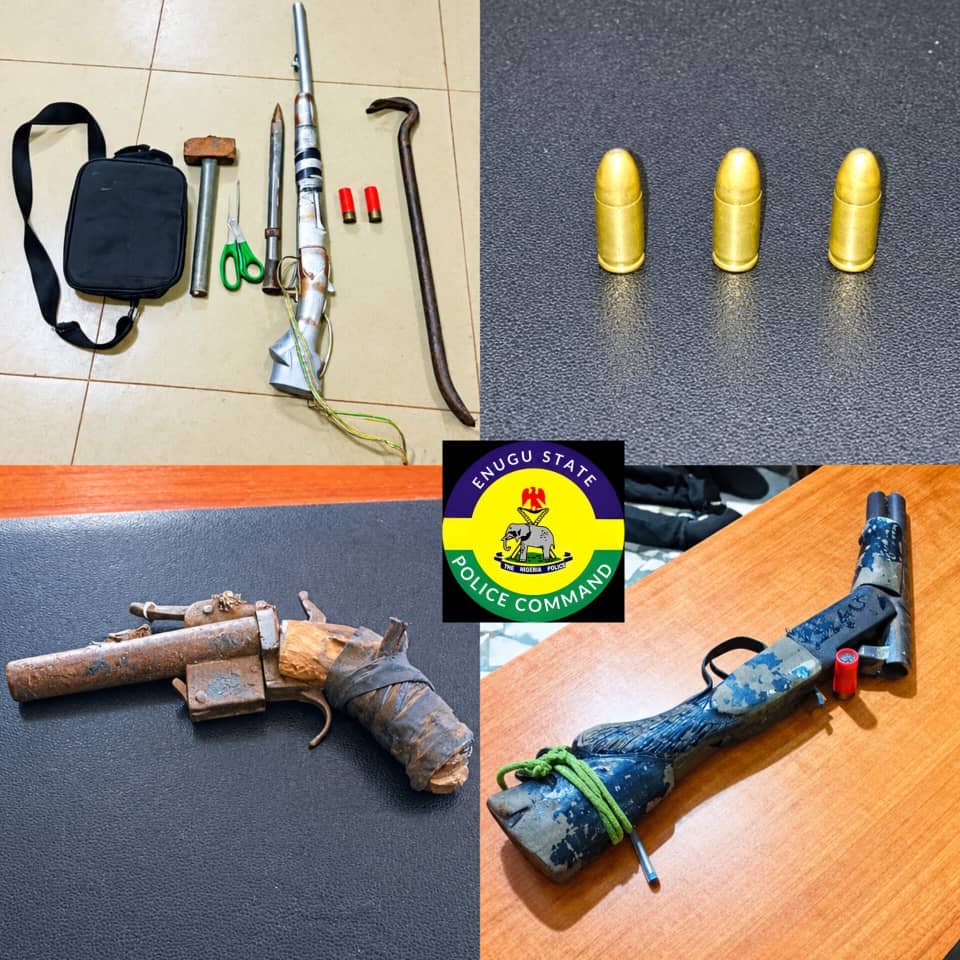
ENUGU — The Enugu State Police Command says it has arrested five male suspects in separate operations across the state and recovered three firearms, six rounds of live ammunition and other exhibits.
The Command disclosed this in a statement issued on Thursday, October 8, 2026, by its Police Public Relations Officer, SP Daniel Ndukwe.
According to the statement, police operatives attached to Inyi Division responded to a distress call about an armed robbery at Umuaor, Umukabia Isiama Awlaw Community, Oji-River Local Government Area, at about 5:10 a.m. on October 7.
One suspect, identified as 26-year-old Arinze Osita Onwuaso, was arrested while other suspects reportedly fled the scene. Police said they recovered a locally made cut-to-size single-barrel gun, two live cartridges, a pry-bar, hammer, scissors and chisel from him.
In a separate operation on October 5, operatives of the Anti-Cultism Section of the Violent Crime Response Unit arrested two suspected cultists, 24-year-old Jonas Adejo, also known as J-Money, and 25-year-old Okoro Innocent, also known as Virus, at Umudioka Community in Nsukka.
Three live rounds of 9mm ammunition were recovered from the suspects. Police said the two men confessed during interrogation to membership of the Supreme Vikings Confraternity.
Meanwhile, on September 25, operatives of Aninri Division, working with members of the Neighborhood Watch Group, raided a suspected criminal hideout at Amagu Mpu Community in Aninri LGA.
The operation led to the arrest of 25-year-old Anichebe Ogbonna, from whom police said one locally made pistol was recovered.
Similarly, on September 18 at about 11:00 p.m., operatives of 9th Mile Division, acting on information and in collaboration with Neighborhood Watch members, arrested 38-year-old Chukwujekwu Chukwuemeka at Ameke-Ngwo, Udi LGA.
He was arrested over alleged involvement in armed robberies in the area. Police said one cut-to-size pump-action gun and one live cartridge were recovered from him.
The Command said investigations into the cases are ongoing and that the suspects would be arraigned in court after the conclusion of investigations.
The Commissioner of Police, CP Mamman Bitrus Giwa, commended members of the public for providing information and praised the police operatives for their response to credible intelligence.
He reiterated the Command’s commitment to intelligence-led operations against armed robbery, cultism and other violent crimes, while urging residents to remain vigilant, law-abiding and supportive of security agencies.

By Okey Maduforo, Awka
The Awka High Court, on Tuesday, denied bail to the General Overseer of Day Spring Assembly, Mr Harrison Anazodo, who is standing trial over alleged offences relating to his activities as a pastor.
Anazodo had applied for bail on health grounds, but the presiding judge, Justice Jude Obiora, rejected the application, citing concerns over possible interference with witnesses.
The development came as seven persons, believed to be members of the congregation, are expected to testify in the case.
The court adjourned the matter until October 16 for further proceedings.
Speaking shortly after the hearing, State Counsel, Victoria Ekwerekwu, commended the Anambra State Government for its efforts to tackle alleged fraudulent activities by some religious figures.
She said, “We thank Governor Charles Soludo for trying to sanitise our society from pastors who make the younger generation believe that making money without hard work is possible.”
According to her, the prosecution has established a prima facie case against Anazodo, although the state would still be required to prove the allegations beyond reasonable doubt.
“Today, there is a prima facie case against the accused, Mr Harrison Anazodo, though it is left for us to prove it beyond reasonable doubt.
“The court ruled on the bail application and denied him bail because of the witnesses, to ensure that they are not interfered with. The matter was subsequently adjourned until October 16,” she said.
The Anambra State Commissioner for Information, Dr Law Mefor, expressed optimism that the case would be concluded expeditiously, stressing that the ultimate decision rests with the court.
“We have been here since 9am. The court considered the bail application filed by his counsel and, after weighing its merits, the judge ruled that bail should be denied.
“We are looking forward to the quick dispensation of the matter and we assure you that justice will be done and will be seen to have been done,” Mefor said.
By Our Correspondent
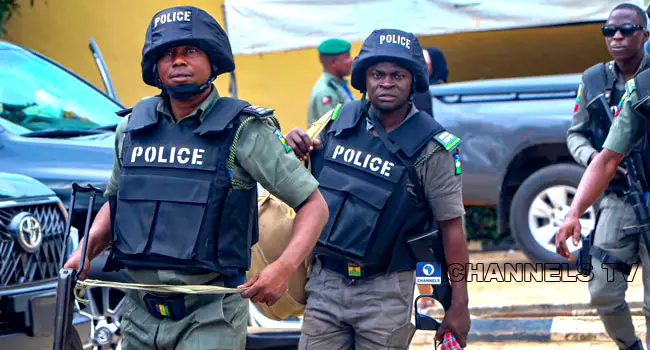
The Inspector-General of Police, Olatunji Disu, has deployed the Deputy Inspector-General of Police in charge of Operations, Shehu Nadada, to Imo State to coordinate the search-and-rescue operation for 20 prospective National Youth Service Corps members and other passengers abducted along the Owerri-Onitsha Road.
The victims were reportedly abducted on Thursday, October 1, 2026, around Umunoha in Imo State.
The Force Public Relations Officer, Force Headquarters, CSP Anietie Iniedu, disclosed this in a statement issued on Friday.
According to the statement, Nadada arrived in the state alongside two Commissioners of Police and immediately conducted an on-the-spot assessment of the incident and the ongoing rescue operation.
He also reviewed the operational strategies, deployment of personnel and available assets, while issuing additional directives aimed at strengthening the coordinated response.
The assessment was conducted alongside the Imo State Commissioner of Police, CP Audu Garba Bosso; the Commissioner of Police in charge of Federal Operations, CP Akpan Anifiok; the Commissioner of Police in charge of the Police Mobile Force; other service commanders and members of the management team of the Imo State Police Command.
Iniedu said the search-and-rescue operation had been intensified, with additional tactical teams and operational assets deployed to identified areas.
He added that the operation was being supported by intelligence-led tracking of the abductors and coordinated efforts with other security agencies.
Nadada assured members of the public that the police remained committed to securing the safe release of the abducted persons.
“The Nigeria Police Force is committed to securing the safe rescue of the 20 abducted persons and will sustain the operation until the mission is successfully concluded,” Iniedu quoted Nadada as saying.
The police boss urged members of the public and the media to remain calm and vigilant, while appealing to anyone with credible information that could assist the operation to contact the police or the nearest security formation.
He assured the public that all information received would be treated with strict confidentiality.
The police said further updates would be provided as the rescue operation progresses.

Five men have been arrested and arraigned before a Chief Magistrate’s Court in Maiduguri, Borno State, after police allegedly found them wearing T-shirts bearing the words “Tinubu Must Go.”
The defendants were identified as Baba Aji Gremami, 44; Mustapha Abba Yemen, 28; Abbacha Mohammed Ali, 32; Adam Umar Gubio, 21; and Abdulhamid Mohammed, 21.
According to a First Information Report issued by the State Criminal Investigation Department, the incident occurred on September 25, 2026, near West End Roundabout in Maiduguri.
Police charged the five men with criminal conspiracy, inciting disturbance, disturbance of public peace and thuggery under Sections 60, 78, 79 and 392 of the Borno State Penal Code.
The defendants pleaded not guilty to the charges when they appeared before Chief Magistrate Court I in Maiduguri.
Their lawyer subsequently applied for bail. The court adjourned the matter until October 6, 2026, to rule on the bail application, while the substantive trial has been scheduled for October 26.
The case has drawn attention because the alleged conduct involved wearing clothing displaying a political message.
Amnesty International criticised the prosecution, describing the arrests as arbitrary and arguing that peaceful political expression is protected by fundamental human rights. The organisation called for the immediate release of the five men and urged authorities to discontinue the case.
Amnesty International also expressed concern that the prosecution could have implications for political expression and opposition activities in Borno State.
The case has generated reactions on social media, with some commentators questioning whether the display of political messages on clothing should constitute a criminal offence.
There have also been allegations that a prominent politician in Borno State may have influenced the arrests. The allegation has not been independently verified.
Efforts to obtain a comment from the Borno State Police Public Relations Officer, ASP Kenneth Daso, were reportedly unsuccessful as of the time of filing.
The defendants remain subject to the court process, and the allegations against them have not been established in court.
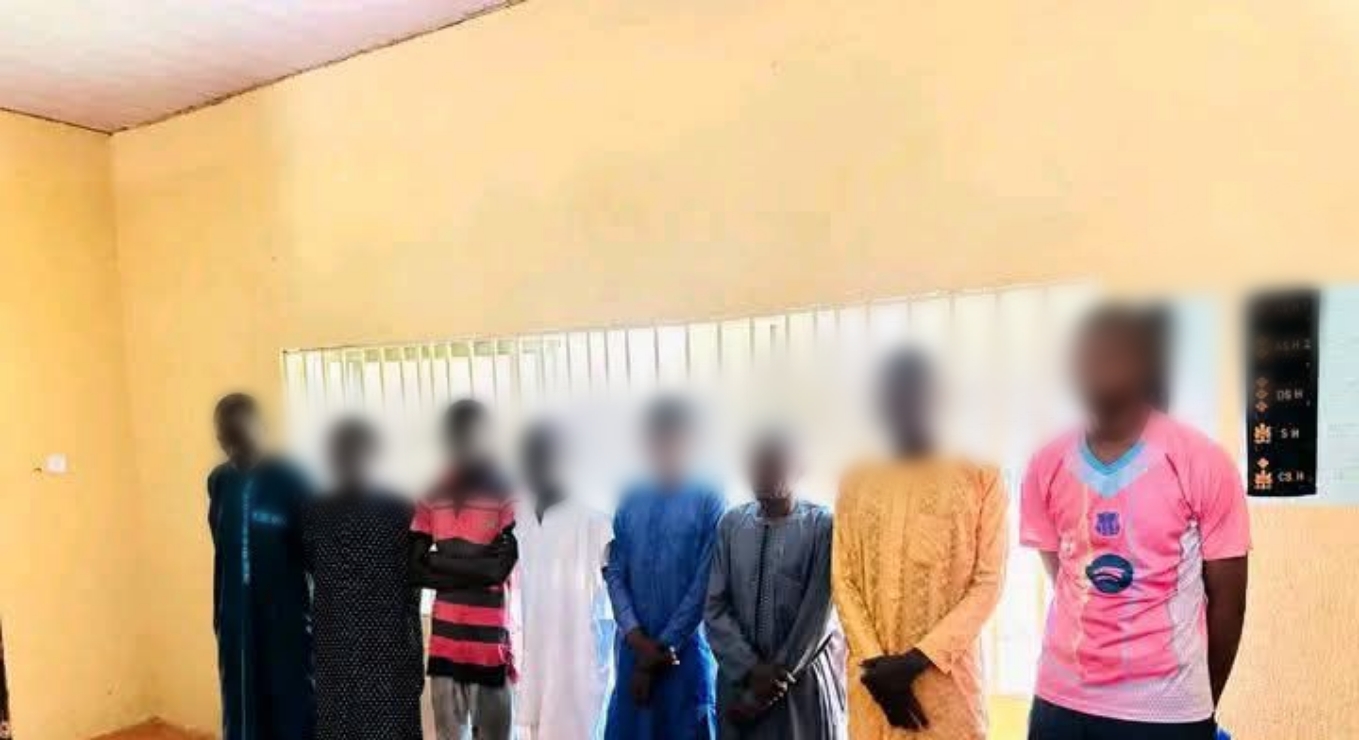
The Jigawa State Hisbah Board has arrested eight people in Kazaure Local Government Area over alleged homosexual acts, according to the board.
The board’s Public Relations Officer, Dauda Hadejia, disclosed this in a statement issued on Saturday, September 26, 2026.
Hadejia said the arrests followed a complaint filed by a 22-year-old man, who alleged that nine individuals had engaged in sexual acts with him on different occasions.
According to the statement, the complainant also claimed that he later contracted HIV, which he attributed to the alleged encounters. He reportedly appealed to the Hisbah authorities for justice, describing the alleged conduct as deceptive and harmful to his life.
Following the complaint, Hadejia said Hisbah operatives launched an investigation and began searching for the nine individuals named by the complainant.
“So far, eight suspects have been arrested, while efforts are ongoing to arrest the remaining suspect,” Hadejia said.
He added that the eight arrested individuals reportedly admitted during preliminary investigations to having engaged in sexual acts with the complainant.
Hadejia said the board had gathered information and evidence that would be presented before a court. He added that the investigation remained ongoing and that the suspects would be charged upon its completion.
The Deputy Commander-General of the Jigawa State Hisbah Board, Dr. Hussain Baban, reportedly urged parents to pay closer attention to their children’s upbringing and the people with whom they associate.
He also called on members of the public to be mindful of the consequences of their actions and to uphold religious and moral values.
The board further expressed appreciation to the Jigawa State Government for its support and cooperation in carrying out its responsibilities.

-

 Politics4 days ago
2027: Odii Will Not Step Down, Says Spokesperson
-

 EverydayNews Telescope4 days ago
Nkalagu Cement Factory: Project or 2027 Political Promise?
-
 News4 days ago
How NAF Plane Vanished From Radar Shortly After Take-Off, Crashes In Ondo Swamp
-

 News4 days ago
No Survivor Found Yet in Ondo Air Crash — Aiyedatiwa
-

 News2 days ago
Curfew Continues as Soludo Sets Up Commission of Inquiry Over Aguleri–Umuoba Anam Clash
-
Crime3 days ago
Court Denies Alleged Fake Pastor Bail as Seven Witnesses Await Trial
-

 Education2 days ago
Ihejirika Hails Mbah’s Infrastructure Drive as Coal City University Inaugurates Governing Council
-

 News3 days ago
NAF Crash Claims Pilot 16 Days After Wedding