




News
FG N50,000 Grant: How Nigerians Can Check Eligibility, Claim Payment



The Federal Government has released guidelines explaining how Nigerians selected for its N50,000 relief grant can confirm their eligibility, accept the offer, access the funds and withdraw the money.
The government also warned beneficiaries against fraudsters seeking to exploit the intervention by demanding money or sensitive personal information.
The National Emergency Relief and Stabilisation Intervention (NERSI) is designed to support vulnerable households struggling with rising living costs.
The programme, managed by the Federal Ministry of Humanitarian Affairs and Poverty Reduction, provides a one-off grant of N50,000 to selected beneficiaries through mobile wallets operated by five approved payment providers.
According to the frequently asked questions published on the programme’s website and sighted by PUNCH Online on Thursday, the grant is not a loan, requires no repayment and can be accessed without a smartphone or internet connection.
Here are the key things Nigerians need to know about the programme.

1. Who qualifies for the N50,000 grant?
The government said beneficiaries were selected from the National Social Register and verified national identity records.
It explained that individuals cannot apply directly or pay anyone to secure a place on the beneficiary list.
Selection is based on need, with beneficiaries drawn from the six geopolitical zones, irrespective of religion, ethnicity or political affiliation.
The government also clarified that payments would be made in phases, meaning not everyone would receive a notification at the same time.
2. How can you check if you are eligible?
Selected beneficiaries will receive SMS notifications from one of the five approved payment providers: ALAT, MoMo PSB, NairaGram, OPay and Moniepoint.
The messages will confirm their selection and provide a USSD code to dial to accept the grant.
Beneficiaries can also dial their assigned provider’s USSD code and select the eligibility-check option to confirm their status.
Those who are not selected will receive a notification informing them that they are currently not eligible for the relief support.
3. How do beneficiaries claim the N50,000?
Recipients are required to dial the USSD code contained in the notification from their payment provider and follow the instructions.
The process activates a mobile wallet, after which the N50,000 is credited and a confirmation SMS is sent.
The government stressed that receiving a selection message does not automatically mean the money has been paid. Beneficiaries must first accept the offer.
Those who mistakenly reject the offer can dial the code again and select the acceptance option.
4. Can people without smartphones receive the grant?
Yes. The government said beneficiaries do not need smartphones or internet access to receive the money.
A basic mobile phone is sufficient because the USSD codes work without an internet connection.
However, customers of OPay, Moniepoint and MoMo PSB can also use their providers’ official mobile applications to access their wallets and carry out transactions.
5. How can beneficiaries withdraw the money?
Beneficiaries can withdraw their funds through Point of Sale agents by transferring money from their mobile wallets and collecting cash.
Each approved payment provider also offers alternative withdrawal and transfer options.
The available USSD codes include:
- ALAT: Dial 94523Account NumberAmount# to transfer funds.
- MoMo PSB: Dial 6710# or use the MoMo NG application.
- NairaGram: Dial 72600#.
- OPay: Dial 95520# or use the OPay application.
- Moniepoint: Dial 557327# or use the Moniepoint application.
Beneficiaries can withdraw the entire N50,000 or take only part of it, leaving the balance in their wallets.
They can also transfer the money to personal bank accounts or other beneficiaries through the available channels.
6. Are there charges for receiving the grant?
The government said accepting the grant, receiving the money and responding to programme SMS notifications are free.
However, POS operators may charge their usual withdrawal fees when beneficiaries collect cash.
Recipients are therefore advised to confirm the applicable charges before completing transactions.
7. What if you have not received an SMS?
The government explained that payments were being made in phases, with payment providers contacting beneficiaries in batches.
Therefore, not receiving an SMS does not necessarily mean an individual has been permanently excluded.
Interested persons can check their eligibility through their assigned provider’s USSD code.
The government, however, warned that nobody could add an individual to the beneficiary list or accelerate payment in exchange for money.
8. How can beneficiaries avoid fraud?
The government warned Nigerians against individuals claiming they could help them secure or release the N50,000 grant for a fee.
It stressed that programme officials and payment providers would never request beneficiaries’ PINs, one-time passwords or Bank Verification Numbers.
Genuine messages will come only from the official sender names of the five approved payment providers and will not contain links.
Beneficiaries were also advised against clicking unfamiliar links, downloading unknown applications or forwarding WhatsApp messages claiming that sharing them would guarantee access to the grant.
The government further warned recipients not to refund money to anyone claiming that the payment was made in error. Such claims should first be verified through the provider’s official customer service channels.
9. What happens if you lose your phone or SIM card?
Beneficiaries who lose their phones or SIM cards should immediately contact their payment providers to secure their wallets.
They should also obtain replacement SIM cards bearing the same phone numbers from their network operators.
The government assured beneficiaries that their money would remain in their mobile wallets even if they lost their phones or SIM cards.
10. What should beneficiaries do if their USSD codes stop working?
The programme advised beneficiaries to check their network signals and retry if their USSD codes fail.
If the problem persists, they should contact their payment providers through their official customer service channels.
The following helplines were provided:
- ALAT by Wema: 0803 900 3700
- MoMo PSB: 671 or 0803 106 7100
- NairaGram: 0201 330 0880 or 0201 330 0881
- OPay: 0700 888 8328 or 0201 888 8328
- NERSI programme: 0700-022-2222
Enquiries concerning mobile wallets and payments should be directed to the respective providers, while questions about the intervention can be addressed to the programme’s helpline.
11. Which organisations are authorised to disburse the grant?
The Federal Government identified five approved payment providers for the N50,000 intervention.
They are ALAT, the digital banking platform of Wema Bank; MoMo PSB, a licensed Payment Service Bank; NairaGram, a digital money transfer service; OPay, a licensed mobile money operator; and Moniepoint, a licensed microfinance bank.
Beneficiaries were advised to deal only with their assigned providers and use official channels for enquiries and transactions.
The government reiterated that beneficiaries do not need to pay anyone, click external links or download unfamiliar applications to access the grant.


By Ugoo Aniagoh
From the restoration of electricity at the local government secretariat after 13 years to renewed road, water, sanitation and security initiatives, the Okakpu-led administration is setting its governance agenda in motion.
The administration of Hon. (Dr.) Ikechukwu Okakpu, popularly known as OKD Jnr, and his Deputy, Hon. Ifunanya Nwanadile, has recorded a number of developmental milestones as the duo mark their first 30 days in office as Mayor and Deputy Mayor of Njikoka Local Government Area of Anambra State.
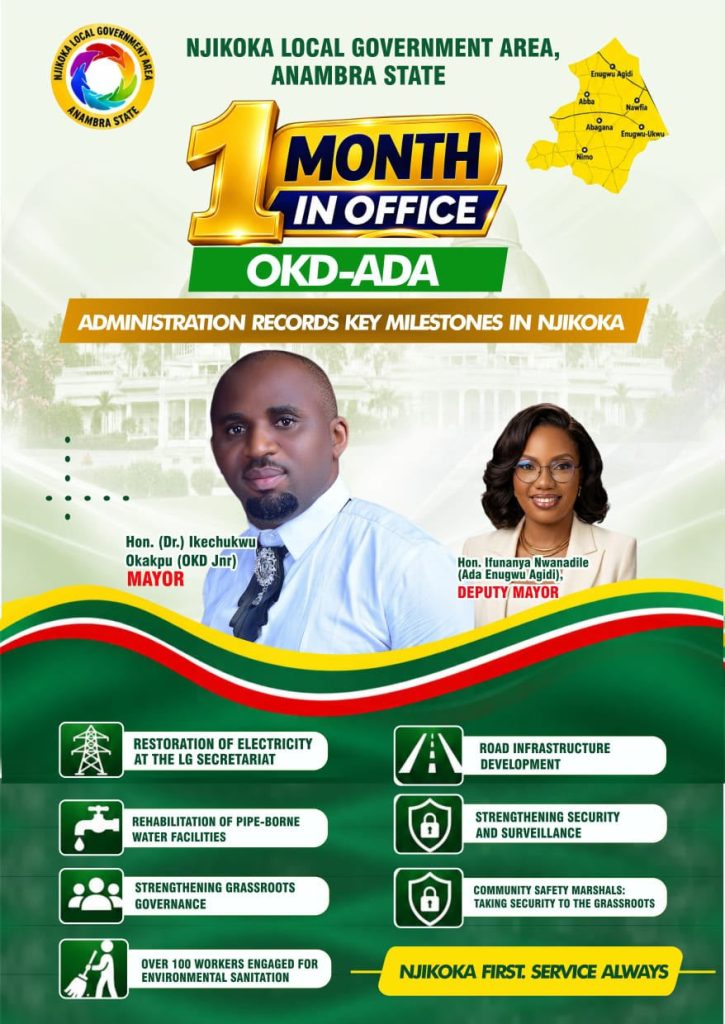
Since assuming office on October 3, 2026, the administration has initiated interventions across critical sectors, including infrastructure, environmental sanitation, water supply, grassroots governance and community security.
One of the notable achievements recorded within the period is the restoration of electricity at the Njikoka Local Government Secretariat after 13 years without public power supply. The development marks a significant improvement in the working environment at the council headquarters and is expected to enhance administrative efficiency.
In the area of water infrastructure, rehabilitation of pipe-borne water facilities across the local government has commenced, reflecting the administration’s commitment to improving access to basic amenities.
The administration has also strengthened its governance structure through the appointment and inauguration of elected councillors, Supervisory Councillors and Special Advisers to support grassroots representation, policy implementation and effective service delivery.

Environmental sanitation has received considerable attention, with over 100 ad-hoc workers engaged to support waste management, routine cleaning and general environmental sanitation across the local government.
On infrastructure development, the administration has commenced a Public-Community-Private Partnership (PCPP) road project along the Awovu–Osili axis in Enugwu Ukwu. An assessment of Ezi Norbert Road has also been conducted as part of efforts to identify infrastructure needs and explore possible interventions.
Security has equally featured prominently in the administration’s first-month activities. Adopting a zero-tolerance stance towards insecurity, the council has mounted CCTV cameras at strategic locations to strengthen surveillance and improve security monitoring.
In a grassroots-driven security initiative, local traders and street operators have also been engaged as Community Safety Marshals. Equipped with walkie-talkies, the marshals are expected to serve as additional sources of community security intelligence, promptly reporting suspicious movements and activities to the appropriate authorities.
These initiatives represent some of the administration’s early efforts to address longstanding challenges while laying the groundwork for sustained development across Njikoka’s six communities.
Speaking through its first-month performance record, the administration maintains that its focus remains on practical governance, improved public services, environmental responsibility, infrastructure development and a safer community.
Although the administration is still in its early days, its first 30 days have provided an indication of its immediate priorities and development direction.
For residents of Njikoka, the expectation will now be to see these initial interventions translated into sustainable projects, measurable improvements and lasting impact across the local government.
Thirty days down, more work ahead. Njikoka First.

By Okey Maduforo, Awka
Pro-Biafran agitators based in the United Kingdom have challenged the three leading presidential contenders ahead of the 2027 general elections to address the lingering consequences of the Nigerian Civil War and the plight of families affected by the conflict.
The agitators, operating under the platform of the Biafran Diaspora Movement (BDM), specifically challenged President Bola Ahmed Tinubu of the All Progressives Congress (APC), Mr Peter Obi of the Nigeria Democratic Congress (NDC), and former Vice President Atiku Abubakar to make the Biafran question and the concerns of affected families part of their political conversations.
The group expressed displeasure over what it described as the continued reluctance of political leaders to openly discuss measures aimed at addressing the historical grievances surrounding the Biafran struggle.
Speaking with reporters in Awka on Thursday, the BDM Luton Zonal Officer, Adeze Vivian Nzelu-Iheanacho, argued that the campaigns of the presidential contenders should address the political foundations of the country and offer concrete commitments towards healing the wounds of the civil war.
According to her, the Nigerian Civil War of 1967–1970 left behind unimaginable suffering, broken families and painful memories, particularly among Igbo communities.
“The Nigerian Civil War of 1967–1970 left behind unimaginable suffering, broken families and painful memories. For many Igbo families, the consequences of that war are not simply a chapter in history books.
“Decades later, concerns about marginalisation, political representation, insecurity and belonging continue to shape conversations across the Southeast.
“We cannot keep asking why people feel angry or unheard without being willing to listen to what they are saying,” she stated.
Nzelu-Iheanacho noted that the Indigenous People of Biafra (IPOB) had become a prominent voice in the campaign for Biafran self-determination, adding that its supporters view the movement as an avenue for expressing concerns about identity, political exclusion and the future of the Southeast.
She, however, maintained that the Biafran question transcended any individual or organisation, insisting that changes in political leadership and continued security operations would not automatically resolve the historical and political grievances associated with the struggle.
“The Biafran question is bigger than any individual or organisation. Even when political leaders change or security operations continue, the historical and political questions surrounding Biafra do not automatically disappear,” she said.
She urged the Federal Government to distinguish between legitimate political grievances and criminal activities, arguing that security measures alone could not provide a lasting solution to the concerns driving agitation in the region.
“A government can disagree with IPOB’s demands, challenge its ideas and act against criminal conduct where evidence supports doing so. But these actions do not remove the need to address the deeper issues that keep political grievances alive.
“A problem left unresolved today may become more difficult to address tomorrow,” she added.
The BDM official observed that while political leaders engage in debates, security operations continue and various movements advance their demands, ordinary citizens bear the consequences of the prevailing situation.
She identified mothers worried about the safety of their children, traders afraid of losing their livelihoods, young people uncertain about their future and families struggling to go about their daily activities as among those affected.
“There are mothers who worry about their children, traders who fear losing their livelihoods, young people who wonder what the future holds, and families who simply want to go to work, send their children to school and return home safely,” she said.
Nzelu-Iheanacho maintained that the group’s position was anchored on justice, protection of human life, respect for peaceful voices and the need for government to address genuine grievances.
“Our position is simple: justice must be fair, human life must be protected, peaceful voices must be heard, and genuine grievances must not be ignored.
“Let justice be done. Let innocent lives be protected. Let the people be heard. And let peace be built on truth, not silence.
“Because at the end of the day, beyond the politics and arguments, ordinary people simply want to live, raise their children and grow old in peace. Surely, that is not too much to ask,” she said.

The Federal High Court in Abuja has nullified the leadership of the African Democratic Congress (ADC) led by Senator David Mark, declaring its actions and decisions on behalf of the party invalid.
The ruling also affects the nomination of former Vice President Atiku Abubakar as the ADC’s presidential candidate for the 2027 general election.
Atiku had earlier appeared on the list of presidential candidates published by the Independent National Electoral Commission (INEC). He had also picked former Rivers State Governor, Rotimi Amaechi, as his running mate.
In a judgment delivered on Thursday, Justice Peter Lifu declared unlawful the caretaker committee led by Mark, which conducted the party’s presidential primary that produced Atiku as its candidate.
The judgment followed a suit filed by Nafiu Bala Gombe, a former ADC National Deputy Chairman (North-East), who challenged the process through which the Mark-led group assumed control of the party.
Gombe argued that following the resignation of the party’s former National Chairman, Chief Ralph Nwosu, he was constitutionally entitled to assume leadership of the ADC.
He subsequently approached the court, seeking to invalidate the decisions and activities undertaken by the Mark-led leadership in the name of the party.
The defendants in the suit, marked FHC/ABJ/CS/1819/2025, included the ADC, INEC, Senator David Mark, Ogbeni Rauf Aregbesola and Chief Ralph Nwosu.
The plaintiff also sought an order restraining Mark and Aregbesola from parading themselves as the party’s National Chairman and National Secretary, respectively, arguing that their emergence violated the ADC constitution and relevant provisions of the Electoral Act.
In his ruling, Justice Lifu upheld Gombe’s arguments and granted the reliefs sought.
The judgment is expected to trigger fresh developments within the ADC as political parties intensify preparations for the 2027 general elections, scheduled for January 16, 2027.
Meanwhile, the ADC has indicated its intention to challenge the ruling at the Court of Appeal.
The party’s National Welfare Secretary, Nkemakolam Ukandu, who was subsequently joined in the proceedings as an interested party, confirmed that the party would appeal the judgment.
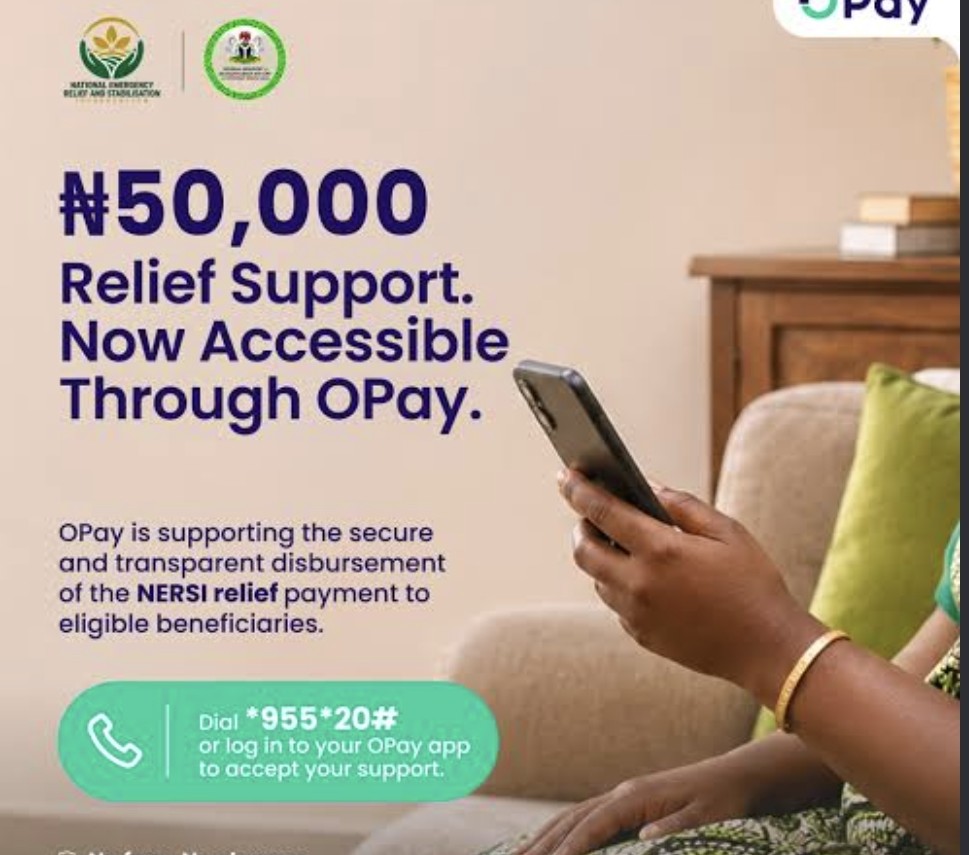
OPay has explained how Nigerians can determine whether they qualify for the Federal Government’s ₦50,000 monthly cash support programme targeted at vulnerable citizens.
The digital financial services company said eligible customers would receive a pop-up notification on the homepage of their OPay mobile application, providing instructions on how to proceed with the registration or verification process.
In a statement shared on its official X handle on Tuesday, the company advised customers to click on the notification and follow the steps provided to access the intervention.
OPay clarified that customers who do not see the pop-up notification on their app are not eligible for the programme.
The company also stressed that it has no responsibility for selecting beneficiaries or determining who qualifies for the Federal Government’s cash support scheme.
According to OPay, Nigerians seeking further information or clarification about their eligibility should contact the National Economic Recovery and Support Initiative (NERSI).
“The ₦50,000 monthly Federal Government cash support is available only to eligible citizens. Eligible customers will see a pop-up notification on their OPay app homepage. Kindly click on the pop-up to proceed with the next steps.
“Kindly note that customers who are unable to see the feature on the app are not eligible for it. Please note that we do not determine your eligibility. Kindly contact NERSI at 07000222222 for assistance,” the company stated.
The clarification comes amid growing interest among Nigerians in the Federal Government’s proposed financial support programme for vulnerable citizens.
News
2027 Budget: C’River Lawmakers Commend Gov Otu for Prioritising Capital Expenditure as Appropriation Bill Scales Second Reading

Members of the Cross River State House of Assembly have commended the State Governor, Senator Bassey Edet Otu, for devoting ₦708.43 billion, representing 71.72% of the 2027 budget estimates, to capital development and ₦279.38 billion, representing 28.28%, to recurrent expenditure.
Lawmakers gave the commendation during Tuesday, 3/11/2026 plenary as they passed the Cross River State 2027 Appropriation Bill for second reading, earlier presented by Governor Otu to the Assembly for consideration and passage.
The Bill scaled second reading following robust deliberations by members at the Assembly Complex, Calabar.
Leading the debate, the Deputy Leader of the House, Rt. Hon. Davis Etta (Abi), described the 2027 budget estimates as people-oriented, development-driven and reflective of the Governor’s ‘People First’ mantra. He particularly commended the Governor for devoting a substantial percentage of the total budget to capital expenditure rather than recurrent expenditure, noting that it marks a clear shift from a consumption budget to a production and growth budget.
According to Etta, Governor Otu’s decision to prioritize capital projects demonstrates a clear commitment to infrastructural development, economic expansion, job creation and the industrialisation of the State.
Contributing to the debate, majority of the members took turns to applaud the Governor for his fiscal discipline and focus. They noted that the high capital component will fast-track the completion of ongoing projects, open up new roads, boost agriculture, improve healthcare delivery, strengthen human capital development, and reposition Cross River as an investment destination.
In his remarks, the Speaker, Rt. Hon. Elvert Ayambem, who presided over the session, commended his colleagues for their painstaking analysis of the budget and also lauded Governor Otu for sustaining a fiscal policy that places premium on infrastructure over frivolities.
He thereafter referred the Appropriation Bill to the House Committee on Finance and Appropriation for detailed budget defence and further legislative work, with a mandate to report back within three weeks.
In a related development, members of the Assembly commended the Speaker, Rt. Hon. Elvert Ayambem, for organising the just-concluded Budget Retreat for members of the Assembly.
Members noted that the retreat was timely, highly educative and impactful, as it widened their scope and deepened their understanding of budget analysis, scrutiny, legislative oversight and fiscal discipline.
They observed that the knowledge gained from the retreat was evident in the quality, depth and professionalism of the debate on the 2027 Appropriation Bill, adding that it has better equipped the House to discharge its constitutional duty of thorough budget consideration.


-

 Special Report5 days ago
SPEAKER ABBAS: A GOOD HEART, THE COMPASSIONATE SERVANT
-
 Politics4 days ago
Enugu APC Warns Residents Against NDC’s ‘Alarmism’, Urges Vigilance
-

 Crime2 days ago
End Of The Road: Kidnapper Arrested While Collecting ₦200,000 Ransom
-
 Politics22 hours ago
Court Nullifies Enugu NDC Primary, Orders INEC to Delist Candidate
-

 Politics4 days ago
Nwifuru vs Wike: Gov fights back says No Rainbow Coalition In Ebonyi
-

 Sports3 days ago
Super Falcons Receive $100,000 Each as Tinubu Fulfils Reward Pledge
-

 Opinion4 days ago
HONOURABLE REP. BASHIR ZUBAIRU USMAN: BLESSED HEART, BLESSED MIND
-
 News3 days ago
Man arrested for Allegedly Pushing 17-Year-Old Girl From Two-Storey Building in Imo