


News
Nigerians reject electricity tariff cut, demand total reversal

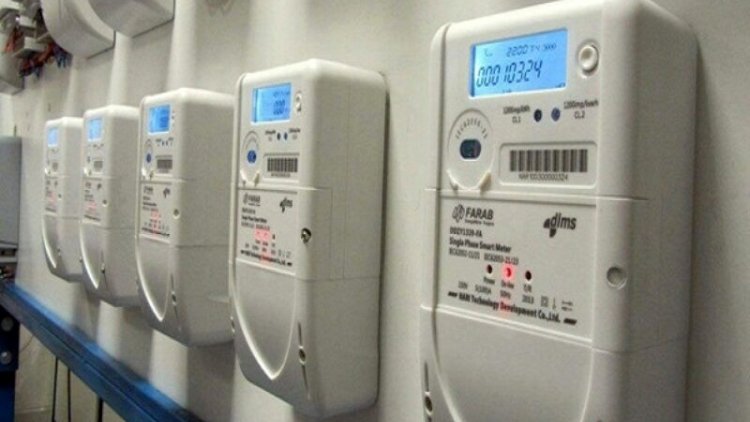

The Nigeria Labour Congress, Trade Union Congress, Nigerian Association of Chambers of Commerce, Industry, Mines and Agriculture, electricity consumers and civil society organisations, in separate interviews with The PUNCH, demanded a reversal of the hike to the subsidy era tariff.
The new tariff announced on Monday came 33 days after the NERC raised the electricity tariff for Band A customers from N68/kWh to N225/kWh, representing about a 240 per cent increase.
Subsidy on electricity was withdrawn completely from the tariff of consumers in the Band A category, which constitutes about 15 per cent of the total 12.82 million power consumers across the country.
Based on the tariff hike, the Federal Government said it would save N1.5tn.

The government stated that the decision took effect from April 3, 2024, adding that Band A customers would enjoy up to 20 hours of power supply daily.
However, the House of Representatives, organised labour and the Nigerian Bar Association kicked against the hike in tariff payable by about 1.9 million consumers.
The House of Representatives called on the NERC to suspend forthwith the implementation of the new electricity tariff nationwide, while organised labour issued a two-week ultimatum demanding the reversal of the tariff hike.
Still, the Minister of Power, Adebayo Adelabu defended the increase during an investigative hearing held by the Senate Committee on Power last week, insisting that there would be a nationwide blackout in the next three months if the increase in electricity tariff was not implemented.
Notwithstanding the opposition to the new tariff order, the spokesman for the power ministry, Florence Eke, told The PUNCH on Sunday that the new tariff had come to stay and the government would not yield to public pressure.
However, 24 hours after Eke’s assertion that the tariff hike would not be reversed, the NERC in a statement announcing the eight per cent reduction for band A customers said this was a result of changes in macroeconomic indices in April, especially the appreciation of the naira against the dollar in the foreign exchange market.
The commission noted that the decision came after a thorough review of the macroeconomic parameters and exchange rate appreciations.
In response to the NERC’s order, the Abuja, Ikeja, and Ibadan electricity distribution companies among others, announced a reduction in their tariffs, accordingly.
Discos comply
The Ikeja Electricity Distribution Company in a notice said, “Dear esteemed customers, please be informed of the downward tariff review of our Band A feeders from N225/kWh to N206.80/kWh effective 6th May 2024 with guaranteed availability of 20-24hrs supply daily. The tariff for Bands B, C, D, and E remains unchanged”.
Also, the Ibadan DisCo informed its customers about the tariff slash, saying, “Customers using prepaid meters will be the first to experience the revised tariff – N206.80/kWh whenever they vend this month of May. While for post-paid customers, the revised tariff will reflect in the electricity bills to be received at the end of May 2024”.
Similarly, the Port Harcourt DisCo as well as its Eko, Abuja, Kano and Kaduna counterparts said they had all implemented the tariff slash to reflect the new order.
The NERC expressed its dedication to maintaining a regulatory environment that balances the interests of the consumers with the sustainability of the electricity supply industry.
It said the tariff reduction was part of its ongoing efforts to ensure that electricity remained affordable for Nigerians while also encouraging efficiency and improvement in service delivery by the distribution companies.
The statement read, “Under the tariff methodology adopted by the Nigerian Electricity Regulatory Commission, a revised tariff order covering the month of May 2024 has been issued by the commission to the 11 electricity distribution companies.
“The commission has considered changes in the macroeconomic parameters over the preceding month of April 2024 and especially the appreciation of exchange rates – consequently the commission has approved a downward review of end-user tariffs for Band “A” customers from NGN225/kWh to NGN206.8/kWh.
“The commission reaffirms its commitment to providing a balanced and effective regulatory regime serving the needs of the Nigerian Electricity Supply Industry.”
Speaking in an interview the NERC Public Affairs General Manager, Dr Usman Arabi, disclosed that the tariff cut was due to the recent rebound of the naira against the dollar at the foreign exchange market.
“The Band A tariff has been reduced from N225 to N206.80/kWh, and it is basically because of the exchange rate. The exchange rate has come down. It is just basically because of the exchange rate.
“You know, exchange rate, inflation and the price of gas are the micro indices for the determination of the tariff. The exchange rate has come down, so the tariff also invariably came down,” Arabi stated.
Asked if the tariff will go up again if the naira falls against the dollar, Arabi expressed optimism, saying, “We are praying that the exchange rate would continue to come down. That is our prayer, and I am sure that is the prayer of everybody.”
Reacting to the development, the National Deputy President of the TUC, Tommy Etim, said, “It is unacceptable. All we want is a total reversal and stakeholders’ engagement.”Also commenting, the National Treasurer of the NLC, Hakeem Ambali, noted, “This is still a far cry from labour expectation; until there is a significant increase in power supply, any increment is unjustifiable.”
The President of the Nigerian Association of Chambers of Commerce, Industry, Mines and Agriculture, Dele Oye, argued that the Discos could not justify the recent tariff hike and, as such, needed to engage stakeholders on the matter to reverse it.
The NACCIMA boss said without engaging key stakeholders like industries, consumers, and trade associations, justifying any pricing formula would be tough.
He said, “By their action, they are showing that the initial increase was arbitrary. Until you engage with real stakeholders, the industry, consumers, and trade associations like chambers of commerce, it will be very difficult to justify any pricing formula.”
Also, electricity consumers under the aegis of the Electricity Consumer Protection Advocacy Centre insisted on total reversal and not what it called a paltry reduction.
The Executive Director of the group, Mr Princewill Okorie, said the decision to hike the tariff was taken by the government to please the DisCos without the input of the consumers.
According to him, the Federal Government should have made gas available to the power-generating companies since the country has it in abundance, warning against the sale of gas in dollars at the local market.
Okorie stated, “We are calling for a reversal. What is the difference between N206 and N225? Why will the Federal Government not make gas available?
“Why can’t the government come up with a policy that will keep a certain percentage of gas for the power sector so that all these complaints about gas will be reduced? Why will gas be paid for in dollars in Nigeria?
“We have gas in abundance and there is no reason why gas should be a problem for electricity production. The legacy debts and others all revolved around the challenges of gas supply. The bold step to take is to bring out a certain quantity of gas for electricity.’’
Okorie stressed that there should be a total reform of the power sector, arguing that the rich in Nigeria were oppressing the poor.
“They will not make decisions that will affect the capitalists and the rich, but they will close their eyes and take decisions that will punish the poor. Who are the owners of the gas companies that are selling gas in dollars?
“Why is it difficult to put in money to make the power sector work? Why will it always be comfortable for them to increase tariffs? Why will the government base their decisions on only what the DisCos tell them without consultations with consumers?” he queried, asking the government to reverse the tariff to the subsidy regime.



Governor Francis Nwifuru of Ebonyi State has removed the Commissioner for Works, Engr. Stanley Lebechi Mbam, from office with immediate effect.
The governor’s directive was contained in a statement issued on Friday by his Chief Press Secretary, Dr. Monday Uzor.
According to the statement, Mbam was directed to immediately hand over all government property in his possession, including his official vehicle, to the Secretary to the State Government.
He was also ordered to transfer the responsibilities of the Ministry of Works to the Permanent Secretary pending further directives from the state government.
The statement read in part: “The Governor of Ebonyi State, His Excellency, Rt. Hon. Francis Ogbonna Nwifuru, has directed the immediate removal from office of the Honourable Commissioner for Works, Engr. Stanley Lebechi Mbam.
“He is to hand over all government property in his possession, including his official vehicle, to the Secretary to the State Government and transfer responsibilities to the Permanent Secretary in the ministry.”
The governor, according to the statement, assured residents that his administration remained committed to effective governance and improving public infrastructure across the state.
No reason was given for Mbam’s removal.
The development comes months after Nwifuru suspended Mbam and the Commissioner for Infrastructure Development and Concession, Engr. Ogbonnaya Obasi-Abara, in February 2026 over alleged dereliction of duty.
The earlier suspension was also announced by Uzor, who directed the affected commissioners to surrender government property and official vehicles to the SSG.
Mbam’s latest removal has reportedly generated concern within the State Executive Council, particularly amid calls for improved performance by government officials.
Former Commissioner for Information and State Orientation under the administration of former Governor David Umahi, Senator Emmanuel Onwe, had recently called on Nwifuru to overhaul his State Executive Council and ensure that officials who were underperforming lived up to expectations.
The government has not indicated whether Mbam’s removal is connected to the earlier suspension or any specific issue concerning the Ministry of Works.
News
SEDC to Launch 50,000-Hectare Agro-Mechanisation Project in Enugu to Tackle Unemployment, Insecurity
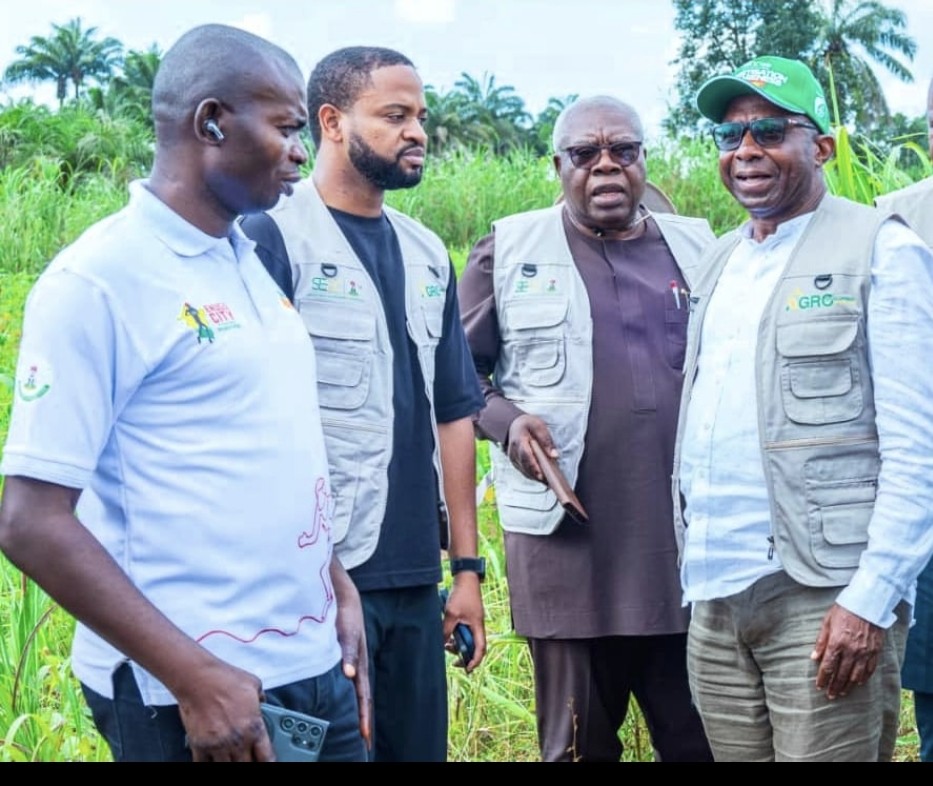
The South-East Development Commission (SEDC) has concluded arrangement for the kick-off the zone-wide 50,000-hectare agro-mechanisation project in Enugu community meant to tackle insecurity, unemployment and food insecurity.
The SEDC zone-wide 50,000-hectare agro-mechanisation, which is meant to be established in each of the 15 senatorial zones of the five South-East states, would commence at a pilot scheme level on Sept. 22.
This is contained in a statement issued by the media aide to the Governor of Enugu State, Chief Uche Anichukwu, on Wednesday in Enugu.
The Managing Director of the Commission, Mr Mark Okoye, disclosed this during a community engagement at the pilot project site in Nomeh Unateze community in Nkanu East Local Government Area of Enugu State on Tuesday.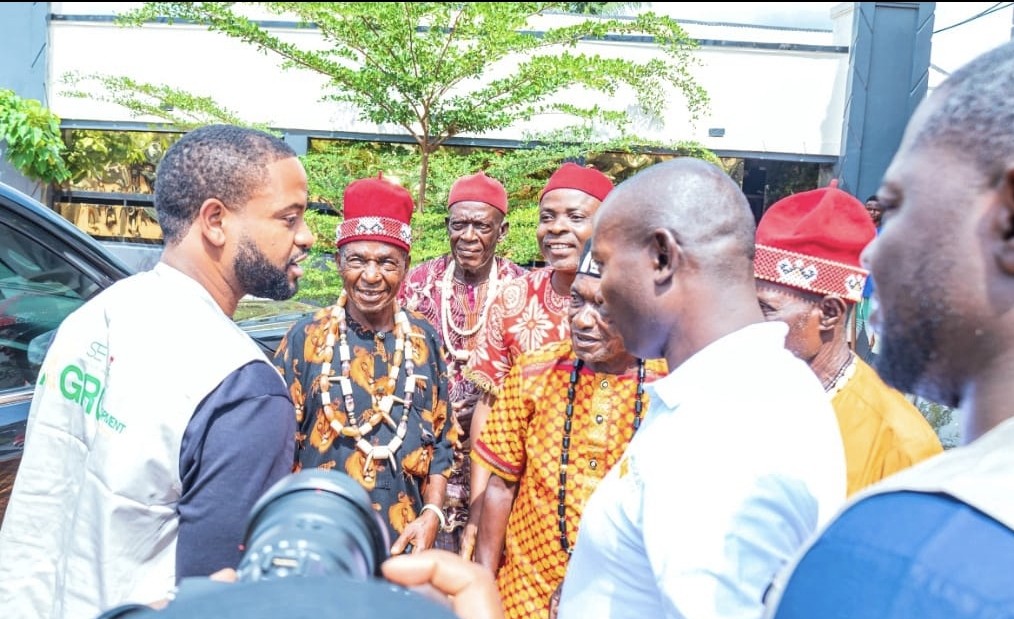
Okoye said the SEDC had, following its establishment in 2024, used the first year to do extensive studies and design a blueprint that cuts across different areas of the South-East economy.
He said the agro-mechanisation projects, remained a major part of the commission’s blueprint, explaining that it would address insecurity, unemployment, and food security.
According to him, so, what we are here for is one of our flagship initiatives, which is called the South-East Agro Mechanisation Programme or the South East Agro Development Programme.
Okoye said that the SEDC was committed to develop up to 50,000 hectares of land and that would be used for mechanised farming across the region.
“We are here for a pre-assessment, pre-flag-off visit to see the area, understand the level of work that needs to be done and ensure that contractors can start mobilising so that once we hit the site we start running.
“Because a big part of what we are looking at is how to address food insecurity and unemployment, ensuring that we are producing what we put on the table.
“We are starting with pilot programmes where we are taking 200 to 300 hectares of farmland across 15 senatorial zones and developing them to standard farms.
“Where you not only have cassava, maize, some of our staple crops, but also some cash crops. In some areas, there will be the centres for learning and centres for productivity,” he said.
Okoye said that Gov. Peter Mbah would flag off the project on Tuesday, adding the SEDC team came to assess the area, meet with the community and ensurr that all the plans are in place.
“And within the second we put this investment here, at least N4 billion or N5 billion of added investment will come in,” he said.
Okoye commended President Bola Tinubu for addressing the long yearning by the South-East for a commission to mobilise resources and coordinate development in the region.
He urged the people to reciprocate the numerous gestures by supporting the Tinubu to continue the development efforts post 2027.
He further revealed that the commission would soon roll ou an investment agency to help mobilise local and Diaspora investments for the region’s speedy development.
A community leader in the community, Chief Uche Anichukwu, described the agro-mechanisation project as one of the blessings of the APC, Tinubu and Mbah administrations to Enugu State in general and Nomeh Unateze in particularly.
Anichukwu, who is also media aide to the Governor of Enugu State, said that the Nenwe-Nomeh-Mburubu-Nara road, with a spur to Oduma, had created ready and multiple access to market for the proposed agricultural project.
Speaking, Chairman, Nomeh Unateze Town Union Caretaker Committee, Dr Chukwudi Anyianuka, and other community stakeholders, reiterated their support for the project.
They commended Tinubu and Mbah for siting the project in their community.
“We are very happy. We cannot wait to see it actualised and we promise that we are going to provide everything that is necessary to make sure that this is established.
“The Commission has taken a methodical approach to regional development.
“Rather than the pitfall of throwing money at development challenges, it undertook a study of the region and came up with a master plan, which includes this initiative, to reinvent the South-East,” Anyianuka added.
Also present at the interactive session were the members of the traditional council of Nomeh Unateze and community heads.
…As Onitsha South Mayor Empowers Workers
By Okey Maduforo, Awka
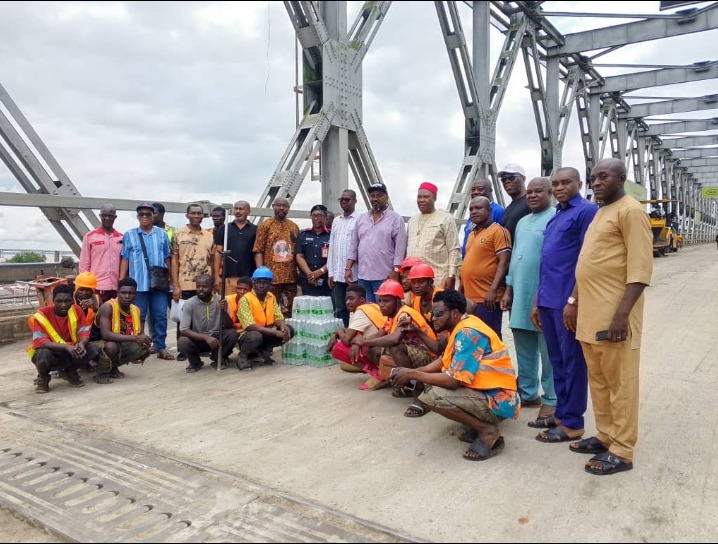
Maintenance and rehabilitation works at the recently closed First Niger Bridge are being hampered by poor lighting during night shifts and inadequate sanitary facilities at the site.
Recall that before the closure of the bridge, the Minister of Works, Engr. Dave Umahi, had disclosed that efforts would be made to carry out some of the rehabilitation works at night.
However, some of the workers at the site said poor lighting was affecting effective monitoring of activities on the bridge, while the poor sanitary condition of the area was also posing a threat to their health.
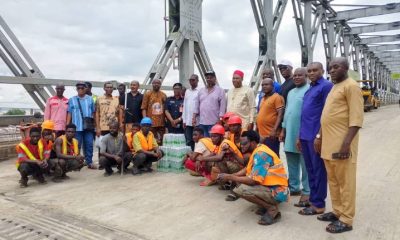
The workers made the complaints during a working visit to the bridge by the Mayor of Onitsha South Local Government Area, Chief Emeka Orji.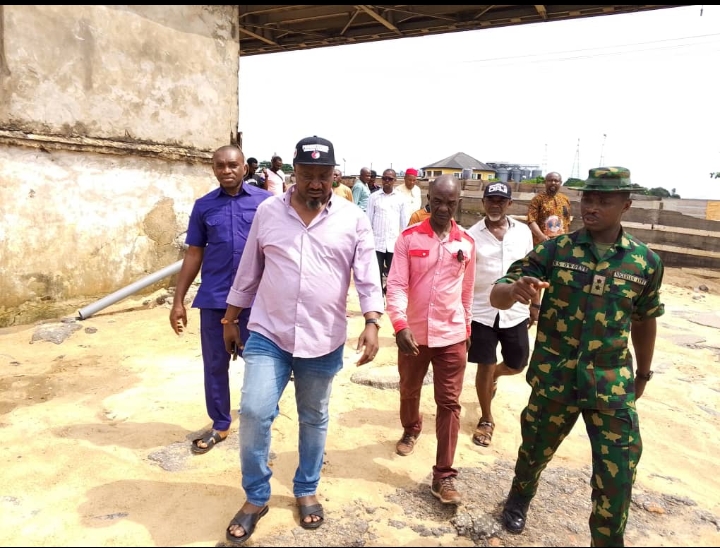
Orji, who was accompanied by the Secretary of the Local Government, Barr. Paul Onuachalla, and executives of the Fegge Community Landlords/Tenants Welfare Association, led by its Chairman, Chief Nnamdi Onugha, provided cooked meals and packs of bottled water to the personnel and workers at the site.
Speaking after the visit, Orji said the gesture was aimed at supporting the workers and showing solidarity with the Federal Government’s rehabilitation efforts on the bridge.
He said, “To support the workers and give them a sense of belonging, that is why we came to appreciate them. We will continue doing so from time to time as part of our Corporate Social Responsibility.”
The Mayor also disclosed that the council had provided facilities, including mobile toilets and water tanks, while arrangements were being made for water tankers to supply water to the tanks.
Orji further stressed the importance of the military presence in Onitsha South, noting that the personnel would contribute to security, rapid response and protection of the bridge, Onitsha South and parts of Ogbaru Local Government Area.
He added that the council would continue to strengthen its collaboration with security agencies to ensure maximum security across Onitsha South Local Government Area.
Earlier, after inspecting the environment with the Mayor, the Officer in Charge, who pleaded anonymity, identified poor lighting at the bridge at night as one of the major challenges confronting the personnel.
According to him, the situation makes it difficult to effectively monitor activities around the bridge, particularly during night shifts.
He also complained about the poor sanitary condition of the under-bridge environment where the personnel camp, saying they had to clean up the area themselves upon arrival.
The officer further appealed for improved accommodation and food support for the personnel.
He, however, commended the Mayor for the visit and assistance, saying the gesture made the workers feel appreciated.
“We feel loved and appreciated. We are happy seeing you around,” he said.

Africa’s richest industrialist, Aliko Dangote, has revealed that he bought his first private jet at the age of 22 and a half.
Dangote made the disclosure on Monday in Lagos during the formal launch of the Initial Public Offering (IPO) of Dangote Petroleum Refinery and Petrochemicals on the Nigerian Exchange.
Reflecting on his business journey, the billionaire said he had enjoyed travelling by private jet over the years but was now comfortable using commercial flights.
He also urged wealthy Nigerians to channel more of their resources into productive investments rather than luxury assets.
Dangote particularly appealed to affluent Nigerians who spend huge sums on private aircraft to consider investing such wealth in industries and businesses that could contribute to Nigeria’s economic growth.
“I try as much as I can to encourage people who are riding $900 million aircraft to please go and put that into production. We are not going to be a great nation without doing something productive,” he said.
He stressed that directing private wealth towards productive ventures would help strengthen the economy, create jobs and provide greater opportunities for national development.
The Niger Delta Chamber of Commerce, Industry, Trade, Mines and Agriculture (NDCCITMA) has rejected claims that it appropriated or “stole” the idea of Niger Delta Economic and Investment Summit from another organisation whose application was reportedly pending before the Federal Ministry of Trade.
NDCCITMA considers the allegation misleading and wishes to set the record straight.
The concept of Niger Delta Economic and Investment Summit is a broad and widely recognised platform used globally to bring together government, the private sector, investors, businesses, development partners and other stakeholders to deliberate on economic growth and development. The use of the term “Economic Summit” does not, in itself, establish exclusive ownership of the concept by any individual or organisation.
More importantly, the chronology of events does not support the allegation being made against NDCCITMA.
While the said application was reportedly still pending before the Ministry of Trade as at September 2025, NDCCITMA had already gone through the appropriate processes and received approval from the Ministry of Trade in August 2025.
NDCCITMA did not rely on, copy, or appropriate the pending application of any other party in arriving at its name or identity
It is also important to distinguish between a concept and legally protected intellectual property, such as a registered trademark, proprietary material or other enforceable intellectual property right.
NDCCITMA remains committed to conducting its activities in accordance with applicable laws and regulatory requirements.Most importantly, in Suit No: FHC/PHC/CS/57/2026 filed on same subject matter in Portharcourt by the petitioner, the learned Judge had restrained the plaintiff from further interfering with the Summit being planned by the NDCCITMA. NDCCITMA will continue respect the rule of law
We therefore urge the public, stakeholders, the media to disregard any narrative unless such claims are supported by verifiable facts and relevant legal documentation.
NDCCITMA firmly rejects the allegation and maintains that its activities and identity were developed and pursued independently and through the appropriate regulatory channels.
The organisation remains focused on its mandate of promoting commerce, industry, trade, agriculture, investment and sustainable economic development across the Niger Delta region.
Signed:
Management
Niger Delta Chamber of Commerce, Industry, Trade, Mines and Agriculture (NDCCITMA)

-
 News5 days ago
Commissioner Dies Suddenly at Abuja Hospital
-
News5 days ago
Niger Delta Chambers Unveils Plan to Transform Region Into Investment Hub
-
News5 days ago
Niger Delta Chamber Breaks Silence on Alleged Summit Trademark Dispute
-
 Health3 days ago
UNTH Begins Contact Tracing After Suspected Diphtheria Case
-
News4 days ago
Dangote Reveals He Bought First Private Jet at 22
-
 News4 days ago
Poor Lighting, Sanitation Frustrate Work At First Niger Bridge
-

 Entertainment5 days ago
Poco Lee Granted Bail in UK Ahead of September 15 Court Hearing
-
 Crime4 days ago
Police Place Nigeria on Red Alert Over Planned Attacks