
Connect with us
Maduka University Advert

News

Report Card: Enugu LGA sets the pace, showcases projects 

Published

on

Maduka University
It was all commendation and praise by the people for Igbo-Etiti Local Government Chairman as he kicked off a programme dubbed ‘Igbo-Etiti Citizens Project Evaluation Tours,’ Igbo-Etiti PET.
Under the initiative, ordinary citizens, mostly those who had never had any close dealings with the government, some of whom were farmers, full time housewives, petty traders, drivers, Keke and Okada riders, youths, students, palm wine tappers, artisans, etc, were randomly selected for participation.
The programme designed to involve these ordinary citizens from the twenty wards of the local government, cutting across the four development centres in the council area, kicked off with 40 persons from the first four wards of Aku Ward 3, Ekwegbe Ward, Ukehe Ward 4 and Ohodo Ward respectively.
The next rounds will also comprise same number of people and wards until the whole twenty wards in the local government is covered.
The idea of a lean assemblage was to make it more closely interactive following the chairman’s determination to have a very close and personal experience with the team.
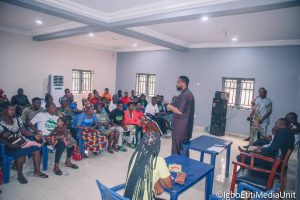
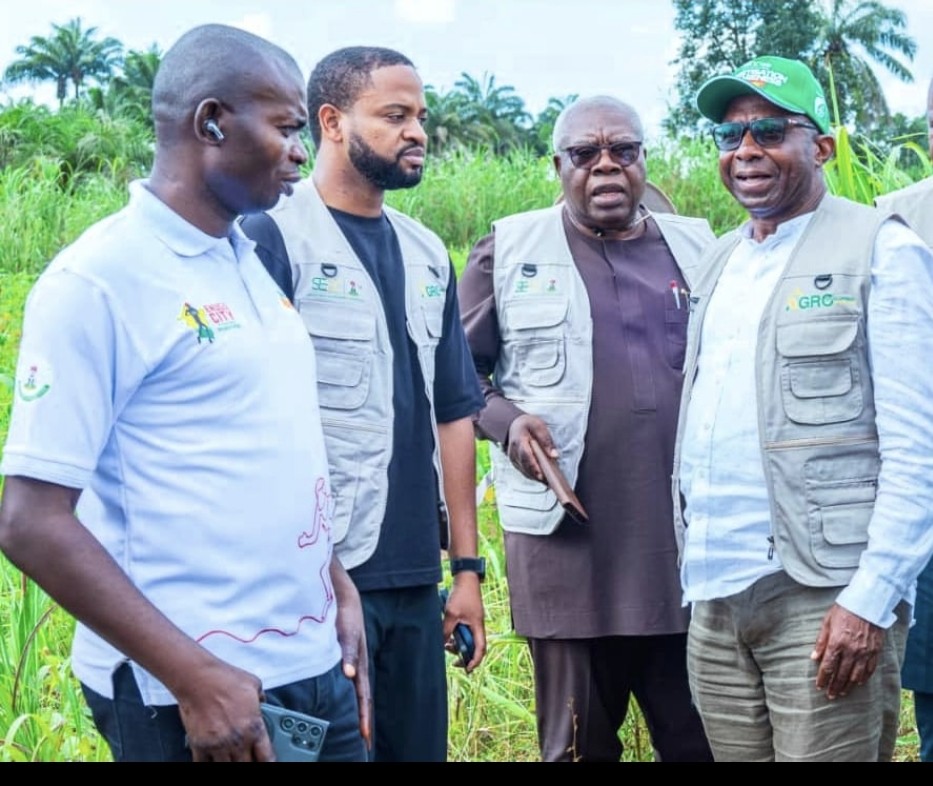
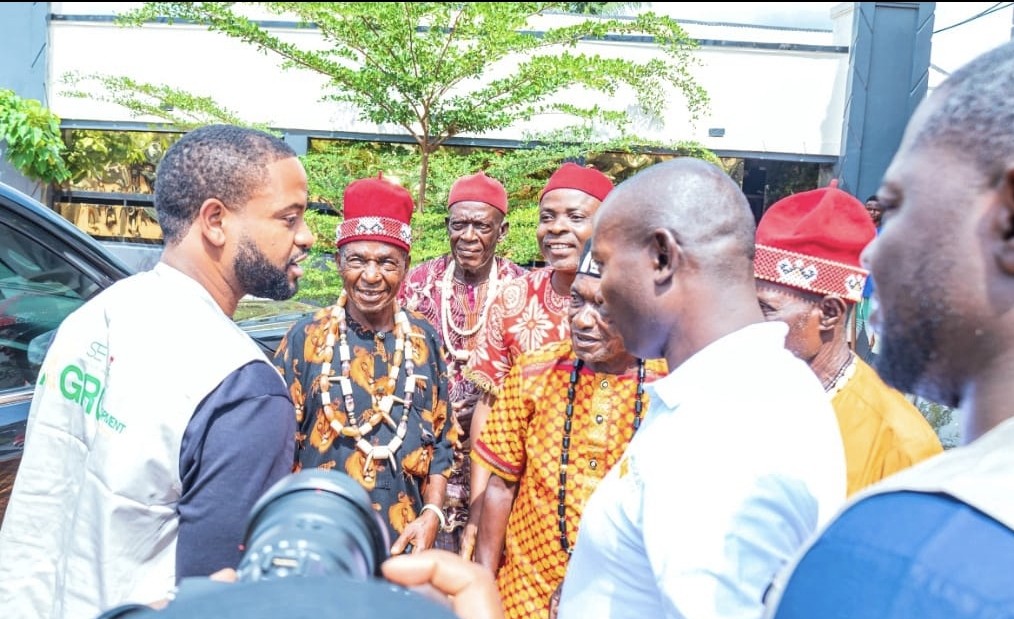
Addressing the team shortly before the tour kick-started, the chairman, Hon. Ikenna Nwodo said “we are here today because you placed your trust in us, to preside over the affairs of the local government. We are on an errand, and it is natural we give account of our stewardship.
“As you sent us to the market, it is the correct thing to do by showing you how we have fared with your resources. We will also hear from you in the true spirit of democracy so that you would have also had the opportunity to contribute to how you want to be governed.”
Nwodo told them that he would take them to see as many projects as they were ready to see during which they were free to ask questions pertaining to the costs, the necessity of such projects, and of course why it was located where it was sited. He also told them that after they had returned to his office, they were free to engage him further in any area just as they were free to make their project requests, as his administration in its citizen-based governance model, and having put the people at the centre of policies and projects is determined to take cues from the people.
The Chairman said, “I want to make it clear to you that this engagement is for you, the people, the real people in our villages, communities and towns, who most of the time have no access to presenting their views to those in government. We want a change for good, and this time, we are coming together in a non-partisan and political gathering, just as citizens of Igbo-Etiti, to rub minds together. So, it is not a party thing. It is a people’s affair. Just the ordinary folks who for long have been denied access to those in power with their voices unheard if not suppressed. So, make the most of it today.”
Thereafter the tours commenced. The first port of call was the local government ICT Center where the youths and indeed anyone interested were being taught and equipped with the knowledge and skills to be a player in the digital economy of the world. The Mayor told them that at the moment, at least eighty Igbo-Etiti sons and daughters were attending training at the facility free of charge, four times a week.
Although most of those around were probably seeing a computer desktop system for the first time in their lives, as they sat awestruck on the rows of desks with computers and watched as images of some of the projects they were going to see were projected on a huge screen. It was not hard to see that even when many of them were not literate, they were all the same connected with the full potential of the good intentions the government had for their children and fellow citizens.
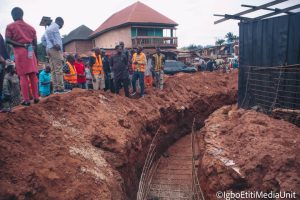
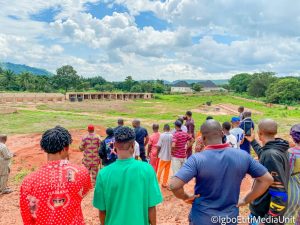
The next port of call was the sprawling Ogbede main market. They were shown the general rehabilitation the market had undergone under the current administration, with a beautiful perimeter fence and arched entrance and exit gates, to secure the entire area. They saw the extensive containment system put in place to effectively checkmate the perennial floodings ravaging the market and environs.
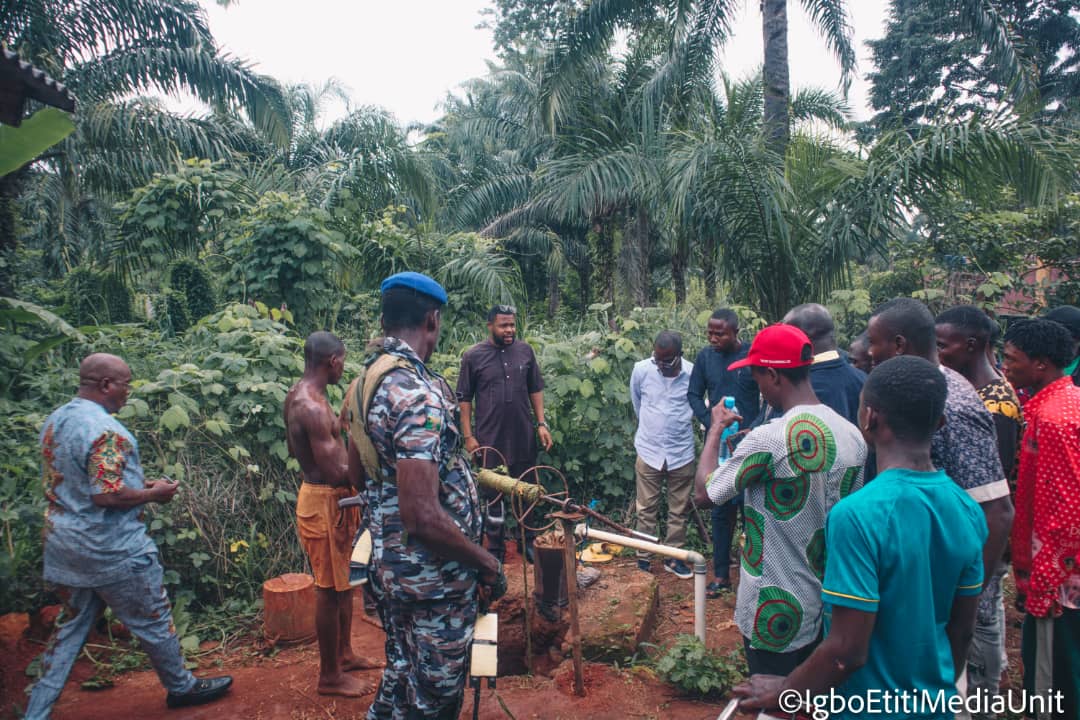
From there they proceeded to the ultra-modern building market under construction nearby, which apart from shops upon completion, would also have other facilities like halls for meetings and other social activities like weddings. The team was also at Aku to see the extensive erosion, flood control, borehole drilling, and rehabilitation, as well as road rehabilitation works the council was undertaking.
On the whole, they visited about fifteen locations where they also saw more water, road projects, and power transformers supplying light to many communities which the Nwodo administration had installed.
The team retired to the chairman’s office only after the people complained of fatigue, having spent nearly four hours touring locations.
Many expressed delight at what they saw, commending the chairman and his government for the many projects he had done across the local government area and as they had seen, with strong impacts on the lives of the people.
Some also made requests for new projects and rehabilitation of existing ones that were moribund in their areas.  Others raised concerns on the proper management of existing ones, to optimally serve the people.
On his part, Ozor Michael Okeigwe, who came from Ndinwara in Ukehe Ward Four said “What the chairman has done is more than unusual. I commend him for his good work. He did so much and that is why he was confident to call us to see. Such boldness can only come from performance. And even though I have seen a lot, I will also ask the chairman to look at our direction as we in Obletiti Nwankwo area of Ukehe, have not been reasonably remembered by the government in the past.”
Mrs. Augustina Agali, from Umuagwani in Ohodo ward, raised some concerns about the habit of commercializing water boreholes provided by the government by some community management committees, and people. According to her, “The people find it quite uncomfortable that after a borehole is provided by the government, some people in the communities would use some means to start collecting money from the people. When you complain, they say it is for maintenance. Yet, when they break down, it is the government that will repair them as the Chairman is doing in some of the places we saw today. Chairman, please look into this.”
The chairman promised to take his time to go through all of their observations and requests and would do the needful according to the resources at the disposal of the government. The event came to an end after a light refreshment, with some tokens handed to each attendee as Fuel Subsidy Removal Palliative.
Meanwhile, below are some of the projects executed or being carried out by the Nwodo administration in Igbo-Etiti:
1. Rehabilitation of Water Works at Ogbede Health Centre (Completed)
2. Rehabilitation of Water Works at Amauwani Nkporogwu Ukehe (Completed)
3. Rehabilitation of Water Works at Amaedem, Ikolo (Completed)
4. Rehabilitation of Waterworks at Oshigo Aku (Completed)
5. New Borehole at Ugwuinyinya Uwelle Amokofia Ukehe (Completed)
6. Rehabilitation of Waterworks at Amufie Ohodo (70 % of work done, further redevelopment required)
7. New Borehole at Umuokwo Idoha (50% done)
8. Rehabilitation of Borehole at Mgboko Aku (40 % of work done)
9. Rehabilitation of Borehole at CSS Umunko (50% done)
10. Rehabilitation of Waterworks at Umuofiagu, Ukehe (Commencing)
11. Rehabilitation of Waterworks at CSS Ekwegbe (Commencing)
12. Rehabilitation of Waterworks at Diogbe 2 (Commencing)
13. Rehabilitation of Waterworks at Ozarra Uwellu (Commencing)
14. Rehabilitation of Waterworks at Ochima (Commencing)
15. Establishment and training of LG Water Sanitation and Hygiene (W.A.S.H) UNIT (Completed)
16. Establishment of 299 community-level institutions called ‘WASHCOMS’ (Completed)
17. Entrepreneurial training on Sanitation Marketing for TBOs (toilet business owners), and masons (Completed)
18. Passing of Prohibition of Open Defecation Law & establishment of a special task force on enforcement (Completed)
19. Supply and Commissioning of 500KVA Transformer at Uwelle Amokofia Ukehe (Completed)
20. Supply and Commissioning of 300KVA Transformer at Onyohor (Completed)
21. Supply and Commissioning of 300KVA Transformer at Ohodo (Completed) (It seems the Transformer is currently faulty; we are procuring a replacement)
22. Supply and Commissioning of 300KVA Transformer at Ohebe Dim (Completed)
23. Commissioning of Transformer and installation of distribution lines in Umuna (Completed)
24. Purchase and modification for security 4 Sienna Vehicles (Completed)
25. Purchase and modification for security 2 Hilux Vehicles (Completed)
26. Purchase of Computers and Printers for local police (Completed)
27. Purchase of security gadgets for Neighbourhood Watch, Forest Guards, and the police (Completed)
28. Refurbishment of seven (7) security Sienna buses for Neighbourhood Watch (Ongoing)
29. Establishment of Igbo-Etiti Tech Hub (Completed)
30. Installation of LG Secretariat-Wide WiFi (Completed)
31. Creation of the first ever Igbo-Etiti LG Website, and probably the only one so far in Enugu state (Completed)
32. Ogbede Market Upgrade (70 % Done)
33. Ogbede Building Material Market (40 % Done)
34. Ogbede Warehouse Rehabilitation Project (50 % Done)
35. Aku Major Drainage and Road project (20 %, Progressing)
36. Diogbe Drainage and Road Project (50 % Completed)
37. Uwelle/Ogbede LG Headquarters Drainage Works (50% Done)
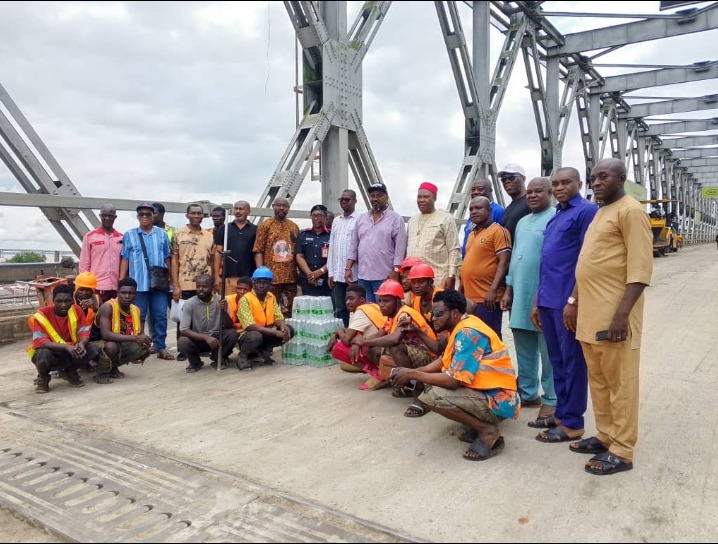
38. Enugu-Markurdi Expressway Igbo-Etiti Portions Remedial Works (Ongoing)
39. Enugu-Orturkpo (Old Road) Igbo-Etiti Portions Remedial Works (Ongoing)
40. Medical Supplies to Various Health Centres (Ongoing)
41. Provision of Seedlings and Fertilizers to Farmers (Ongoing)
42. Scholarships Awarded to Students (Completed)
43. Procurement of Educational Materials for Primary and Secondary Students (Ongoing)
44. Infrastructural Works at Ogbede New Layout (Ongoing)
45. Furnishing of All Offices in the Chairman’s Office Block (Ongoing)
46. Renovation of Councillors Offices (Completed)
47. GEEP Programme (Completed)
48. Omenuko Adult Education and Welfare Scheme – Monthly Financial Support to over 700 indigenes)
49. ITF-NECA Construction and Artisanal Training in collaboration with Enugu SME (Ongoing) – Training about 10 students on 4 Month Course. Currently in the third month)
50. Ogbede Skills Acquisition Centre Project (Ongoing)
51. Supply and Commissioning of 300KVA Transformer at Umuofiagu, Ukehe (Soon to Commence)
Advertisement
Click to comment

Leave a Reply

Your email address will not be published. Required fields are marked *

News

Enugu community alleges imposition of traditional ruler, insists on election

Published

on

Maduka University

By Chinedu Sabastine

ENUGU — Tension is mounting in Umuchigbo Iji Nike Autonomous Community in Enugu East Local Government Area of Enugu State as hundreds of indigenes have rejected the alleged appointment of a traditional ruler, insisting that only a transparent election can produce their Igwe.

The residents, who gathered at the community square on weekend, declared that the autonomous community has no recognised traditional ruler and appealed to Governor Peter Mbah to direct the Ministry of Chieftaincy Affairs to conduct an election in line with the community’s constitution.

The protest followed reports that Jude Agu had been presented as the community’s traditional ruler, a move the indigenes described as unconstitutional and capable of causing unrest.

The protesters also cited a subsisting interlocutory injunction of the Enugu State High Court restraining Jude Agu from parading himself as Igwe or Igwe-elect of the community pending the determination of the substantive suit.

The order, delivered on July 25, 2025, by Justice A.A. Onovo in a suit No E/491/2023 filed by Chief Maurice Nonyelum Ekete against Jude Agu and Hon. Kenneth Mbah, directed all parties to maintain the status quo until the case is determined.

Advertisement

The indigenes argued that recognising any monarch without an election amounted to disregarding both the community’s constitution and a valid court order.

Addressing journalists, community elder Chief Gabriel Okoh accused former Town Union Chairman, Hon. Kenneth Mbah, of frustrating an earlier election process.

“Umuchigbo people are against imposition. All we want is election. If Jude Agu wants to be Igwe, he should come to the village square and contest like every other aspirant,” he said.

Youth leader Anthony Ikechukwu Anike warned that imposing a monarch without the consent of the people could trigger avoidable tension.

“The matter is still in court, yet we are hearing that someone has received a staff of office. We will pursue every legal means to protect our rights. The government should come and conduct a transparent election,” he said.

Advertisement

Speaking on behalf of other aspirants, retired Permanent Secretary Chief Maurice Nonyelum Ekete said the community’s constitution clearly prescribes election as the only legitimate process for selecting an Igwe.

“Our demand is simple. Let the Ministry of Chieftaincy Affairs conduct an election as it has done in other communities. Whoever wins should become the Igwe. We are not against anybody; we are against imposition. We are not against anybody becoming Igwe. We are only saying that whoever wants the throne should submit to a transparent election.” Chief Ekete said.

Other aspirants, Chief Joseph Iloka and Chief Josephat Ezeoha, also backed the call for a transparent election, insisting that the people should be allowed to freely choose their traditional ruler.

As of the time of filing this report, efforts to obtain the reaction of the Enugu State Ministry of Chieftaincy Affairs were unsuccessful.

Umuchigbo community rejects ‘appointed’ monarch, insists on election

Advertisement

By Chinedu Adonu

ENUGU — Tension is mounting in Umuchigbo Iji Nike Autonomous Community in Enugu East Local Government Area of Enugu State as hundreds of indigenes have rejected the alleged appointment of a traditional ruler, insisting that only a transparent election can produce their Igwe.

The residents, who gathered at the community square on weekend, declared that the autonomous community has no recognised traditional ruler and appealed to Governor Peter Mbah to direct the Ministry of Chieftaincy Affairs to conduct an election in line with the community’s constitution.

The protest followed reports that Jude Agu had been presented as the community’s traditional ruler, a move the indigenes described as unconstitutional and capable of causing unrest.

The protesters also cited a subsisting interlocutory injunction of the Enugu State High Court restraining Jude Agu from parading himself as Igwe or Igwe-elect of the community pending the determination of the substantive suit.

Advertisement

The order, delivered on July 25, 2025, by Justice A.A. Onovo in a suit No E/491/2023 filed by Chief Maurice Nonyelum Ekete against Jude Agu and Hon. Kenneth Mbah, directed all parties to maintain the status quo until the case is determined.

The indigenes argued that recognising any monarch without an election amounted to disregarding both the community’s constitution and a valid court order.

Addressing journalists, community elder Chief Gabriel Okoh accused former Town Union Chairman, Hon. Kenneth Mbah, of frustrating an earlier election process.

“Umuchigbo people are against imposition. All we want is election. If Jude Agu wants to be Igwe, he should come to the village square and contest like every other aspirant,” he said.

Youth leader Anthony Ikechukwu Anike warned that imposing a monarch without the consent of the people could trigger avoidable tension.

Advertisement

“The matter is still in court, yet we are hearing that someone has received a staff of office. We will pursue every legal means to protect our rights. The government should come and conduct a transparent election,” he said.

Speaking on behalf of other aspirants, retired Permanent Secretary Chief Maurice Nonyelum Ekete said the community’s constitution clearly prescribes election as the only legitimate process for selecting an Igwe.

“Our demand is simple. Let the Ministry of Chieftaincy Affairs conduct an election as it has done in other communities. Whoever wins should become the Igwe. We are not against anybody; we are against imposition. We are not against anybody becoming Igwe. We are only saying that whoever wants the throne should submit to a transparent election.” Chief Ekete said.

Other aspirants, Chief Joseph Iloka and Chief Josephat Ezeoha, also backed the call for a transparent election, insisting that the people should be allowed to freely choose their traditional ruler.

As of the time of filing this report, efforts to obtain the reaction of the Enugu State Ministry of Chieftaincy Affairs were unsuccessful.

Advertisement

Umuchigbo community rejects ‘appointed’ monarch, insists on election

By Chinedu Adonu

ENUGU — Tension is mounting in Umuchigbo Iji Nike Autonomous Community in Enugu East Local Government Area of Enugu State as hundreds of indigenes have rejected the alleged appointment of a traditional ruler, insisting that only a transparent election can produce their Igwe.

The residents, who gathered at the community square on weekend, declared that the autonomous community has no recognised traditional ruler and appealed to Governor Peter Mbah to direct the Ministry of Chieftaincy Affairs to conduct an election in line with the community’s constitution.

The protest followed reports that Jude Agu had been presented as the community’s traditional ruler, a move the indigenes described as unconstitutional and capable of causing unrest.

Advertisement

The protesters also cited a subsisting interlocutory injunction of the Enugu State High Court restraining Jude Agu from parading himself as Igwe or Igwe-elect of the community pending the determination of the substantive suit.

The order, delivered on July 25, 2025, by Justice A.A. Onovo in a suit No E/491/2023 filed by Chief Maurice Nonyelum Ekete against Jude Agu and Hon. Kenneth Mbah, directed all parties to maintain the status quo until the case is determined.

The indigenes argued that recognising any monarch without an election amounted to disregarding both the community’s constitution and a valid court order.

Addressing journalists, community elder Chief Gabriel Okoh accused former Town Union Chairman, Hon. Kenneth Mbah, of frustrating an earlier election process.

“Umuchigbo people are against imposition. All we want is election. If Jude Agu wants to be Igwe, he should come to the village square and contest like every other aspirant,” he said.

Advertisement

Youth leader Anthony Ikechukwu Anike warned that imposing a monarch without the consent of the people could trigger avoidable tension.

“The matter is still in court, yet we are hearing that someone has received a staff of office. We will pursue every legal means to protect our rights. The government should come and conduct a transparent election,” he said.

Speaking on behalf of other aspirants, retired Permanent Secretary Chief Maurice Nonyelum Ekete said the community’s constitution clearly prescribes election as the only legitimate process for selecting an Igwe.

“Our demand is simple. Let the Ministry of Chieftaincy Affairs conduct an election as it has done in other communities. Whoever wins should become the Igwe. We are not against anybody; we are against imposition. We are not against anybody becoming Igwe. We are only saying that whoever wants the throne should submit to a transparent election.” Chief Ekete said.

Other aspirants, Chief Joseph Iloka and Chief Josephat Ezeoha, also backed the call for a transparent election, insisting that the people should be allowed to freely choose their traditional ruler.

Advertisement

As of the time of filing this report, efforts to obtain the reaction of the Enugu State Ministry of Chieftaincy Affairs were unsuccessful.

Continue Reading

News

The Great Recalibration: How President Bola Ahmed Tinubu Is Restructuring Nigeria for a Stronger Tomorrow

Published

on

Maduka University

By RT HON
CHINEDUM ENYINNAYA ORJI

“You cannot build a house for tomorrow on the weak foundation of yesterday. We must lay new blocks, even when the rain is falling.”— Adapted from President Bola Ahmed Tinubu

Three years into his presidency, President Bola Ahmed Tinubu has embarked on what may be the most deliberate economic and governance recalibration Nigeria has seen in a generation.

He came into office on May 29, 2023 with a clear declaration: “Fuel subsidy is gone.” In that single sentence, he signaled that the era of deferring hard choices had ended.

Restructuring, at its core, is about rearranging the house so it can stand longer and serve more people. For Nigeria, that meant confronting distortions that had weakened public finances, scared investors, and made planning impossible.

Advertisement

The first pillar of this restructuring is fiscal discipline. By removing the costly petrol subsidy and cutting electricity subsidies, the administration stopped the bleeding of trillions of naira that once vanished into opaque payments.

The results are already visible in the numbers. The fiscal deficit narrowed from 5.4 percent of GDP in 2023 to approximately 3 percent in 2024, while federation revenue rose from ₦16.8 trillion to ₦31.9 trillion.

That new revenue is not sitting idle. It is being channeled into roads, rails, power, and social programs that touch ordinary citizens directly. More than 2,700 kilometers of roads are under construction or rehabilitation nationwide.

The second pillar is monetary credibility. The unification of exchange rates and clearing of a $4 billion FX backlog restored confidence in the naira and in Nigeria’s commitment to market-based policies.

That credibility has produced tangible dividends. The stock market surged nearly fivefold to a record 250,000 points, market capitalization grew, and international rating agency Fitch upgraded Nigeria from B- to B in April 2025.

Advertisement

Foreign investors, who had stayed on the sidelines, are returning. New oil and gas investments are being announced, domestic refining capacity is rising, and fuel imports are falling, easing pressure on our foreign exchange.

The third pillar is sectoral transformation. Recognizing that oil alone cannot carry Nigeria’s future, President Tinubu approved a Presidential Petroleum Reform and Value Optimisation Taskforce to design the next phase of structural reforms in that sector.

The Taskforce is not another talking shop. It is a time-bound technical body charged with delivering execution-ready blueprints to unlock capital, improve transparency, and position Nigeria as a leading global energy investment destination.

Beyond oil, the February 2026 launch of the Nigeria Industrial Policy marks a decisive shift toward manufacturing, value addition, and job creation. The goal is a $1 trillion economy in five years, driven by inclusive and decentralized growth.

This is restructuring with a human face. Through NELFUND, millions of Nigerian students now have access to loans to stay in school. The CNG program is reducing transport costs and easing the burden of subsidy removal on households.

Advertisement

Governance itself is being rewired. The Renewed Hope Ward Development Plan is mapping economic potential across all 8,809 wards, ensuring that planning starts from the grassroots and moves upward to the state and federal levels.

Such decentralization matters. When wards have data, they have a voice. When local governments have more resources, service delivery improves. That is how accountability becomes real, not theoretical.

On security, the administration has intensified operations against banditry, insurgency, and criminal gangs. The link is clear: no investor builds factories where there is no peace, and no farmer feeds the nation where there is no safety.

A good example is the renewed engagement with Ogoni communities. By addressing historical grievances, the government is creating the conditions to restart oil exploration in a way that benefits both the people and the treasury.

Critics are right to point out the hardship. The cost-of-living squeeze has been severe, and inflation remains a challenge. But restructuring is not magic. It is medicine, and medicine often tastes bitter before it heals.

Advertisement

What distinguishes this moment is political will. Previous administrations discussed these reforms for decades. President Tinubu chose to act in the first week, knowing the political cost, because the economic cost of delay was higher.

The international community has noticed. The World Bank’s April 2026 Nigeria Development Update and the IMF’s 2025 Article IV Consultation both acknowledge significant progress in restoring macroeconomic stability.

More importantly, Nigerians are beginning to see the logic. A stable currency means businesses can plan. More revenue to states means more projects in communities. More transparency means fewer excuses.

The central test ahead is jobs. With 3.5 million Nigerians entering the labor force each year, the restructuring must now translate into employment-intensive growth. The industrial policy and infrastructure push are designed for exactly that.

This is not about one man or one party. It is about laying a foundation that no future government can afford to ignore. Institutions, rules, and incentives are being reset.

Advertisement

History will judge this period not by the pain of the transition, but by whether we used the pain to build something durable. The early signs suggest we are.

President Tinubu’s restructuring is far from complete, but it has already changed the trajectory. Nigeria is no longer drifting. It is recalibrating, with purpose, toward a future where our resources work for our people, and where governance finally matches our potential.
RT HON
Chinedum Enyinnaya orji
APC House of Representatives Candidate for Ikwuano Umuahia Fed. Constituency writes from Amaokwe Ugba Ibeku, Abia State.

Continue Reading

News

Enugu FRSC Sector Commander Franklin Agbakoba Is Dead

Published

on

Maduka University

The Federal Road Safety Corps (FRSC) has announced the demise of its Enugu State Sector Commander, Corps Commander Franklin O Agbakoba.

This is contained in a statement issued by FRSC Deputy Corps Commander in-charge of Enugu State Operations, DCC Kyrian C Okolo, on Friday in Enugu.

“FRSC Enugu State Sector Command received the sad news of the demise of CC Franklin Agbakoba on Thursday, July 30,2026.

“The late Sector Commander died at Niger Foundation Hospital, Enugu where he was receiving treatment.

“His corpse have been deposited at the Eastern Medical Center, Enugu,” he said.

Advertisement

Until his death,CC Franklin Agbakoba made inter-agency collaboration and partnership his legacy and promoted safer roads within Enugu State.

Continue Reading

News

Aguiyi-Ironsi’s family demands compensation, apology 58 years after counter-coup

Published

on

Maduka University
The family of Nigeria’s first military Head of State, Johnson Aguiyi-Ironsi, has demanded an apology from the Federal Government over his killing in 1966. The family also called for compensation and reconciliation.

The family’s head, Imo Aguiyi-Ironsi, made the demand during an interview with Arise News on Thursday.

“I think the family needs apology. The family needs to be compensated. We need sincere apology. We need sincere reconciliation,” he said.

He described his uncle as a visionary leader who was wrongly punished for a coup he had no role in.

“He was a man of vision. He was a detribalized Nigerian. He was a good leader,” he said.

Advertisement

Imo Aguiyi-Ironsi noted that his uncle’s tenure as Head of State was brief and ended violently.

“He occupied the seat of head of state for only six months, and he was taken away from us.

“Not because of a sin he committed, because he wasn’t part of the January 1966 coup.”

He insisted this fact was widely established. “Everybody knows that,” he said.

According to him, Aguiyi-Ironsi’s death resulted from his position rather than any wrongdoing on his part.

Advertisement

“Only because of his position as the most senior military officer, he was told to take charge. And then that cost him his life,” he said.

He expressed hope that his appeal would reach those with the power to act on it.

“Well, I hope there are people who are in positions to make this happen that are listening to you tonight,” he said.

Aguiyi-Ironsi served as Nigeria’s Head of State from January 16 to July 29, 1966, taking charge in the aftermath of the January 15, 1966 coup that had claimed the lives of the country’s political leadership.

He survived that coup and helped crush the mutiny, but his later decision to centralise power under Decree 34, along with his failure to prosecute the plotters, fuelled resentment among northern officers.

Advertisement

He was killed on July 29, 1966, alongside his host, Lieutenant Colonel Adekunle Fajuyi, in a mutiny by northern soldiers that became known as the July counter-coup

Continue Reading

News

CJN bans use of ‘Barrister’ title as name prefix at Supreme Court

Published

on

Maduka University
The Chief Justice of Nigeria, Justice Kudirat Kekere-Ekun, has directed lawyers and court officials to stop using the title “Barrister” as a prefix to their names in all official engagements at the Supreme Court.

The directive was contained in a memorandum dated July 13, 2026, and signed by the Chief Registrar of the Supreme Court, Kabir Akanbi.

Addressed to litigation staff, legal practitioners, court registrars and lawyers, the circular said the order took immediate effect and formed part of efforts to uphold professional standards within the apex court.

The memorandum read, “I am directed by the Honourable the Chief Justice of Nigeria to notify all Litigation Staff, Legal Practitioners, Court Registrars, and Lawyers that the use of the title ‘Barrister’ as a prefix to names is inappropriate and inconsistent with the standards of professionalism expected within the Supreme Court of Nigeria.”

It further directed all affected officers to immediately stop using the title in official correspondence and other official materials.

Advertisement

The memo stated, “Consequently, all officers concerned are hereby directed to discontinue the use of the title ‘Barrister’ before their names in all official correspondence, records, documents, identity materials, and any other official engagements with immediate effect.”

To ensure full implementation of the directive, the Chief Justice also directed supervisory officers to enforce compliance.

The memorandum added, “Heads of Departments and Unit Heads are requested to ensure strict compliance with this directive by all officers under their supervision. Please be guided accordingly.”

The directive comes weeks after the Council of Legal Education cautioned prospective lawyers against wearing wigs and gowns or presenting themselves as qualified legal practitioners before they are formally called to the Nigerian Bar.

The council said such conduct undermined the dignity of the legal profession and warned that violators could face disciplinary measures.

Advertisement

It also reminded candidates that the use of legal regalia is governed by the Rules of Professional Conduct and is reserved for duly qualified legal practitioners

Continue Reading
Advertisement

Trending