


News
Electoral Act: Reps to override Buhari’s veto on statutory delegates


The House of Representatives has concluded plans to override the President, Major General Muhammadu Buhari (retd.), on Section 84(8) of the Electoral Act 2022 which seeks to provide for statutory delegates at the meetings, congresses and conventions of political parties.
To achieve this, Speaker of the House, Femi Gbajabiamila, called on members willing to move a motion for the chamber to override Buhari’s veto to do so anytime from Thursday.
Two members of the Peoples Democratic Party – the Deputy Minority Leader, Toby Okechukwu and Ben Igbakpa – who failed to get tickets to seek reelection at the recently concluded primaries, had protested on the floor of the House on Wednesday.

Okechukwu backed Gbajabiamila on the comments made by the Speaker earlier on Tuesday, faulting the way political parties conducted primaries leading to the failure of members of the National Assembly to get tickets of their respective parties to seek reelection in the 2023 general elections.
Gbajabiamila had particularly criticised the failure of the parties to allow statutory delegates to vote for candidates at the primaries, as the National Assembly proposed in the amendment to Section 84(8) of the Electoral Act 2022, which the President has yet to assent to.
It was reported that the National Assembly, on May 13, transmitted the bill to the President for assent. However, Buhari had yet to sign the amendment bill into law as of Tuesday.
It is now over 30 days after the National Assembly passed and transmitted the legislation to the Presidency, the window within which the parliament can veto the bill should the President fails to assent to it.
On Wednesday, Okechukwu said, “I want to take notice regarding the very copious and auspicious comments you (Gbajabiamila) made yesterday regarding the Electoral Act where, in the circumstances, it has been weaponised; where as a matter of fact, there was an aspiration to make the law a more perfect law to remove every ambiguity; and where there isn’t any material difference between the 2010 Act and that of 2022. And suddenly, the majority of members, where it has been weaponised, have become victims.
“Something is wrong in an environment – in an institution – where the two (Majority and Minority) Leaders of the Senate would have to cross to other parties because of inherent inclement conditions. Anything that occasions it, anything that warrants it, if it is our Electoral Act, if it is our politics, if it is the environment where we operate, we need to retool. And like you said, we have to do better work and we have to fight on.
“For me, it is just a battle that is lost, the war is on and we should go ahead to make sure that that law is retooled, made clear. And if it requires this parliament to take action to override what has not been signed, we should be willing to do so.”
Shortly after, Igbakpa decried that lawmakers were recalled from recess to quickly consider and pass the amendment to Section 84(8) and it was transmitted to the President for assent.
He said, “Mr President did not just ignore (the amendment bill), he travelled out of the country on a condolence visit to Dubai and that created a lot of problems for the country. There was tension and many of our political parties, out of the tension, created what will now be for us in the 2023-2027 electoral process.
“Nigerians are crying for good leadership and the leadership recruitment process starts with our primaries. You have worked hard and that is why I took us to Section 58 (of the Constitution). We are to make laws and present to Mr President and where he does not sign (a bill into law), that same 58 gives us the powers to make sure that we pass that law without Mr President’s assent.
“There is nowhere in the Constitution that says that one arm of the government is subservient to the other.”
The lawmaker noted that Gbajabiamila, despite showing good leadership of the House, would only be judged by Nigerians based on the laws passed that better their lot. “And that is why we cannot continue to act as if we are under the Executive arm of government,” he said.
Igbakpa added, “This Constitution gave us the powers, just as it gave to them. We must wake up as a parliament. When we pass laws and we are sure that we have done the right thing, we should start overriding Mr President, because this is just the beginning.
“Today, the NDDC Act is in force because the parliament, which you were part of, did it. Why are we afraid? Mr President has not committed any offence. What he has done is the rule of law and the Constitution, and I believe by the time we do our own by overriding his veto, we would not have committed any offence. We would be working according to the Constitution and the rule of law.
“I think it is time for us, before some of us leave, if we manage to come back, that this parliament must stamp its feet and tell Nigerians that we are working for them and not for any party or any individual.
“Mr Speaker, I implore you as a great leader, to please, it is time, if we are sure we have done what is right to the Electoral Act 2022, rise up, take our pens, collect signatures and by the grace of God, override Mr President and give Nigerians the enabling electoral law that will stand the test of time.”
While responding, Gbajabiamila listed the conditions under which the lawmakers could override a veto successfully.
The Speaker said, “Clearly, the Constitution says he has 30 days leeway and we have since gone beyond the 30 days. But the Constitution also says it is not automatic that you override, it is if you are convinced as a House that that amendment must stand. If you are not convinced with the arguments advanced by the president, or in this case there is really no argument advanced, then you can override.
“For us to override, I believe we require two-thirds majority and it cannot be by voice vote neither can it be by way of signatures unless, of course, you have enough two-thirds by signatures what I will suggest is that you bring the application – a formal motion on notice – perhaps tomorrow or whenever you are able to do that and we will determine whether or not this House is ready to override or not.
“I think that is the way to go. That is the proper procedure. I appreciate your comments and I believe you are talking about the provision of statutory delegates which Honourable Toby alluded to earlier. We will go ahead. You can file your motion and hopefully we will be able to list it tomorrow or whenever the calendar permits.”
PUNCH
“If You Have Evidence Against Stanley Mbam, Charge Him; Otherwise, Release Him” — Oganiru Izzi
A socio-cultural organisation of Izzi extraction, Oganiru Izzi, has challenged Ebonyi State Governor, Chief Francis Ogbonna Nwifuru, to either release the state’s sacked Commissioner for Works, Mr Stanley Mbam, or charge him before a competent court if the government has credible evidence of wrongdoing against him.
The group said the continued detention of the former commissioner without a formal charge raises concerns about due process, constitutional rights and the rule of law.
The leader of Oganiru Izzi, Mr Godwin Mbam, made the demand while speaking with correspondents of National Issue Newspapers at the Crack Department of the Ebonyi State Police Command in Abakaliki.
Mbam condemned what he described as the prolonged detention of Stanley Mbam without allowing a court to determine whether he had committed any offence.
He challenged the state government to produce evidence if it believes the former commissioner committed a criminal offence.
“If there is credible evidence against him, charge him to court and let the court decide. If there is no case against him, he should be released,” Mbam said.
He also appealed to the Ebonyi State Police Command to uphold the Constitution and resist any pressure that could result in unlawful detention.
Vanco Flyover: “We Will Reveal the Full Details”
Mbam also issued a three-day challenge to Governor Nwifuru, declaring that if the former commissioner was not released or charged to court, his organisation would make public what it described as the “full details” of the Vanco Flyover project.
According to him, the proposed disclosure would address issues surrounding the project, including its funding, payments, contractual arrangements and other financial details.
“We will let the world know the full details of the Vanco Flyover and how the funds were utilised,” he warned.
He further challenged the state government to demonstrate transparency by making relevant documents concerning the project available to the public.
“What About the Alleged ₦1.5 Billion Forfeiture?”
The Izzi group also questioned what it described as the selective application of the state government’s anti-corruption campaign.
Mbam referred to allegations involving an account reportedly frozen by the Economic and Financial Crimes Commission (EFCC) and an alleged ₦1.5 billion forfeiture to the Federal Government.
He questioned why, according to him, the governor had allegedly not taken similar action if the facts surrounding the matter warranted it.
Mbam stressed that he was not opposed to the fight against corruption but insisted that any anti-corruption campaign must be comprehensive, transparent and applied equally.
“If Governor Nwifuru wants to fight corruption, let him fight it holistically. Nobody should be targeted while other serious allegations are ignored,” he said.
“If Nwifuru Says He Knows Nothing, We Will Produce the Facts”
Mbam further challenged Governor Nwifuru to publicly state whether he was aware of alleged corruption issues within the Ministry of Works.
“If Nwifuru publicly claims that he is unaware of corruption in the Works Ministry, I will make public the facts available to me. The facts will shock the state,” he declared.
He insisted that the matter should not degenerate into a political vendetta, arguing that the appropriate place to determine criminal liability is a court of law.
According to him, the people of Ebonyi State deserve clear answers concerning the Vanco Flyover and other issues involving public funds.
“Everybody Should Be Subject to the Law”
The Oganiru Izzi leader maintained that the controversy should be resolved through transparency, documentary evidence and due process.
“If there is a case, charge him. If there is no case, release him. The government cannot claim to be fighting corruption while abandoning the principles of justice and the rule of law,” he said.
Mbam warned that failure to address the issues could compel the organisation to make further disclosures concerning the Vanco Flyover and other matters it considers to be in the public interest.
By Our Correspondent
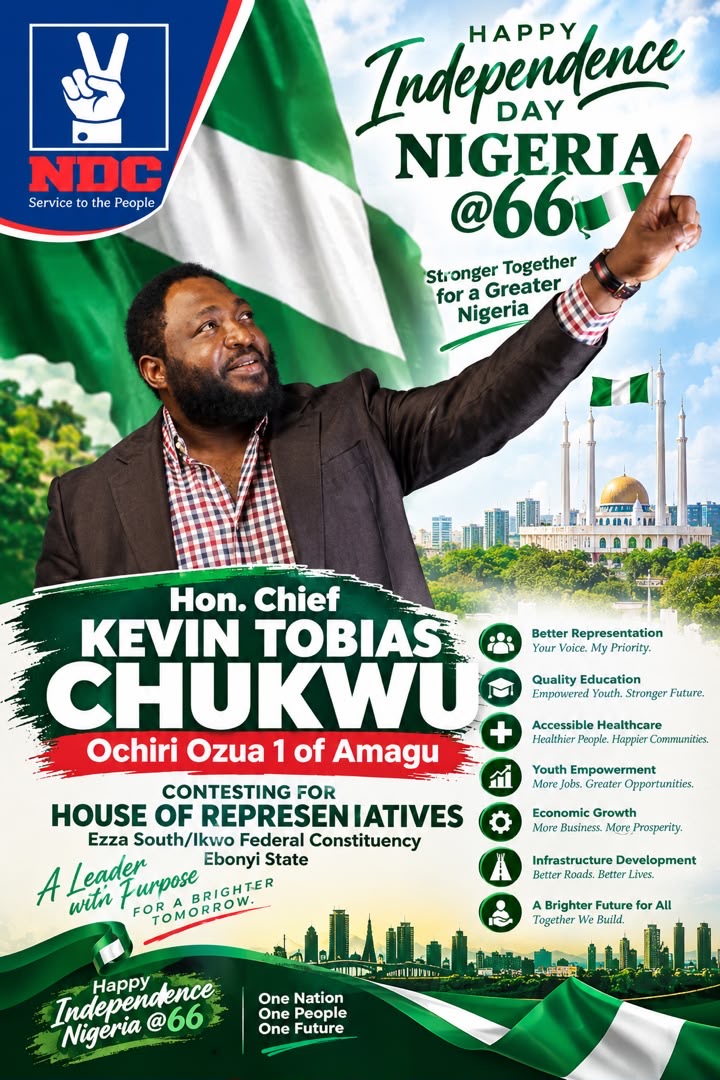
As Nigeria celebrates its 66th Independence Anniversary, the candidate for the House of Representatives seat representing the Ezza South/Ikwo Federal Constituency, Hon. Chief Kevin Tobias Chukwu, has called on Nigerians to remain hopeful and committed to building a better country.
Chukwu, also known as Ochiri Ozua 1 of Amagu Ikwo, made the call in an Independence Day message to Nigerians, particularly the people of Ezza South/Ikwo Federal Constituency and Ebonyi State.
He described the anniversary as not only a moment for celebration but also an opportunity to reflect on the state of the nation and the responsibilities of leaders in building a Nigeria that meets the aspirations of its citizens.
According to him, Nigeria’s journey since independence has been marked by significant challenges, with millions of citizens currently facing economic hardship, while young people continue to search for opportunities and many communities contend with insecurity and uncertainty.
Despite these challenges, the Ebonyi politician said the resilience of Nigerians remained a source of hope for the country’s future.
“I believe in the resilience of our people. I believe in the ingenuity of our youths, the strength of our women, the wisdom of our elders and the determination of ordinary Nigerians who wake up every morning and refuse to give up on this country,” he said.
Chukwu, however, stressed that hope must be matched by responsible leadership, arguing that public office should be viewed as a responsibility rather than a privilege.
He called for leadership that prioritises the protection of lives, creation of economic opportunities, provision of infrastructure, strengthening of institutions and responsible management of national resources.
The candidate also emphasised the need to create an environment where young Nigerians can pursue successful lives within the country and where hard work, merit and enterprise are rewarded.
He said Nigeria had “come too far to surrender to hopelessness,” urging citizens and leaders alike to remain committed to the country’s progress.
“A better Nigeria is still possible, but it will require responsible leadership, accountable institutions and citizens who refuse to give up on their country,” he said.
Chukwu concluded by expressing optimism about Nigeria’s future, declaring: “Nigeria will rise. Nigeria must rise. And together, we must build the Nigeria we deserve.”
He also paid tribute to the nation’s past heroes, praying that their sacrifices would continue to inspire the country.
“May the labour of our heroes past never be in vain,” he said, as he wished Nigerians a happy 66th Independence Anniversary.
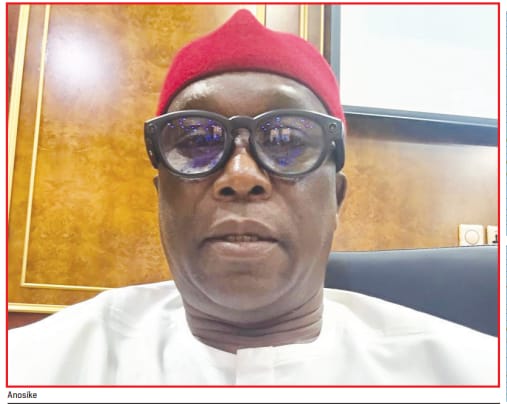
By Okey Maduforo, Awka
As Nigeria celebrates its 66th anniversary of independence from colonial rule, democracy in the country has continued to evolve and deepen, the Anambra State Chairman of the All Progressives Congress (APC), Senator Emma Anosike, has said.
Anosike made the observation in a message to mark Nigeria’s Independence anniversary, noting that despite the challenges the country had encountered since 1960, its democratic system had continued to improve under successive administrations.
According to him, since the return to democratic rule in 1999, Nigeria has witnessed relatively smooth transitions from one administration to another, while citizens have continued to exercise their fundamental rights to hold governments accountable for their performance.
“Before the return of the democratic process, it was indeed difficult and near taboo to challenge the leadership of the country, and those who may have attempted it in the past faced grave consequences.
“Similarly, we have had smooth transitions from one dispensation to another, producing five presidents through the ballot and not through the barrel of the gun. These elected presidents were produced by different political parties.”
Anosike said the administration of President Bola Ahmed Tinubu had sustained the country’s democratic principles and created an avenue for Nigerians, irrespective of tribe, race or religion, to express their views on government policies and programmes.
“Under the stewardship of President Bola Ahmed Tinubu, Nigerians have been enjoying the freedom to express themselves over issues, policies and programmes of government, and those expressions have been shaping and guiding the administration of Mr President,” he said.
The APC chairman said Nigeria’s 66th independence anniversary provided an opportunity for citizens to reflect on the country’s journey as a nation and the progress made since independence.
He said President Tinubu’s Independence Day broadcast had offered another opportunity for Nigerians to renew their hope for a greater and more prosperous country.
Anosike also commended what he described as the “enormous infrastructural development” taking place across the country under the Tinubu administration.
He urged Nigerians to continue to support and have faith in the administration as the country approaches the 2027 general elections.
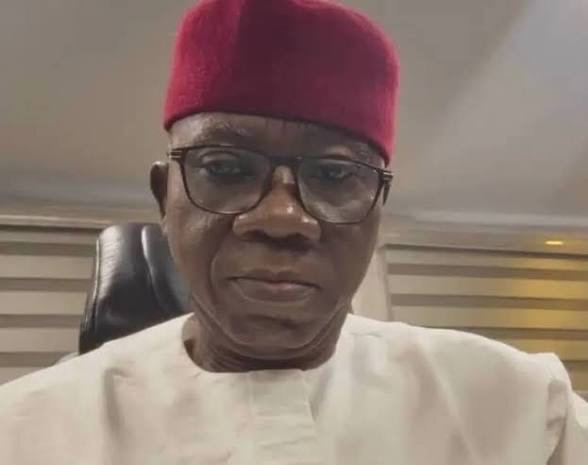
An Elder Statesman, Chief Hycienth Ngwu, has called on political leaders and policies formulators to ensure governmental policies and programmes directly touch lives of the people and reduce hardship in the country.
Ngwu, who is a prominent community leader in Enugu, urged Nigerians to maintain peace within neighbourhoods and communities, as no meaningful development can take place without peace.
The statesman made the call on Thursday in Enugu while reacting to the developmental efforts of Nigeria at its 66th Independence.
He said that previous and present administrations had put in place policies and programmes to reset the socioeconomic fabric of the nation.
Ngwu said that while the removal of fuel subsidy, and unification of the foreign exchange had good intentions, their impact is yet to reflect on the lives and livelihoods of vast majority of Nigerians.
He urged leaders to ensure that public resources were properly managed while citizens remained patient with reforms aimed at improving the socioeconomic status of the country.
The elder statesman noted that at 66th independence, the country was still struggling on keeping its peace and co-existence as a country; adding that the founding leaders of Nigeria envisaged a closely united, bonded and peaceful country.
He called for return to policies that promote local production, indigenous industries and entrepreneurship, arguing that excessive dependence on imports had continued to weaken the country’s productive capacity.
According to him, we are yet to achieve economic independence even as we needed to do more on non oil revenue earns as the greater part of the world is moving towards greener and clean energy.
“Greater emphasis should be on skills acquisition, creativity and entrepreneurship education system, as academic qualifications without practical skills could leave graduates dependent on scarce white collar jobs.
“We ought to be economically productive nation capable of producing and exporting goods while developing its human capital,” he said.
Ngwu noted that current insecurity and social instability could be partly attributed to poverty and ignorance, while calling for greater honesty and trust between leaders and citizens.
“Corruption, tribalism and selfishness must be addressed if Nigeria is to achieve peace and lasting progress,” he added.
He also called for the scrapping of state electoral commissions as they have not helped in deepening democracy at that level. The National Election body should take over that responsibility.

As Nigeria marks its 66th Independence Day, Macmaduson Concepts Limited, a leading provider of HVACR,industrial parts, sensors, electrical and plumbing materials, has extended warm Independence Day greetings to its customers, clients and business partners across the country.
In a goodwill message to mark the occasion, the company expressed appreciation to its valued customers for their continuous support, trust and partnership over the years.
Macmaduson Concepts Limited, which specialises in HVACR,Industrial Materials, sensors, air-conditioners, refrigerators, cold rooms, chillers, refrigerants, electrical materials and plumbing materials, said the occasion provides an opportunity to celebrate Nigeria and reflect on the nation’s journey.
The company wished Nigeria continued growth, unity, peace and prosperity, while expressing hope for a brighter future for all Nigerians.
The message from the company reads in part:
At Macmaduson Concepts Limited, we celebrate our great nation, Nigeria, and appreciate our valued clients for their continuous support, trust and partnership. May Nigeria continue to grow in unity, peace and prosperity.”
The company concluded its Independence Day message with the theme: “One Nation, One People, A Brighter Tomorrow.”
Happy Independence Day, Nigeria!
Happy 66th Independence Anniversary from Macmaduson Concepts Limited.

-
 Business3 days ago
No Bad Blood Over New Cement Factories, But Our Mining Rights Run Till 2045 — Ibeto Tells Ebonyi Govt
-

 Sports3 days ago
Enugu Speaker’s boxing talent hunt unearths 5 budding stars
-
News3 days ago
Nigeria at 66: Macmaduson Concepts Limited Sends Independence Day Greetings to Clients
-

 Crime4 days ago
Five Arrested By Police For Wearing ‘Tinubu Must Go’ T-Shirts
-
 Politics4 days ago
EBONYI 2027: The People, Not Individuals Will Decide Who Becomes Governor – Igwe
-
 News3 days ago
66th Independence: Elder statesman wants policies to reduce hardship, calls for peace
-
 Politics3 days ago
Ebonyi Guber: ‘Our People Deserve Better Government,’ Odii Insists
-
 News3 days ago
Nigeria @66: Democracy Evolving, Says Anambra APC Chairman Anosike