



Crime
3 killed, The Nation vehicle burnt as sit-at-home in Southeast turns bloody

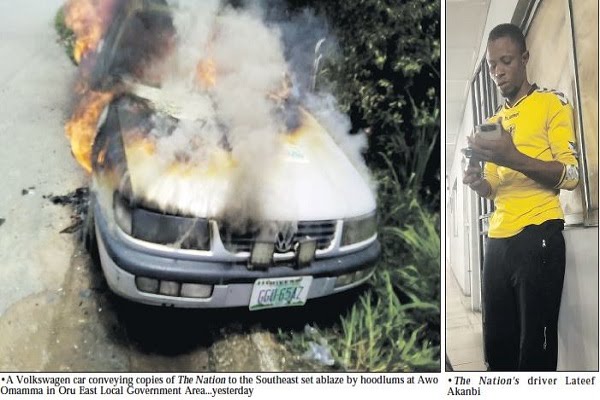

Security agents on Monday killed three hoodlums who were purportedly enforcing the suspended sit-at-home directive of the Indigenous People of Biafra (IPOB) in Imo State.
Another set of hoodlums burnt The Nation newspaper’s distribution car after trying to extort N100,000 from the driver.
The incident occurred in Awo Omamma, in Oru East Local Government Area of Imo.
Businesses and offices were shut again in the Southeast as residents stayed indoor for fear of being harmed or killed.
Not even the reassurances of governors and security agencies, as well as the threat of a sack or sanction, could make them come out.
Many said they would rather lose their jobs or daily income than die.

Transporters also stayed away, leaving residents who came out stranded.
IPOB had urged Ndigbo to stay home every Monday to protest the detention of its leader Nnamdi Kanu, who is on trial over treasonable felony charges at the Federal High Court in Abuja.
The 6 am to 6 pm exercise was first observed on August 9, with several deaths recorded and properties, especially commercial vehicles, destroyed.
Despite the subsequent suspension of the sit-at-home based on an order from Kanu, residents had refused to come out on the last two Mondays. It was the same again yesterday.
Ebonyi State Governor David Umahi had threatened to sack civil servants who fail to report to work or sanction business owners who fail to open, but even a petrol station said to belong to him was shut yesterday. His workers were not convinced.
Soldiers killed three hoodlums said to be enforcing the sit-at-home at Umuonyewere, Umuowa in Ngor Okpala Local Government Area in Imo.
An eyewitness, who pleaded not to be named for safety reasons, said the hoodlums dispossessed residents of their valuables.
He said the security agents engaged the hoodlums in a gun duel at a filling station where they allegedly robbed a fuel attendant of his cash and phones.
Three of the hoodlums were gunned down; others fled into the bush.
Two vehicles, including a Toyota Rav4, two locally-made pistols, five bullet shells, hard drugs, charms, two plate numbers, among other weapons, were recovered from them.
Some of the residents expressed delight at the prompt response of the joint security team.
It was learnt that the hoodlums snatched a vehicle from Emmanuel Chima Ekeh in the Amafor community at about 6:00 am.
“They went on shooting sporadically in the community and stopped by a filling station where they claimed to be enforcing the sit-at-home.
“They assaulted the pump attendants, snatched his phone and all the money he had on him,” the eyewitness said.
The Commander, 34 Artillery Brigade, Obinze, Owerri, Brig.-Gen Raymond Utsaha, advised the people to be vigilant and report suspected criminals to law enforcement agencies.
The Nation van set ablaze
A Volkswagen car conveying copies of The Nation to the Southeast was burnt at Awo Omamma in Oru East Local Government Area.
The driver, Lateef Akanbi, said: “They flagged me down but when I noticed that they were armed hoodlums, not the police, I sped into the bush and hid.
“From a distance, I heard them saying: ‘Bring N100,000!’. I had no money with me, so, I did not come out. What I saw next was a cloud of smoke coming out from the vehicle. I then realised they had set it on fire.”
Police spokesman, Michael Abattam, a Chief Superintendent of Police, said an investigation had begun.
“They are thugs. We are investigating the matter,” he said.
Businesses, offices, roads and markets were again deserted in Imo, despite Governor Hope Uzodimma’s claim that the sit-at-home did not work in Imo.
Abakaliki, Ebonyi capital, was deserted. Most businesses did not open despite the threat by the state government that shop owners could lose the right of occupancy of their businesses should they not open.
At the international market Abakaliki, the majority of the shops did not open.
Banks remained shut; a few that had their gates open did not have customers to attend to.
A banker told our reporter that they were instructed to report for work but not to open till they were told to do so.
Some security agents were seen in their vans on patrol of major streets. Students for the National Examination Council (NECO) examinations were seen going to school in the morning.
Major transport companies did not open for business. Filling stations and major eateries did not open, including Brass Filling Station said to belong to Umahi.
Enugu residents urge govt to intervene
Some Enugu State residents urged the government to prevail on transporters and traders to end the sit-at-home.
They lamented that the exercise had impacted negatively on their well-being.
A doctor, Cosmas Anibeze, said: “This whole thing is taking a new dimension. Everyone is afraid of being attacked although IPOB, which initially imposed this order, later cancelled it.
“I think what the government needs to do is prevail on the traders and especially transporters to always come out because this economy depends on everyone to thrive.
“Four of my staff could not come out because there were no buses to convey them from their various locations.”
A trader, Josiah Udeh, attributed the situation to fear created by some mischief-makers as well as insistence by transporters to withdraw their services.
Catholic Bishop of Enugu Diocese, Calistus Onaga, appealed to agitators in the Southeast to suspend the sit-at-home.
He spoke at the opening of the Second Plenary Meeting of the Catholic bishops Conference of Nigeria (CBCN) in Enugu.
He wondered why the agitators, who claimed to be protecting the interest of the poor masses of Southeast, would turn around to inflict pains on them.
Onaga said: “The various leaders of ethnic agitations and interest groups should take care not to employ methods to contradict their intentions in any way or try to reduce their intentions.
“They should take an example from those who have done that in the past. Martin Luther King who died for the Blacks did not punish those he was fighting for.
“Even Emeka Odumegwu Ojukwu used his father’s wealth to look for our independence, yet he did not come back to demand return from any of us.”
“When you make us afraid, those you feel you are protecting, what will happen when you get the Independence?”
“This part of the world is known for business; this part of the world is known for education and you tell us to sit at home, doing what?
“What of the parents, who will need to sell their goods to train their children – you tell them to sit at home? Is that the way we can progress?”
Abia, Anambra residents stay home
Residents of Aba, Abia State and Umuahia, the state capital, again closed their shops, offices and markets.
Banks, federal, state and local government workers stayed away despite the assurances of their safety by the security agencies.
Security agents were spotted at different locations in their various patrol vehicles.
In Anambra, commercial activities were paralysed.
Banks, markets, shops and other commercial activities were grounded again in Awka, Nnewi and Onitsha.
It was learnt that there was a gun duel between some criminals and security operatives at Awkuzu, Oyi Local Government Area.
Police spokesman, Ikenga Tochukwu, did not confirm the incident.
Roads and streets in Onitsha, the commercial city and Nnewi, the Industrial town, were empty.
Markets in the two cities were under lock, including the Onitsha Main Market and Nkwo Nnewi.
A group, the Balance and Equity Group (BEG), appealed to IPOB leadership to ensure proper dissemination of suspension of the weekly sit-at-home.
Its Founder, Chris Arinze, urged IPOB to help save the region’s economy.
He said: “It’s very clear that Southeast governors can’t give a contrary order against that of IPOB for the traders and businessmen in Igboland to go back to their businesses on Mondays.
“Every genuine Igbo accepts that Igbos are not well-treated. There are injustices against Ndigbo and Mazi Kanu cannot be faulted on that, but IPOB needs to do something about this Monday weekly sit-at-home.
“Otherwise, people will continue to observe it from now to December or when Mazi Kanu is released and it is not good for our economy.
“It is, therefore, left for IPOB to order them back to their businesses through the mass media, as a show of love, respect and loyalty.”
Nation






By Okey Maduforo, Awka
The Awka High Court, on Tuesday, denied bail to the General Overseer of Day Spring Assembly, Mr Harrison Anazodo, who is standing trial over alleged offences relating to his activities as a pastor.
Anazodo had applied for bail on health grounds, but the presiding judge, Justice Jude Obiora, rejected the application, citing concerns over possible interference with witnesses.
The development came as seven persons, believed to be members of the congregation, are expected to testify in the case.
The court adjourned the matter until October 16 for further proceedings.
Speaking shortly after the hearing, State Counsel, Victoria Ekwerekwu, commended the Anambra State Government for its efforts to tackle alleged fraudulent activities by some religious figures.
She said, “We thank Governor Charles Soludo for trying to sanitise our society from pastors who make the younger generation believe that making money without hard work is possible.”
According to her, the prosecution has established a prima facie case against Anazodo, although the state would still be required to prove the allegations beyond reasonable doubt.
“Today, there is a prima facie case against the accused, Mr Harrison Anazodo, though it is left for us to prove it beyond reasonable doubt.
“The court ruled on the bail application and denied him bail because of the witnesses, to ensure that they are not interfered with. The matter was subsequently adjourned until October 16,” she said.
The Anambra State Commissioner for Information, Dr Law Mefor, expressed optimism that the case would be concluded expeditiously, stressing that the ultimate decision rests with the court.
“We have been here since 9am. The court considered the bail application filed by his counsel and, after weighing its merits, the judge ruled that bail should be denied.
“We are looking forward to the quick dispensation of the matter and we assure you that justice will be done and will be seen to have been done,” Mefor said.

By Our Correspondent
The Inspector-General of Police, Olatunji Disu, has deployed the Deputy Inspector-General of Police in charge of Operations, Shehu Nadada, to Imo State to coordinate the search-and-rescue operation for 20 prospective National Youth Service Corps members and other passengers abducted along the Owerri-Onitsha Road.
The victims were reportedly abducted on Thursday, October 1, 2026, around Umunoha in Imo State.
The Force Public Relations Officer, Force Headquarters, CSP Anietie Iniedu, disclosed this in a statement issued on Friday.
According to the statement, Nadada arrived in the state alongside two Commissioners of Police and immediately conducted an on-the-spot assessment of the incident and the ongoing rescue operation.
He also reviewed the operational strategies, deployment of personnel and available assets, while issuing additional directives aimed at strengthening the coordinated response.
The assessment was conducted alongside the Imo State Commissioner of Police, CP Audu Garba Bosso; the Commissioner of Police in charge of Federal Operations, CP Akpan Anifiok; the Commissioner of Police in charge of the Police Mobile Force; other service commanders and members of the management team of the Imo State Police Command.
Iniedu said the search-and-rescue operation had been intensified, with additional tactical teams and operational assets deployed to identified areas.
He added that the operation was being supported by intelligence-led tracking of the abductors and coordinated efforts with other security agencies.
Nadada assured members of the public that the police remained committed to securing the safe release of the abducted persons.
“The Nigeria Police Force is committed to securing the safe rescue of the 20 abducted persons and will sustain the operation until the mission is successfully concluded,” Iniedu quoted Nadada as saying.
The police boss urged members of the public and the media to remain calm and vigilant, while appealing to anyone with credible information that could assist the operation to contact the police or the nearest security formation.
He assured the public that all information received would be treated with strict confidentiality.
The police said further updates would be provided as the rescue operation progresses.

Five men have been arrested and arraigned before a Chief Magistrate’s Court in Maiduguri, Borno State, after police allegedly found them wearing T-shirts bearing the words “Tinubu Must Go.”
The defendants were identified as Baba Aji Gremami, 44; Mustapha Abba Yemen, 28; Abbacha Mohammed Ali, 32; Adam Umar Gubio, 21; and Abdulhamid Mohammed, 21.
According to a First Information Report issued by the State Criminal Investigation Department, the incident occurred on September 25, 2026, near West End Roundabout in Maiduguri.
Police charged the five men with criminal conspiracy, inciting disturbance, disturbance of public peace and thuggery under Sections 60, 78, 79 and 392 of the Borno State Penal Code.
The defendants pleaded not guilty to the charges when they appeared before Chief Magistrate Court I in Maiduguri.
Their lawyer subsequently applied for bail. The court adjourned the matter until October 6, 2026, to rule on the bail application, while the substantive trial has been scheduled for October 26.
The case has drawn attention because the alleged conduct involved wearing clothing displaying a political message.
Amnesty International criticised the prosecution, describing the arrests as arbitrary and arguing that peaceful political expression is protected by fundamental human rights. The organisation called for the immediate release of the five men and urged authorities to discontinue the case.
Amnesty International also expressed concern that the prosecution could have implications for political expression and opposition activities in Borno State.
The case has generated reactions on social media, with some commentators questioning whether the display of political messages on clothing should constitute a criminal offence.
There have also been allegations that a prominent politician in Borno State may have influenced the arrests. The allegation has not been independently verified.
Efforts to obtain a comment from the Borno State Police Public Relations Officer, ASP Kenneth Daso, were reportedly unsuccessful as of the time of filing.
The defendants remain subject to the court process, and the allegations against them have not been established in court.
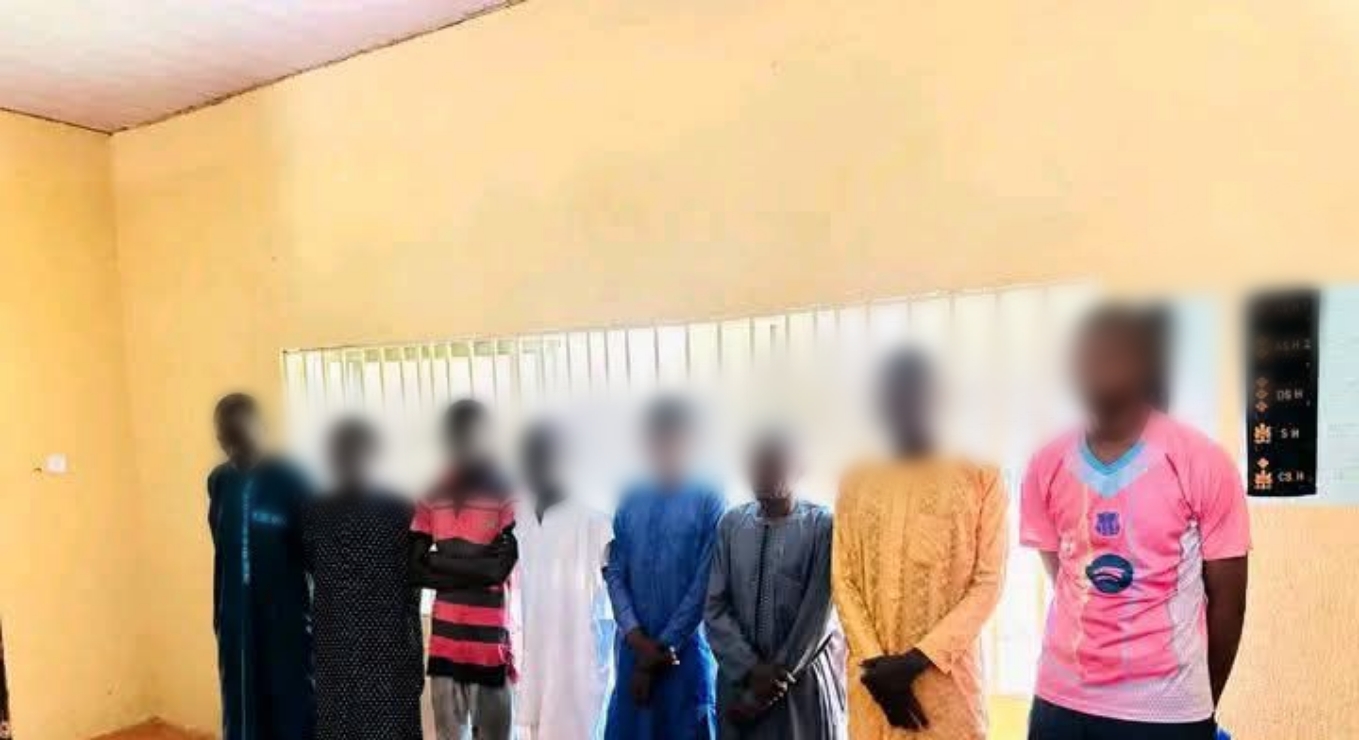
The Jigawa State Hisbah Board has arrested eight people in Kazaure Local Government Area over alleged homosexual acts, according to the board.
The board’s Public Relations Officer, Dauda Hadejia, disclosed this in a statement issued on Saturday, September 26, 2026.
Hadejia said the arrests followed a complaint filed by a 22-year-old man, who alleged that nine individuals had engaged in sexual acts with him on different occasions.
According to the statement, the complainant also claimed that he later contracted HIV, which he attributed to the alleged encounters. He reportedly appealed to the Hisbah authorities for justice, describing the alleged conduct as deceptive and harmful to his life.
Following the complaint, Hadejia said Hisbah operatives launched an investigation and began searching for the nine individuals named by the complainant.
“So far, eight suspects have been arrested, while efforts are ongoing to arrest the remaining suspect,” Hadejia said.
He added that the eight arrested individuals reportedly admitted during preliminary investigations to having engaged in sexual acts with the complainant.
Hadejia said the board had gathered information and evidence that would be presented before a court. He added that the investigation remained ongoing and that the suspects would be charged upon its completion.
The Deputy Commander-General of the Jigawa State Hisbah Board, Dr. Hussain Baban, reportedly urged parents to pay closer attention to their children’s upbringing and the people with whom they associate.
He also called on members of the public to be mindful of the consequences of their actions and to uphold religious and moral values.
The board further expressed appreciation to the Jigawa State Government for its support and cooperation in carrying out its responsibilities.

A newly married couple, Funmilayo Bamidele and her husband, Reverend Abiodun David, have been abducted along the Iyemero-Eruku Road, a border route linking Kwara and Kogi states.
The couple were reportedly returning from their engagement ceremony in Eruku on Saturday evening when armed men intercepted their vehicle and abducted them alongside four other passengers.
According to sources, the vehicle was initially expected to take the Isanlu Road. However, the driver reportedly chose an alternative route to drop off the best man and other members of the group at Iyamoye in Kogi State.
The vehicle was subsequently intercepted by armed men along the Iyemero-Eruku Road, leading to the abduction of all the occupants.
A photograph of the newly abducted couple has since emerged following the incident, while details about the whereabouts of the other passengers remain unclear.
Confirming the incident on Sunday, Kwara State Commissioner of Police, Adekimi Ojo, said soldiers had been deployed to search the surrounding bushes and rescue the victims while also pursuing the suspected kidnappers.
Ojo disclosed that the vehicle used by the victims was later found abandoned at a former police station in Ayetoro, Ekiti State.
He added that police operatives from Kwara, Kogi and Ekiti states were working jointly on the rescue operation because the incident occurred around the border communities of the three states.
Authorities have yet to disclose further details on the identities of the suspected abductors or whether any contact has been established with the victims.

-
 News2 days ago
No Survivor Found Yet in Ondo Air Crash — Aiyedatiwa
-
 News1 day ago
How NAF Plane Vanished From Radar Shortly After Take-Off, Crashes In Ondo Swamp
-

 News3 days ago
Sacked Works Commissioner: Release or Charge Him to Court, Oganiru Izzi Challenges Nwifuru
-

 Politics2 days ago
2027: Odii Will Not Step Down, Says Spokesperson
-

 EverydayNews Telescope1 day ago
Nkalagu Cement Factory: Project or 2027 Political Promise?
-
Crime3 days ago
Police Deploy DIG, Two Commissioners to Rescue 20 Abducted Prospective Corps Members
-
Crime18 hours ago
Court Denies Alleged Fake Pastor Bail as Seven Witnesses Await Trial
-

 News17 hours ago
NAF Crash Claims Pilot 16 Days After Wedding