



Crime
Reign of terror: 165 farmers killed, farms deserted as bandits demand N3bn



Out of the 165 farmers killed this year, the highest number was recorded in Benue State, where 130 of them were killed by the bandits.
The Association of Nigerian Farmers in the state told The PUNCH on Tuesday that 130 farmers were killed by bandits in four local government areas of the state this month (March). Also, in Sokoto State, 28 farmers have been killed since the beginning of the year, while six farmers lost their lives in Niger State during bandits attacks. One farmer was murdered by bandits in Plateau State.
In Sokoto State, the association lamented that not less than N3bn had been paid by its members as ransoms to bandits, who kidnapped them from their farms.
There has been an upsurge in banditry recently with over 295 victims being held hostage by kidnappers in Sokoto, Kaduna, and Borno states.

Lamenting the implications on farming The Benue State Chairman of the AFAN, Aondongu Saaku, told The PUNCH that six farmers were kidnapped in the state in the last two weeks.
According to him, farmers lost over N1.1bn to bandits’ attacks in the last few months in Benue State.
Saaku said, “The figure I will give you is for March alone so you can know the gravity of what farmers in the state are passing through.
“Six farmers were kidnapped in their farms. No fewer than 130 farmers were also killed in Kwande, Ukum, Agatu, and Apa LGAs.”
Asked to quantify what his members might have lost, the Benue State AFAN chairman replied, “It’s difficult to quantify because how do we quantify those farm crops that were harvested and burnt by the bandits?
“It’s huge. We will be talking about something around N1.1bn, because many farmers lost the whole farm, some over 100 bags of rice, several thousands of tuber of yams and the seeds, cassava chips, corn and a host of others.”
Saaku stated that going to the farm now was between life and death, “because in as much as one doesn’t have another source of income, you have to risk it and go to the farm. If you are caught and killed, that is your fate; and if you go and come back alive, it’s your luck.”
He, however, called on the Federal Government to declare a state of emergency on security, warning that Nigerians were at risk of heavy famine shortly if nothing is done to arrest the insecurity plaguing the country.
Farmers in Borno State noted that the production of sorghum and other crops had fallen by 90 per cent in the state.
Eight Delta farmers
On their part, farmers in Delta State stated on Tuesday that about eight of them were kidnapped last week and paid between N1m and N5m each as ransoms.
Farmers in Ika North-East and Aniocha South Local Government Area of Delta State said they could not access their farms following the incessant kidnapping in the state.
A farmer, Mr Okwudili Uti, in the Ute-Okpu community, said, “My brother we passing through hell now, as I speak we cannot go to farm again. The kidnappers have been kidnapping our people.
“In Ute-Okpu, Ute-Erumu, Abavo and communities around the Ika North-East, recently when the kidnapping started, we usually go to farms in groups. But last week, about eight farmers were kidnapped, and some paid ransoms of between N1m and N5m.
“Our farm produce have all gone bad in the farms because we cannot go to the farm even in groups, due to the fear of being kidnapped.”
The Chairman of the All Farmers Association of Nigeria, Delta State, Mr Rechard Asemina, said virtually all the farmers in the state could not access their farms.
“Currently, not only farmers in Ika North-East and Aniocha South but also those in Ugheli, Abraja, and other places cannot access their farms. We don’t know what to do now. We are appealing to the government to come to our aid because we are in trouble in Delta State.
“Even those who summon courage and manage to get to their farms, find out that your farm produce has been damaged by cows.’’
Sokoto loses over N3bn
Also, the Chairman of AFAN in Sokoto State, Jamilu Sanusi, said members lost over N3bn to ransom payments to bandits in the state.
He also explained that over 80 per cent of people in the internally displaced persons camps in Sokoto were farmers.
Sanusi stated, “We are the major people who suffer most when we talk of these bandits’ activities in the state. Over 80 per cent of those people you see at the various IDP camps are farmers who are all displaced by the activities of the so-called bandits.
“If I have to give you a rough estimate of how much money we have paid to these people in the past two years, it should be more than N3bn.
“This is apart from what we are losing on each farming season as a result of our people who have to abandon their farms and relocate to IDP camps for fear of being attacked.
“Not less than 10,000 hectares of land could not be cultivated for over three years now, in which in each farming season, a farmer can make up to N1m or more. About 28 farmers have been killed this year. “
Sanusi called on the state government to sustain the tempo of the state security outfit, Sokoto Community Guard Corps, stressing that with their presence in the remote areas, security might improve when compared to what obtained in the past.
In Plateau State, farmers stated that they were constantly under threat of being kidnapped by bandits.
The state Chairman, AFAN, Sako Danboyi, said he was in a meeting when contacted over the issue, but a farmer in Bokkos LGA, Stephen Garuba, confirmed the development.
Garuba said, “I cannot tell you how many of our members have been kidnapped, but honestly, farmers in Bokkos are having a lot of challenges, especially in the area of security.
“We are finding it difficult to go to our farms. In some communities like Yelwa Nunu, the residents who are mainly farmers are yet to return to the community after they were initially chased away by bandits. Even we that are in Bokkos town are not safe either. Some weeks ago, a man was shot dead and his wife was kicked by some hoodlums who attacked his house.
“So, you can understand what we are facing. We are aware of the efforts of the state government to protect farmers and ensure that they go to the farm, but more should be done to achieve the objective.”
The Chairman of AFAN in Jos North LGA, Umar Fodio, expressed hope that with the renewed support to farmers in the state by the state government, farmers would heave a sigh of relief in the coming rainy season.
Farmers in Niger State now avoid their farms in some local governments notorious for bandits attacks.
The farmers adopted this practice as the last option after the bandits operating in those troubled areas persistently attacked and abducted farmers who dared to defy them.
The bandits had also reportedly set farm produce worth millions of naira ablaze and demanded that the farmers must pay levies before they would be allowed to harvest their crops.
Some of these Local Governments include Munya, Shiroro, Meriga, Paikoro, Rafi Mashegu, Wushishi and Borgu. There are 25 local government areas in the state.
In February, this year the bandits reportedly killed six farmers and abducted over 20 women.
In another incident in February, security operatives were said to have rescued 16 farmers kidnapped at Dan-Gunu Community of Munya Local Government Area of Niger State.
The bandits reportedly stormed the community and kidnapped the victims, including pregnant women and children.
Munya LGA Chairman, Abdulhamid Najume, confirmed the attack and explained how the victims were rescued when he said, “We had an emergency security meeting after which we mobilised security operatives and dispersed them to go after the bandits.
“Luckily, they were able to rescue all the kidnapped victims. Currently, they are receiving medical care at a hospital after which they will be reunited with their families.”
A leader of the Rice Farmers Association in Minna, the state capital, Abdullah Imam, said farmers avoid anything to do with those Local Governments known for attacks by bandits.
“No farmer wants to lose his life or even his farm produce. Everyone is avoiding those places. Even farmers whose ancestral homes and farmlands used to be those places have given them up. It is better to lose farmlands than lose one’s life.
“The government and the military must do something to address the problem. These bandits are still there and imagine the vast land in those places. Now farmers don’t want to go near those places because of bandits. This will surely have an impact on the harvest of the coming year because if farmers do not farm on those lands the harvest will not be much,” Imam said.
This came as farmers in Ondo State, under the auspices of the Cocoa and Plantain Farmers Association of Nigeria, appealed to President Bola Tinubu to find urgent solutions to the incessant bandit attacks on farmers and their produce.
The group lamented the countless number of farmers who lost their lives, while many had been kidnapped on the farms.
Speaking in Akure, Ondo State capital, the National President of the Cocoa and Plantain Farmers Association of Nigeria, Mr Ayodele Ojo, decried the incessant killing of farmers and destruction of their farmlands.
He said, ”We don’t know what is happening. The insecurity in the land is getting out of hand. We want Mr. President to look into it as a matter of urgency. Farmers cannot access their farms to harvest their farm produce even though the produce is due for harvest.
“Bandits have harvested some of the farm products, they kidnap our members (farmers) while we also pay ransom for their freedom.
“Some of the hoodlums are now in control of the farms of some of our members, and we are in a very difficult situation now because we are not allowed to visit our farms again. Many of us have not been to the farms for weeks now because of the fear of being kidnapped.”
Farming declines in Nasarawa
Farmers in Nasarawa State also lamented that the issue of banditry and kidnapping in the state had stopped many of them from going to their farms.
Farmers who were victims of recent attacks in Keana and Nasarawa Eggon local government areas of the state expressed deep concern over the persistent attacks on their communities by yet-to-be-identified gunmen.
They, therefore, called on the security agencies to as a matter of urgency, provide adequate security to communities prone to attacks across the state.
One of the farmers in the Keana LGA, Musa Yamusa, stated that quite several farmers in the area had deserted their homes and completely stopped going to farms as a result of the insecurity in the area.
“What we are passing through in our farms is not easy to describe. The situation is quite pathetic. Before now, we did go to our farms daily but since the insecurity increased in the state, we have not been frequent at our farmlands because we are scared of being attacked by gunmen.
“We need assistance from both the federal and state governments to address the security challenges. They should assist us in this predicament because most of us rely solely on farming. If we do not go to our farms, we will not be able to eat or take care of our families,” he stated.
Another farmer in the Lizzin-Keffi area of Nasarawa Eggon LGA, Alaku Ibrahim, said the activities of bandits in the area had made many farmers lose their valuables, adding that they were most times attacked by the bandits while going to their farms.
Speaking on the security situation in the state, the Senior Special Assistant to Governor Abdullahi Sule on Public Affairs, Peter Ahemba, said the state government was already collaborating with security agencies to provide adequate security for all residents of the state.
He said, “Insecurity is a thing of concern in almost every state of the federation at the moment. But as a responsible government, we will continue to do everything within our power to collaborate with the security agencies to ensure that all residents of Nasarawa State do not go through any kind of challenge in accessing their farmlands or going about their daily activities.
“Governor Abdullahi Sule is fully ready to serve the people of the state, and I can assure you that the security of everyone in Nasarawa State is a top priority to him.”
In Borno State, though no one could put a figure on the number of farmers killed in the state, it should be noted that in the 2023 farming season, no fewer than 100 farmers were reportedly butchered.
At least 30 of them were slaughtered by the terrorists as they were clearing the fields for the cultivation of crops, as this happened across the local government areas of Jere, Mafa, and Konduga, which surround the Maiduguri metropolis.
The state Chairman of the Sorghum Farmers and Marketers Association of Nigeria, Goni Alhaji Adam, said production of Sorghum in the state had fallen by 90 per cent
“While I can only say hundreds, reported and unreported, have been killed by Boko Haram across the state over the last few years, terror activities have drastically reduced sorghum and related crops production to between 80 percent and 90 percent,” he stated.
The Secretary, AFAN, Ogun State, Mr Abiodun Ogunjinmi, said farmers in the state were currently contending with the problem of indiscriminate grazing by some ruthless herders, stressing that this posed a threat to food security.
Although he noted that the state had not recorded abductions or killing of farmers lately, some herders had through their indiscriminate grazing continued to destroy farmers’ investment in the state.
Kaduna rice farmer
In Kaduna, farmers under the aegis of the Rice Farmers Association of Nigeria, have also lamented over the security challenges in the state.
They said they could no longer access their farms due to insecurity in the state.
Speaking to The PUNCH, Chairman of the Kaduna Chapter of the Association, Alhaji Mohammed Umar Numbu, the security situation had forced their members to stay home for fear of being attacked by bandits.
He stated, “It has instilled fears in farmers such that they can no longer venture into their farms. Most of our members who are about 72,000 cannot go to farms now.’’

A Lagos State Special Offences Court sitting in Ikeja has ordered the remand of Nigerian-American car dealer Oluwatobi Adegoke at the Kirikiri Maximum Security Correctional Centre over an alleged $680,000 vehicle-import fraud.
Justice Olubunmi Abike-Fadipe issued the order on Friday following Adegoke’s arraignment by the Ilorin Zonal Directorate of the Economic and Financial Crimes Commission (EFCC) on a one-count charge of stealing.
According to the EFCC, Adegoke was arrested in July 2026 over an alleged cross-border scheme involving the purported purchase and importation of luxury vehicles from the United States to Nigeria.
Investigators reportedly linked him to a US-based syndicate allegedly targeting Nigerians seeking to purchase vehicles abroad.
The commission alleged that Adegoke, while residing in the United States, circulated photographs of a 2024 Mercedes-Benz G63 AMG to prospective buyers, claiming he could procure and ship the vehicle to Nigeria.
The EFCC further alleged that two victims paid more than $320,000, equivalent to approximately ₦434.88 million, in connection with the transaction.
However, the charge before the court cited an alleged theft of $680,000 belonging to Ikechukwu Osita Ifeabunike.
According to the charge, the money was transferred to the bank account of Adegoke’s company, Omosco Auto Sales LLC, for the purchase of a 2022 G-Wagon from an individual identified as Mr Robinson.
The alleged offence is punishable under Sections 278(1)(b) and 285(1)(a) of the Criminal Law of Lagos State, 2015.
Adegoke pleaded not guilty to the charge.
Following the plea, EFCC counsel Arazeem Adebayo urged the court to fix a trial date and remand the defendant.
Defence counsel Olalekan Abiodun, whose earlier objection to the arraignment was overruled, subsequently asked the court to keep his client in EFCC custody pending the filing of a bail application.
The judge rejected the request and ordered that Adegoke be remanded at the Kirikiri Maximum Security Correctional Centre.
The court adjourned the case until January 13, 2027, for the commencement of trial.
The allegations against Adegoke remain subject to judicial determination.

The 20 prospective National Youth Service Corps (NYSC) members abducted in Imo State have reportedly been given the opportunity to choose any of the six South-West states for their national service.
According to Saturday PUNCH, the graduates were kidnapped on October 1 along the Owerri–Onitsha Road, near Umunoha in Mbaitoli Local Government Area of Imo State, while travelling in two commercial buses belonging to Uko Akwa Ibom Motors. They were reportedly heading to Abia and Akwa Ibom states.
Families of the victims disclosed that they paid ₦6 million per captive to secure their release, after the kidnappers initially demanded ₦50 million per person. One victim’s mother said the demand was later reduced to ₦15 million before the kidnappers agreed to accept ₦6 million following appeals from the family.
Relatives and well-wishers reportedly contributed money towards the ransom. Some family members also described the emotional and physical toll of the incident, with one mother revealing that she and her daughter had been hospitalised following the ordeal.
The Imo State Police Command, however, maintained that the graduates were rescued through sustained security operations and denied knowledge of any ransom payment. The police had announced their rescue on Wednesday, after which the victims were taken to a Department of State Services hospital in Owerri for medical evaluation.
The Director-General of the NYSC, Brigadier General Olakunle Nafiu, also visited the released graduates alongside senior security officials.
However, the NYSC had yet to officially confirm the reported offer allowing the graduates to choose their preferred South-West states as of the time of publication.
The incident has renewed concerns over the safety of corps members travelling long distances for national service. Similar kidnappings in other parts of the country have intensified calls for improved security measures and, in some quarters, the scrapping of the 53-year-old scheme.
Although the Federal Executive Council approved NYSC reforms in June 2026, including risk-sensitive deployment and a technology-driven mobilisation process, questions remain about how effectively the measures will protect young graduates from security threats.
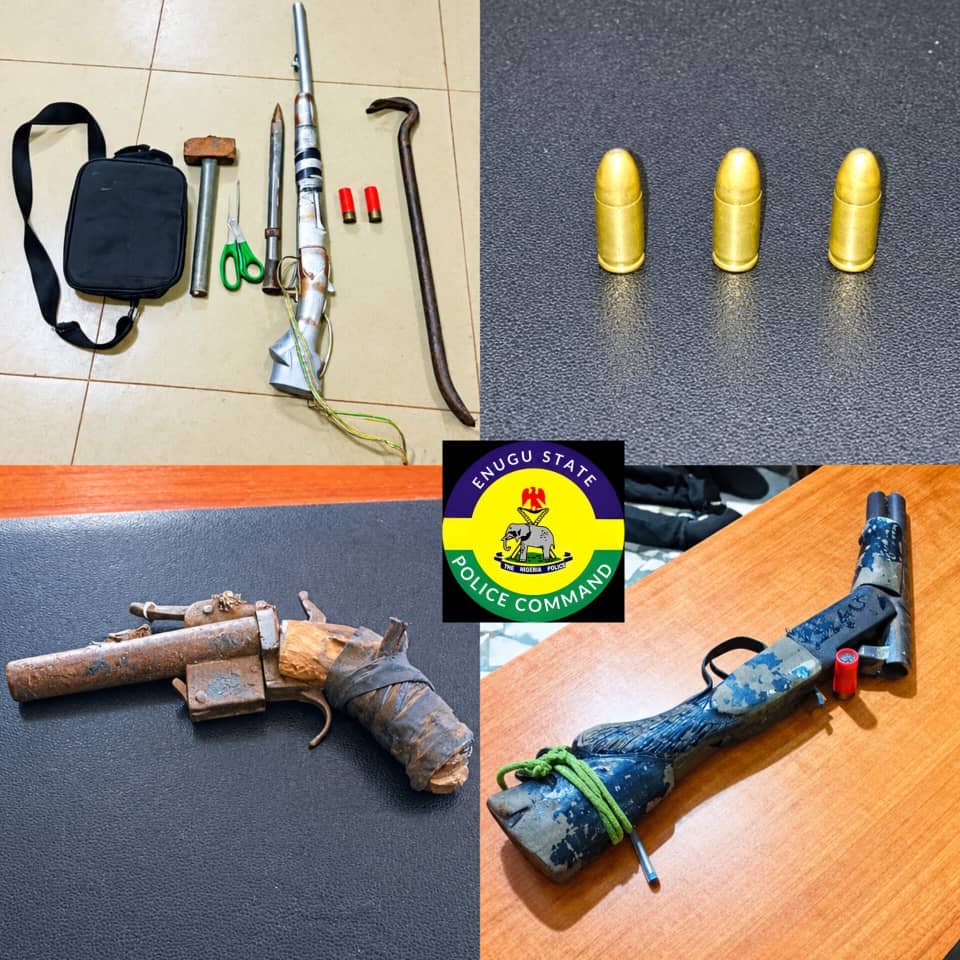
ENUGU — The Enugu State Police Command says it has arrested five male suspects in separate operations across the state and recovered three firearms, six rounds of live ammunition and other exhibits.
The Command disclosed this in a statement issued on Thursday, October 8, 2026, by its Police Public Relations Officer, SP Daniel Ndukwe.
According to the statement, police operatives attached to Inyi Division responded to a distress call about an armed robbery at Umuaor, Umukabia Isiama Awlaw Community, Oji-River Local Government Area, at about 5:10 a.m. on October 7.
One suspect, identified as 26-year-old Arinze Osita Onwuaso, was arrested while other suspects reportedly fled the scene. Police said they recovered a locally made cut-to-size single-barrel gun, two live cartridges, a pry-bar, hammer, scissors and chisel from him.
In a separate operation on October 5, operatives of the Anti-Cultism Section of the Violent Crime Response Unit arrested two suspected cultists, 24-year-old Jonas Adejo, also known as J-Money, and 25-year-old Okoro Innocent, also known as Virus, at Umudioka Community in Nsukka.
Three live rounds of 9mm ammunition were recovered from the suspects. Police said the two men confessed during interrogation to membership of the Supreme Vikings Confraternity.
Meanwhile, on September 25, operatives of Aninri Division, working with members of the Neighborhood Watch Group, raided a suspected criminal hideout at Amagu Mpu Community in Aninri LGA.
The operation led to the arrest of 25-year-old Anichebe Ogbonna, from whom police said one locally made pistol was recovered.
Similarly, on September 18 at about 11:00 p.m., operatives of 9th Mile Division, acting on information and in collaboration with Neighborhood Watch members, arrested 38-year-old Chukwujekwu Chukwuemeka at Ameke-Ngwo, Udi LGA.
He was arrested over alleged involvement in armed robberies in the area. Police said one cut-to-size pump-action gun and one live cartridge were recovered from him.
The Command said investigations into the cases are ongoing and that the suspects would be arraigned in court after the conclusion of investigations.
The Commissioner of Police, CP Mamman Bitrus Giwa, commended members of the public for providing information and praised the police operatives for their response to credible intelligence.
He reiterated the Command’s commitment to intelligence-led operations against armed robbery, cultism and other violent crimes, while urging residents to remain vigilant, law-abiding and supportive of security agencies.

By Okey Maduforo, Awka
The Awka High Court, on Tuesday, denied bail to the General Overseer of Day Spring Assembly, Mr Harrison Anazodo, who is standing trial over alleged offences relating to his activities as a pastor.
Anazodo had applied for bail on health grounds, but the presiding judge, Justice Jude Obiora, rejected the application, citing concerns over possible interference with witnesses.
The development came as seven persons, believed to be members of the congregation, are expected to testify in the case.
The court adjourned the matter until October 16 for further proceedings.
Speaking shortly after the hearing, State Counsel, Victoria Ekwerekwu, commended the Anambra State Government for its efforts to tackle alleged fraudulent activities by some religious figures.
She said, “We thank Governor Charles Soludo for trying to sanitise our society from pastors who make the younger generation believe that making money without hard work is possible.”
According to her, the prosecution has established a prima facie case against Anazodo, although the state would still be required to prove the allegations beyond reasonable doubt.
“Today, there is a prima facie case against the accused, Mr Harrison Anazodo, though it is left for us to prove it beyond reasonable doubt.
“The court ruled on the bail application and denied him bail because of the witnesses, to ensure that they are not interfered with. The matter was subsequently adjourned until October 16,” she said.
The Anambra State Commissioner for Information, Dr Law Mefor, expressed optimism that the case would be concluded expeditiously, stressing that the ultimate decision rests with the court.
“We have been here since 9am. The court considered the bail application filed by his counsel and, after weighing its merits, the judge ruled that bail should be denied.
“We are looking forward to the quick dispensation of the matter and we assure you that justice will be done and will be seen to have been done,” Mefor said.

By Our Correspondent
The Inspector-General of Police, Olatunji Disu, has deployed the Deputy Inspector-General of Police in charge of Operations, Shehu Nadada, to Imo State to coordinate the search-and-rescue operation for 20 prospective National Youth Service Corps members and other passengers abducted along the Owerri-Onitsha Road.
The victims were reportedly abducted on Thursday, October 1, 2026, around Umunoha in Imo State.
The Force Public Relations Officer, Force Headquarters, CSP Anietie Iniedu, disclosed this in a statement issued on Friday.
According to the statement, Nadada arrived in the state alongside two Commissioners of Police and immediately conducted an on-the-spot assessment of the incident and the ongoing rescue operation.
He also reviewed the operational strategies, deployment of personnel and available assets, while issuing additional directives aimed at strengthening the coordinated response.
The assessment was conducted alongside the Imo State Commissioner of Police, CP Audu Garba Bosso; the Commissioner of Police in charge of Federal Operations, CP Akpan Anifiok; the Commissioner of Police in charge of the Police Mobile Force; other service commanders and members of the management team of the Imo State Police Command.
Iniedu said the search-and-rescue operation had been intensified, with additional tactical teams and operational assets deployed to identified areas.
He added that the operation was being supported by intelligence-led tracking of the abductors and coordinated efforts with other security agencies.
Nadada assured members of the public that the police remained committed to securing the safe release of the abducted persons.
“The Nigeria Police Force is committed to securing the safe rescue of the 20 abducted persons and will sustain the operation until the mission is successfully concluded,” Iniedu quoted Nadada as saying.
The police boss urged members of the public and the media to remain calm and vigilant, while appealing to anyone with credible information that could assist the operation to contact the police or the nearest security formation.
He assured the public that all information received would be treated with strict confidentiality.
The police said further updates would be provided as the rescue operation progresses.

-

 Politics4 days ago
2027: Odii Will Not Step Down, Says Spokesperson
-

 EverydayNews Telescope4 days ago
Nkalagu Cement Factory: Project or 2027 Political Promise?
-
 News4 days ago
How NAF Plane Vanished From Radar Shortly After Take-Off, Crashes In Ondo Swamp
-

 News4 days ago
No Survivor Found Yet in Ondo Air Crash — Aiyedatiwa
-
Crime3 days ago
Court Denies Alleged Fake Pastor Bail as Seven Witnesses Await Trial
-

 News2 days ago
Curfew Continues as Soludo Sets Up Commission of Inquiry Over Aguleri–Umuoba Anam Clash
-

 Education2 days ago
Ihejirika Hails Mbah’s Infrastructure Drive as Coal City University Inaugurates Governing Council
-

 News3 days ago
NAF Crash Claims Pilot 16 Days After Wedding