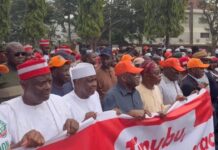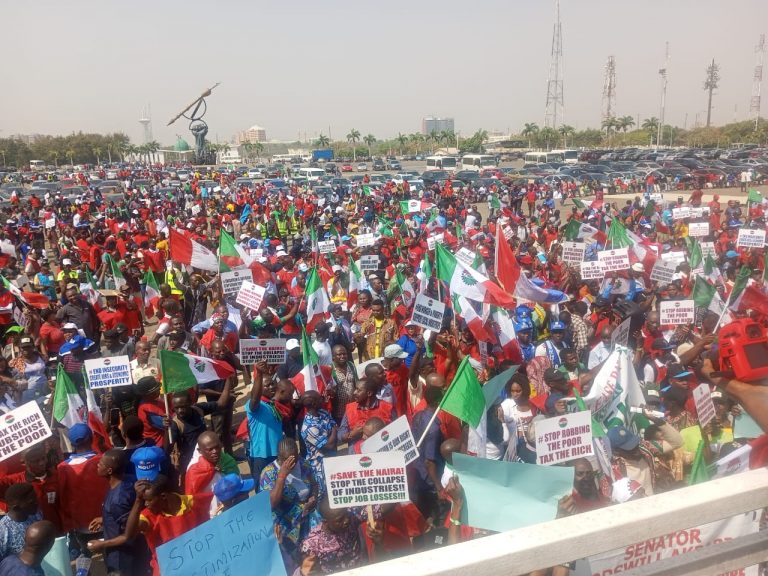
On Tuesday, workers and other Nigerians in the Federal Capital Territory, Abuja, Lagos, Ibadan, Kano, Benin, Osogbo, Akure, Port Harcourt, Sokoto, Jos, Katsina, and other urban centres protested the economic hardship in the country.
Nigerians have been grappling with economic difficulties on the heels of the fuel subsidy removal and other economic reforms being implemented by the Federal Government.
To express its dissatisfaction with the hardship in the country, the NLC on Tuesday commenced a two-day demonstration to pressure the federal and state governments to tackle hunger across the nation.
The NLC and Trade Union Congress had on February 8 issued a 14-day nationwide strike notice to the government over its failure to implement the agreements reached on October 2, following the removal of the fuel subsidy.
The unions also issued a protest notice over the Federal Government’s failure to fulfil its promises to address the economic crisis, but the TUC later withdrew from the protest, citing the failure of the NLC to carry it along.
A last-minute meeting called by the Federal Government on Monday to dissuade the NLC leadership from pressing ahead with the protest deadlocked as the NLC President, Joe Ajaero, said the protests would take place.
Insisting that the protest was needless, the presidential spokesperson, Ngelale, said the Federal Government had commenced efforts to alleviate the hardship in the country.
Ngelale said there was no unanimity behind the NLC’s action, citing the withdrawal of the TUC and National Association of Nigerian Students from the protests.
He stated “Any labour union that is speaking to the concerns of Nigerian families, the pains that are being felt by our people, is absolutely free to do so. It is right that Nigerians speak up in difficult situations.
“And the government has been doing everything possible to alleviate those concerns. But we also want to separate the legitimate concerns being expressed by some of the labour unions from people trying to leverage some of the situations in the country to achieve a political agenda.
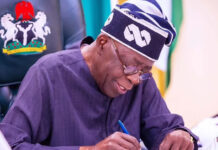
“We have seen the Trade Union Congress pull out of the purported nationwide protest. We have seen the National Association of Nigerian Students pull out of the protest. There is no unanimity behind what the NLC is trying to do. I believe all of the legitimate concerns being raised by the unions are being tackled by the administration of President Bola Tinubu.”
Meanwhile, the NLC president has lamented the hardship in the country.
Ajaero, led workers to the National Assembly, Abuja, where he presented the demands of workers to the Chairman of the Senate Committee on Labour, Employment, and Productivity, Senator Diket Plang, for delivery to President Bola Tinubu.
The NLC president in his address at the National Assembly said Nigerians embarked on the peaceful protest because there was hunger in the land, adding that Nigeria was becoming like Zimbabwe.
Ajaero said that the protest would serve as a signal to the government to immediately tackle the country’s challenges.
NLC laments hunger
He explained, “We are here today because there is hunger in the land. In the last week, it was a struggle for us to come to the street but we are here today.
‘’History will not forgive us if we do not protest today and tell the government that there is hunger in the land. It is important to note that this is not just a symbolic rally but it is a rally to signal to the people in authority that t inhere is a problem in the land. People are dying of hunger, and banditry, among others.
“We are going to present a letter to the National Assembly for onward transmission to the President. We were here a few months back and we presented a letter. Unfortunately, those demands have not been addressed.
“We want to remind our representatives that we do not bring letters for the fun of it. Rather, actions can be taken with immediate effect. If we give you this letter and you don’t take action on it, then we will resort to self-help.’’
Referencing the food crisis, he noted, “A bag of rice is over N70,000 whereas, the minimum wage is N30,000. How long will Nigerians continue to suffer? We cannot pay school fees with N30,000 minimum wage. Let the poor eat. The currencies of Cameroon, Benin Republic, and Niger Republic, are higher than Nigeria’s because of the devaluation of naira.’’
Plang, after receiving the letter, assured the NLC that its demands would be attended to immediately.
He stated, “We understand you. We feel what you feel. We want to assure you that this letter will be discussed immediately at the plenary session.’’
Addressing journalists after the protest, Plang assured that the leadership of the National Assembly was working to address the plight of Nigerians.
The demands presented by the labour leaders to the National Assembly leadership include the full implementation of the welfare provisions as contained in chapter two of the Constitution of the Federal Republic of Nigeria (as amended) by making the provisions justiciable; employment generation through massive investment in agriculture and value-added manufacturing and Immediate subsidy to farmers to boost agricultural production and food security.
The protesters also asked the government to open all food storage silos and enforce equitable distribution across the country, fix abandoned factories, and revive local production and patronage of Made-in-Nigeria goods and services.
The protesters asked the government to go after the oil subsidy cabal and other economic saboteurs and put a stop to the dollarization of the Nigerian economy.
They also demanded fast-track negotiation and implementation of the new national minimum wage even as they advised the authorities to “abandon IMF/World Bank policies as they bring extreme hardship to Nigerians as well as imperil our security and sovereignty.’’
States’ protests
The protests, which were also held in Lagos, Ogun, Plateau, Delta, Benin, Katsina, Oyo, Osun, Gombe, Benue, Kogi, Ondo, and other states, recorded an appreciable turnout.
In Lagos, scores of protesters trooped out to express their grievances over the current economic hardship while pleading with President Tinubu to reverse the fuel subsidy.
The protest started at Ikeja at about 7 am from the Ikeja under-bridge and moved to the State House of Assembly.
To ease the stress of the long walk, police officers from the Lagos State command distributed bottled water and biscuits to the protesters in the Alausa area.
The cops were hailed for the kind gesture.
The state Police Public Relations Officer, Benjamin Hundeyin, told one of our correspondents that the snacks were provided by the Commissioner of Police, Adegoke Fayoade, as a show of solidarity with the protesters.
Hundeyin said, “It was the idea of the commissioner of police. All credit goes to him. He believes in service to humanity and being your brother’s keeper. That was why he did that. He does not treat protesters as enemy and that was why he deployed policemen for security to make their protest easier.”
Fayoade on his part said, “It is their right to protest. Our presence is not to bring any fear, and we have been greeting and exchanging banters with them. There is nothing to be afraid of.’’
Present were the state NLC chairperson, Funmi Sessi, Deputy General Secretary, Emeka Nkwoala, Assistant General Secretary, Medinat Balogun, and human rights lawyer, Femi Falana, among others.
The protesters were seen carrying various placards: ‘End suffering and poverty now,’ ‘Petrol subsidy is a fraud,’ ‘Fix the refineries now and others.
Addressing journalists before the protest, Falana stated that the Senate and House of Representatives should be merged.
He said it was ridiculous that each legislator was given a Sports Utility Vehicle valued at N160m.
Falana added, “The government has announced the merger of ministries; that report is outdated and does not reflect the current situation. As of today, Nigeria has 1,316 ministries, agencies, and parastatals.
The national president of the Precision Electrical and Related Equipment Senior Staff Association, Rufus Solusesan, said, “We are here to protest the suffering of the masses at the hands of the Tinubu-led government. We recall that since he removed the subsidy, Nigerians have been walking in abject poverty.’’
The chairman of the Association of Staff Union of University, University of Lagos, Prof. Kayode Adebayo, said the citizens voted for the present government to right the wrongs of the past government.
Kano protesters
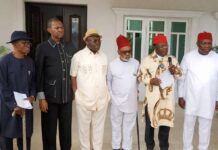
The Kano protesters were received by the Head of Service, Abdullahi Musa, who pledged to convey their grievances to the President.
Speaking at the Government House before submitting a letter to the governor for onward submission to the President, the state NCL Chairman, Kabir Inuwa, complained that poverty is increasing daily.
“We are not against him. He is our President, we respect him but let him allow the poor to breathe,” he said.