

Opinion
The Lies About Ekweremadu and South East Roads


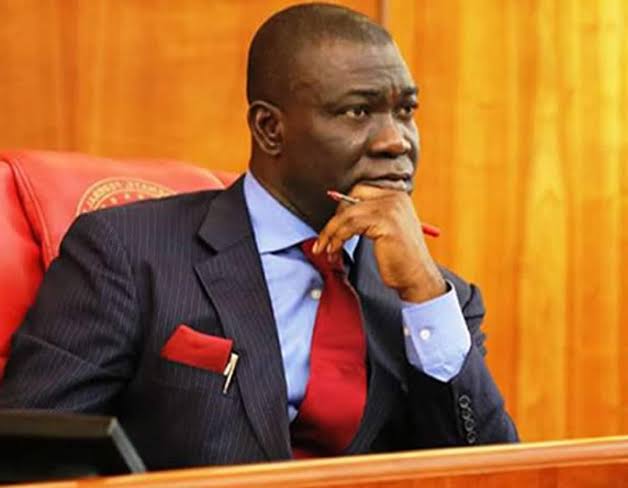
By Uche Anichukwu
Among Ndigbo, we say, “ _Onwu gbuo okorobia, ewere asiri jee akwa ya”,_ meaning: when sudden death befalls an able-bodied, young man, many fallacious stories are told at his funeral. Indeed many tales have been told since the unfortunate fate that befell former Deputy President of the Senate, Senator Ike Ekweremadu, and his family in London.
Only a few days ago, one Houston-based critic vomited a whole lot about Ekweremadu with triumphal gusto and air of finality. Among others, he wrote: “I had always told the senator in his face and written extensively on how he used his time in the Senate to collude with contractors to loot the funds budgeted for several public projects in Igbo land. These, of course, include Enugu/Onitsha, Enugu/Port-Harcourt, and Oji-River/Awgu roads, which have continued to claim many innocent lives. A simple scan of the internet on my name alongside Ekweremadu will show more, including a library, water, and road projects that were looted in my hometown of Ugbo, Enugu State”.
He also added: “One of the perceived prophesies is that I never ceased to tutor the senator on the genius of the adage: ‘A tree does not make a forest.’… Senator Ike Ekweremadu made sure that none of his political associates from his area could rise or shine”.
The irony of it all is that this man’s community, Ugbo, in Awgu LGA, is one of the greatest beneficiaries of Ekweremadu’s sojourn in the Senate, be it in terms of infrastructural projects or human capital development, regular employments, and political empowerment. Beside the asphalt road network across the length and breath of the hilly community, the water projects, electricity etc., which Ekweremadu attracted to Ugbo, the slanderer’s kinsman and political scion of Ekweremadu, Hon. Toby Okechukwu, rose from being Ekweremadu’s Special Adviser to becoming a three-term Member of the House of Representatives and incumbent Deputy Minority Leader of the House of Representatives. This has had a multiplier effect in development projects, employments, etc. in Ugbo in particular, and Enugu West, Enugu State and the South East in general. Ekweremadu also facilitated the appointment of the critic’s elder brother, Dr. Alex Ogbonnia, into federal boards and subsequently as Special Adviser to Deputy President of the Senate. In appreciation for all these, the three autonomous communities of Ugbo came together to confer a chieftaincy title of Onwa na-etiri ora (Moon that shines for all) of Ugbo on Ekweremadu in 2011.
Instructively, although this senseless falsehood that funds voted for the reconstruction of South East roads were diverted by Ekweremadu into buying properties formed the core of the mischievous petition to the Economic and Financial Crimes Commission (EFCC) in 2016 (in a bid to exploit the adverse relationship between the executive and legislature following Ekweremadu’s emergence as presiding officer from opposition and Dr. Bukola Saraki’s emergence without the blessings of the “powers that be”, EFCC has not told anyone that it traced such funds to Ekweremadu after six years of investigating him. The asset forfeiture lawsuit is based on EFCC’s claim that Ekweremadu’s properties are above his “legitimate income” as a former Local Government Council Chairman, Chief of Staff at Enugu Government House, Secretary to Enugu State Government, five-term Senator, three-term Deputy President of the Senate, former Deputy Speaker and Speaker of ECOWAS Parliament as well as a legal practitioner.
Absurd and meretricious as this sounds, I will not go into it since it is subjudice. However, it suffices to observe that right-thinking Nigerians have continued to flay this strange arrangement where a Nigerian public officer is being called to prove his innocence (from his overseas detention) over his alleged assets contrary to the well-held dictum and practice that he who alleges, proves. This judicial ambush tells an entire story on its own. It is reminiscent of the July 24, 2018 siege when the EFCC led hosts of security agents to storm Ekweremadu’s official residence at about 4am without previous invitation as though they came for Osama bin Laden. At the same material time, battalions of security agents already laid siege to Dr. Saraki’s residence during the failed attempt to impeach them illegally.
Elementary knowledge of government tells us that the legislature makes laws, including the Appropriation Acts, while the executive implements them. As it were, Ekweremadu has never been a governor, minister, and director-general of any federal or state government agency. He has not been in a position to administer public funds, except as a local government council chairman between 1997 and 1998 when he was voted the best council chairman at the time.
A striking irony in the whole fallacy of Ekweremadu’s culpability for the state of South East roads is that Chief Olusegun Obasanjo could not reconstruct the Lagos-Ibadan road in the eight years that he was President, and the same goes for Abeokuta road.
I travelled by road from Port Harcourt to Yenogoa in November 2020. Obviously, Goodluck Jonathan could not fix the single most important road in the Niger Delta, the East-West road, for the little over five years he was president. I equally travelled from Yenegoa to Otuoke during that trip. It was not paved with gold. In July 2021, Niger Delta youths barricaded the East-West road last year to protest the state of that road.
Just like the Enugu-Onitsha road, travelling on Abuja-Minna Road or Bida-Minna Road is never a pleasant experience. In 2019 and again in 2020, the people of Niger State staged protests, blocking Abuja-Minna road for hours to register their displeasure. In September 2021, truck drivers barricaded the Bida-Mokwa-Kwara road in protest. Malam Abdullahi Mohammed, a tanker driver, lamented to the News Agency of Nigeria, saying, “The Bida/Lapai/Lambata road is completely bad. We sleep there for two or three days before getting to our destinations”. Let us bear in mind that Niger State produced two military Heads of State.
Furthermore, right from the days of Yar’Adua to President Buhari administration, the Kano-Katsina road is still work in progress.
Yet these are roads in the areas that have produced Nigerian Heads of State and I do not think they are pleased with the situation. It is therefore total ignorance or deliberate malice to argue that a lawmaker syphoned contract sums for South East roads when even successive CEOs (presidents) of Nigeria, who supposedly provided the funds, cannot boast of better roads in their regions and hometowns.
As could be seen, the poor state of our roads is a national and systemic problem not peculiar to any region. The root cause is our wrong road funding and governance models. Instead of concessioning our roads to the private sector, we are still depending on annual budgets, which are a far cry from reality and hardly released. When government announces award of a N10 billion road contract, for instance, it does not mean that N10 billion was released. Such funds are released to the Ministry in tranches and sparingly. Most times, completed parts fall apart before a new tranche is released. It is so bad that during budget defence in 2021, Minister of Works and Housing, Babatunde Fashola, called for embargo on new road contracts pending the funding and completion of ongoing projects.
He has underscored the challenges yet again in the ongoing budget defence at the National Assembly. He said: “The main challenge to highways development in the country remains inadequate funding. As at date, the government is committed to highway contractors to the tune of about N10.4trillion while a total of about N765billion are unpaid certificates for executed works.
“As at October 2022, the Ministry had a cumulative unpaid certificate in the sum of N765,017,139,752.92 for ongoing highway and bridge projects. Apart from the pressure of resources to pay, there is the inadequacy of annual budget provisions where N100 million or N200 million was provided for roads costing N20 billion or more”.
The truth is that the only roads guaranteed to succeed as of now are those captured under the Presidential Infrastructural Development Fund (PIDF) managed by the Nigerian Sovereign Investment Authority (NSIA) because they do not depend on the unrealistic and yearly budget. They are notably the Lagos-Ibadan highway, the Abuja-Kano highway, and the Second Nigeria Bridge. By the way, it took the strategic thinking of Hon. Toby Okechukwu as the Chairman of the House Committee on Works in the 8th NASS and Ekweremadu to move the Second Niger Bridge from the stranded PPP arrangement with Julius Berger to the NSIA through the magnanimity of Fashola.
Besides funding, the initial serious flaw in the engineering design of the Enugu-Onitsha road by the Ministry of Works contributed to the delay in the reconstruction of that road. The built portions were collapsing such that even the contractors, RCC, were not willing to continue. The government had to either re-award it or redesign it. Ekweremadu and some other South East stakeholders preferred to have it redesigned than get an undurable road. In redesigning it, polymer, some level of filter (sand), cement, double binder (instead of the initial single binder), etc., were added. Anyone, who has plied the reconstructed portions would attest to the difference.
Apart from the usual funding challenge, the summary of the story of Oji-Achi-Mmaku-Awgu road, is that the Federal Government awarded it to a contractor that lacked the capacity for such a challenging topography. Unfortunately, successive Ministers of Works neglected to annul and rearward the contract despite recommendations by successive National Assembly Committees on Works after each oversight visit. Only Fashola could take that bold step in 2018 and it was awarded to SETRACO Nigeria after ten wasted years. The great work done on that road since then is there for the world to see.
By way of epilogue, although sacks of tales are taken to the funeral of an able-bodied man, the good thing is that it is not yet Ekweremadu’s funeral, by God’s grace. Those hastily composing a dirge, hurrying to bury a breathing man will have to cloth themselves in long, flowing gowns of patience because God is still on the throne. As Ekweremadu always says, the just shall be vindicated and the wicked will never go unpunished.
_Anichukwu is Media Adviser to Senator Ekweremadu_
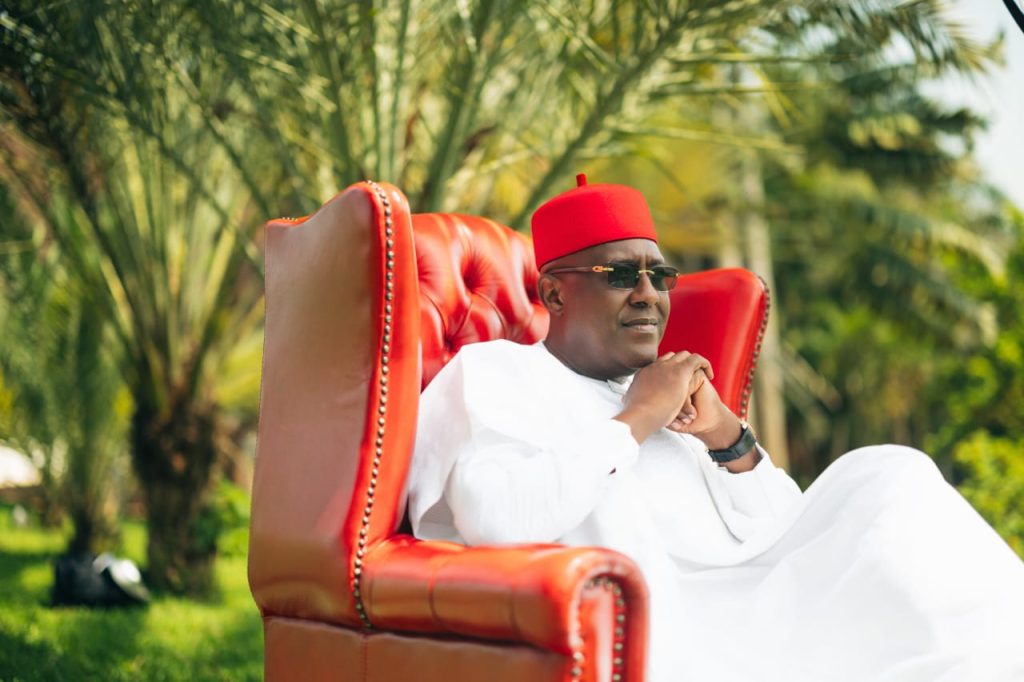

*By Kamen Chuks Ogbonna*.
The political landscape of Nigeria, particularly in the Southeast, has been set abuzz following the announcement by the Governor of Imo State and National Coordinator of the Renewed Hope Ambassadors (RHA), His Excellency Hope Uzodinma.
The appointment of 16 high-caliber directors to lead the RHA’s nationwide directorates is not merely an administrative exercise; it is a clear signal that the countdown to 2027 has begun with a surgical focus on grassroots mobilization.
While the list features several heavyweights—including Tunde Rahman (Media), Sunday Dare (Digital Media), and Muiz Banire, SAN (Legal)—one name has sent a specific jolt through the opposition: Chief Olisa Metuh.
For those who observed the peak years of the People’s Democratic Party (PDP), the name Chief Olisa Metuh is synonymous with high-stakes political engineering.
Metuh, often described as a “political warhorse,” rose through the ranks from ex-officio, auditor to the formidable National Publicity Secretary of the party whose big shoes never got filled after his exit.
He was the “Maverick” who preferred the shadows but whose tactical fingerprints were visible on every major victory the PDP recorded during its era of dominance.
History recalls that when the PDP faced its darkest hours post-2015, it was Metuh who acted as the anchor, preventing the party from sinking.
He was the mastermind behind the emergence of Bukola Saraki as Senate President alongside PDP’s Ike Ekweremadu as deputy and the elevation of Hon. Yakubu Dogara as Speaker—moves that effectively ran rings around the then-ruling APC under President Buhari.
His track record in the Southeast is equally legendary. From orchestrating Peter Obi’s move into the PDP to the yeoman efforts that secured governorships for PDP’s Okezie Ikpeazu in Abia and David Umahi in Ebonyi, Metuh’s ability to deliver electoral mandates is undisputed.
Critics might wonder what brings a man out of a self-imposed retirement—announced just two years ago—into the fold of the RHA.
However, for a man who recently dedicated over half a billion naira to charity, it is evident that pecuniary interests are not the driver.Instead, it appears that the “political legend” has answered a call of strategic importance.
By accepting the role of Director of Organisation and Mobilisation, Metuh is being positioned exactly where his talents shine brightest: at the intersection of strategy and execution.
President Bola Tinubu, through Governor Uzodinma, has played a deft hand. The Southeast has long been a complex battleground for the ruling party. By bringing in a man who understands the regional political DNA better than most, the Renewed Hope administration is moving beyond rhetoric.
Metuh knows the backroom because he built it. His appointment is a massive blow to the opposition in the Southeast because it replaces theoretical campaigning with proven, battle-tested electoral dexterity.
The Renewed Hope Ambassadors (RHA) was designed by President Tinubu in November 2025 as the primary vehicle to disseminate the achievements of his administration.
With the appointment of this dream team of directors, the RHA has moved from a conceptual framework to a fully operational political machine.
In the chess game of Nigerian politics, Governor Uzodinma has just moved a queen.
As the January elections approach, the inclusion of Chief Olisa Metuh ensures that the Renewed Hope Agenda will not just be heard in the Southeast—it will be felt.
In the street parlance- E Go Loud !
For Ndi Igbo and the nation at large, this appointment is a testament to the fact that in politics, strategy is the only currency that never devalues.

– Kamen Chuks Ogbonna
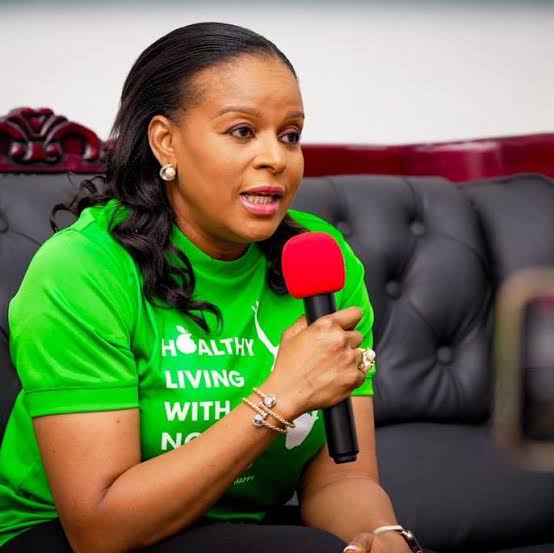
In the landscape of sub-national governance in Nigeria, the office of the First Lady has often been seen through the lens of ceremonial duties. However, in Anambra State, Dr. (Mrs.) Nonye Soludo—affectionately known as Mama Anambra—is fundamentally redefining this role. Through a series of bold, unprecedented interventions, she has evolved from a pillar of support to a strategic driver of socio-economic transformation.
The impact of Mama Anambra’s leadership first gained significant momentum in the healthcare sector. Championing the cause of the vulnerable, she has been at the forefront of the free maternal and child healthcare initiative. This program has provided thousands of women and children across the state with access to life-saving services that were previously out of reach. Beyond clinical care, her “Healthy Living” crusade has introduced a paradigm shift in domestic wellness, promoting organic products and nutritional education as a primary defence against preventable diseases.
The Anambra First Lady’s vision quickly extended to the fields and farms of the state. Recognizing that food security is the bedrock of community stability, she successfully mobilized women at the grassroots level into productive farming. By providing tools, seedlings, and technical support, she has empowered the home-front to become a formidable force in Anambra’s agricultural value chain, ensuring that empowerment is not just a slogan but a harvest.
Mama Anambra has raised the bar once again by moving into the territory of high-impact vocational empowerment. Her current focus on skills acquisition for females in male-dominated fields is perhaps her most strategic move yet. By opening doors for women in technology, construction, welding, solar energy installation, and mechanics, she is actively dismantling age-old barriers. These sectors, long regarded as “no-go areas” for women, are now being flooded with talented female trainees ready to compete in the modern economy. This initiative does more than provide a job; it destroys the gender limitations that have historically stifled the potential and prosperity of the girl child.
For Ndi Anambra, the work of the First Lady is a clear signal that leadership fueled by empathy and vision delivers tangible results. Her interventions are not merely philanthropic gestures, as they are strategic investments in the human capital of the state. Through her tireless efforts, Dr. Mrs Nonye Soludo is proving that when leadership has a heart, change is not just felt—it is seen and touched.
As she continues to break new ground, the prayer of the people remains constant: May God continue to strengthen her for the journey ahead.

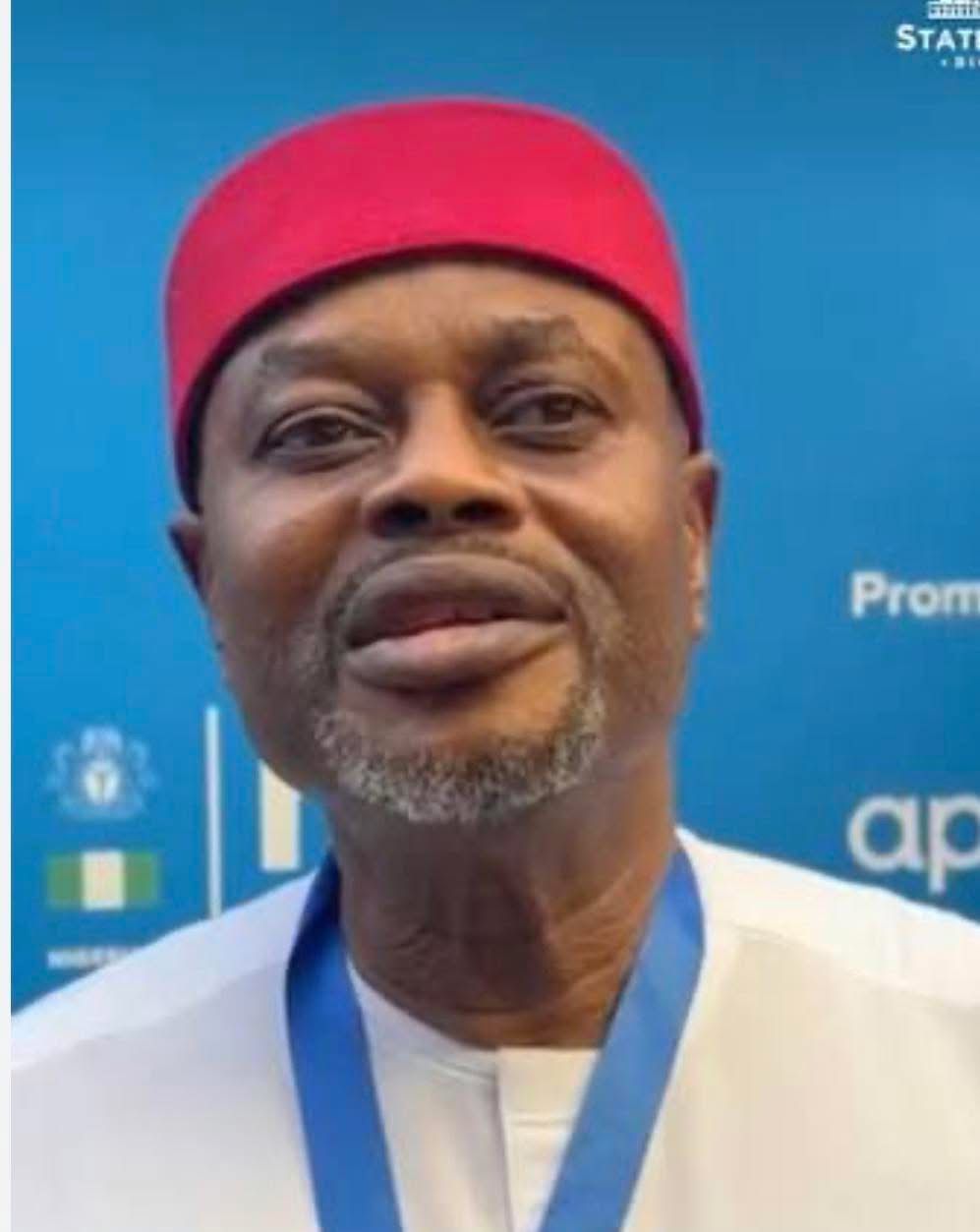
By Emeka Nwobodo Jr
There is a saying in Akpugo that elders often repeat whenever a son brings public disgrace upon his people and yet appears completely oblivious of it. They say the mad man dancing naked at Oriemba market never feels ashamed of himself, but his kinsmen do. The mad man laughs loudly, beats his chest, and continues his strange dance as though nothing is wrong, utterly unaware of the embarrassment he has caused, while his people are left to pass through the same market with their eyes lowered, quietly enduring the humiliation that someone from their own kindred has turned himself into a public spectacle before the entire community.
That local saying has suddenly become painfully real for many sons and daughters of Akpugo today, because what we are experiencing at this moment mirrors exactly the kind of shame those elders spoke about.
Our son, Chief Uche Geoffrey Nnaji, the former Minister of Innovation, Science and Technology, has dragged the good name of Akpugo through the mud in a manner so appalling that it has now become a constant conversation, and the painful truth is that the disgrace echoes loudly across the country.
When the first murmurs of the certificate controversy surrounding Uche Nnaji began to circulate months ago, many of us in Akpugo initially dismissed the allegations as the usual mischief of Nigerian politics, where accusations are often peddled, sometimes driven by rivalry, jealousy, or the relentless struggle for power. After all, Nigerian political life is crowded with smear campaigns, and it is not unusual for public figures to be accused of things that later turn out to be exaggerated, distorted, or entirely fabricated.
But this particular story refused to fade away. Instead, it lingered stubbornly, gathering more evidence, and attracting more scrutiny in a way that made it increasingly difficult for any discerning observer to dismiss as mere political gossip.
For nearly two years, investigative journalists at Premium Times searched for documents, spoke with university officials, filed Freedom of Information requests, and examined records that had long been buried. As these revelations began to surface, the scandal exploded with extraordinary force. The shit literally hit the ceiling fan!
The entire country was stunned that the man entrusted with overseeing scientific research and technological innovation in Nigeria could find himself entangled in a scandal involving forged academic credentials, an irony that might have been amusing if it were not so embarrassing.
Even those who were prepared to give him the benefit of the doubt were thrown into confusion when, in a self-indicting overreach, he rushed to the Federal High Court in Abuja and filed a suit against UNN, with a sworn affidavit supporting his motion wherein he admitted that he had not been issued a degree certificate by UNN, even though a certificate bearing the university’s name had earlier been submitted by him to the Nigerian Senate during his ministerial screening. How then did he come into possession of the one he submitted to the Senate, many people asked?
To the credit of the federal authorities, rather than rushing to conclusions or reacting impulsively to the media storm, the presidency reportedly moved discreetly, dispatching a team of DSS officers directly from the Abuja headquarters to the UNN, where they conducted their own verification of academic records and examined the files connected with Uche Nnaji’s student history. The operatives reportedly examined the registry archives, scrutinized correspondences, and verified documentary evidence relating to his academic history. Their findings reportedly corroborated the mounting evidence that had already begun to surface in the public domain.
Once the facts had been assembled and verified, the information was reportedly relayed to the highest levels of government. When Uche Nnaji was subsequently summoned to Aso Rock, the outcome was his quiet exit from the seat of power as an ex-Minister. His purported resignation was widely interpreted as a move to save the image of the government before the scandal could inflict grave reputational damage on the administration both within Nigeria and in the eyes of the international community.
But the matter did not end there. The federal government set up an investigative panel under the Federal Ministry of Education to determine the truth once and for all. The panel did not rely on hearsay or political narratives. Members of the panel physically travelled to the UNN, where they examined the institution’s archives, reviewed Senate graduation lists, inspected registry movement logs and academic files, and interviewed university officials who were directly involved in keeping academic records.
When the panel eventually submitted its report, the conclusion was devastating. It found that our brother had indeed forged his UNN degree certificate, confirming earlier investigative findings which had already raised serious questions about the authenticity of the documents he submitted when he was nominated and confirmed as minister.
The records examined by the panel showed that although he had been admitted to study Biological Sciences at the UNN in the 1981/82 academic session, he never graduated from the university because he failed a core course, Virology (MCB 431). His name did not appear on the Senate-approved graduation list for the class of 1985, and correspondences found in his academic file showed that he was still communicating with the university in 1986, requesting for permission to retake the same failed course.
Yet somehow, despite these records, a certificate dated July 1985 surfaced, the very certificate he presented to the presidency and the National Assembly as proof that he had graduated from one of Nigeria’s most prestigious universities.
When the details of this investigation became public two weeks ago, the scandal again spread across the country like wildfire.
But for many of us in Akpugo, the shock went beyond the scandal itself. What worsened the embarrassment was the astonishing mediocrity of the inconsistencies surrounding the documents. If someone were attempting to deceive the entire country in such a serious matter, one would at least expect that the deception would be executed with careful attention to detail. Instead, what Nigerians saw were contradictions so glaring that even a primary school pupil could detect them without difficulty.
Imagine claiming to have graduated from university in July 1985 while records show that you wrote a letter in your own handwriting in 1986 applying to resit the exam for the same course that had prevented you from graduating. Imagine presenting an NYSC discharge certificate claiming that you began national service in April 1985, three months before the supposed graduation that made you eligible for service in the first place. The absurdity of such a claim leaves one wondering whether the basic chronology of university education and national service was ever considered in constructing that narrative.
But it got even worse. The NYSC certificate that was presented bore the signature of Colonel Animashaun Braimoh, who only served as Director-General of the National Youth Service Corps between 1988 and 1990, yet the certificate was supposedly issued in 1986.
Even the serial numbering exposed the forgery. NYSC certificates issued during that period were known to carry six-digit numbers without alphabetic characters, yet the certificate attributed to him carried the serial number A231309, complete with a letter prefix that did not exist in the numbering format of that period.
At that point, many of us in Akpugo began to ask a painful question. Who actually handled the contract for this forgery, and why was it done so carelessly?
For those of us who have known Uche Nnaji over the years, especially as Minister of the Federal Republic, always immaculately dressed in sparkling white attire, projecting confidence, speaking with bravado, and presenting himself as a man of class and sophistication, the revelations were shocking because they suggested a man operating at a surprisingly low, inept and dull-witted level.
It was not merely the allegation of forgery that hurt us the most, it was the clumsiness, the mediocrity, and the lack of intellectual rigour reflected in the inconsistencies that riddled it.
For a community like Akpugo that prides itself as one of the most human-resource rich communities in Nkanuland, perhaps even in Enugu State, the humiliation has been profound.
When the revelations exploded across the country, something unusual happened within our community. Akpugo WhatsApp groups fell silent. The chatter that usually fills our platforms disappeared almost immediately. Nobody seemed able to muster a convincing defence. Nobody could confidently explain what was happening. The silence itself spoke volumes.
Many of us expected that our son would at least address his people directly, perhaps by releasing a brief statement assuring us that the allegations were false and that he would clear his name.
Instead, a group of young men whom he had helped secure federal appointments suddenly emerged as his defenders, flooding social media with accusations against political enemies and elaborate theories about conspiracies orchestrated by opponents.
They blamed political enemies, they blamed Governor Mbah and anyone who could possibly be blamed, while leaving the the central question unanswered. But even if we assume that political rivalry played a role in exposing the matter, the question that still demands an answer is: Did Uche Nnaji forge the certificates or not?
The federal government’s investigative panel has already delivered its conclusion with findings that leave very little room for ambiguity, and the next logical outcome is arraignment and prosecution before a court of competent jurisdiction. Why that has not happened is a matter for lawyers to enlighten us on.
Yet what has been happening since then has been even more bewildering. Even by Nigerian standards, when a public figure is caught in a scandal of such magnitude, humility usually follows. The person withdraws from the spotlight, keeps a low profile, and allows time and reflection to restore whatever dignity remains. But what we are witnessing instead is a relentless attempt to project normalcy. An aggressive social-media campaign filled with praise songs, banners, and political slogans announcing grand ambitions for the future suddenly appeared everywhere, with posters declaring “Uche Ndi Enugu Ga Eme” and “Uche Nnaji for Governor 2027” circulating as though nothing had happened.
It leaves many observers wondering which political party would willingly entrust its governorship ticket to someone whose academic credentials have been publicly discredited in such a dramatic fashion. Even more troubling is that since the scandal erupted, Uche Nnaji himself has carefully avoided direct engagement with the press to answer questions on the certificate saga. At one point he invited journalists to a press conference but failed to appear, leaving proxies behind to answer questions they could not adequately address. Yet if there is anyone who can narrate the story of his academic records better than anyone else, it is Uche Nnaji himself.
This is why the situation pains many of us in Akpugo to the marrows of our bones. Our community has never been associated with this level of public scandal. Our elders often boast that Akpugo have it all. Our land has produced true legends and giants whose contributions have brought honour to our people. From distinguished military officers like Navy Commodore James Aneke, who once served as a military governor, and Colonel Anthony Obi, another respected former military governor, to national figures like Ogbonnaya Onovo, the first Igbo Inspector-General of Police, Akpugo has produced individuals whose careers were defined by excellence and integrity. The intellectual and spiritual leadership of Very Rev. Father Emmanuel Edeh, founder of Madonna University, Caritas University, and the Osisatech institutions, has shaped generations of students and professionals. Scholars such as Prof. Onyemaechi Ogbunwezeh, Prof. B. A. Okorie, Prof. Gozie Ogbodo (current Rector of the IMT Enugu), to mention but a few, have continued that tradition of academic excellence.
These men and women represent the values of hard work, honesty, discipline, and integrity that Akpugo holds dear. That is why this scandal hurts so much.
Our elders must call our son home, sit him down, and remind him that wherever he goes he carries the name of Akpugo with him, and that name must not be dragged through the mud of public scandal.
So with heavy hearts, we say to our son Uche Nnaji, Enough is Enough. Although we still love you as our own flesh and blood, although we can longer disown you, you must however be a man, face the truth and clear your name if you can. But please, do not continue to parade this disgrace before the world.
Because whether you feel the shame or not, your shame dey shame us!
- – Nwobodo writes from Akpugo, Nkanu West LGA.


“Go and Verify”: How Sunday Umeha Is Redefining Representation in Ezeagu/Udi
Chief Sir Paul Chukwuma Lays His Beloved Sister to Rest

2027: Anambra ADC Intact Despite Obi, Kwankwaso Departure – Guber Candidate





-
 News5 years ago
Uncompleted structures in Enugu to undergo integrity test – Authority
-
 News4 years ago
BREAKING: FG to release Nnamdi Kanu tomorrow, fixes emergency hearing
-
 News2 years ago
BREAKING: Former Anambra Governor is Dead
-
 Entertainment4 years ago
Chrisland School Girl’s Online Activities Leak [Video]
-
 Social event4 years ago
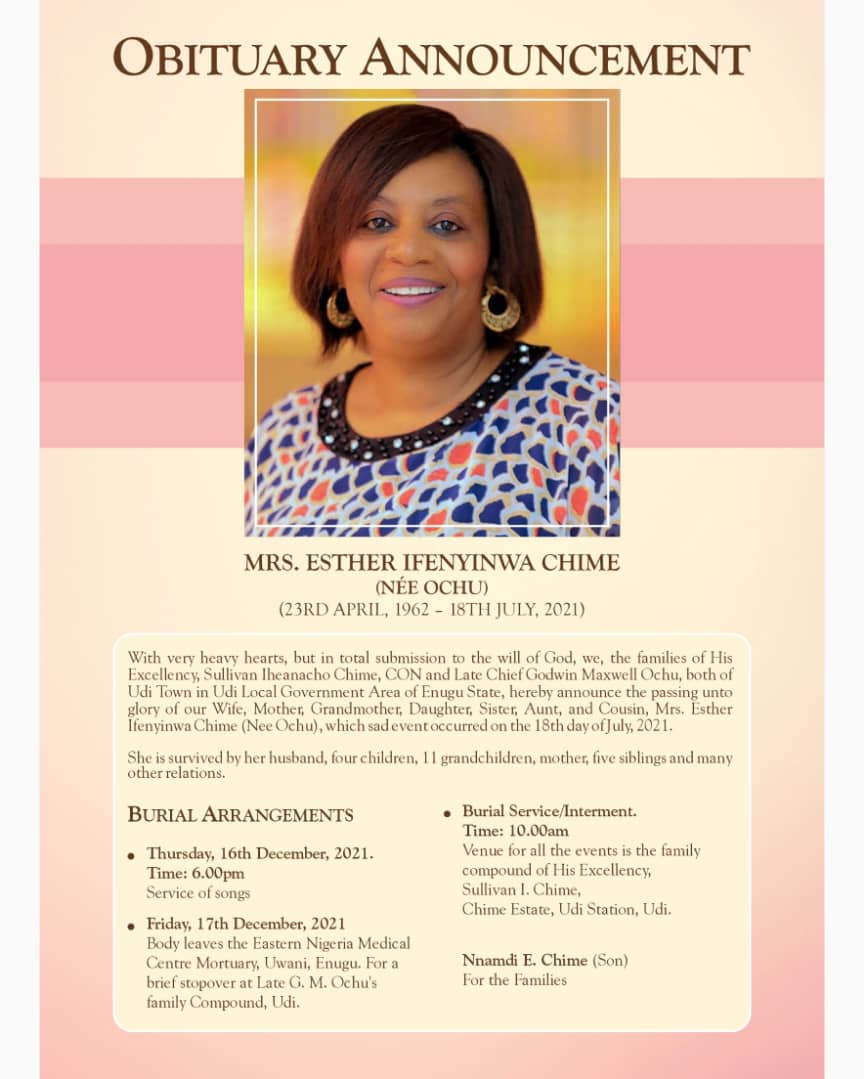
Ex-Enugu governor, Sullivan buries wife December 17
-
 Politics2 years ago
Enugu spends the least as 30 govs burn N968.64bn on refreshments, others in 3 months
-
 Foreign2 years ago
Denmark announces visas for, welders mechanics, bricklayers, others
-
 Crime5 years ago
BREAKING! Sit-at-home: Vehicle conveying tomatoes, set ablaze in Enugu


