





Crime
Hisbah Arrests Eight Over Alleged Homosexual Acts in Jigawa

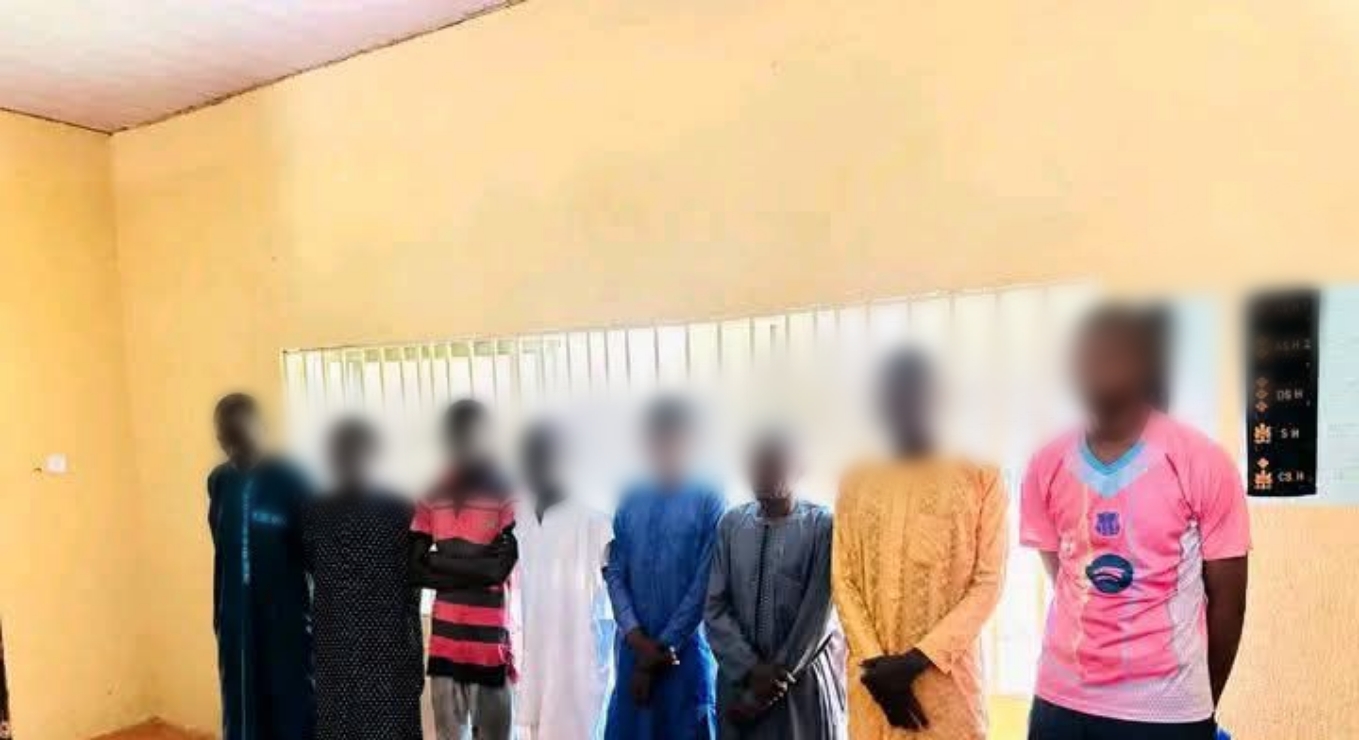

The Jigawa State Hisbah Board has arrested eight people in Kazaure Local Government Area over alleged homosexual acts, according to the board.
The board’s Public Relations Officer, Dauda Hadejia, disclosed this in a statement issued on Saturday, September 26, 2026.
Hadejia said the arrests followed a complaint filed by a 22-year-old man, who alleged that nine individuals had engaged in sexual acts with him on different occasions.
According to the statement, the complainant also claimed that he later contracted HIV, which he attributed to the alleged encounters. He reportedly appealed to the Hisbah authorities for justice, describing the alleged conduct as deceptive and harmful to his life.
Following the complaint, Hadejia said Hisbah operatives launched an investigation and began searching for the nine individuals named by the complainant.

“So far, eight suspects have been arrested, while efforts are ongoing to arrest the remaining suspect,” Hadejia said.
He added that the eight arrested individuals reportedly admitted during preliminary investigations to having engaged in sexual acts with the complainant.
Hadejia said the board had gathered information and evidence that would be presented before a court. He added that the investigation remained ongoing and that the suspects would be charged upon its completion.
The Deputy Commander-General of the Jigawa State Hisbah Board, Dr. Hussain Baban, reportedly urged parents to pay closer attention to their children’s upbringing and the people with whom they associate.
He also called on members of the public to be mindful of the consequences of their actions and to uphold religious and moral values.
The board further expressed appreciation to the Jigawa State Government for its support and cooperation in carrying out its responsibilities.

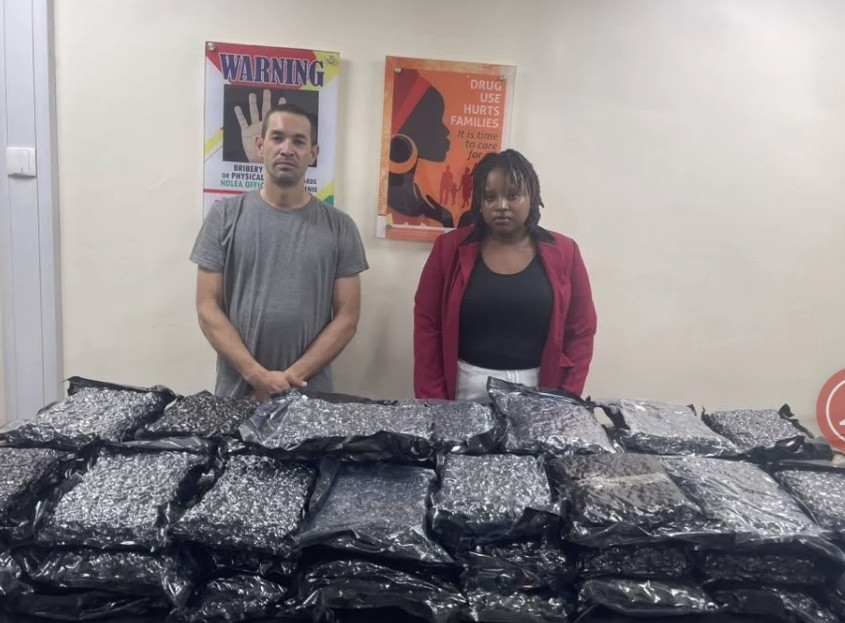
NDLEA Arrests South African Golfer, Kenyan Chef Over 50.4kg Cannabis
The National Drug Law Enforcement Agency (NDLEA) has arrested a 37-year-old South African professional golfer, Grobler Henlo, and a 25-year-old Kenyan chef, Abubakar Njambi, over an alleged attempt to smuggle 50.40 kilogrammes of a potent cannabis strain known as Loud into Nigeria.
The suspects were arrested at the Murtala Muhammed International Airport, Ikeja, Lagos, in October, according to a statement issued on Sunday by the NDLEA spokesperson, Femi Babafemi.
The agency said Henlo arrived in Lagos from South Africa aboard a South African Airways flight on October 11 and was intercepted at the Terminal 2 arrival hall.
A search of two travelling boxes in his possession reportedly led to the discovery of 46 parcels of Loud weighing 50.40kg.
According to the NDLEA, investigations revealed that although the boxes were in Henlo’s possession, they bore the luggage tags of Njambi, who had collected two other boxes bearing his tags from the airport conveyor belt before leaving the terminal.
The agency said the exchange of luggage tags was a deliberate strategy by the syndicate to conceal ownership of the consignments and enable each courier to deny responsibility if intercepted.
During preliminary interrogation, Henlo reportedly disclosed that he was recruited by a South African associate identified as Shanel, who connected him with other members of the syndicate whom he had never met physically.
The golfer, who travelled in business class while his alleged accomplice flew economy, said a driver picked him up from his home in South Africa, handed him four travelling boxes and took him to the airport.
He was allegedly instructed to meet the Kenyan woman and exchange luggage tags with her. He claimed he was promised 5,000 South African rand upon successful delivery of the consignment.
The NDLEA added that further examination revealed that tracking devices had been installed in the travelling boxes and on Henlo’s mobile phone. Similar devices were reportedly discovered in bags abandoned by an American basketball player arrested a month later.
The agency said the discovery showed how closely international drug cartels monitor their couriers and consignments.
It further disclosed that the passport biodata page of Abubakar Faiza Njambi, recovered from the golfer’s phone, was used to profile her and place her on its watchlist.
She was subsequently arrested at the departure boarding gate of the Lagos airport on Thursday, October 15, 2026, as she attempted to board a South African Airways flight to Kenya.
The 25-year-old private chef reportedly told investigators that she was recruited by a man through a friend in Kenya, who persuaded her to accept an offer of $8,000 upon successful delivery of the drugs.
She said she travelled from Kenya to South Africa on October 4, stayed in a hotel for about a week and met the golfer at the South African airport on October 11.
According to her account, Henlo handed her two of the four boxes before they checked in the luggage under their respective tags.
Upon arrival in Lagos, she allegedly collected the two boxes bearing the golfer’s tags before a driver conveyed her to a hotel in the Lekki area of the state.
The claim tag for the two boxes bearing her name, which she reportedly abandoned at the airport, was recovered from her hand luggage. Both suspects subsequently identified each other during an identification parade.
In a separate operation at the Lagos airport on November 13, NDLEA operatives intercepted a consolidated consignment from the United Kingdom aboard an Allied Air flight.
The shipment reportedly contained 10 parcels of synthetic cannabinoids weighing 10.10kg, 27 packs of marshmallow weighing 318.80kg and precursor chemicals weighing 34.55kg.
A freight agent, Sobowale Oladayo, was arrested when he presented himself to clear the consignment.
The alleged consignee, identified as 35-year-old Kareem Issa, also known as Ola, was arrested the following day when he arrived to collect the shipment at a logistics company’s premises in a grey Lexus 460 SUV.
The agency said Issa, a plumber residing on Lagos Island, allegedly posed as a senior security official and routinely used a siren installed in his vehicle when visiting the logistics company to collect consignments.
In Kaduna State, operatives arrested two men, Lawali Muhammad, 35, and Aliyu Mohammed, 30, in connection with 160 pieces of explosives intercepted along the Abuja-Kaduna Expressway at Jere on November 17.
The intended recipient, Mohammed, was arrested in a follow-up operation in Gusau, Zamfara State, the agency said.
Two other suspects were also arrested along the same route with 6,900 tablets of tramadol, 20,000 tablets of diazepam and 25,000 tablets of Exol-5.
NDLEA operatives also recovered 627,500 capsules of tramadol weighing 21.50kg from a Hummer bus along the Zaria-Kano Expressway after the driver reportedly abandoned the vehicle and fled.
In Ogun State, a woman, Esther Ogundipe, was arrested on November 19 during a raid on a suspected drug joint at Eleweran, Abeokuta. Two locally made firearms and five live cartridges were also recovered.
Two other women were arrested in Ilaro on November 17 with 7.4 grammes of cocaine, 638 grammes of cannabis and 5.9 grammes of methamphetamine.
In Osun State, a 43-year-old man, Francis Oduke, was arrested along the Ikire-Ibadan Expressway with 359 bags of skunk weighing 4,627.7kg.
The drugs were allegedly concealed beneath a load of granite in a truck.
In neighbouring Ondo State, operatives intercepted a truck conveying 93 bags of cannabis weighing 1,045kg and heading towards Kano State.
The seizure was made along the Zango-Ado Expressway in Akure on November 16, leading to the arrest of four suspects identified as Adamu Yerima, 19; Mohammed Mohammed, 19; Nura Mohammed, 25; and Usman Mohammed.
The agency also reported arrests and drug seizures in Edo, Katsina, Abia and Rivers states.
In Edo, Emmanuel Eze, 48, was arrested with 11 and a half bags of cannabis weighing 156kg at Aduwawa community, Benin City, on November 20.
In Katsina, Abbas Bello, 39, was arrested in the Gafai area on November 17 with 148 blocks of cannabis weighing 72kg, allegedly concealed in the boot of his white Honda Accord.
In Abia, operatives recovered 2kg of cannabis from a hole beneath the tiled floor of a shop belonging to a 25-year-old woman, Oluebube Innocent, at Amankwa Street, Obingwa Local Government Area, on November 18.
In Rivers State, a 46-year-old physically challenged man, Peter Sunday, was arrested with 300 grammes of cannabis during a raid in Eneka on November 17.
The NDLEA also said its commands and formations across the country had continued to intensify its War Against Drug Abuse (WADA) sensitisation campaigns in schools, worship centres, workplaces and communities.
The activities included lectures for students and staff of Local Government Primary School, Ebute Ikorodu, Lagos; Government Girls Unity College, Birnin Kebbi; and Community Secondary School, Usa, Enugu Ezike.
The Ondo State Command also paid an advocacy visit to the Deji of Akure, Oba Aladetoyinbo Ogunlade Adelusi.
Commending officers of the affected commands, the NDLEA Chairman, Brig. Gen. Mohamed Buba Marwa (retd.), said the arrests of the South African golfer and Kenyan chef, coming within the same period as that of the American basketball player, indicated that international drug cartels were changing their couriers while retaining their methods.
He said the cases showed a growing trend of international drug syndicates recruiting sportsmen and other professionals as couriers in the belief that their profiles would shield them from scrutiny.
Marwa warned that no profession, passport or travel class would provide protection for anyone attempting to traffic illicit drugs through Nigeria’s ports of entry.
He urged officers at all ports of entry to remain vigilant and professional, while charging personnel across the agency’s commands to sustain efforts towards reducing both drug supply and demand, particularly through sensitisation campaigns in schools, workplaces, worship centres and communities.

Critics question legality of arming local security operatives ahead of 2027 elections
Mixed reactions have continued to trail the recruitment and inauguration of over 200 personnel of a local security outfit, known as Neighbourhood Watch, by the Chairman of Ohaozara Local Government Area of Ebonyi State, Engr. Osborne Umahi, amid concerns over the possible implications for security and the 2027 general elections.
The development has triggered public debate, with some residents and social commentators questioning the authority of a local government council to establish and arm a security outfit, particularly with the 2027 general elections approaching.
The security outfit was inaugurated on Friday at the council headquarters in Obiozara.
Speaking at the ceremony, Umahi said the initiative was established to strengthen grassroots security, safeguard lives and property, and complement the efforts of existing security agencies, particularly during the Christmas and New Year festivities.
Addressing the newly inaugurated personnel, the council chairman charged them to demonstrate discipline, commitment and professionalism in the discharge of their responsibilities.
He warned against any conduct capable of undermining public confidence in the outfit or bringing the organisation into disrepute.
Umahi also emphasised the need for strict adherence to the rule of law and effective collaboration with established security agencies to ensure efficient policing and the protection of communities across the local government area.
He assured the personnel of his administration’s commitment to their welfare, provision of a conducive working environment and the necessary infrastructure to facilitate their operations.
The council chairman subsequently announced Mr. Amos Eze of Umunaga Ward as the Leader and Commander of the Neighbourhood Watch.
According to him, the outfit, with more than 200 personnel enlisted, would work alongside established security institutions to promote safer communities and protect residents, businesses and property throughout Ohaozara.
However, the inauguration has attracted criticism from some social commentators, who have raised concerns about the composition, training, armament and possible political implications of the security outfit.
A social critic, Mr. Nwoba Chika Nwoba, condemned the development in a post on his social media platform, questioning the constitutional authority of a local government council to establish and arm such an outfit.
He wrote: “This is not a good beginning. Does a local government have the constitutional authority to establish a security outfit and arm them, moreover as election is two months away?”
Nwoba further alleged that the initiative could be used to intimidate political opponents and compromise the credibility of the 2027 general elections.
He also described the personnel as suspected political thugs and warned against what he perceived as the possible use of the outfit for electoral manipulation.
Another social media commentator, Mr. Idaga, questioned the type of firearms reportedly issued to the personnel, arguing that individuals without coordinated security training should not be armed with sophisticated weapons.
“My interest is the type of guns those guys are armed with. People without coordinated security training have no business being armed with the type shown in this optic,” he wrote.
Similarly, another commentator, Mr. Kelvin, expressed concern over the implications of arming civilians and linked the development to the ongoing national debate on the establishment of state police.
He argued that if civilians could be armed with sophisticated weapons without adequate oversight, the introduction of state police could raise additional security concerns.
The controversy has brought renewed attention to the need for clarification on the legal framework governing the establishment, recruitment, training and arming of community-based security outfits, as well as their relationship with conventional security agencies.
As the 2027 general elections approach, stakeholders are expected to seek greater transparency and assurances that local security initiatives will operate within the law and remain insulated from partisan political activities.
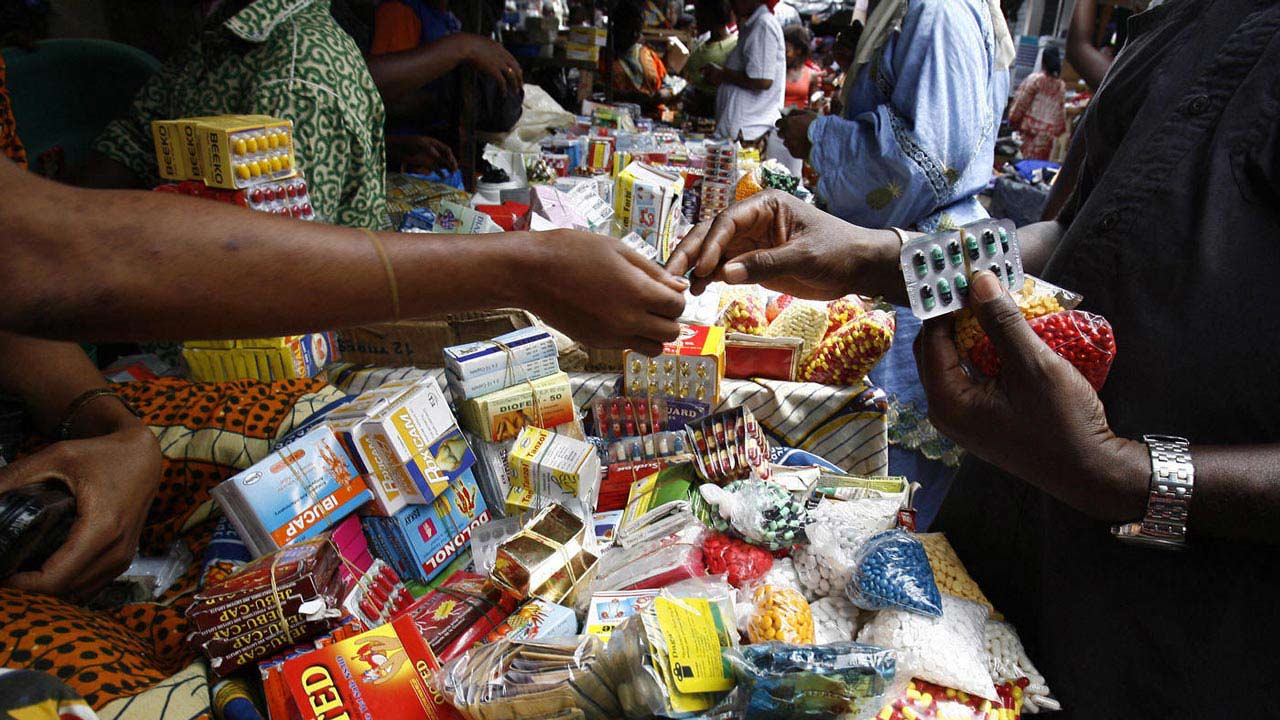
The National Agency for Food and Drug Administration and Control (NAFDAC) has called for tougher punishment, including life imprisonment or the death penalty, for individuals involved in the production and distribution of counterfeit drugs and other dangerous regulated products in Nigeria.
The agency’s Director-General, Professor Mojisola Adeyeye, described counterfeiters as “merchants of death”, arguing that their activities pose a serious threat to public health and endanger millions of Nigerians.
Adeyeye said the existing penalties were insufficient to deter offenders who continue to manufacture and distribute fake medicines, adulterated food, contaminated water and substandard consumer products for financial gain.
The call comes amid growing concerns over the circulation of counterfeit products across the country.
NAFDAC enforcement statistics show that between January and August 2026, the agency recorded 474 new cases, 821 product seizure entries and 213 raids nationwide.
During the period, 52 suspects were arrested, 179 establishments were closed or sealed, while 295 cases were concluded.
The agency also disclosed that its surveillance operations between May and July 2026 covered 5,738 facilities across the 36 states and the Federal Capital Territory, resulting in the removal of 7,210 non-compliant product brands.
In recent operations, NAFDAC uncovered alleged counterfeit CWay dispenser water bottles, as well as products bearing the names of established brands, including Oral-B, Colgate, Nivea and Listerine.
The agency also warned Nigerians against purchasing suspicious KY Jelly lubricant products currently circulating in the market.
Adeyeye further disclosed that NAFDAC had secured 64 convictions against counterfeiters, with offenders receiving prison sentences ranging from one to seven years without an option of fine.
The agency recalled that its enforcement operations in Lagos, Aba and Onitsha between February and March 2025 resulted in the seizure and destruction of more than 137 truckloads of counterfeit and substandard products valued at over N1.5 trillion.
Similarly, in February 2026, counterfeit and expired medicines worth more than N15 billion were destroyed in Ibadan, Oyo State.
The Pharmaceutical Society of Nigeria (PSN) has also raised concerns over the country’s pharmaceutical supply chain, calling on the Federal Government to declare a state of pharmaceutical insecurity.
The PSN President, Ayuba Ibrahim Tanko, who spoke at the society’s 99th Annual National Conference in Awka, Anambra State, warned that drug diversion, illicit trafficking and unregulated distribution were undermining public health and national security.
The society advocated the establishment of a Federal Drug Management Agency, stronger government supervision of pharmaceutical distribution and the replacement of unregulated open drug markets with licensed Coordinated Wholesale Centres.
Meanwhile, NAFDAC’s proposed death penalty has generated wider questions about the adequacy of existing laws and the proportionality of punishment.
Under the existing Counterfeit and Fake Drugs and Unwholesome Processed Foods Act, offenders face imprisonment of between five and 15 years, a fine of up to N500,000, or both, depending on the offence.
The death penalty is not currently prescribed under the law for counterfeit drug-related offences. Its introduction would therefore require legislative amendments.
Beyond tougher punishment, stakeholders have stressed the need for stronger border surveillance, improved regulatory monitoring, better coordination among security agencies and effective prosecution of those behind counterfeit production and distribution networks.
NAFDAC has also urged Nigerians to purchase medicines from licensed pharmacies, verify product registration details and report suspected fake or unsafe products to the agency.
The agency maintains that the fight against counterfeit products requires sustained enforcement and public cooperation to protect consumers and prevent avoidable deaths.

The Enugu State Internal Revenue Service (ESIRS) has raised the alarm over a fraudulent property tax notice circulating in the state, warning residents and property owners against making payments based on its contents.
The agency, which disowned the purported notice, described it as unauthorised and misleading, insisting that it did not originate from or receive approval from the Service.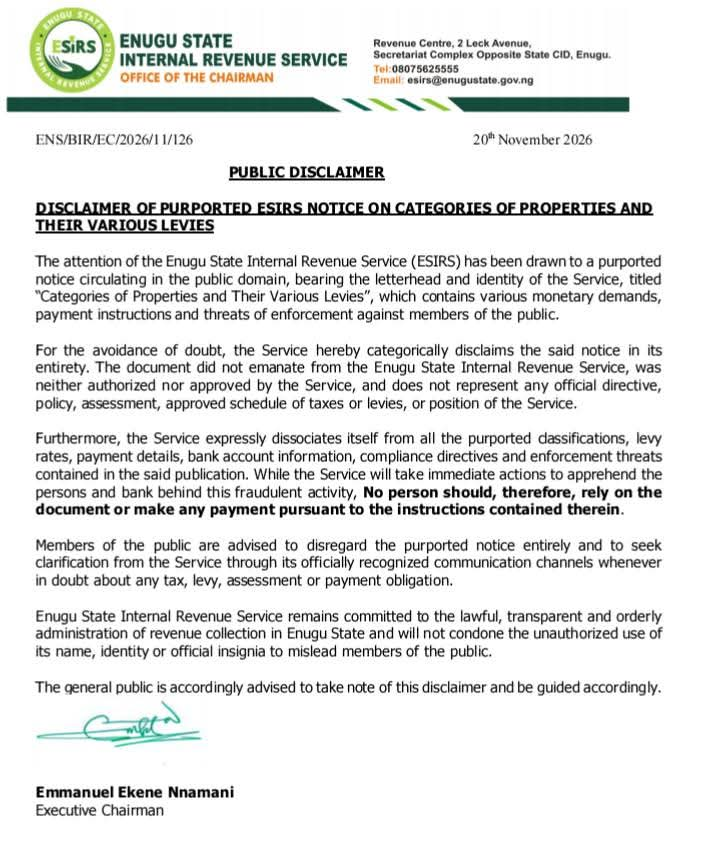
The fake document, titled “Categories of Properties and Their Various Levies,” reportedly contains classifications of properties, corresponding tax rates, payment instructions, bank account details and threats of enforcement against defaulters.
In a disclaimer dated November 20, 2026, and signed by its Executive Chairman, Emmanuel Ekene Nnamani, ESIRS said the publication was being circulated as though it were an official government directive.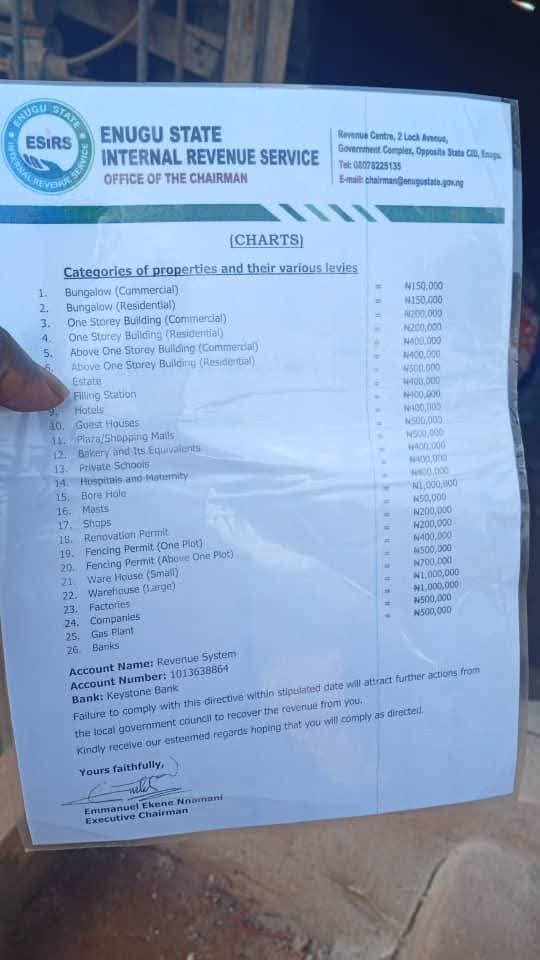
The agency, however, maintained that the document did not represent any approved property tax assessment, revenue policy or official schedule of levies.
“For the avoidance of doubt, the Service hereby categorically disclaims the said notice in its entirety,” the statement said.
ESIRS specifically warned residents against relying on the purported property classifications, levy rates, payment instructions and bank account details contained in the document.
It cautioned that unsuspecting property owners could suffer financial losses if they acted on the fraudulent publication.
“No person should, therefore, rely on the document or make any payment pursuant to the instructions contained therein,” the agency warned.
The revenue authority urged residents to disregard the publication and seek clarification through its recognised communication channels whenever they have concerns about taxes, levies or property assessments.
Meanwhile, ESIRS disclosed that it would take immediate steps to identify and apprehend those responsible for producing and circulating the fake notice.
It also warned against the unauthorised use of its name, identity and official insignia, describing such actions as deliberate attempts to mislead the public and undermine confidence in the state’s revenue administration.
The agency reaffirmed its commitment to transparent and lawful revenue collection, assuring residents that all legitimate tax demands would be issued through approved procedures.
It further advised property owners and members of the public to verify revenue-related demands directly with the Service before making payments, particularly where unfamiliar bank accounts and threats of enforcement are involved.
The disclaimer was signed by Nnamani in his capacity as Executive Chairman of the Enugu State Internal Revenue Service.
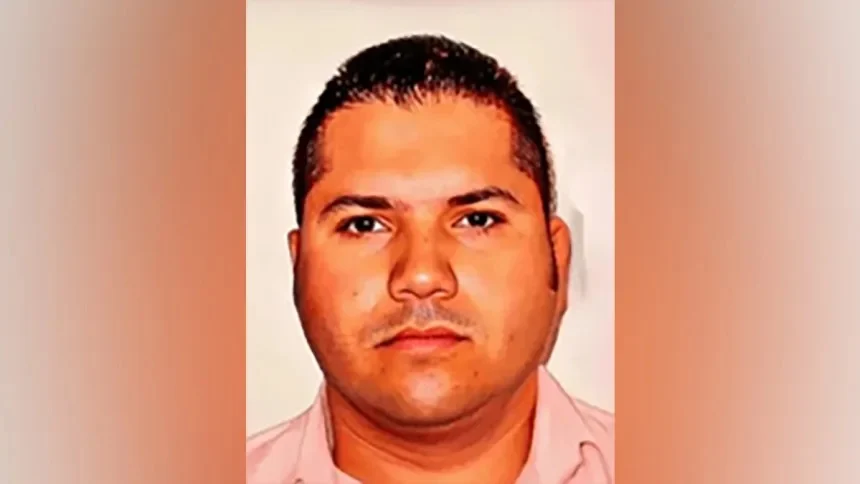
Mexican security forces have arrested notorious drug cartel leader Fausto Isidro Meza Flores, popularly known as Chapo Isidro, during a military operation in Guasave, Sinaloa State.
The arrest was made on Friday, November 20, during a joint operation involving the Mexican Army and National Guard special forces, with intelligence support from the United States, according to a report by the New York Post on Saturday.
Meza Flores, described by American authorities as a major drug trafficker, was reportedly arrested alongside two alleged associates identified as Germán N, also known as Serafín, and José N, who was said to oversee the organisation’s financial operations.
The three suspects were subsequently flown to Mexico City.
The operation reportedly triggered violent clashes between security forces and suspected cartel members, resulting in gunfire, road blockades and the burning of vehicles in parts of Sinaloa.
The violence also disrupted a baseball match in Guasave, forcing players and spectators to flee as gunshots rang out. The match was subsequently abandoned, the New York Post reported.
Meza Flores’ arrest is considered a major breakthrough in the fight against drug trafficking, particularly as he was among the Federal Bureau of Investigation’s 10 Most Wanted Fugitives.
The FBI added him to its Ten Most Wanted Fugitives list on February 4, 2025, accusing him of leading the Meza-Flores cartel, an organisation allegedly involved in trafficking fentanyl, cocaine, heroin, methamphetamine and marijuana into the United States.
The US government had offered a reward of up to $5m for information leading to his arrest and conviction.
Announcing his addition to the wanted list, then FBI Acting Director, Brian Driscoll, accused Meza Flores of spending about 20 years trafficking illegal drugs into the United States.
American authorities also accused the cartel leader of involvement in kidnapping, extortion, torture and murder.
According to the FBI, Meza Flores was first indicted on May 2, 2012, at the United States District Court for the District of Columbia. A superseding indictment returned on November 26, 2019, charged him with drug-trafficking offences and firearms possession.
The indictment alleged that he conspired to manufacture and distribute cocaine, heroin, methamphetamine and marijuana in the United States between 2005 and 2019.
The New York Post reported that Meza Flores faces drug-trafficking and firearms-related allegations, alongside an extradition request from the United States.
His organisation, also known as the Meza-Flores cartel, has been linked to the wider Sinaloa criminal network and operates in the northern Mexican state.
The arrest comes amid renewed security operations against criminal organisations in Sinaloa, where suspected cartel members have repeatedly clashed with security forces.
Authorities reportedly deployed additional security personnel following the violence that erupted during Friday’s operation, while efforts were made to reopen affected roads and restore normal activities.
Meza Flores’ arrest comes years after the capture of another notorious Mexican drug lord, Joaquín ‘El Chapo’ Guzmán.
Guzmán was arrested on February 22, 2014, in Mazatlán, Sinaloa, but escaped from prison in July 2015. He was rearrested on January 8, 2016, and extradited to the United States on January 19, 2017.
He was subsequently sentenced to life imprisonment in 2019 and is being held at the ADX Florence maximum-security prison in Colorado, where he is expected to spend the rest of his life.


-

 Uncategorized5 days ago
Disaster Averted As British Airways Flight To Lagos Skids Off Heathrow Runway, Aborts Take Off
-
 Uncategorized5 days ago
Enugu Rent Bill: Landlords fight Back, Rush to Increase Rents Ahead of Governor’s Assent
-
 Politics5 days ago
2027: Jonathan Raises Alarm Over Political Intolerance, Warns of Post-Election Crisis
-

 Uncategorized4 days ago
Minister, Governor’s Marriages Crash Amid Separation Disputes
-

 Uncategorized4 days ago
CP Ogarabe Visits AIG Zone 13, Notifies Him of Assumption of Duty
-

 Uncategorized4 days ago
Enugu East Celebrates Shirley Emehelu’s Emergence as New Jersey Lieutenant Governor
-
News3 days ago
Enugu Rent Bill: Landlords New Plans To Frustrate Tenants Exposed
-
 Uncategorized4 days ago
Anambra Police Strengthen Security Ahead of APC, NDC Rallies, Warn Against Inciting Utterances