



Crime
Congestion: Condemned inmates on the rise, Govs refuse to approve execution

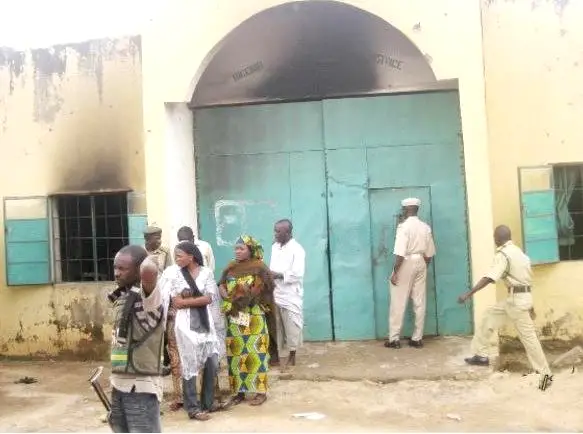

There are no fewer than 3,145 inmates on death row in custodial centres across the country.
Spokesperson for the Nigerian Correctional Service, Umar Abubakar, in his response to an enquiry by one of our correspondents, said there were 3,084 males and 61 females on death row.
Some lawyers and human rights activists have consistently expressed concerns over the fate of the inmates, as most state governors refuse to sign the death warrant, leading to the rising number of inmates on death row. Some of them have suggested the conversion of the death sentence to life imprisonment, while some argued that if government wasn’t unwilling to sign the warrant, capital punishment should be expunged from the constitution and other relevant laws.

Meanwhile, despite complaints by several stakeholders, including lawyers and authorities of the NCoS, over the congestion of the facilities, the number of inmates in the custodial centres has continued to rise, fuelling its congestion and making the management of the centres difficult.
Figures on the website of the NCoS indicated that as of July 4, there were a total of 74,675 inmates in the country, comprising 52,714 awaiting trial and 21,961 convicted inmates. Also, the total number of male inmates was given as 73,139 while there were 1,536 female inmates.
SANS react
Speaking on the fate of inmates on death row, human rights lawyers, Mr Femi Falana (SAN) said the indefinite detention of inmates on death row in correctional facilities could not be justified under the law.
He said, “Our governors ought to be challenged to address prison congestion caused by their failure to ratify death warrants. It is not enough to withhold their approval. We should be honest enough to admit that the death penalty cannot be implemented. Therefore, it ought to go and be replaced by life imprisonment or other terms of imprisonment.
“The law has been amended to say, ‘If a prisoner on death roll exhausts his/her right of appeal and the death penalty is not executed within ten years, the judge has the same powers to commit the death sentence to life imprisonment.’”
Also reacting, Mr Ebun-Olu Adegboruwa (SAN) noted that the governors should exercise their statutory responsibility to sign the warrant for those who have been convicted by the court and have no pending appeal.
He added, “The challenge is that most governors are reluctant to sign. The solution to this is that it would be necessary to consider death row inmates who have been there for a particular time to be committed to life imprisonment. It constitutes torture for one to be expecting to die every day and it lingers on for 10 or fifteen years.
“The Supreme Court has said if one is kept on death roll for too long, it constitutes a torture. The government should set a time limit so anyone waiting to be executed should be committed to life imprisonment or a lesser punishment instead of just crowding the prisons in that regard.”

By Our Correspondent
The Inspector-General of Police, Olatunji Disu, has deployed the Deputy Inspector-General of Police in charge of Operations, Shehu Nadada, to Imo State to coordinate the search-and-rescue operation for 20 prospective National Youth Service Corps members and other passengers abducted along the Owerri-Onitsha Road.
The victims were reportedly abducted on Thursday, October 1, 2026, around Umunoha in Imo State.
The Force Public Relations Officer, Force Headquarters, CSP Anietie Iniedu, disclosed this in a statement issued on Friday.
According to the statement, Nadada arrived in the state alongside two Commissioners of Police and immediately conducted an on-the-spot assessment of the incident and the ongoing rescue operation.
He also reviewed the operational strategies, deployment of personnel and available assets, while issuing additional directives aimed at strengthening the coordinated response.
The assessment was conducted alongside the Imo State Commissioner of Police, CP Audu Garba Bosso; the Commissioner of Police in charge of Federal Operations, CP Akpan Anifiok; the Commissioner of Police in charge of the Police Mobile Force; other service commanders and members of the management team of the Imo State Police Command.
Iniedu said the search-and-rescue operation had been intensified, with additional tactical teams and operational assets deployed to identified areas.
He added that the operation was being supported by intelligence-led tracking of the abductors and coordinated efforts with other security agencies.
Nadada assured members of the public that the police remained committed to securing the safe release of the abducted persons.
“The Nigeria Police Force is committed to securing the safe rescue of the 20 abducted persons and will sustain the operation until the mission is successfully concluded,” Iniedu quoted Nadada as saying.
The police boss urged members of the public and the media to remain calm and vigilant, while appealing to anyone with credible information that could assist the operation to contact the police or the nearest security formation.
He assured the public that all information received would be treated with strict confidentiality.
The police said further updates would be provided as the rescue operation progresses.

Five men have been arrested and arraigned before a Chief Magistrate’s Court in Maiduguri, Borno State, after police allegedly found them wearing T-shirts bearing the words “Tinubu Must Go.”
The defendants were identified as Baba Aji Gremami, 44; Mustapha Abba Yemen, 28; Abbacha Mohammed Ali, 32; Adam Umar Gubio, 21; and Abdulhamid Mohammed, 21.
According to a First Information Report issued by the State Criminal Investigation Department, the incident occurred on September 25, 2026, near West End Roundabout in Maiduguri.
Police charged the five men with criminal conspiracy, inciting disturbance, disturbance of public peace and thuggery under Sections 60, 78, 79 and 392 of the Borno State Penal Code.
The defendants pleaded not guilty to the charges when they appeared before Chief Magistrate Court I in Maiduguri.
Their lawyer subsequently applied for bail. The court adjourned the matter until October 6, 2026, to rule on the bail application, while the substantive trial has been scheduled for October 26.
The case has drawn attention because the alleged conduct involved wearing clothing displaying a political message.
Amnesty International criticised the prosecution, describing the arrests as arbitrary and arguing that peaceful political expression is protected by fundamental human rights. The organisation called for the immediate release of the five men and urged authorities to discontinue the case.
Amnesty International also expressed concern that the prosecution could have implications for political expression and opposition activities in Borno State.
The case has generated reactions on social media, with some commentators questioning whether the display of political messages on clothing should constitute a criminal offence.
There have also been allegations that a prominent politician in Borno State may have influenced the arrests. The allegation has not been independently verified.
Efforts to obtain a comment from the Borno State Police Public Relations Officer, ASP Kenneth Daso, were reportedly unsuccessful as of the time of filing.
The defendants remain subject to the court process, and the allegations against them have not been established in court.
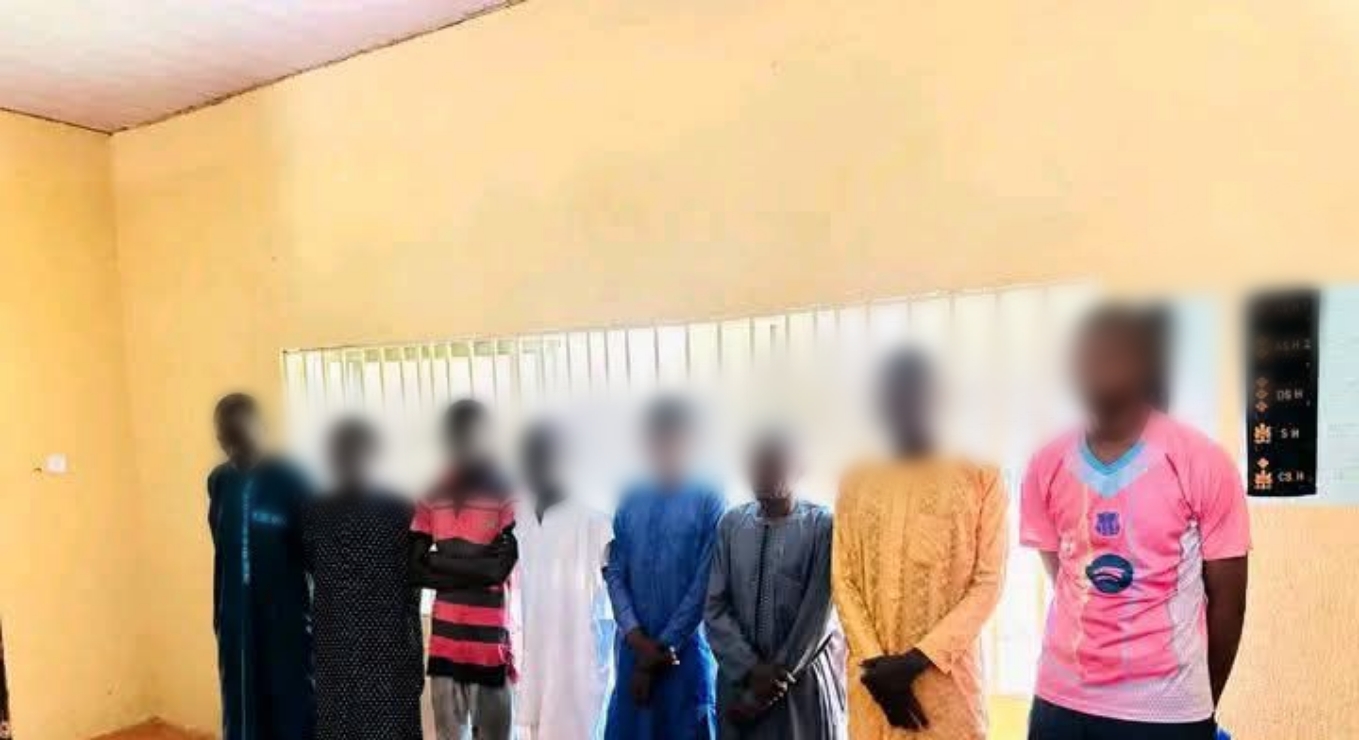
The Jigawa State Hisbah Board has arrested eight people in Kazaure Local Government Area over alleged homosexual acts, according to the board.
The board’s Public Relations Officer, Dauda Hadejia, disclosed this in a statement issued on Saturday, September 26, 2026.
Hadejia said the arrests followed a complaint filed by a 22-year-old man, who alleged that nine individuals had engaged in sexual acts with him on different occasions.
According to the statement, the complainant also claimed that he later contracted HIV, which he attributed to the alleged encounters. He reportedly appealed to the Hisbah authorities for justice, describing the alleged conduct as deceptive and harmful to his life.
Following the complaint, Hadejia said Hisbah operatives launched an investigation and began searching for the nine individuals named by the complainant.
“So far, eight suspects have been arrested, while efforts are ongoing to arrest the remaining suspect,” Hadejia said.
He added that the eight arrested individuals reportedly admitted during preliminary investigations to having engaged in sexual acts with the complainant.
Hadejia said the board had gathered information and evidence that would be presented before a court. He added that the investigation remained ongoing and that the suspects would be charged upon its completion.
The Deputy Commander-General of the Jigawa State Hisbah Board, Dr. Hussain Baban, reportedly urged parents to pay closer attention to their children’s upbringing and the people with whom they associate.
He also called on members of the public to be mindful of the consequences of their actions and to uphold religious and moral values.
The board further expressed appreciation to the Jigawa State Government for its support and cooperation in carrying out its responsibilities.

A newly married couple, Funmilayo Bamidele and her husband, Reverend Abiodun David, have been abducted along the Iyemero-Eruku Road, a border route linking Kwara and Kogi states.
The couple were reportedly returning from their engagement ceremony in Eruku on Saturday evening when armed men intercepted their vehicle and abducted them alongside four other passengers.
According to sources, the vehicle was initially expected to take the Isanlu Road. However, the driver reportedly chose an alternative route to drop off the best man and other members of the group at Iyamoye in Kogi State.
The vehicle was subsequently intercepted by armed men along the Iyemero-Eruku Road, leading to the abduction of all the occupants.
A photograph of the newly abducted couple has since emerged following the incident, while details about the whereabouts of the other passengers remain unclear.
Confirming the incident on Sunday, Kwara State Commissioner of Police, Adekimi Ojo, said soldiers had been deployed to search the surrounding bushes and rescue the victims while also pursuing the suspected kidnappers.
Ojo disclosed that the vehicle used by the victims was later found abandoned at a former police station in Ayetoro, Ekiti State.
He added that police operatives from Kwara, Kogi and Ekiti states were working jointly on the rescue operation because the incident occurred around the border communities of the three states.
Authorities have yet to disclose further details on the identities of the suspected abductors or whether any contact has been established with the victims.

At least five miners have been killed and two others injured after gunmen reportedly ambushed them at a mining site in Plateau State.
The incident occurred at about 1 p.m. on Saturday, September 26, in Marit village, Barkin Ladi Local Government Area.
According to community sources, the miners were carrying out their legitimate activities when they came under attack. The incident has plunged the community into mourning and renewed concerns over the safety of residents in the area.
Confirming the attack, the National Publicity Secretary of the Berom Youth Moulders Association, Rwang Tengwong, said five people lost their lives while two others sustained injuries.
“It is a very sad and painful development. Our people are once again mourning the loss of lives to violence,” Tengwong said, while calling on security agencies to intensify efforts to protect communities and prevent similar incidents.
A community member, Simon Mundat, also described the attack as devastating and appealed to the authorities to strengthen security in the area.
“We are deeply saddened by this attack. We appeal to authorities to strengthen security in the area so that our people can go about their legitimate activities without fear,” he said.

-

 Politics5 days ago
BREAKING: SaharaReporters Report on Arrest of Enugu Traditional Ruler, Ex-Lawmaker Is False and Misleading
-

 Business3 days ago
No Bad Blood Over New Cement Factories, But Our Mining Rights Run Till 2045 — Ibeto Tells Ebonyi Govt
-

 Sports3 days ago
Enugu Speaker’s boxing talent hunt unearths 5 budding stars
-
News3 days ago
Nigeria at 66: Macmaduson Concepts Limited Sends Independence Day Greetings to Clients
-

 News5 days ago
ACTDA Flags Off Flood Control Measures in Awka, Commences Dredging of Obibia Stream
-
 News5 days ago
Anambra to Prosecute Culprits Denying Females Right to Property Inheritance
-

 Crime4 days ago
Five Arrested By Police For Wearing ‘Tinubu Must Go’ T-Shirts
-

 Politics4 days ago
EBONYI 2027: The People, Not Individuals Will Decide Who Becomes Governor – Igwe