





Crime
Dowen College: They told my son to describe his sister’s private part, says late Sylvester Oromoni’s father



The father of the deceased Dowen College student, Sylvester Oromoni Jnr, who bears the same name, has revealed some of the atrocities his son went through in the school.
In an exclusive interview with The Cable, Oromoni Snr revealed that his son was subjected to severe bullying, disclosing that the boys who allegedly bullied Oromoni Jnr had been reported to the school management the previous term.
He said, “My son suffered. His birthday is next tomorrow (Dec 4). I’ll celebrate it. I’ll have a cake baked. I’ll cut it on his behalf. The boys they mentioned were also reported to the school last term when they bullied Junior and collected all his foodstuffs; clothes. I have two daughters, one of whom earlier graduated. I had to remove the second after this incident. They asked this boy to describe the sister’s privates and this got to us.”
The boy’s father also revealed to The Cable that Oromoni Jnr had been issued death threats if he ever revealed what happens to him in school.
He also stated that contrary to what Dowen College had said in a statement addressing the incident, the family friend who they sent to pick up Oromoni Jnr from the school described a totally different situation.
“They put fear in him so much so that, when you ask him, he might keep to himself and say, ‘they will kill me’. This way, we didn’t know what to do. I considered removing him, reconsidered since his sisters were still in the school,” Oromoni Snr told The Cable.

“The new incident came to my knowledge on November 21st after the school called my wife to notify us that our son was in the school clinic, injured. My senior son, who was to make a London trip, came to see us in Warri.
“The next day, we sent a family friend to help pick up our son since he was the only person in Lagos and take him to the hospital. When he got there, he panicked, pointing out that he doubts it’s a football injury as the school claimed. He said the boy couldn’t stand because his waist was bent and swollen along with one side of his belly. His mouth was black. I asked, ‘is this really a football injury?’ He was taken to my house in Lagos but couldn’t sleep at night.
“I asked my eldest to fly to Lagos on November 24 while I took a trip to Asaba, from where I’d also make for Lagos. On getting there, he screamed. ‘This is beyond football injury. Come to Lagos now,’ he told me over the phone.”
Meanwhile, Dowen College, in an email sent to parents early Friday morning, stated that students should not come to school on Friday, 3rd December and Monday, 6th December because of the incident.


Critics question legality of arming local security operatives ahead of 2027 elections
Mixed reactions have continued to trail the recruitment and inauguration of over 200 personnel of a local security outfit, known as Neighbourhood Watch, by the Chairman of Ohaozara Local Government Area of Ebonyi State, Engr. Osborne Umahi, amid concerns over the possible implications for security and the 2027 general elections.
The development has triggered public debate, with some residents and social commentators questioning the authority of a local government council to establish and arm a security outfit, particularly with the 2027 general elections approaching.
The security outfit was inaugurated on Friday at the council headquarters in Obiozara.
Speaking at the ceremony, Umahi said the initiative was established to strengthen grassroots security, safeguard lives and property, and complement the efforts of existing security agencies, particularly during the Christmas and New Year festivities.
Addressing the newly inaugurated personnel, the council chairman charged them to demonstrate discipline, commitment and professionalism in the discharge of their responsibilities.
He warned against any conduct capable of undermining public confidence in the outfit or bringing the organisation into disrepute.
Umahi also emphasised the need for strict adherence to the rule of law and effective collaboration with established security agencies to ensure efficient policing and the protection of communities across the local government area.
He assured the personnel of his administration’s commitment to their welfare, provision of a conducive working environment and the necessary infrastructure to facilitate their operations.
The council chairman subsequently announced Mr. Amos Eze of Umunaga Ward as the Leader and Commander of the Neighbourhood Watch.
According to him, the outfit, with more than 200 personnel enlisted, would work alongside established security institutions to promote safer communities and protect residents, businesses and property throughout Ohaozara.
However, the inauguration has attracted criticism from some social commentators, who have raised concerns about the composition, training, armament and possible political implications of the security outfit.
A social critic, Mr. Nwoba Chika Nwoba, condemned the development in a post on his social media platform, questioning the constitutional authority of a local government council to establish and arm such an outfit.
He wrote: “This is not a good beginning. Does a local government have the constitutional authority to establish a security outfit and arm them, moreover as election is two months away?”
Nwoba further alleged that the initiative could be used to intimidate political opponents and compromise the credibility of the 2027 general elections.
He also described the personnel as suspected political thugs and warned against what he perceived as the possible use of the outfit for electoral manipulation.
Another social media commentator, Mr. Idaga, questioned the type of firearms reportedly issued to the personnel, arguing that individuals without coordinated security training should not be armed with sophisticated weapons.
“My interest is the type of guns those guys are armed with. People without coordinated security training have no business being armed with the type shown in this optic,” he wrote.
Similarly, another commentator, Mr. Kelvin, expressed concern over the implications of arming civilians and linked the development to the ongoing national debate on the establishment of state police.
He argued that if civilians could be armed with sophisticated weapons without adequate oversight, the introduction of state police could raise additional security concerns.
The controversy has brought renewed attention to the need for clarification on the legal framework governing the establishment, recruitment, training and arming of community-based security outfits, as well as their relationship with conventional security agencies.
As the 2027 general elections approach, stakeholders are expected to seek greater transparency and assurances that local security initiatives will operate within the law and remain insulated from partisan political activities.
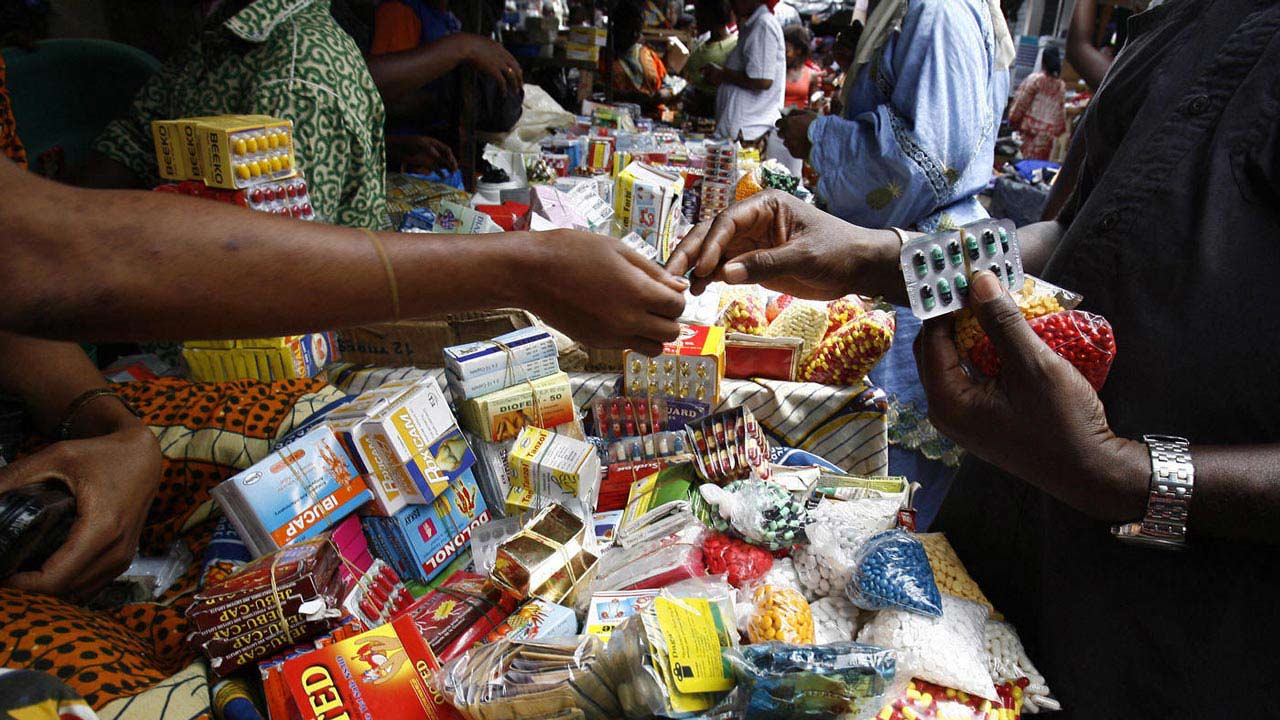
The National Agency for Food and Drug Administration and Control (NAFDAC) has called for tougher punishment, including life imprisonment or the death penalty, for individuals involved in the production and distribution of counterfeit drugs and other dangerous regulated products in Nigeria.
The agency’s Director-General, Professor Mojisola Adeyeye, described counterfeiters as “merchants of death”, arguing that their activities pose a serious threat to public health and endanger millions of Nigerians.
Adeyeye said the existing penalties were insufficient to deter offenders who continue to manufacture and distribute fake medicines, adulterated food, contaminated water and substandard consumer products for financial gain.
The call comes amid growing concerns over the circulation of counterfeit products across the country.
NAFDAC enforcement statistics show that between January and August 2026, the agency recorded 474 new cases, 821 product seizure entries and 213 raids nationwide.
During the period, 52 suspects were arrested, 179 establishments were closed or sealed, while 295 cases were concluded.
The agency also disclosed that its surveillance operations between May and July 2026 covered 5,738 facilities across the 36 states and the Federal Capital Territory, resulting in the removal of 7,210 non-compliant product brands.
In recent operations, NAFDAC uncovered alleged counterfeit CWay dispenser water bottles, as well as products bearing the names of established brands, including Oral-B, Colgate, Nivea and Listerine.
The agency also warned Nigerians against purchasing suspicious KY Jelly lubricant products currently circulating in the market.
Adeyeye further disclosed that NAFDAC had secured 64 convictions against counterfeiters, with offenders receiving prison sentences ranging from one to seven years without an option of fine.
The agency recalled that its enforcement operations in Lagos, Aba and Onitsha between February and March 2025 resulted in the seizure and destruction of more than 137 truckloads of counterfeit and substandard products valued at over N1.5 trillion.
Similarly, in February 2026, counterfeit and expired medicines worth more than N15 billion were destroyed in Ibadan, Oyo State.
The Pharmaceutical Society of Nigeria (PSN) has also raised concerns over the country’s pharmaceutical supply chain, calling on the Federal Government to declare a state of pharmaceutical insecurity.
The PSN President, Ayuba Ibrahim Tanko, who spoke at the society’s 99th Annual National Conference in Awka, Anambra State, warned that drug diversion, illicit trafficking and unregulated distribution were undermining public health and national security.
The society advocated the establishment of a Federal Drug Management Agency, stronger government supervision of pharmaceutical distribution and the replacement of unregulated open drug markets with licensed Coordinated Wholesale Centres.
Meanwhile, NAFDAC’s proposed death penalty has generated wider questions about the adequacy of existing laws and the proportionality of punishment.
Under the existing Counterfeit and Fake Drugs and Unwholesome Processed Foods Act, offenders face imprisonment of between five and 15 years, a fine of up to N500,000, or both, depending on the offence.
The death penalty is not currently prescribed under the law for counterfeit drug-related offences. Its introduction would therefore require legislative amendments.
Beyond tougher punishment, stakeholders have stressed the need for stronger border surveillance, improved regulatory monitoring, better coordination among security agencies and effective prosecution of those behind counterfeit production and distribution networks.
NAFDAC has also urged Nigerians to purchase medicines from licensed pharmacies, verify product registration details and report suspected fake or unsafe products to the agency.
The agency maintains that the fight against counterfeit products requires sustained enforcement and public cooperation to protect consumers and prevent avoidable deaths.

The Enugu State Internal Revenue Service (ESIRS) has raised the alarm over a fraudulent property tax notice circulating in the state, warning residents and property owners against making payments based on its contents.
The agency, which disowned the purported notice, described it as unauthorised and misleading, insisting that it did not originate from or receive approval from the Service.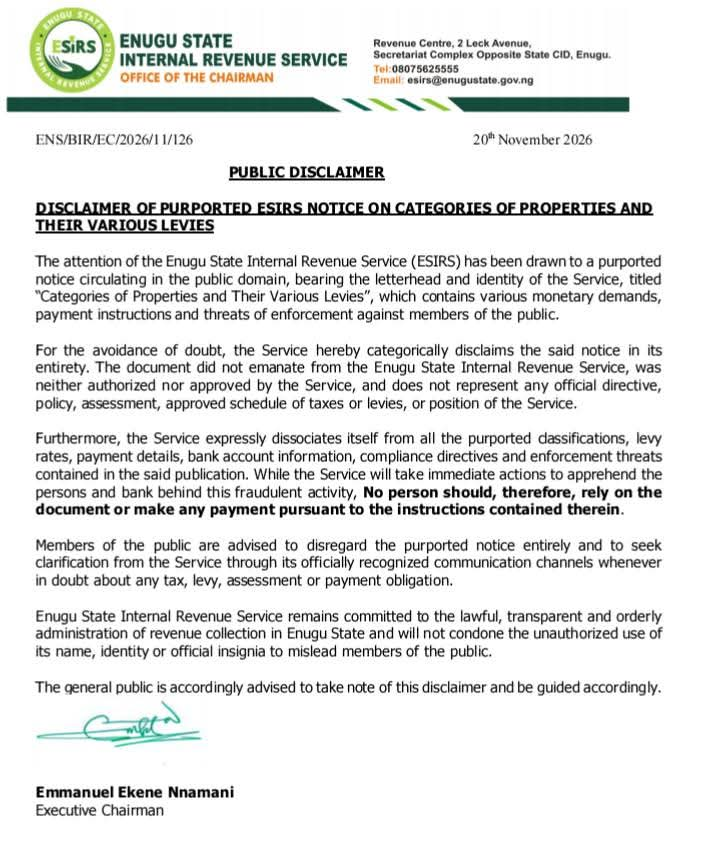
The fake document, titled “Categories of Properties and Their Various Levies,” reportedly contains classifications of properties, corresponding tax rates, payment instructions, bank account details and threats of enforcement against defaulters.
In a disclaimer dated November 20, 2026, and signed by its Executive Chairman, Emmanuel Ekene Nnamani, ESIRS said the publication was being circulated as though it were an official government directive.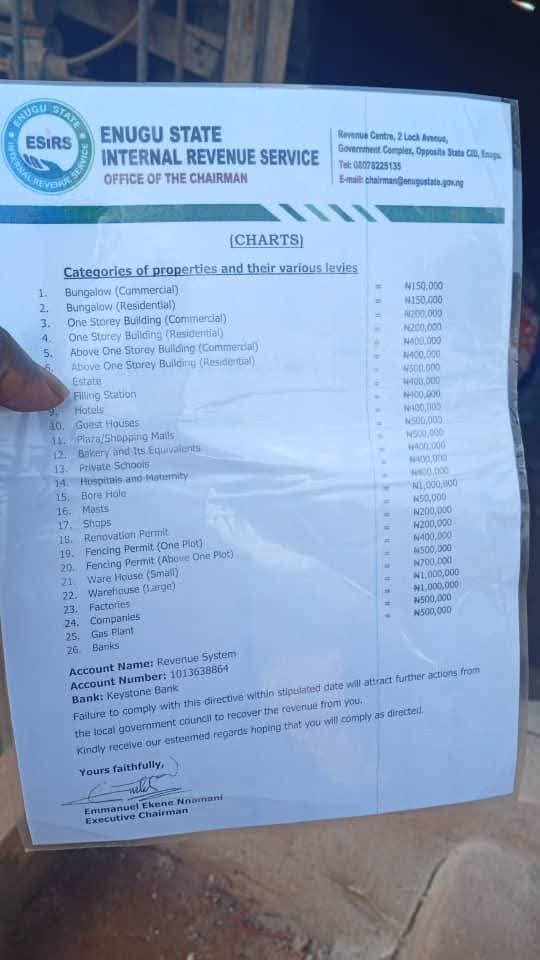
The agency, however, maintained that the document did not represent any approved property tax assessment, revenue policy or official schedule of levies.
“For the avoidance of doubt, the Service hereby categorically disclaims the said notice in its entirety,” the statement said.
ESIRS specifically warned residents against relying on the purported property classifications, levy rates, payment instructions and bank account details contained in the document.
It cautioned that unsuspecting property owners could suffer financial losses if they acted on the fraudulent publication.
“No person should, therefore, rely on the document or make any payment pursuant to the instructions contained therein,” the agency warned.
The revenue authority urged residents to disregard the publication and seek clarification through its recognised communication channels whenever they have concerns about taxes, levies or property assessments.
Meanwhile, ESIRS disclosed that it would take immediate steps to identify and apprehend those responsible for producing and circulating the fake notice.
It also warned against the unauthorised use of its name, identity and official insignia, describing such actions as deliberate attempts to mislead the public and undermine confidence in the state’s revenue administration.
The agency reaffirmed its commitment to transparent and lawful revenue collection, assuring residents that all legitimate tax demands would be issued through approved procedures.
It further advised property owners and members of the public to verify revenue-related demands directly with the Service before making payments, particularly where unfamiliar bank accounts and threats of enforcement are involved.
The disclaimer was signed by Nnamani in his capacity as Executive Chairman of the Enugu State Internal Revenue Service.
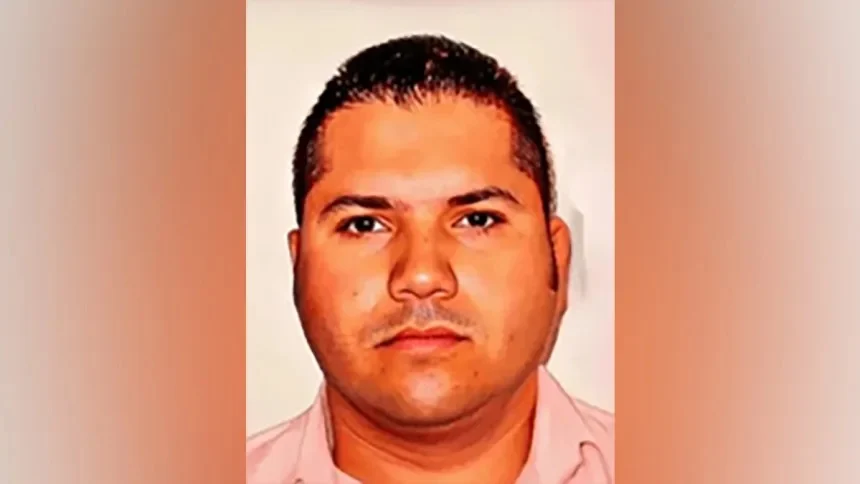
Mexican security forces have arrested notorious drug cartel leader Fausto Isidro Meza Flores, popularly known as Chapo Isidro, during a military operation in Guasave, Sinaloa State.
The arrest was made on Friday, November 20, during a joint operation involving the Mexican Army and National Guard special forces, with intelligence support from the United States, according to a report by the New York Post on Saturday.
Meza Flores, described by American authorities as a major drug trafficker, was reportedly arrested alongside two alleged associates identified as Germán N, also known as Serafín, and José N, who was said to oversee the organisation’s financial operations.
The three suspects were subsequently flown to Mexico City.
The operation reportedly triggered violent clashes between security forces and suspected cartel members, resulting in gunfire, road blockades and the burning of vehicles in parts of Sinaloa.
The violence also disrupted a baseball match in Guasave, forcing players and spectators to flee as gunshots rang out. The match was subsequently abandoned, the New York Post reported.
Meza Flores’ arrest is considered a major breakthrough in the fight against drug trafficking, particularly as he was among the Federal Bureau of Investigation’s 10 Most Wanted Fugitives.
The FBI added him to its Ten Most Wanted Fugitives list on February 4, 2025, accusing him of leading the Meza-Flores cartel, an organisation allegedly involved in trafficking fentanyl, cocaine, heroin, methamphetamine and marijuana into the United States.
The US government had offered a reward of up to $5m for information leading to his arrest and conviction.
Announcing his addition to the wanted list, then FBI Acting Director, Brian Driscoll, accused Meza Flores of spending about 20 years trafficking illegal drugs into the United States.
American authorities also accused the cartel leader of involvement in kidnapping, extortion, torture and murder.
According to the FBI, Meza Flores was first indicted on May 2, 2012, at the United States District Court for the District of Columbia. A superseding indictment returned on November 26, 2019, charged him with drug-trafficking offences and firearms possession.
The indictment alleged that he conspired to manufacture and distribute cocaine, heroin, methamphetamine and marijuana in the United States between 2005 and 2019.
The New York Post reported that Meza Flores faces drug-trafficking and firearms-related allegations, alongside an extradition request from the United States.
His organisation, also known as the Meza-Flores cartel, has been linked to the wider Sinaloa criminal network and operates in the northern Mexican state.
The arrest comes amid renewed security operations against criminal organisations in Sinaloa, where suspected cartel members have repeatedly clashed with security forces.
Authorities reportedly deployed additional security personnel following the violence that erupted during Friday’s operation, while efforts were made to reopen affected roads and restore normal activities.
Meza Flores’ arrest comes years after the capture of another notorious Mexican drug lord, Joaquín ‘El Chapo’ Guzmán.
Guzmán was arrested on February 22, 2014, in Mazatlán, Sinaloa, but escaped from prison in July 2015. He was rearrested on January 8, 2016, and extradited to the United States on January 19, 2017.
He was subsequently sentenced to life imprisonment in 2019 and is being held at the ADX Florence maximum-security prison in Colorado, where he is expected to spend the rest of his life.

The Enugu State Police Command has intensified efforts to apprehend kidnappers who abducted a 73-year-old man, Patrick Onyia, in Umuabi community, Udi Local Government Area, following his release after sustained rescue operations.
Onyia regained his freedom on Thursday evening, November 19, 2026, following operations involving police operatives, Forest Guards and Neighbourhood Watch personnel.
The Commissioner of Police, CP Fidelis Ndubuisi Ogarabe, has ordered an intensified manhunt for the fleeing suspects responsible for the abduction, which occurred at about 6 p.m. on Wednesday, November 18.
In a press statement issued on Friday, November 20, the Police Public Relations Officer, SP Daniel Ndukwe, disclosed that preliminary investigations indicated that the kidnappers allegedly used the victim’s ATM card to withdraw an undisclosed sum of money from his bank account before fleeing.
According to the statement, Ogarabe directed police operatives to sustain the operation until all those involved in the crime are arrested and brought to justice.
The police commissioner also reassured residents of the command’s commitment to protecting lives and property, urging members of the public to provide credible information that could assist in tracking down the fleeing suspects.
The command called for greater public cooperation, stressing that timely and useful intelligence remains crucial to its efforts to combat kidnapping and other criminal activities across the state.


-

 Uncategorized5 days ago
Enugu Assembly Passes Bill Capping Rent Increase at 2 Per Cent
-

 Uncategorized4 days ago
Disaster Averted As British Airways Flight To Lagos Skids Off Heathrow Runway, Aborts Take Off
-
 Uncategorized4 days ago
Enugu Rent Bill: Landlords fight Back, Rush to Increase Rents Ahead of Governor’s Assent
-
 Politics4 days ago
2027: Jonathan Raises Alarm Over Political Intolerance, Warns of Post-Election Crisis
-

 Uncategorized4 days ago
Minister, Governor’s Marriages Crash Amid Separation Disputes
-
 Uncategorized4 days ago
CP Ogarabe Visits AIG Zone 13, Notifies Him of Assumption of Duty
-
 Uncategorized5 days ago
Ogarabe Assumes Duty as 30th Enugu Police Commissioner, Promises Intelligence-Led Policing
-

 Uncategorized4 days ago
Enugu East Celebrates Shirley Emehelu’s Emergence as New Jersey Lieutenant Governor