
Tribute
Pascal G. Dozie: A Brief Reflection

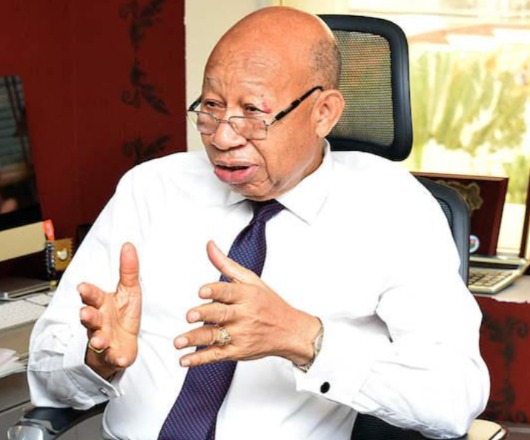
By Professor Bart Nnaji, CON, NNOM, FAS
It was for a divine purpose that I met Pascal Gabriel Dozie over 30 years ago. Our first meeting was in the early 1990s when we were members of the Vision 2010 Committee, a team set up to provide a strategic direction for Nigeria to become a higher-medium income nation by 2010. Some credible sources attribute to him the idea of Vision 2010, but PGD, as he was popularly known, never took the credit. He was self-effacing. What is well known is that it was engineered by PGD and his cohorts of leaders in the Nigerian economy, including Chief Ernest Shonekan, and they convinced the then Head of State, General Sani Abacha, to set up the Vision 2010 Committee.
There are many institutions PGD was instrumental in founding without noise, including Diamond Bank, MTN Nigeria, Lagos Business School, Nigeria Economic Summit Group, etc. But the one that significantly touched my family’s life and the lives of many Nigerians is Geometric Power’s Aba Integrated Power Project.
In 2005, after the concession of the Aba Ring-fenced Area for the Aba Integrated Power Project (Aba IPP) was granted by President Olusegun Obasanjo’s government and development was completed, PGD was the first person to buy into the vision of the Aba Integrated Power Project, which has turned out to be one of the largest indigenous investments in the Southeast region of our dear country, Nigeria. Even when there were no private power companies operating in the country at that time, and the banks had never invested in any power ventures, he understood and supported the vision that through the Aba IPP concession, the power sector would blossom. Under his leadership, Diamond Bank provided the critically needed facility to commence construction of the project. Diamond Bank, before its merger with Access Bank, became the arranger of finance for the completion of the project. PGD invested financially and emotionally in the project because of his utter commitment to improving the welfare of the people. Because of the trust other bankers and the business community in general had in his vision, the Aba IPP project was able to attract funds from other banks and investors despite the global recession and subsequent economic challenges in our dear country.
Despite his preeminent role in both the Aba Integrated Power Project and Geometric Power Ltd, Ndaa Pascal, as his Owerri kinsmen and women refer to him, was never obstructive in the affairs of either the project or the company. He was steadfast and practicalized his Christian faith in the power of the Almighty to see us through the multiple, (and mind-boggling) challenges that the Aba Integrated Project has gone through over the last 15 years, since we both firmly believed that it would be for the overall benefit of the masses.
He saw me as his son, and I, in turn, related to him as my father. My wife Agatha and I see ourselves as part of the PGD family. In PGD, I witnessed the Christian virtues of solidarity, love, humility, altruism, and genuine spirituality. I have never met in flesh and blood anyone who compares to him on the same scale.
My family and I, as well as the Geometric Power team, will always have great and fond memories of Ndaa Pascal G. Dozie, a rare and unassuming being who the Almighty God has used to touch multiple lives across the globe, and change the development history of our nation positively.
We will miss his physical presence and his calm, wise counsel very much.
Professor Bart Nnaji,
Chairman,
Geometric Power Group
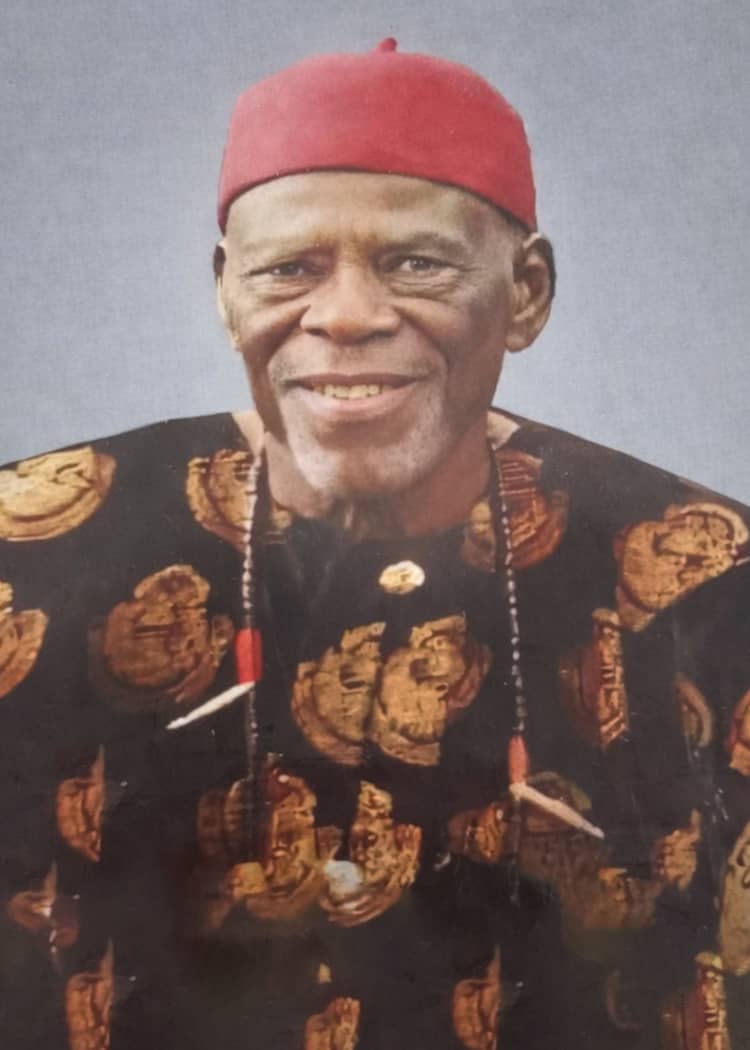
TRIBUTE
By BenWalters Okeke
Today, 24 February, 2026, we gather in our country home, Obuoffia Awkunanaw, a suburb of Enugu, Nigeria, and in Philadelphia, Pennsylvania, the United States (for those of us in Diaspora) to mark the two-year memorial of our patriarch, the distinguished Chief Okeke J. Omagu, who bowed to the will of his Creator at the grand age of 92. While time has passed, the void he left remains, but it is heavily overshadowed by the warmth of memories, the depth of his wisdom, and the enduring strength of his legacy.
Our patriarch, a man of uncommon grit and courage, moved on to the higher realm on 24 February, 2024, taking with him a time; the time-hallowed golden era of result-oriented, honest, hard, work. Chief Okeke J. Omagu, much like the ethnic Germans of northern Europe, believed that we all are in bondage; only hard work can set us free.
And for once, death came late, I dare say, too late, after a 92 year odyssey during which Okeke Omagu rose from absolute obscurity to become, arguably, one of the most revered men, certainly of his own time, if not of all times, in our community.
Our patriarch was born on 30th January, 1932, in the then agrarian Amupata, Obuoffia Awkunanaw Community, 7 kilometers south of Enugu metropolis. His father was the unconventional Omagu Ude, and his mother was the quite, unassuming, Ogwene Arum Ede from Enugwuegu (Amangwu) Obuoffia. Omagu, whose actual name was Chime Ude, was nicknamed Omagu, that is, Omaa Agu/Omee Ka Agu, translated as “the one that behaves like a lion” because of his no-nonsense, if brutal, adherence to, and pursuit of, fairplay, justice, and equity. He was a maverick whose story is told across Awkunanaw clan as the one, “whoru ichikere maa” and got away with it. In 1926, he was reputed to have flouted a masquerade rule (whoru ichikere maa) he deemed unjust and incompatible with his right to freely move and associate with other sections of the community. A section of the Amupata community rose against him, he fought back and they capitulated.
Earlier in 1903, before the advent of local colonial structure of governance, Omagu Ude’s fight against injustice nearly took his life. He was framed in a charge of committing a treasonous sacrilege, tried by the village Court, and sentenced to death by hanging. Tied to a tree in a vigorously dehumanised environment of death, he awaited the oddly symbolic ritual of the last meal, the centuries-old hangman meal. As fate could have it, minutes before his execution, his maternal relations from the neighbouring Umuokwuo Akegbe village, reputed for their strength, stormed the execution ground. The hangman and his cohorts scampered into the bushy banks of Atavu River. Omagu secured a second life!
Persuasions by his maternal relations to take him to his maternal village, Umuokwuo Akegbe, were rebuffed by Omagu who considered exile as the line of least resistance, the hallmark of cowards. He remained and weathered the storm.
Omagu was a farmer and a petty tobacco dealer while Ogwene assisted in farming and trading beside tending the children. Our patriarch was born to this couple as the 4th child and second son. Six months after he was born, an attempt was made to kidnap him, as it happened one night when a brute emerged from the darkness of the night and tried to snatch the little Okeke from his mother’s arms. Mother screamed, and while the father staggered out of the hut, the kidnapper melted into the darkness.
The scholar of the fields.
Okeke had the life of a normal African child and showed early outstanding intellect which endeared him to his parents. But this had a tinge of irony. When he was not going to some distant market, he was toiling in the farm, or in the fields as a shepherd boy. There he was in the fields, a boy of the earth, sometime in 1940, herding his father’s sheep with a diligence that caught the eye of the missionaries. They seized him, seeking to forcibly enroll him in school. His father, however, did something unexpected. He didn’t see the classroom as the only path to wisdom, and not wanting a son who merely studied the world, but one who could master it, he went to the school and “bailed” his son out, returning him to the discipline of labor and the dignity of the fields where he was so deligent, so essential to the family’s prosperity.
Ironically, that act closed the door on a formal Western education. But in doing so, it opened a door to a different kind of mastery. He did not learn leadership from textbooks, he learned it from the seasons, from the discipline of the flock, and from the sacred responsibility of labor. He proved that you do not need formal education to be a man of high intellect or a certificate to be the wisest man in the room.
The Eclipse, the Steady Hand in the Dark
Freed from the “captivity of the missionaries”, he continued with his father in farm work, livestock breeding, and trading. He trekked far and near, traversing distant markets with his dad, father and son trudging side by side, more often than not, along hilly winding bush paths, heavily laden with market wares.
On May 20, 1947, he was returning from Orie Agu market in Udi in the company of his father when, minutes to 4pm local time, around Nvene river on the hilly boundary of Nkanu and Udi, a total solar eclipse of the sun occurred. The moon passed between the earth and the sun, obscuring the image of the sun for viewers on earth, turning the day into pitch darkness across several countries including the then colonial Nigeria. He narrated to us how, as a young lad, trekking home on what seemed like a normal day, his small strides trying to match the rhythmic pace of his father, the birds, suddenly, went silent. The world trembled as the air chilled. The day turned into a haunting, unnatural midnight as the great solar eclipse began to swallow the sun. In that moment of cosmic shadow, when many on the undulating track road had to forcibly sit down, and hopelessly waited for the return of day light, young Okeke did something that would define the rest of his nearly a century sojourn on earth: even when the sun disappears, he reasoned, a man of courage keeps his footing, he reached out, gripped his father’s hand, and kept walking.
He often told us the story, not to talk about the darkness, but to talk about the guidance. He learned that day that even when the light disappears, you do not lose your way if you are walking beside a man of substance as light is not something you wait for – it is something you carry within you. That boy on the market road grew up to become the man who held our hands when our worlds went dark. He became the father who didn’t flinch when the “eclipses” of life – the hardships, the changes, the trials – threatened to obscure the path. To the world, he was the Signpost of a Golden Time. But to us, he was that young boy who learned early in life that light doesn’t just come from the sky; it comes from the integrity of your person or the person walking beside you.
The Journey North: From the Blade to the Beam
Over time, in his late teens, the young Okeke manifested the trait that would make him a legend: vision. He looked at the quite hills and far-flung fields of his rural community, and realized that without Western education, he stood at a disadvantage in a changing world. Most men would have resigned themselves to fate. However, this was not the cloth from which he was cut. Just as the profound darkness that descended upon the world during the eclipse, which similarly threatened to infect the public with an air of hopelessness, was pierced by the steady steps of Okeke and his father, so too was Okeke determined to cleave through the gloom that threatened his own future.
He left the village for Northern Nigeria with nothing but his father’s blessing and a dream. He had a dream that would never be deferred as in Alfred Lord Tennyson’s extra-ordinary poem, Ulysses, “To strive, to seek, to find, and not to yield”.
Back then, as he used to reminisce, years later, his core philosophy was that though he was without Western education, that which he was, he was, and with “one equal temper of raw strength” and his brand of uncommon common sense, failure was not an option because the opportunity cost of failure outweighed the price for success.
Settling in Makurdi, he did not go to sit in classroom; he went to the stalls and the stockyards. He entered the butcher business, mastering the trade of cattle and commerce. In the north, he found his own education. He learned the languages of different men, the art of the deal, and the discipline of the entrepreneur. He turned the disadvantage of his youth into the advantage of his adulthood. He proved that while the missionaries did not teach him how to read, the world taught him how to lead.
However, as he narrated further, for him, this trade of daily slaughtering of animals looked like a fairly bloody and gory occupation. His spirit – a spirit destined for creation, not destruction – recoiled from it, prompting his decision to quit the trade.
The Master Builder
Showing the true mark of a Signpost, he had the courage to pivot. He traded the butcher’s knife for the sawyer’s blade. He moved into the world of woodworking, timber, and lumber. In the North Central city of Lafia in the present-day Nasarawa state, Okeke did not just find a job; he found a calling. He became a Lead Sawyer; a master of both the raw timber of the forest and the refined lumber used to build the homes of a growing nation. This was the Golden Time. While others were reading books, Okeke was reading the grain of the wood. He understood that a fallen tree could be transformed into a pillar, and that raw strength, when processed with discipline, becomes a structure that lasts forever. He did not just witness the development of Nigeria; as a Lead Sawyer in Middle Belt Nigeria, he was one of those who provided the very materials that built it.
This business gave him a moderate fortune as he traversed the middle belt, Cross River, part of South-South, settling in Abakaliki before the 1967 – 1970 civil war.
The Great Trial: The War and the Vacuum
The Golden Time was tested by the fires of 1967. The Nigerian Civil War did not just take his peace, it took everything. Like many Nigerians of Igbo origin, the war saw his fortune plummet to zero and further south of zero in the years after.
Then came August 1, 1974, one of those rare opportunities when history and fate intersect in time and place to shape the fortune of those who dare, those who know how to walk through an eclipse. He joined the Nigeria Coal Corporation, NCC, as a miner. Descending into the dark bellies of the earth, he began a one-man epic, implacable, insurrection against the seemingly insurmountable post-war oddities of life stacked high against him. As a wagoner, from Onyeama Mine to Okpara Mine in Enugu, he was noted for his outstanding ability to turn out, daily, several loaded tubs of coal to the Conveyor Belts. He rose rapidly in the ladder, becoming a Mine Headman, whose duties included supervising the mining operations of his team, organising work pools, and accounting for mining equipment, ensuring operational safety, planning quotas, and coordinating between different teams to ensure a safe and efficient workflow. He proved that a Signpost is not just someone who stands tall in the sun; it is someone who can find the way even in the dark tunnels of a coalmine. He literally pulled himself – and his family – out of the depths and back into the light.
Marriage and Family
Meanwhile, while on the move, at 26, in 1959, Okeke had married the love of his life, Miss Comfort, and the marriage is blessed with several children: Nwakaego, Emeka, BenWalters, Tony, Patience, Maxwell, Chizoba, Victoria and Nnamdi.
A developer of Human Capital
Okeke was clear-eyed and hard-nosed in his belief in the development of human capital. He was a man who understood that the wealth of a nation – and the family – is not found in its soil, but in its people. He was an architect of Human Capital Development long before that phrase even became corporate buzzword. In the 1950s, while still a young man, building his own path, he looked back. He did not climb alone. He systematically lifted his siblings, ensuring they were trained and established in gainful trades. He understood that a tree could only stand tall if the roots around it are also strong.
He ensured his children received the finest education Nigeria could offer, creating a diaspora of excellence. Today, his success at that speaks for itself as he has built a family that has presence in diverse disciplines: Law, Medicine, Accountancy, Politics, Engineering, Science, Technology, Artificial Intelligence, etc.
One of the notable pillars of this legacy is his son, Barr. Emeka Okeke. A lawyer by training, Emeka carried his father’s torch into the halls of power in Enugu State. Between 2015 and 2023, he served the state with distinction, holding high profile roles under the administration of Governor Ifeanyi Ugwuanyi: Commissioner in two different strategic ministries (Labor & Productivity, Chieftaincy Matters) and later, Special Adviser (SPA) on Political Matters to the Governor. Through Emeka’s service, Chief Okeke’s Golden Standard of integrity and community development was felt at the highest levels of state government.
Growing old, he got himself immersed in the education of his grandchildren. Every weekend he wined and dined in his country home with his grandchildren and talked about their education. Besides instituting a cash award for every grandchild on the announcement of the results of any exam taken, he attended every one of their early education programs/ceremonies until his bones got impaired by old age morbidity. But before then, on 9 October, 2018, one of his grandsons, Tony, won an outstanding national honor in science (the national champion of the 2018 prestigious Nigeria National Petroleum Corporation, NNPC, Science Quiz Competition) which Okeke holds proudly as the pinnacle of his investment in education. He watched the live coverage of the competition broadcast by Nigeria Television Authority (NTA) and several other electronic media from the Amphitheatre of the NNPC Group Towers, Abuja. The climax was when his grandson emerged the overall winner in the presence of former Heads of State, Yakubu Gowon, Abdulsalami Abubakar, several state governors and captains of industry, who graced the occasion. Tony had beaten 15,480 other contestants from all over the country.
After emerging as Nigeria’s brightest young scientific mind, Tony moved to the United States, graduating Summa Cum Laude (First Class with the highest Distinction) in accelerated dual degree (B.Sc. & M.Sc.) program in Biomedical Engineering. Today, beside his recognition by the USA-based interdisciplinary Scientific Honor Society, Sigma Xi, as a notable young Scientist in the United States, Tony does not just work in science; he leads it, expanding the frontiers. He was the Moberg Analytics Lead Engineer in the development of Autonomous Care Medical Ecosystem (ACME) for United States Defense Department.
Think of the distance traveled! The boy who was pulled away from a primary school in 1940 has his grandson build autonomous medical systems for the most advanced military on earth. Okeke did not just give his children an education; he built a dynasty of the mind, and gave the world a future.
Communal Catalyst
Okeke’s leadership was never confined to his household or his businesses. He was a man who believed that private success is hollow if it does not translate into public progress. His commitment to the Obuoffia community was legendary. He was not just a resident; he was a builder of infrastructure and peace. His wisdom and “clear eyed” approach to human capital development caught the attention of the traditional institution as he was nominated into the Cabinet Council of the Traditional Ruler of the larger Obuoffia clan. There, he served as a bridge between ancient tradition and modern development, bringing the same strategic mind he used in the coalmines and the oil industry to the governance of his people.
Okeke’s life became a case study for the entire Obuoffia, a living proof that the lack of formal education in one”s youth is not a life sentence but a challenge to overcome through the education of the next generation. While his success was visible in the education of his children, his most enduring impact was on the mindset of his people. In his community, he became the living curriculum of human possibility. In an era where many in the rural community viewed Western education with either suspicion or as an unreachable luxury, Okeke’s household stood as a beacon. As his children began to emerge in diverse disciplines, the golden standard he set at home became the goal of every neighbor. He did not just tell people to value school; he showed them the harvest of doing so. It was a common sight to see parents visiting his home, seeking advice on which schools to choose or how to fund a child’s dream. He was a man who saw tomorrow, helping the rural parents understand that the world was moving from hand (manual labor) to the head (professional expertise). He often intervened to settle doubts, encouraging fathers who, like his own, were tempted to keep their industrious sons in the fields, to, instead, send them to schools. Beyond advice, he was known to quietly provide the “bridge” for those whose dreams were stalled by a few missing Naira, ensuring that no bright mind in his vicinity was extinguished by poverty.
In the twisted and pervasive logics that inform the ways and means of today, Okeke stood himself apart as unimpeachable; say, untainted character, carrying absolutely no moral baggage, though, sometimes, on the flip side, he carried the bag of rocks of dislike and threats from people who were uncomfortable with his unwavering commitment to justice and fair play. In 1971, he narrowly escaped assassination by his nephew who was aggrieved by Okeke’s insistence on justice in the resolution of decades-long feud in the larger Omagu Ude family. He remained, however, resolute until the matter was resolved and the would-be assassin forgiven.
Traditional Prime Minister (Onowu)
The ultimate validation of his character came when he became the Traditional Prime Minister of Omuoha Obuoffia community. As the Onowu, he became the Signpost in a legal and cultural sense – the chief advisor to the throne and the custodian of the people’s peace. He was the Prime Minister who used his office not for title, but for transformation. He provided perspective and was the steady hand on the rudder of the community culture. He was a man who realized that for a child to study AI in the United States or Medicine in Lagos, they first need a community with infrastructure and peace to lay the foundation for, and support, their dreams.
While others might have sought the trappings of office – the fanfare and the influence – he saw his position as a sacred trust. In an act that remains a reference point for integrity in the community, he chose to resign the office when he felt that his continued stay was no longer in the best interest of his people. This was not a retreat, but a final, courageous act of leadership, showing that as the Traditional Prime Minister, he wore his beads of office with dignity, but never let them weigh down his conscience.
He taught the community that true power lies in the ability to walk away for the sake of the collective and that the highest office a man can hold is not a throne in the palace, but the throne of his own integrity. Doing the unthinkable, a resignation, when his principles were tested, shows that he was a man of principles over prestige. He did not just hold the signpost – he was willing to step aside to ensure it pointed in the right direction. Because he was willing to let go of title, he gained a legacy that will never die.
The Final Frontier: Checkpoint Petroleum
From the forests of the Middle Belt to the depths of the coalmines, and finally to the boardrooms of the energy sector, his life was a masterclass on evolution. Most men would have sought a quiet rest after retiring from the Coal Corporation on December 31, 1995, but a Signpost does not stop pointing the way. Thus, upon retirement, Okeke entered the downstream sector of the oil industry. As a co-founder of Checkpoint Petroleum Limited, he transitioned from the solid mineral era to the oil era where he remained an active and visionary leader until his death on 24 February 2024, a passage that elicited outpouring of condolences and tributes from a wide spectrum of the society.
The Chairman of South East Council of Traditional Rulers, HRH, Igwe, Amb. Dr. Lawrence Agubuzu, described him “as a pioneer in many endeavors that brought civilization and enlightenment near this capital City of Enugu;” while the Governor of Enugu State, Dr. Peter Mbah, wrote, “Late Chief Okeke Omagu was a distinguished elder statesman … an accomplished industrialist and a revered community and religious leader who would be remembered for his legacy of service, industriousness and dedication.”
The man, Okeke Omagu, may be gone, leaving the multitude that encountered him wondering, as in the Shakespearean quote, “Here was a Caesar! When comes such another”, however, our solace is anchored on the fact that he left behind, deeds that never die, chiseled on the marble of time. That is the finest epitaph to the fallen giant. While the years (92) in his life meant a lot to all of us, it is the life in those years that we are celebrating now, and will, always. Sleep on, the great one!
BenWalters Okeke, a Lawyer & Businessman, wrote from Munich, Germany.
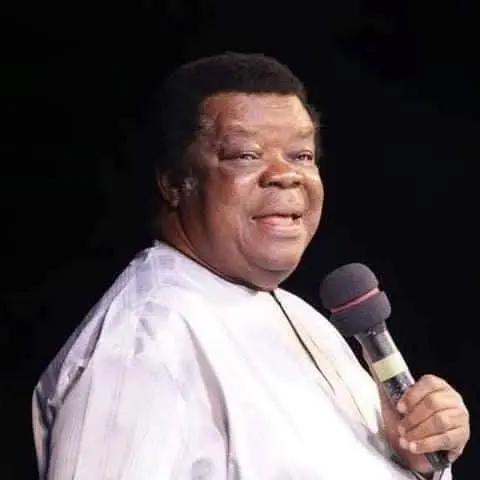
Presidential candidate of the Labour Party (Nigeria) in the 2023 general election and former Governor of Anambra State, Peter Obi, has penned an emotional tribute to the late renowned evangelist, Uma Ukpai, describing him as “one of Nigeria’s most revered clerics” whose life was devoted to spreading the Gospel and transforming lives.
Obi, in a statement Monday via X handle, expressed deep sadness over the passing of the Founder and President of the Uma Ukpai Evangelistic Association.
“I have just received with deep sadness the news of the passing on to glory of one of Nigeria’s most revered clerics, Rev. Dr. Uma Ukpai,” Obi said. “My heartfelt condolences go to his family, friends, and the entire congregation of his ministry. May God’s peace and comfort be with them during this difficult time.”
He described the late cleric as a selfless servant of God who dedicated his life to preaching, healing, and uplifting souls across Nigeria and beyond.
“Dr. Uma Ukpai devoted his life to preaching the Gospel, healing, and uplifting souls across Nigeria and beyond. Through the Uma Ukpai Evangelistic Association, he organised large-scale crusades, healing services, and leadership conferences that brought hope and transformation to countless lives,” Obi noted.
The former governor commended Ukpai’s lifelong commitment to evangelism, which, he said, has left a lasting spiritual legacy for future generations. “May his gentle soul rest in perfect peace. My thoughts and prayers are with his family and loved ones,” he added.
The passing of Rev. Dr. Uma Ukpai marks the end of an era for many in Nigeria’s Christian community, where he was widely respected as a beacon of faith and hope.
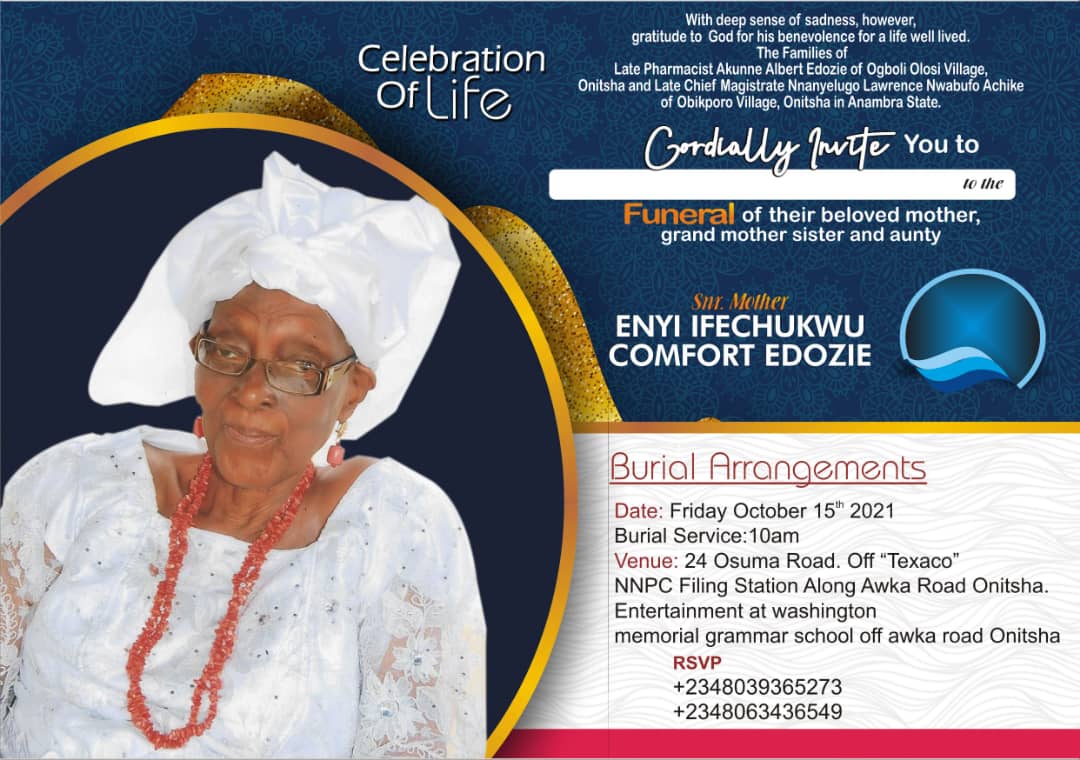
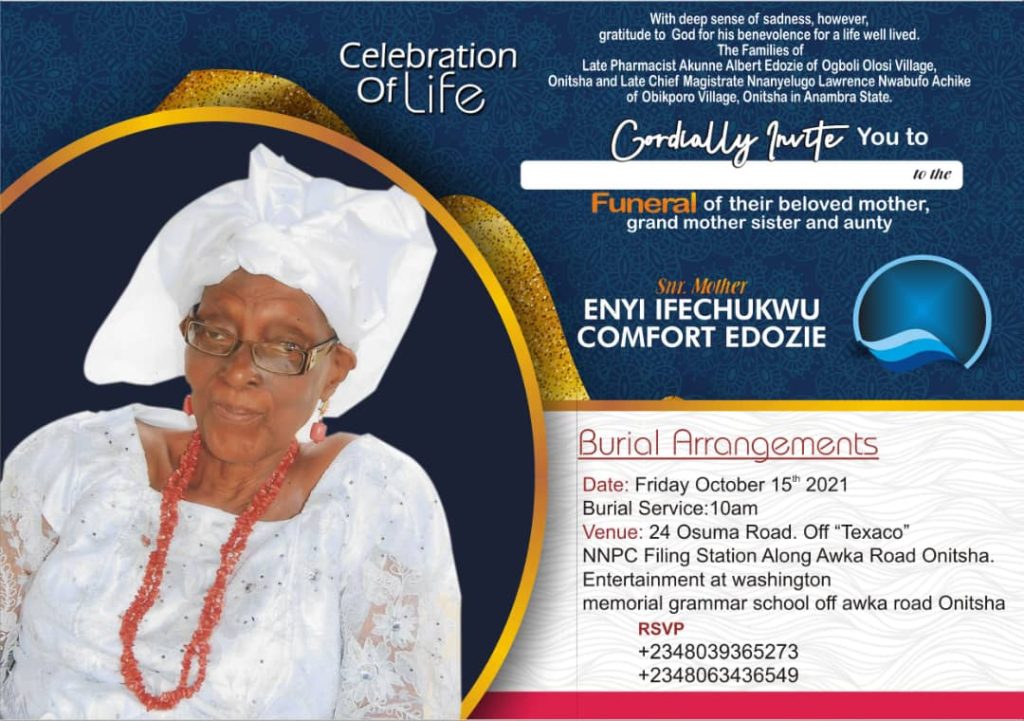
By Afam Edozie
The remains of Enyi Comfort Ozoemena Edozie, is to be committed to mother earth at her residence in Onitsha, Anambra state , tomorrow.
Enyi Edozie was a devout Christian and committed teacher who served as Headmistress to some schools including Housing Estate Primary School, Abakpa Nike, Enugu and retired at St Charles, Onitsha.
A philanthropist who assisted many people particularly less privileged children and women,Enyi Comfort Edozie was a community leader.
She was also Senior Mother in Eternal Sacred Order Cherubim and Seraphim, Onitsha Province,a church she joined in early 60s.
After retirement from service of Anambra state,she joined Otu Odu,as social status and took the titled name:Ifechukwukwlu, aka, whatever God ordained would happen. She was survived by her children,Afam Edozie, Amechi Edozie, Rosemary lgbo,Hilda Ubaike,Benedeth Oforkansi and Olisaemeka Edozie.
Afam Edozie worked for National Light newspaper as Abuja burea Chief/Presidential Villa Correspondent while his wife Chibota Edozie, former Vice President, South East NAWOJ, currently works for National Light,owned by Anambra state government.
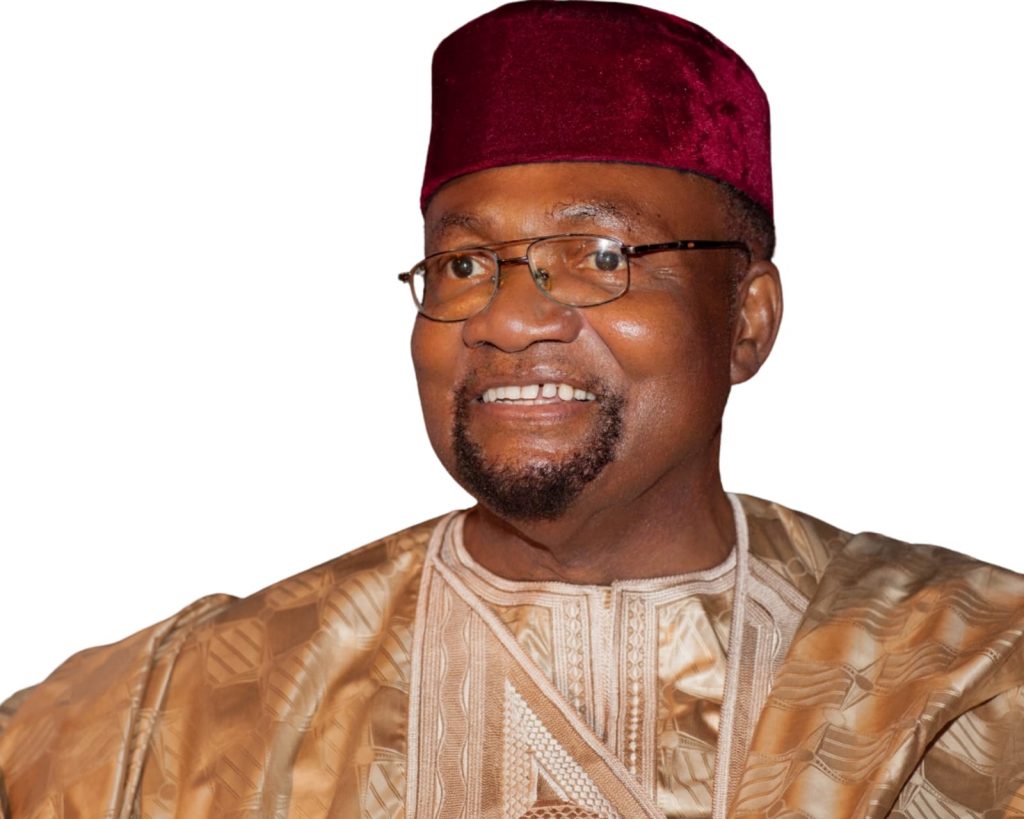
Dr. Joe Nwodo whom all of us gathered here tonight needs no introduction. He was a scion of the great Oak Tree, late Igwe J.U. Nwodo, a former Regional Minister in the then Eastern Regional Government of Nigeria under the able leadership of Chief Dr. Micheal Iheonukara Okpara, of the Blessed Memory.
Dr. Joe’s family background and up bringing was not like those whose aristocratic pretentions reposed on imaginary foundations. The Odo Nwokoro Royal Family of Amakofia Ukehe cannot be second guessed, for their indelible imprints are there for all to see.Dr. Joe Nwodo, the grammarian, the wordsmith, the matchless rhetorician, the orator par excellence and the best of them all in the late Igwe J.U. Nwodo’s family, an intellectual giant, an accomplished lawyer and businessman, was my mentor and friend.
He was a source of inspiration and a role model. Very early in my relationship and association with him, he noticed my potentials and never relented in prodding and encouraging me to be the best I am expected to be, to the extent that between 1999 and 2007, I was his choice at different times, either as a member of House of Reps or as a Governorship aspirant on the platform of APGA, that never was.
When Dr. Joe Nwodo decided to run for the Governorship of the then old Enugu State, I happen to be one of the early able bodied youth in the Nsukka cultural zone to pledge my support and loyalty to this noble cause. I coordinated the Youth Wing of his struggle and campaign in Uzo-Uwani LGA of Enugu State. In close range, I watched him painstakingly lay the foundation of modern day governorship bids for elites in Enugu North Senatorial District and beyond.
Following his example and footsteps, many of our political elites dared to dream big and aspired to be Governor such as Hon. Fidelis Ayogu, Chief Okechukwu Itanyi, Okey Ezea Esq, the Incumbent Governor of Enugu State, His Excellency Rt. Hon. Ifeanyi Ugwuanyi and Most Distinguished Senator Ayogu Eze. My fellow sympathizers, by the death of Dr. Joe Nwodo, humanity has lost a man with the heart of gold. A man that was as large hearted as he was in size. A man that espoused meritoquotocracy- three issues rolled into one. A man who preached a brand of home-grown democracy that recognized merit/competence, while ensuring that the Federal Character Principle/Quota system as enshrined in Section 14(3) of the 1999 Constitution as amended, were not shortchanged on the altar of nepotism and greed.
Dr. Joe Nwodo, the first proponent of ‘ka foto onye Nsukka Zone kobe na Government House, Enugu’, a man who used his wealth and oratorical skill to galvanize a civil revolution in Nsukka Zone to dare and to conquer, was my man. He was a preacher and an embodiment of can do spirit. Where do I start and where do I stop talking about Okenwa ana amuru oha, Dr. Joe Nwodo, ahuma nwa, echeta nna? In his governorship campaign rallies, Dr. Joe Nwodo was always in his elements. He was so gifted in speech deliveries that he can mobilize and move a mass of the people into action, like no other person.
Any reader of Robert Payne’s classical book on ‘The Life and Death of Adolf Hitler,’ will agree with the author that Dr. Joe Nwodo shared with Adolf Hitler in mass hypnosis when it was said by Payne that Hitler was ‘an actor of prodigious talent who could do with his audience whatever he pleases, and had learned how to raise the temperature of his audience to flash point, and at this point, they were no longer separate individuals; they were fused into the mass… And he alone can perform these seemingly miraculous feat of mass hypnosis. And so was Dr. Joe Nwodo.
Dr. Joe Nwodo replicated this feat not only in his campaign trails in the old Enugu State. No. He exported it to the National Convention of the Nigerian Republican Convention’s (NRC) Presidential Primary in Port- Harcourt in 1993, where he held the National Convention Delegates spellbound and narrowly lost to Ibrahim Tofa as a second in the hotly contested primary. Like Adolf Hitler, it was said of Dr. Joe Nwodo that….. ‘as he continued talking, the future began to draw closer, and the longer he talked, the closer it became until it seemed that the future might be tomorrow or the day after’. No wonder Dr. Joe Nwodo talked up the sleepy and hilly Nsukka Zone’s landscape into serious political activity ever since. He woke up the sleeping giants in what used to be docile Nsukka political elites to the extent that for the first time, an Nsukka man in His Excellency Dr. Okwesilieze Nwodo was elected the first Executive Governor of the old Enugu State in the 19th December, 1991 Governorship election. Fate turned Dr. Joe unto a John the Baptist for his younger brother, His Excellency Dr. Okwesilieze Nwodo, and the rest as they say is history. Dr. Joe Nwodo by his revolutionary actions confirmed the notorious Iraq Saying that “an army of sheep led by a lion will defeat an army of lions led by a sheep”.Talking about Dr. Joe Nwodo and his several years of being bed ridden, I will certainly and wholeheartedly agree with Jean de La Bruyere when he opined and reasoned that ‘A long illness between life and death makes death a comfort both to those who die and to those who remain’. But notwithstanding, true friends and compatriots of the Nwodos are grieving over this death. And again, I agree with Thomas Babington Macaulay in his letter to Hannah Macaulay in 1833 that ‘There are not ten people in the world whose deaths would spoil my dinner, but there are one or two whose deaths would break my heart”. And certainly Dr. Joe Nwodo is one of them. This is because there is no grief like the grief which does not speak.
Dr Joe Nwodo, Agadagbachiriuzo of Ukehe, what do we do for thee than to commit your body to the ground; earth to earth, ashes to ashes, dust to dust; in sure and certain hope of the Resurrection to eternal life. But then like Benjamin Franklin in his 1728 Epitaph on himself wrote. “The body of Dr. Joe Nwodo the lawyer (like the cover of an old book, its contents torn out and stripped of its lettering and gilding), lies here, food for worms; but the work shall not be lost, for it will (as he believed) appear once more in a new and more elegant edition, revised and corrected by the author’. To Dr. Joe’s wife, Emeka and his siblings, I say take heart. You had a great husband and father. To the family of late Igwe J.U. Nwodo, I say thanks for being there for your brother, through thick and thin, for according to Samuel Butler, ‘it costs a lot of money to die comfortably.’To Dr. Joe Nnabuchi Nwodo, my mentor and hero, in the words of William Shakespeare in his Henry IV, I say, ‘Adieu and take thy praise with thee to Heaven, Thy ignominy sleep with thee in the grave, But not remembered in thy epitaph’. May your pilgrim soul, and the souls of all the faithfuls departed, through the mercy of God, rest in perfect peace. Amen.
Senator Chukwuka Utazi, Enugu North Senatorial District

-
 News19 hours ago
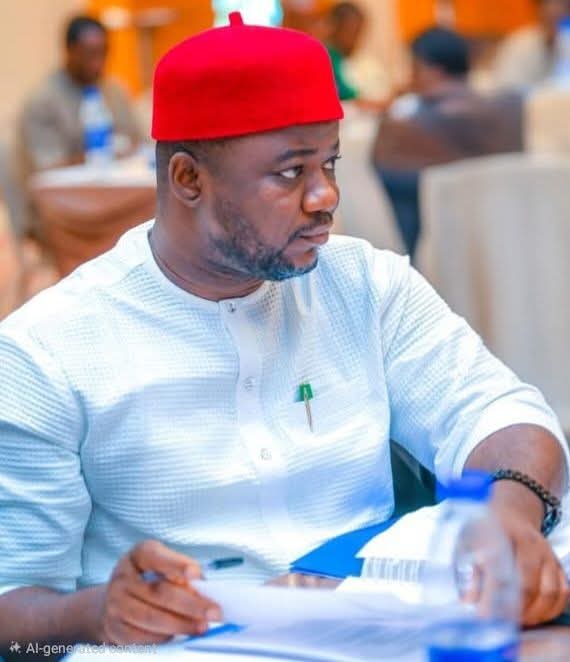
“Go and Verify”: How Sunday Umeha Is Redefining Representation in Ezeagu/Udi
-
 Politics4 days ago
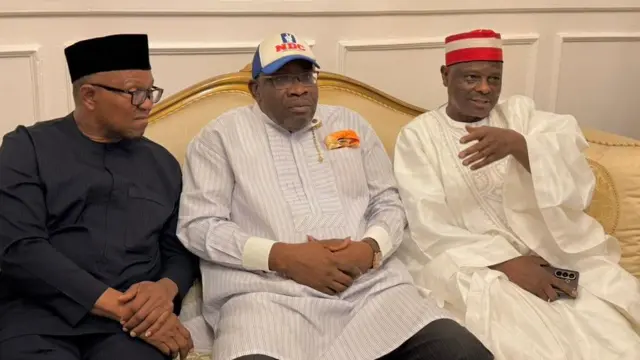
Mass exodus: Obi, Kwankwaso exit rocks ADC, 18 lawmakers join NDC
-
News1 day ago
Chief Sir Paul Chukwuma Lays His Beloved Sister to Rest
-
 News5 days ago
Awka Monarchy Tussle: Ndigwe Denounces Claim as Eze Uzu III, Dismisses Social Media Reports
-
 News5 days ago
Enugu Govt Disowns Group Accused of Defrauding Traditional Medicine Practitioners
-
 News3 days ago
Enugu, SSDO advance domestic resource mobilisation for climate responsive budgeting
-
 Politics2 days ago
Anambra Communities Boil As Group Carpets Traditional Rulers Over Zoning
-
 Crime3 days ago
Anambra Police Burst Gunmen Armoury in Orumba