
Education
More troubles for Parents as schools raise fees

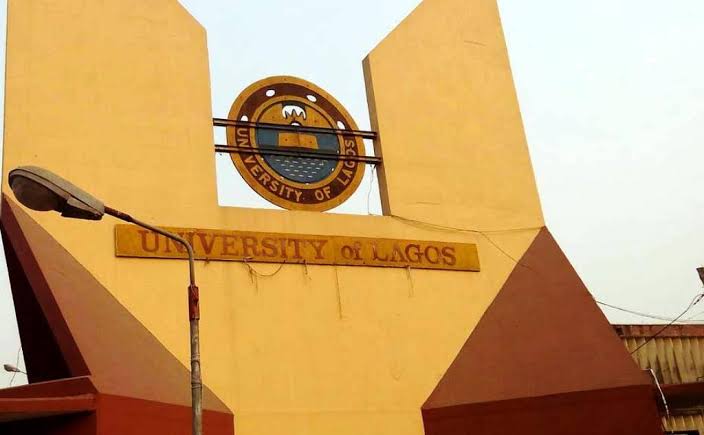
FG increases Unity Colleges tuition, UNILAG jacks up fees from N19,000 to N190,250
Private schools plan further hike, say 50% increment no longer realistic
Amidst escalating cost of living in the country, some educational institutions have announced significant increases in tuition and other fees, while others are planning to do so in order to cope with the effects of the removal of subsidy on petrol.
This is putting parents on the edge as the current academic session draws to a close for primary and secondary schools, while the calendar of tertiary institutions has been impacted by incessant strikes and crises.
On Friday, primary and secondary schools in Lagos and some other states brought the academic calendar to a close and some informed parents and guardians of pupils to prepare for a significant rise in fees when the next academic session begins in September.

Leading the school owners who had announced tuition fees increment was the Federal Government, which through the Federal Ministry of Education announced an upward review of school fees for new students into its secondary schools otherwise known as Federal Unity Colleges from N19,000 to N100,000.
This was contained in a directive from the office of the Director of Senior Secondary Education Department of the ministry with reference number ADF/120/DSSE/I, dated May 25, 2023, and addressed to all principals of Federal Unity Colleges.
According to the circular titled, ‘Approved fees/ charges for Federal Unity Colleges (1st term) for new students’, signed by the Director of Senior Secondary Education, Hajia Binta Abdulkadir, new students are expected to pay N100,000 instead of the previous N45,000.
The latest fee/charge increment will affect virtually all aspects and activities of the schools, including tuition and boarding, uniform, textbooks, exercise books, prospectus, caution fee, identity card, stationery, clubs and societies, sports, extra lesson and insurance, among others.
“Please be informed that the ministry has approved only the under-listed fees and charges for all Unity Colleges,” the memo read in part.
Similarly, the management of the University of Lagos, Akoka, reportedly increased the fees for undergraduates in the institution.
This was contained in a statement dated July 20, 2023, by the Senior Staff Association of Nigerian Universities, UNILAG branch, following a meeting with the top management of the institution.
The union said in the statement that fees would be increased for undergraduate students in the next academic session.
Students of the institution previously paid N19,000 for tuition, but the management has now fixed N190,250 for students studying Medicine, while for courses that require laboratories and studios are to pay N140,250.
According to SSANU, the Vice-Chancellor, Prof Folasade Ogunsola, met with representatives of the three non-academic staff unions on Thursday to discuss issues concerning members’ welfare.
“During the meeting, the proposed fees for undergraduate students of UNILAG were disclosed. Students without lab and studio use will pay N100,750, those with lab use will pay N140,250 and the College of Medicine will pay N190,250,” the statement said.
The SSANU representative at the meeting, Rasaki Yusuf, however, asked for a rebate for staff members with children in the university, but the vice-chancellor insisted that the new charges were set nationally and could not be modified for specific categories of students.
Ogunsola, however, gave the option of staff paying in instalments but with a condition to pay up one month before final exams.
The UNILAG management later issued a statement confirming the development.
The statement said, “After careful deliberations with its stakeholders (students, parents/guardians, staff unions and alumni, among others), the University of Lagos Management has reviewed the obligatory fees (mandatory charges for an academic session/year) of new and returning undergraduate students of the university.
“The adjustment in fees, which will take effect from the first semester of the 2023/2024 academic session, is in view of the prevailing economic realities and the need for the university to be able to meet its obligations to its students, staff and municipal service providers, among others.
“It is also pertinent to note that the university has not increased its obligatory fees in recent years. Management, therefore, seeks the kind understanding and support of students and other stakeholders with the assurance of its commitment to ensuring that students get the best learning experience.”
Private school owners
The President, National Association of Proprietors of Private Schools, Chief Yomi Otubela, said the removal of subsidy on petrol had hit the education sector hard and the effects would be felt more in the months ahead.
According to him, most private school owners are battling with the withdrawal of pupils and the resignation of teachers, who are increasingly finding it difficult to commute to school.
Otubela said, “We have so many parents who are withdrawing their children from school for their inability to meet up with the cost of transporting them to school or even paying the school fees. We have teachers who have tendered their resignation because their take-home pays can no longer take them home and back to school.
“We have instances where vendors, who supply one material or the other, have increased the cost of their materials. For instance, publishers have taken the cost of books from N25,000 to N65,000 for all books needed on average in all classes. We have instances where the use of technology is becoming obsolete because people can no longer fuel their generators and there is a limit to what the solar system can power.
“As it is now, we have a report of so many schools selling off their buses because the cost of patronising buses to parents has tripled and there is so much uncertainty as to what the actual price will be with the rising inflation. Generally, there is so much uncertainty within the private school sector. We consulted experts and all of them are beginning to see where many private schools will cease to exist and some will reduce the quality of education while looking for ways to weather the storm.”
“The uncertainty cannot make anybody predict the percentage of increase that might likely come up. All school management are in different meetings and retreats to ascertain how to mitigate the current situation. At the initial stage when subsidy was removed, about 40 per cent to 50 per cent increase in transport fares was advocated.
“But with the further increase in the pump price and the inflation in the open market, no one can determine the percentage increase now although the bill taken home by the students is showing 40 to 50 per cent, there may be a need to review that further in line with new fuel price and the escalating prices of goods and services.”
He called on the government to intervene in the private school sector and state-owned schools by introducing mass transit buses to be dedicated to pupils in nursery and primary schools.
Otubela explained, “One (bus) cannot be attached to a school, but it can be attached to a location that will make it easy for the pupils to trek to schools around the area. If this is done all over the country, it will ameliorate the cost of transportation.
“The government should also set up an education bank that will focus on giving revolving loans at single-digit interest rate to operators in the education sector, which are not school owners alone, but also educators, teachers, publishers, furniture makers, solar energy system providers, generator system providers, instructional materials’ providers and the likes to curtail the rising cost of provision of education.
“The government should sponsor the capacity building of teachers in state-owned and private schools. At least once in a term, there should be capacity building for all the teachers that will be fully sponsored by the Federal Government and this should be the criteria for people to remain in the teaching profession.”
Similarly, the Publicity Secretary of the National Association of Proprietors of Private Schools in Abuja, Paul Edoh, said parents should anticipate at least a 10 per cent hike in tuition fees from the 2023/2024 academic session.
He told one of our correspondents, “There has not been any official statement from the FCT and the local government chapters of the NAPPS with regards to the aforementioned, but schools in rural areas and some schools in the city centre have resolved that already; by September, there will be changes in school fees by the way of upward reviews to help balance the overhead cost and day-to-day running of the schools.
“Some local communities within the AMAC jurisdiction are considering a five per cent increment, while some are looking at 10 per cent, though there is no uniformity as per fee increment.”
Speaking on the challenges being encountered by private school owners, Edoh said, “Sure, you are aware of the current multiple taxes being experienced by school owners. The area councils are demanding taxes, the FCT Administration and the Federal Inland Revenue Service are asking for theirs. Don’t forget that the Department of Quality Assurance’s annual due is still there.”
On if parents had been informed about the proposed hike, he said, “Sure, written notes have been sent to them and some schools have even held PTA meetings on it too.”
The National President, National Parent-Teacher Association, Haruna Danjuma, did not respond to inquiries by one of our correspondents on the way forward for parents as of the time of filing this report.
A school proprietor in the Ibafo area of Ogun State, who spoke on condition of anonymity, said it had become clear that private school owners would have to increase their fees in order to stay afloat, adding that the management of his group of schools had concluded plans to raise the tuition fees by between 10 per cent and 15 per cent.

By Our Reporter
Tragedy has struck the family of Comrade Ambrose Nnamani of Isi-Ama Ejona in Mbu Amon, Isi-Uzo Local Government Area of Enugu State, following the death of their 14-year-old son, Kosisochukwu Nnamani.
The deceased, who was a student of the College of Immaculate Conception (CIC) Enugu, was reportedly drowned while attempting to recover a bucket that fell into a water reservoir.
Sources disclosed that the unfortunate incident occurred on May 4, 2026, throwing the family and members of the community into mourning.
A burial poster released by the family described the death of the teenager as a “painful exit,” stating that his sudden demise has left relations, friends and schoolmates devastated.
According to the burial arrangements, a Christian wake is scheduled to hold at the College of Immaculate Conception (CIC) Enugu on Tuesday, May 12, 2026, while funeral Mass and interment will take place on Thursday, May 14, 2026, at his father’s compound in Ugwu-Faith, Isi-Ama Ejona, Isi-Uzo LGA of Enugu State.
The family prayed for the peaceful repose of the young boy, describing him as a “little angel gone too soon.”
By Okey Maduforo Awka .
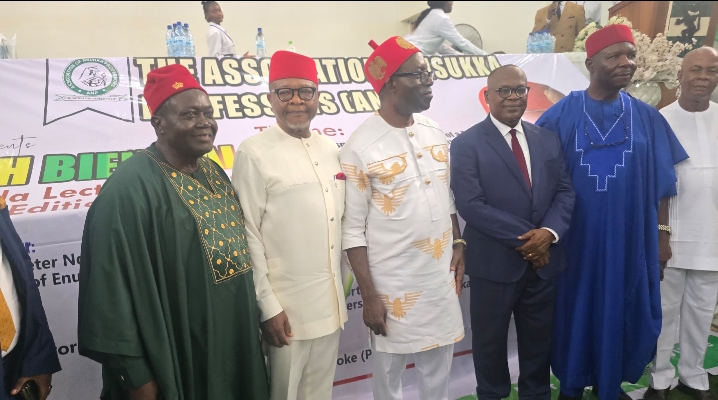
Governor Charles Soludo of Anambra state has lamented lack of research in public policy making contending that academic research with positive impact on governance is sterial.
He further challenged the academic community to step up it’s intellectual works towards solving contending issues that shape the wellbeing of the immediate society.
The Governor who delivered a lecture at the 6th Biennial Adada Lecture Series 2026 convened by Association of Nsukka Professors noted that gone are those days when intellectual works end up at the University book shelf without transforming the socioeconomic needs of any given society.
Soludo observed that the “fusion of thought and action” remains the only bridge to a national rebirth.
Soludo questioned why academic discussions have seemingly lost their authority in national life. Despite producing thousands of professors and journals, he noted a “severed link” between academic research and public policy.
“If you have 200 Professors as members, how is the Adada zone not a first world?” he asked, challenging the audience to move beyond the walls of the university. “We produce journal articles, but how many have become policies? Intellectualism without activism is sterile.”
The Governor further advocated for “Productive Intellectualism,” where critical thinking guides public purpose. Drawing from his first tenure as Governor over the last four years, Governor Soludo highlighted how he has attempted to bring intellectualism to governance through “sacrificial volunteerism” and how he succeeded in laying the foundation for the African Dubai-Taiwan-Silicon Valley.
He emphasized that nations do not develop by resources alone, but by ideas that precede institutions; citing historical giants like Isaac Newton, Nnamdi Azikiwe, Obafemi Awolowo, Kwame Nkrumah, Ahmadu Bello, and a host of others, as examples of a shared pattern of logical thinking that yield ideas and then built.
“This is a challenge to the intellectuals and the wider academic community: to multi-task, as the modern intellectual must be both a thinker and a doer, Question the Status Quo which remains a fundamental element of true intellectualism”
“Standing akimbo is too expensive,” Soludo warned. “We don’t just live; we live to matter. It is time to get back to basics and drive the African renaissance through active participation.”
Speaking earlier, Professor Osita Ogbu, presiding as Chairman, observed that the true benchmark of academic excellence is not found in the complacency of achievement, but in an unyielding hunger for discovery and the courage to apply that knowledge to real-world challenges. He asserted that intellectuals are never satisfied, they keep working.
Also speaking, the Vice Chancellor of the University of Nigeria, Nsukka, Professor Simon Ortuanya, framed the gathering as a significant homecoming for Governor Soludo. He offered a glowing tribute to the Governor, commending his transformative contributions to the Nigerian state and his broader dedication to the service of humanity.
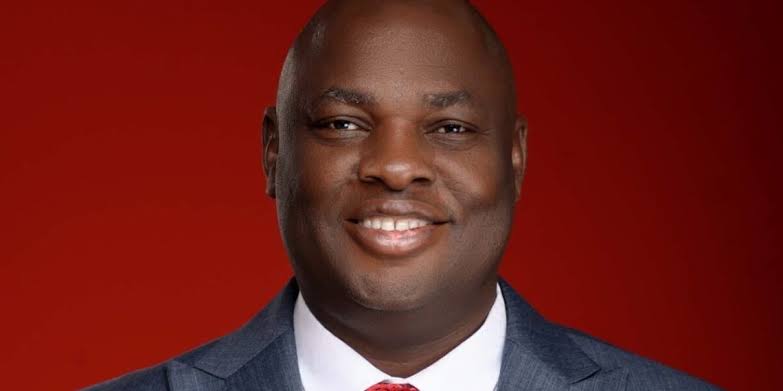
Enugu East Local Government Area has formalised a strategic partnership with David Umahi Federal University of Medical Sciences following the signing of a Memorandum of Understanding (MoU) aimed at strengthening human capital development in the council area.
The agreement, signed during a high-level meeting between officials of the council and the university’s management, is expected to open new opportunities in medical education, training, and healthcare capacity building.
Speaking at the signing ceremony, the Executive Chairman of Enugu East LGA, Engr. Pst. Beloved-Dan Obi Anike, described the partnership as a major step toward building a healthier and more prosperous society through deliberate investment in education.
He noted that the initiative aligns with the broader development agenda of the Enugu State Government under Governor Peter Ndubuisi Mbah, particularly in the area of human capital development.
As part of the agreement, the council unveiled plans to sponsor 100 students from Enugu East to study medical-related courses at the university, a move aimed at addressing manpower gaps in the health sector while empowering local youths.
“This partnership is not just about education; it is about securing the future of our people. By investing in medical training, we are building a foundation for sustainable healthcare delivery in Enugu East,” Anike said.
In his remarks, the Vice Chancellor of the university, Jesse Uneke, commended the council for its forward-thinking approach, describing the MoU as a mutually beneficial arrangement that would enhance both academic excellence and community impact.
He assured that the institution would provide the necessary support to ensure the success of the scholarship programme and other areas of collaboration captured in the agreement.
The MoU is also expected to cover research collaboration, capacity building, and possible medical outreach programmes within Enugu East communities.
Stakeholders say the partnership marks a significant milestone in the council’s drive to improve access to quality education and healthcare, while positioning Enugu East as a model for grassroots-driven development.
Implementation of the agreement is expected to commence in the coming weeks, with both parties set to outline detailed modalities for its execution.
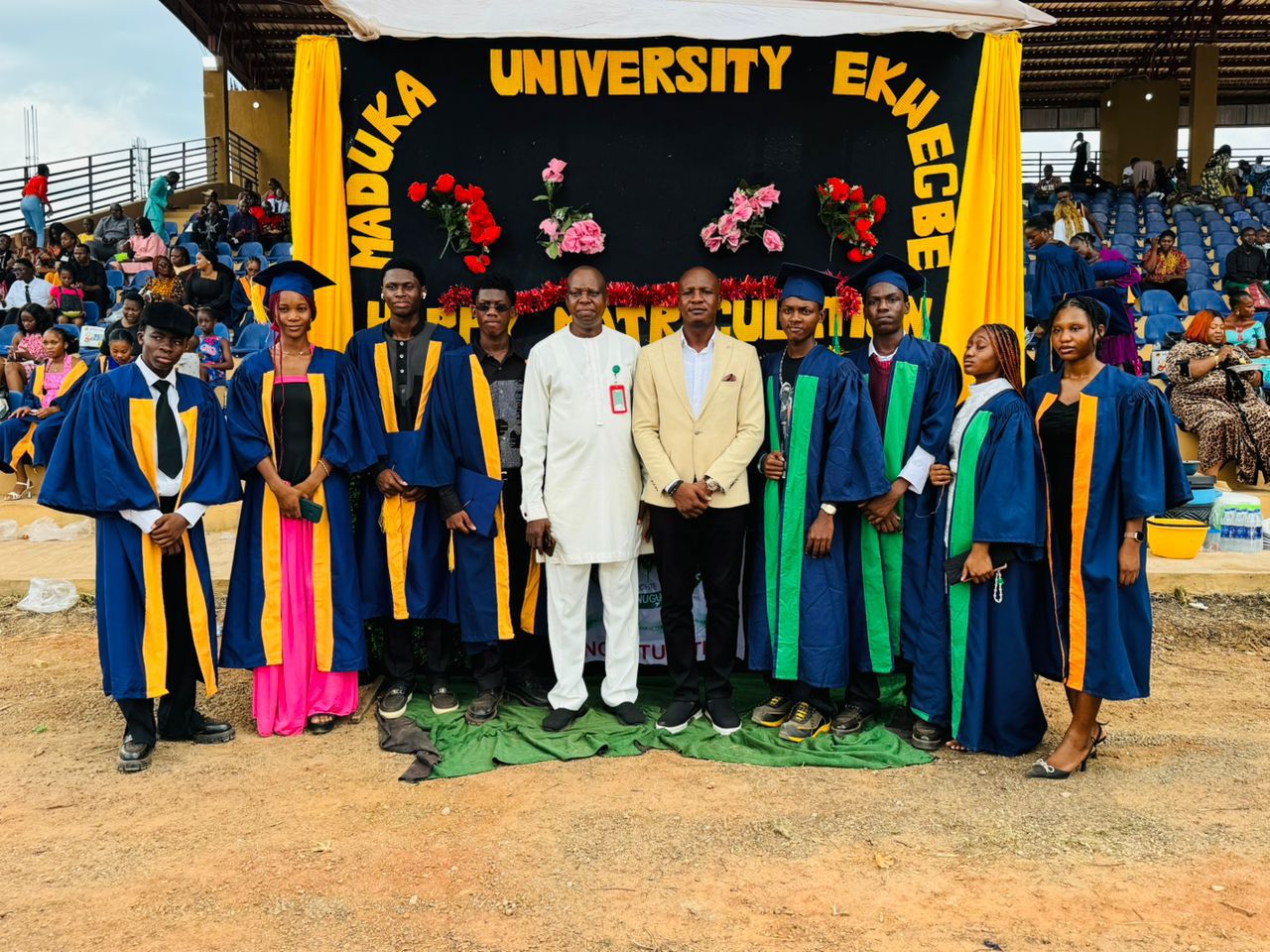
Fifteen students from Enugu East Local Government Area who were awarded scholarships to study medicine and engineering at Maduka University have officially matriculated, marking a major milestone in their academic journey.
The scholarship initiative, driven by the Enugu East Local Government Council under the leadership of Engr. Pst. Beloved-Dan Obi Anike, is part of efforts to boost human capital development through strategic investment in education.
The council facilitated admission for the beneficiaries into high-demand professional courses, positioning them to become future leaders in medicine, engineering, and related fields.
The matriculation ceremony was attended by key government representatives, including Barr. Uche Mbaeke, Secretary of Enugu East LGA, and Pst. Polycarp Ugwu, Secretary of the Enugu East Human Capital Trust Fund, who represented the council at the event.
The ceremony signals the beginning of a new academic chapter for the students, who are expected to make meaningful contributions to their community and beyond.
The initiative has been widely commended as a bold step toward youth empowerment and sustainable development in Enugu East.

A lecturer at Kogi State Polytechnic, Lokoja, Mr. Anslem Ojodomo, has died after collapsing in class while teaching.
The Rector of the polytechnic confirmed the incident in a statement issued on Friday in Lokoja by the Acting Coordinator, Directorate of Public Relations, Mr. John Onimisi, describing the development as a “deep personal shock.”
The tragic incident has sent shockwaves across the institution, coming just a month after another lecturer, Dr. Barnabas Akuba, passed away shortly after completing his PhD programme.
Ojodomo’s death has sparked concern among staff and students, with many questioning the circumstances surrounding the sudden losses.
Student eyewitnesses, who spoke to journalists on condition of anonymity, said Ojodomo collapsed while addressing his class. Despite efforts to save him, he was pronounced dead at a nearby hospital.
The polytechnic community has been left in a state of uncertainty, having lost two lecturers in quick succession.
Meanwhile, the Rector, Prof. Salihu Avidime, extended heartfelt condolences to the institution and the family of the deceased, noting that Ojodomo was a lecturer in the Department of Public Administration.
Avidime recalled meeting Ojodomo just hours before his death, where they exchanged pleasantries.
He described the late lecturer as a dedicated and humble academic committed to excellence.
“The Polytechnic community is mourning the loss of a promising academic and dependable colleague who embodied scholarship, service, and character,” he said.
“Ojodomo’s contributions as Deputy Dean, Student Services, and lecturer were impactful and inspiring.”
Anselm Victory Ojodomo (October 5, 1992 – March 27, 2026) held a Master’s degree from Prince Abubakar Audu University, Anyigba, where he had recently defended his PhD proposal.
He joined Kogi State Polytechnic in 2021 and served on several committees.
The polytechnic community commiserated with his family and the people of Igalamela/Odolu, praying for his soul to rest in peace.
-
 News2 days ago
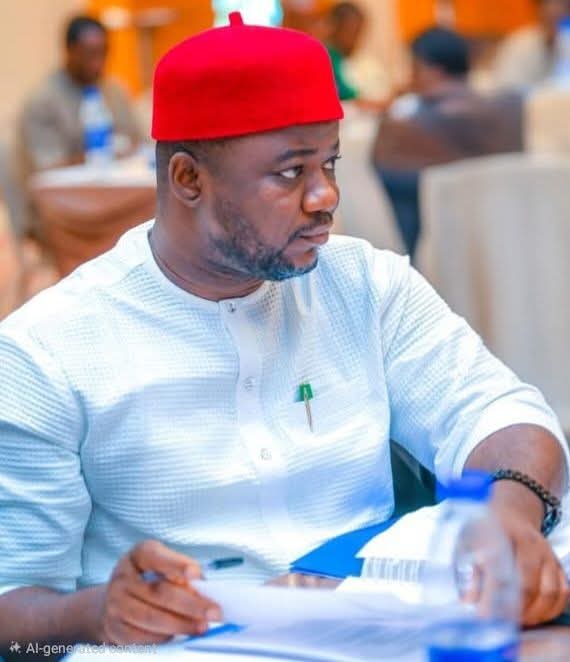
“Go and Verify”: How Sunday Umeha Is Redefining Representation in Ezeagu/Udi
-
News3 days ago
Chief Sir Paul Chukwuma Lays His Beloved Sister to Rest
-
 Politics3 days ago
Anambra Communities Boil As Group Carpets Traditional Rulers Over Zoning
-
 Crime4 days ago
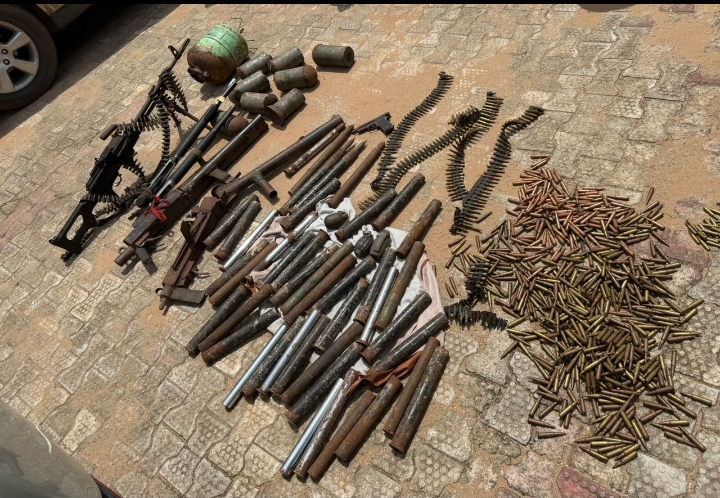
Anambra Police Burst Gunmen Armoury in Orumba
-
 News4 days ago
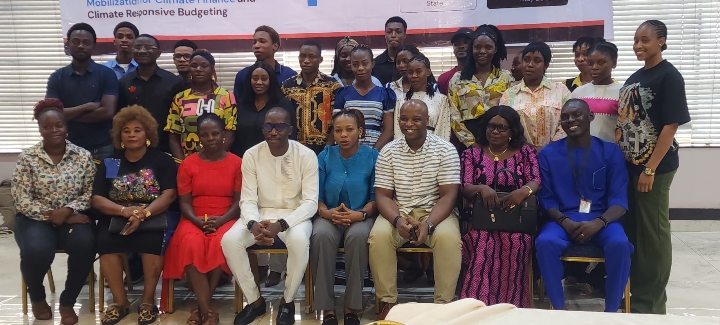
Enugu, SSDO advance domestic resource mobilisation for climate responsive budgeting
-
 News3 days ago
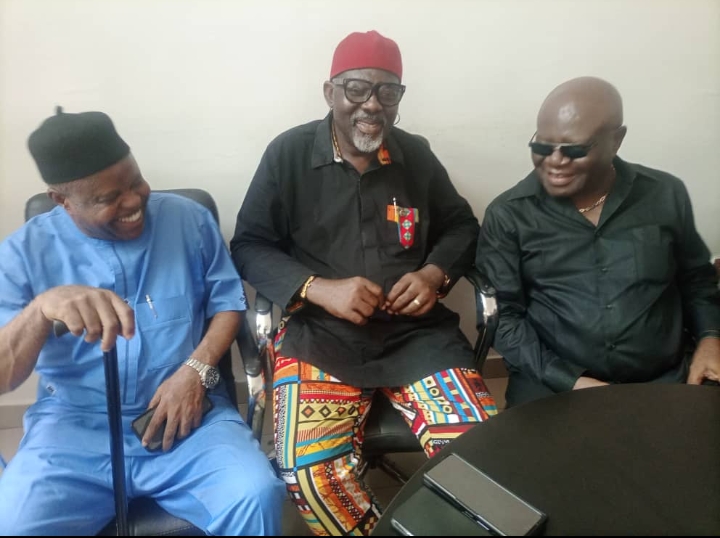
2027: Anambra ADC Intact Despite Obi, Kwankwaso Departure – Guber Candidate
-

 Tech2 days ago
How Chatgpt Detector Tools Are Changing Content Verification
-
 Politics9 hours ago
APC House of Reps Screening: Onwuegbu Clears Exercise Ahead Of Primaries