

Business
Smuggled Nigerian petrol floods W’African markets, sells N1,700/litre


The Federal Government, on Monday, raised the alarm over the renewed smuggling of Premium Motor Spirit, popularly called petrol, following the massive hike in the pump price of the commodity in neighbouring countries.
It stated that while the average price of petrol in Nigeria was about N701/litre, the average cost of the product in neighbouring countries was N1,787/litre, a development that heightened PMS smuggling out of Nigeria in the past two weeks.
The Comptroller-General of the Nigeria Customs Service, Adewale Adeniyi, who disclosed this at a press conference in Yola, said the NCS had to join forces with the Office of the National Security Adviser to tackle the menace.
He said, “Today, we are here to update members of the public on the strategic efforts of the Nigeria Customs Service in addressing the critical issue of fuel smuggling through the recently launched Operation Whirlwind, under the auspices of the Office of the National Security Adviser.
“About a year ago, the Federal Government made the bold strategic decision to remove the fuel subsidy. This crucial step was aimed at freeing up substantial funds that could be redirected to other productive sectors of the economy, reducing pressure on our foreign exchange reserves, and diversifying economic growth.
“The immediate impact was an upward adjustment in fuel prices to reflect current realities. Despite the inflationary pressures and financial strain on households, particularly those with lower incomes, comparative studies still show that fuel prices in Nigeria remain the cheapest compared to other countries in the West and Central African region,” he stated.
PMS prices
Speaking further, Adeniyi said, “While PMS is sold at an average of N701.99 in Nigeria, it is sold at an average of N1,672.05 in the Republic of Benin and N2,061.55 in Cameroon. In other countries around the region, the price of PMS ranges from N1,427.68 in Liberia to N2,128.20 in Mali, averaging N1,787.57, according to the fuel price data obtained from opensource.”
The customs boss said this comparative price advantage, though beneficial to Nigerian citizens, unfortunately, created a lucrative incentive for smuggling PMS out of Nigeria, where prices were two to three times higher.
He said this is substantiated by the report on the average daily evacuation of PMS to various states in Nigeria, obtained from the Nigeria National Midstream and Downstream Petroleum Regulatory Authority.
In his speech, which was made available to our correspondent in Abuja, he said, “The (NMDPRA) report shows significant changes in evacuation patterns that are not justified by corresponding economic and demographic changes, particularly in border states that share contiguous borders with our neighbours.
“Between April and May 2024, Borno and Kebbi states recorded 76 and 59 per cent increases in evacuations, ranking among the top three states. On a year-on-year basis (May 2023 and May 2024), Sokoto and Taraba states recorded the most substantial increases in evacuations, with 247 and 234 per cent increases, respectively.
“Border states like Katsina and Kebbi also recorded more than 50 per cent increases in evacuation. These discrepancies, along with the price disparity between domestic PMS (N701.99) and neighbouring countries (N1,787.57), raise concerns about the actual delivery of PMS and the potential for smuggling.”
Adeniyi said credible intelligence on activities around border areas corroborated these suspicions.
“In response to the alarming increase in fuel smuggling, the NCS in close collaboration with the NSA initiated Operation Whirlwind. This nationwide operation aims to: a. Ensure that Nigerians enjoy the full benefits of fuel price deregulation in line with the vision of President Bola Tinubu.
“b. Defend the national currency and reduce pressures that may be attributed to the activities of smugglers. c. Identify, dismantle and disrupt cartels of smugglers operating within the ecosystem. d. Raise awareness of the local communities and solicit their support to achieve these objectives,” he stated.
Anti-smuggling team
He said the operations, which were guided by credible intelligence and empowered by the new Customs Act 2023, target illegal exportation, particularly of petroleum products, ensuring their availability within the country and conserving government resources.
“Coordinated by a Comptroller of Customs, the operation covers all NCS Zones (A-D), involving selected officers trained and equipped to handle the task with strict adherence to professionalism.
“Collaboration with the ONSA and the NMDPRA supports the operation, utilising internal and external sources. This operation was launched approximately two weeks ago,” Adeniyi stated.
According to him, the NCS had made some significant strides in the ongoing Operation Whirlwind, aimed at curbing the smuggling of Premium Motor Spirit out of the country.
“In the past two weeks we have received credible intelligence on the relative stability of the price of PMS around border states, this is easily attributed to disruptions in the operations of smugglers. Within seven days of intensive operations, a total of 150,950 litres of PMS, valued at N 105,965,391, have been intercepted at various locations nationwide.
“The seizures include: a. On Friday, May 31, 2024. A total of 45,000 litres of PMS in a tanker was seized at Mova, Adamawa. b. On Saturday, June 1, 2024, a total of 45,000 litres of PMS in a tanker was seized at Mubi, Adamawa. c.On Monday, June 3, 2024, a total of 2,375 litres of PMS in 95 25-litre jerrycans were seized at Mubi, Adamawa State.
“d. On Wednesday, June 5, 2024, a total of 4,450 litres of PMS in 178 25-litre jerrycans were seized in three different locations, including Song-Wuroboki, Mubi-Sahuda road and Gidan Madara
– Sahuda road all in Adamawa. e. On Thursday, June 6, 2024, a total of 20,030 litres of PMS in 25 and 30-litre jerrycans were sized in various locations across
the country including Maiha, Adamawa State, Illela, Sokoto and Agbaragba Creek in Mfum border of Cross River State.
“f. On Friday, June 7, 2024, a total of 32,900 litres of PMS were seized at border locations in the North-East and South-West axis of the country. A total of 17,500 litres was recorded in Mubi, Adamawa State, while 15,400 litres was recorded around Imeko Obada Road in 616 25-litre jerrycans. g. On Saturday, June 8, 2024, a total of 8,525 litres of PMS were also seized in two separate locations in Owode (Owode-Ilaro road and Owode-Atan road) in Ogun State.”
Adeniyi stated that in addition to the ongoing operations under Operation Whirlwind, the Customs Area Commands remained vigilant against the illicit activities. of smugglers targeting PMS.
He said the service had recorded significant seizures of PMS from unpatriotic individuals attempting to deprive Nigerians of access to fuel and cause unnecessary hardship.
“While the operation continues, our Federal Operating Units and Marine Commands have intercepted a total of 129,185 litres of fuel valued at N90,558,685. Notably, 54.48 per cent of these seizures occurred in the North-West region, including states such as Katsina, Kebbi, and Sokoto, while 23.87 per cent of the seizures were recorded in the North-Eastern part of the country, particularly in states like Taraba and Adamawa.
“It is worth noting that these states have also seen a significant increase in fuel evacuation as reported by the NMDPRA. It is now evident that the recent rise in the distribution of PMS to border states is driven by the activities of smugglers.
“A combined diversion of 280,135 litres of PMS worth N196,524,075.50 raises serious economic concerns with broader implications on national security. The quantum of this diversion is equivalent to more than 84 per cent of the daily evacuation of PMS to states like Ekiti and Jigawa. It also represents around 32.57 per cent of the daily evacuation to the border states of Borno and Katsina according to the data on average daily evacuation obtained from NMDPRA,” Adeniyi said.
He noted that if these activities were left unchecked, they could further deteriorate the country’s economic situation and exacerbate current foreign exchange challenges.
The customs helmsman stated that the influx of unaccounted foreign currency could be channelled into funding illegitimate activities, including the support of non-state actors engaged in criminal activities against the Nigerian state.
“These issues have serious implications for national security, making it imperative to check, curtail, and dismantle these illicit operations. Achieving this requires the cooperation and collaboration of patriotic government agencies, exemplified by the ongoing Operation Whirlwind.
“Under this collaboration, efforts are being made to resolve existing gaps in the following areas: a. Sharing of Critical Data Among Agencies. Ongoing engagement with the NMDPRA and the ONSA focuses on sharing daily data on PMS loading. This will enable the NCS to track the movement and delivery of these products to their intended locations.
“b. Monitoring movement of PMS lifting. The NCS will enforce strict monitoring of tanker movements, ensuring that
PMS products lifted from NMDPRA facilities are delivered to approved locations. c. Use of Manual Systems by Independent Marketers. Independent marketers are advised to automate their existing fleet management systems to enable tracking and geo-fencing
capabilities.
“d. Proliferation of fuel stations at border areas. The NCS will collaborate with relevant licensing agencies to manage the proliferation of petrol stations around border areas,” Adeniyi stated.
He said these measures were essential and would be rigorously implemented to ensure strict adherence to government expectations.
“However, in enforcing these measures, we are mindful of the potential challenges they may pose to border communities. Our operations will not obstruct or interfere with the legitimate activities of patriotic citizens in these areas. I will conclude with a stern warning to the perpetrators of these illicit acts: Desist immediately or face the full wrath of the law,” Adeniyi declared.
Petrol subsidy
On May 29 2023, the Federal Government removed the subsidy on petrol.
Earlier in February that year, the government declared that it had to shut down 270 filling stations in a bid to stop the smuggling of petrol out of Nigeria.
It said the activities of smugglers pushed Nigeria’s petrol consumption daily to about 67 million litres because a large volume of the product was moved out of the country illegally by smugglers.
The PUNCH precisely reported on February 3, 2023 that the Federal Government had to deploy operatives of the Department of State Services on tankers transporting petrol to filling stations to halt the diversion and smuggling of the product.
The report stated that over 120 DSS officers were deployed at the time to follow fuel tankers to their various retail outlets in Abuja, as more security agencies were drafted into the exercise for nationwide coverage.
This came as the government also revealed at the time that it shut down over 270 filling stations for being involved in diverse infractions such as hoarding and selling above-approved price, among others.
The Chief Executive of the Nigerian Midstream and Downstream Petroleum Regulatory Authority, Farouk Ahmed, and the Group Chief Executive Officer of the Nigerian National Petroleum Company Limited, Mele Kyari, disclosed this in Abuja during a live television programme monitored by our correspondent.
Speaking on efforts being put in place to halt the diversion and cross-border smuggling of PMS, Kyari had said, “So much is going on, there are government security interventions.
“I know the kind of work that we do with the security agencies, for instance, in Abuja alone, we have over 120 DSS officers following every truck to fuel stations and we are activating this across the country.
“We are ensuring that we get other government security agencies to follow these trucks to their locations, in order to be very sure that these trucks actually get to the fuel stations and there are not sold on the way and they don’t cross the borders.”
Kyari had earlier explained at a stakeholders meeting in Abuja that Nigeria’s fuel was smuggled to other countries, as he insisted that the scarcity of PMS at the time was not due to the elections that were held in February 2023.
“There’s no dispute about this that our fuel gets to other countries, including in marine containers. We have evidence now that some of our customers are actually taking investors to other countries and we will get to the root of this.
“The appropriate government security agencies will deal with this. But this is the reality that we are dealing with. You do have cross-border smuggling, either in the form of round-tripping or whatever name we call it.
“So the 66 or 67 million litres that you have always seen include all these, the cross-border smuggling volumes. And it means that anytime we don’t satisfy those markets, it will affect your domestic market. This is the reality that we are dealing with,” he stated.
The NMDPRA boss, while speaking on sanctions taken against downstream operators who flouted the approved regulations, stated that over 270 filling stations and seven depots were closed at the time.
Ahmed had said, “Because of control that we have in most of the major cities, whether it is Port Harcourt, Lagos, Ibadan, Abuja, etc, the marketers tend to go to the rural areas where you can buy petrol at a high price.
“And, of course, it is our responsibility as a regulator to ensure strict monitoring and enforcement. What we did was that a couple of weeks ago we had to shut about seven depots because of the inflation of their ex-depot price.”
PUNCH
Findings by our correspondent showed that some filling stations now sell petrol below N860 per litre, while Dangote partners, such as MRS, Heyden, and others, sell at N865 or N875 in Lagos and Ogun States.
A filling station named SGR in Ogun State reduced its price to N847 per litre as of Tuesday. Marketers confirmed to The PUNCH that most importers have reduced their ex-depot petrol prices below that of the Dangote refinery.
As of Tuesday, it was learnt that Dangote refinery was selling petrol at N820 per litre while some depots sold the product at N815 per litre. According to Petroleumprice.ng, Aiteo, Menj and others put their prices at N815/litre as of Tuesday.
Our correspondent learnt that the importers were making efforts to remain in business through competitive pricing. Many had previously complained of recording losses when the 650,000-barrels-per-day capacity Dangote refinery began implementing constant price cuts earlier this year.
The National Publicity Secretary of the Independent Petroleum Marketers Association of Nigeria, Chinedu Ukadike, confirmed the ongoing downward price review by the importers.
“Depot owners are dropping their petrol prices. Some of them are selling N815, some are selling N817, while Dangote is selling N820. NNPC is still selling at N825; it has not dropped its prices yet,” Ukadike disclosed.
He described this as the beauty of market liberalisation, saying President Bola Tinubu should not heed calls to ban fuel importation.
“This is the beauty of the liberalisation of the market. That is why we opined that the President should not ban anybody from importing petroleum products. Nobody should be stopped from bringing in petroleum products. That is the beauty of opening up the market. Implementation and local refining will checkmate unfair pricing. As an indigenous country, you must refine to ensure that you have the best price,” Ukadike said.
On claims that toxic and substandard fuels are being imported into the country, the IPMAN spokesman said the Nigerian Midstream and Downstream Petroleum Regulatory Authority is in place to check substandard fuels.
To remain viable, he urged governments across Africa to take deliberate steps as the United States, Canada, and the European Union have done to protect domestic producers from what he called unfair competition.
Dangote did not mince words when he said that the Nigeria First policy announced by Tinubu should apply to the petroleum products sector. “The Nigeria First policy announced by His Excellency, President Bola Tinubu, should apply to the petroleum product sector and all other sectors,” he stated.
This request by Dangote seeks to place a ban on the importation of petrol, diesel, and other products being produced locally. He argued that local refiners were finding it difficult to sell their products because of what he called dumping. The billionaire businessman alleged that importers were dumping toxic fuel that would never be allowed in Europe.
“And to make matters worse, we are now facing increased dumping of cheap, often toxic petroleum products, some of which are blended to substandard levels that would never be allowed in Europe or North America,” he said.
Dangote mentioned that some importers bring subsidised fuel or crude oil from Russia into Nigeria. This, he said, affects local pricing, forcing refiners to lower their prices below production cost.
“Due to the price caps on the Russian petroleum products, discounted petroleum products produced in Russia or with discounted Russian crude find their way to Africa, severely undercutting our local production, which is based on full crude pricing. This has created an unlevel playing field in most African countries. Petrol and diesel are sold for about a dollar net of taxes.
“In Nigeria, due to this unfair competition, this price is just about 60 cents, even cheaper than Saudi Arabia, which produces and refines its own oil. This is due to the fact that we are having too much dumping. To remain viable, we urge the governments across Africa to take deliberate steps as the United States, Canada, and the European Union have done to protect domestic producers from unfair competition,” he stated at a recent event organised by the Nigerian Upstream Petroleum Regulatory Authority in Abuja.
However, marketers disagreed with Dangote, urging the Federal Government not to consider adding petroleum products to the list of items banned from importation under the ‘Nigeria First’ policy.


… Govt set to develop tourist sites
… Work starts on Nnamdi Azikiwe Stadium, Awgu Games Village in earnest
The Enugu Air, CNG Mass Transit Programme, and the ultramodern transport terminals all built from scratch by the Governor Peter Administration are to be launched for operation before the second anniversary of the government.
The government has also approved the development of the state’s tourism industry, while total transformation of the Nnamdi Azikiwe Stadium and Awgu Games Village will start in June to get them ready for the National Sports Festival to be hosted by the state in 2026.
These were made known by the Commissioner for Transportation, Dr. Obi Ozor; Commissioner for Culture and Tourism, Dame Ugochi Madueke; Commissioner for Works and Infrastructure, Engr. Gerald Otiji; and Commissioner for Youth and Sports Development, Barr. Lloyd Ekweremadu after the State Executive Council meeting at the Government House, Enugu, at the weekend.
Briefing Government House Correspondents, Ozor said, “We are starting off with the initial three aircraft and two of the aircraft are already on ground. The third one will be on ground by the end of this month. We are hoping to start the commercial operations before the second year anniversary of this administration.
“You have also seen buses for the mass transit programme across the state. 50 of them are already parked at Okpara Square, and an additional 50 will be joining that fleet in the next few weeks. The 100 of them will be going into commercial operations before the end of this month, which is the second year anniversary.
“Also, the bus terminals, two at Holy Ghost, one each at Gariki, Abakpa and Nsukka, will also be commissioned and go into commercial operations before the 29th of May, this year.”
He added that the government planned to bring in the electric and CNG automotive manufacturing plant into Enugu as well as launch in the next 150 days the Enugu Smart Transport Programme, which would see to the injection of over 2,000 electric vehicles.
Also briefing newsmen, Dame Madueke said funds would be invested in the tourism industry in phases.
“We are going to have it in phases. For the first phase, we are having Awhum Waterfall, Nsude Pyramid where we are going to have the first canopy walkway in the South East. It measures about 600 metres, which will actually be the longest in Nigeria.
“We also have Ngwo Pine Forest where we are having the first zipline in Nigeria. The zipline will measure about 300 metres. In the same Ngwo, we will have a big rotunda and a smaller rotunda. We have the Cross of Hope to be located at Okpatu. The Cross of Hope will be sitting 580 metres above sea level and the cross itself will measure about 50 metres, making it a total of about 630 metres above sea level. The cross will have about 15 floors with a lift.
“At Awhum Waterfalls, we are going to have another canopy walkway and a boardwalk to preserve the ecosystem.
“We equally have the Akwuke/Atakkwu Waterpark and Ovu Lake Golf and Resort at Akpawfu,” she stated.
She explained that all the tourist sites would have experience centres, food courts and renewable energy, adding that tour buses would soon arrive to ensure ease of movement of tourists.
Ahead of the 23rd edition of the National Sports Festival, Enugu 2026, Barr. Ekweremadu said the State Executive Council had equally directed the commencement of work both at the Nnamdi Azikiwe Stadium and Awgu Games Village not later than June.
“We also briefed the council on the progress made in establishing a Lab for Animation for young people in Enugu State, which His Excellency will be commissioning soon. The lab is ready.
“We are similarly working towards empowering over 2,100 young people across the state, who were trained around December last year. This empowerment will be coming up on the 12th of August, being the International Youth Day’” Ekweremadu concluded.


By Sabastine Gabriel
The Enugu State House of Assembly has taken steps to address the issue of dropped calls and customer dissatisfaction with telecom operators in the state.
During a plenary session on Tuesday, member representing Igbo-Eze South Constituency, Hon. Harrison Ogara raised concerns over the impact of poor telecom services, which he believes are financially harming consumers who pay for unreliable services.
Ogara highlighted that with over 219 million Nigerians subscribing to telecom services, the residents of Enugu State have been particularly affected by the erratic performance of these providers, leading to significant financial losses.
He proposed that the telecom operators, MTN, Globacom, Airtel, and 9 Mobile be summoned to provide explanations on how they plan to reimburse customers affected by dropped calls.
In addition to refunds, Ogara requested that the telecom companies present accurate subscriber data and evidence of their tax compliance with the Enugu State Government.
He urged the establishment of a committee that includes state officials to investigate the financial losses incurred by residents due to telecom inefficiencies, making the findings public and ensuring that refunds are issued where due.
“Mr. Speaker, distinguished colleagues, I rise draw your attention to the current epileptic services of the telecoms services providers in Enugu State which has resulted to huge loss of funds by our citizens. Not minding being a late entrant in the global system for mobile (GSM) market, Nigeria has obviously out paced many countries across when we take into consideration the market size and telephone usage.
“It is quite absurd and preposterous that even with the rapid growth of the sector and it’s consequential growth in consumer size, users of telecom services in Enugu State have continued to groan under the scorching pressure of abysmal performance in services,” he lamented.
Other assembly members echoed Ogara’s motion, expressing frustration over the operators’ poor service and high tariffs, comparing the situation to problematic billing practices seen in other utility sectors.
The member representing Nsukka West, Hon. Malachy Onyechi likened the telecome operators to EEDC that give consumers exorbitant estimated billing without rendering commensurate services.
On his part, while supporting the motion, Hon. Clifford One, representing Igbo-Eze North 2, said that the activities of telecom operators are like the banking services where one is debited yet transaction does not go through.
Earlier the House of Assembly passed into law the Enugu State Land Use Charge Second Amendment, House Bill 6, 2025 presented by Hon. Iloabuchi Aniagu, member representing Nkanu West Constituency into law.
To give room for accelerated passage of the bill, the Enugu State House of Assembly suspended Order 14, Rule 102 sub section 1 of the House Standing Order.


“Go and Verify”: How Sunday Umeha Is Redefining Representation in Ezeagu/Udi
Chief Sir Paul Chukwuma Lays His Beloved Sister to Rest

2027: Anambra ADC Intact Despite Obi, Kwankwaso Departure – Guber Candidate






-
 News5 years ago
Uncompleted structures in Enugu to undergo integrity test – Authority
-
 News4 years ago
BREAKING: FG to release Nnamdi Kanu tomorrow, fixes emergency hearing
-
 News2 years ago
BREAKING: Former Anambra Governor is Dead
-
 Entertainment4 years ago
Chrisland School Girl’s Online Activities Leak [Video]
-
 Social event4 years ago
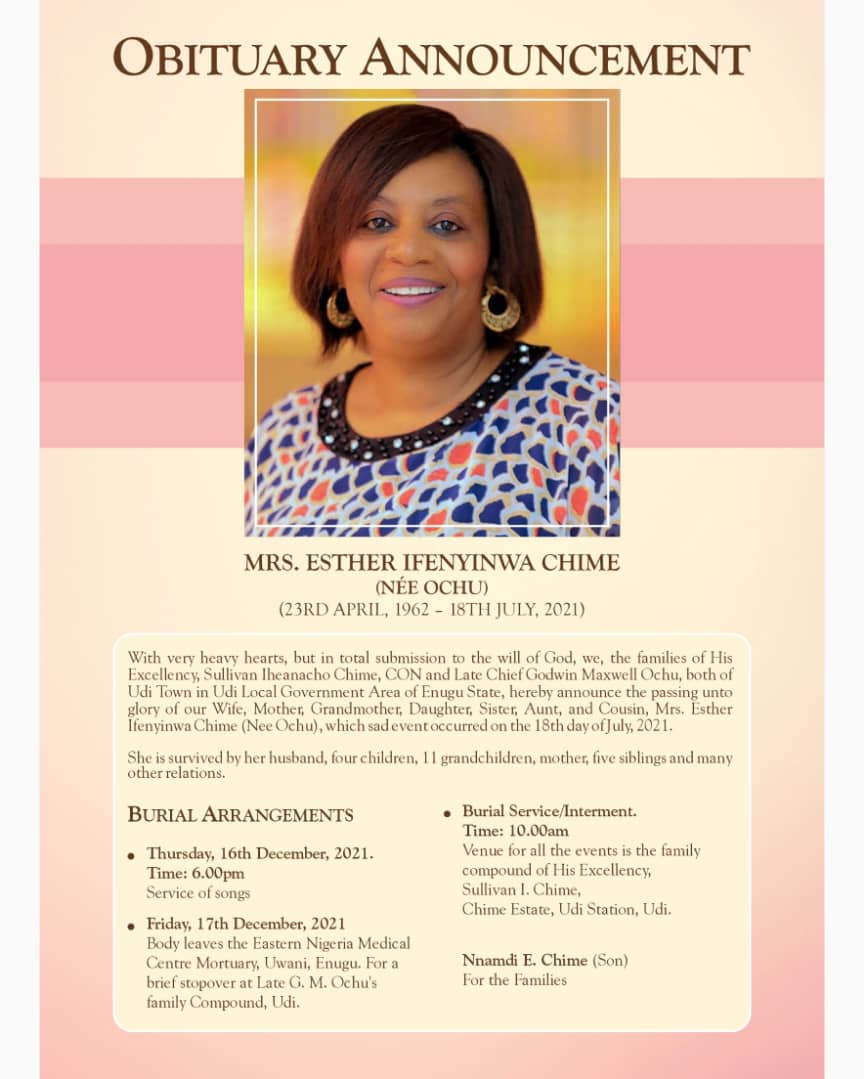
Ex-Enugu governor, Sullivan buries wife December 17
-
 Politics2 years ago
Enugu spends the least as 30 govs burn N968.64bn on refreshments, others in 3 months
-
 Foreign2 years ago
Denmark announces visas for, welders mechanics, bricklayers, others
-
 Crime5 years ago
BREAKING! Sit-at-home: Vehicle conveying tomatoes, set ablaze in Enugu


